Lost in Temptation

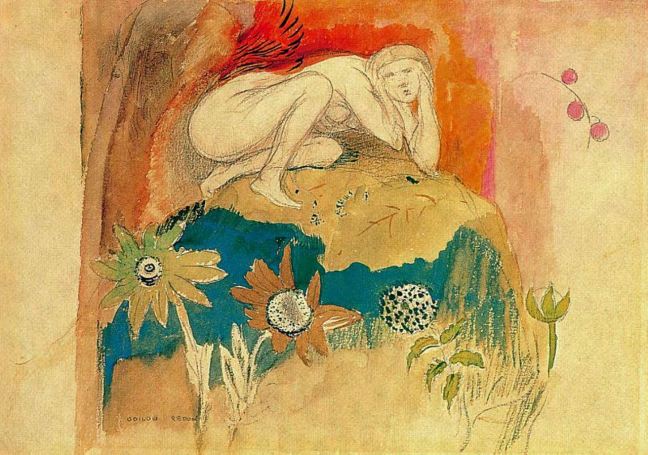
‘Temptation’ – Odilon Redon, 1912 – WikiArt

You have to keep close to yourself. You cannot escape on a line of thoughts, thinking yourself out of your present experience of being. You cannot bring about another world — imaginations, beliefs, projections — on top of what you are already, on the mountain of being which you sit and already spend your whole existence on. You have to stay with what you are deeply — that unmoved, unchanging identity of being which you have been immersed in from time immemorial. It is too easy to take advantage of your senses and believe the world to be outside yourself. Too easy to pretend that you are separate, and that you live in the limitations of your own world as body and mind. Don’t move anywhere out of the very confines of your unlimited, dimensionless being. Keep very close to that. Believe me, that’s your only solace. They will try to convince you otherwise, but keep at it unreservedly.

You cannot move out of consciousness, out of the knowing of anything. You have your eternal home inside that knowing. You have your consciousness always with you, and every place you go to is already soaked in it. You have already curled yourself up in that place of being and found your anchor there. So don’t pretend you have to go out to find the sustenance of objects for your own happiness. You can’t find anything worthy outside yourself. Stay where you have already your essence in. Keep very close. It is tempting I know, to go out for a ride on a fleeting joy, or the promise of temporary happiness. It is compelling to suspend your suffering, even for a moment. But trust me, there is nowhere in this world where you could go and find a peace which you don’t have already within, waiting, sighing for your returning. So keep so very close to your own reality as being. Stay there uncompromisingly.

And don’t think yourself small there. Your being is not what you think. It is not a vague sensation inside your body, lodged in the recesses of your mind. You made it small because you have lost touch with it. You have buried it under the shine of your many experiences. You have scattered it in a thousand wrong identities. Your being is vaster than you think. It is the infinite which you have lost faith in and replaced by the little space provided by your senses. It is the eternal that you have pushed and imprisoned in the cage of time, which is but the activity of thinking. Nourish your inside. See that in doing so, in living in the heart of your true identity as pure, unalloyed being, just under the surface of objective experience, the within will be shown to be without, and the without within. You will come to notice that being is all there truly is. You will see the world finding its true, most fitting place in and as the consciousness from which you have once exiled it from. So pay a constant visit to yourself. Check that you don’t flee from home, no matter the circumstances you are in.

Be under the constant protection of your being. Live there. Find no temptation outside the plain attraction contained in the inevitability of being. You have been placed here for a reason. This is where you find yourself to be whole and therefore peaceful, your suffering being but this covenant broken. This is where the world is clothed in its innate beauty, which is conferred by your being both in this shared place of being. This is where love thrives and finds its origin — in being, when it is seen to be shared by everyone. The same being — not two, not many. One and the same for all, therefore evenly distributed as love. Love is not a feeling that appears when the other fits your own selfish requirements. It is the nature of being and of yourself when you recognise your own, given, divine nature. This is what is meant by the ‘love of God’. Not the love of a parent for its infamous, ungrateful children. But the love immense and unconditional that being shelters and showers upon itself, and which you have now recognised to be your own self, and the self of all.

~~~

Text by Alain Joly

Painting by Odilon Redon (1840-1916)

~~~

Website:
– Odilon Redon (Wikipedia)

Suggestion:
Other ‘Ways of Being’ from the blog…

On Retreat

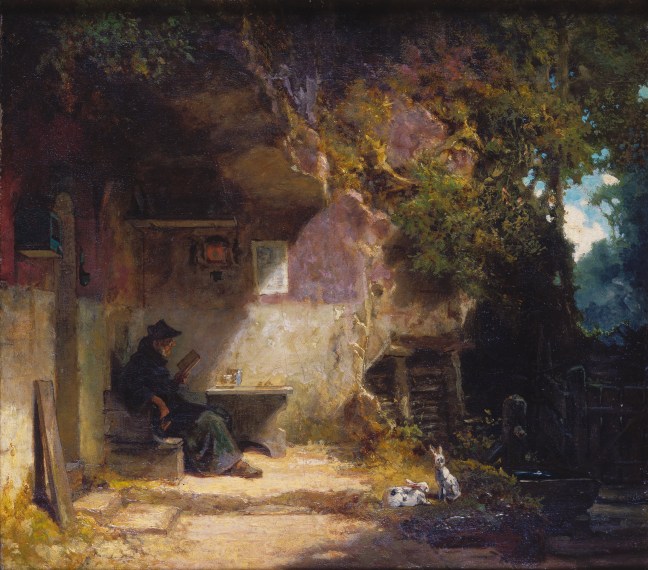
‘The Hermit in front of His Retreat’ – Carl Spitzweg, 1844 – Wikimedia

There is nothing innocent about going on a spiritual retreat. We come to plead guilty. We want to be delivered from a wrongdoing, to be free from a form of captivity. We come here to be disentangled. To take a step back. Not only from our busy life, from our problems, but from our many false identities. We have too many of them, and we are willing to undress, to disengage for a while from everything that we have wrongly taken to be ourself. From our habitual, rehearsed, believed identification with our mind, our body, and our many thoughts. From our obsession and addiction with the objects of the perceived world, which we think bear the promise of our happiness. From our endless hopes, fears, projections, and our constant seeking. We retreat from the battle that it is to be somebody, and to live in the limitations of the known. We come to be courageous, and to wrestle with what we don’t know. To discover a way of living that is fresh. To be in awe.

We have come to pull back. To leave the periphery of our life — where the superficial is our only landscape — for the deeper ground of our true nature. We are willing to be wronged, to show our vulnerabilities, our ignorance, in a life where we are prompted to pretend. There can be nothing new in staying with what we know. So our retreat is a process of unknowing. It is the journey from what we know to the unknowable. And we know the unknowable by not being qualified. By remembering our primary, unborn identity, which finds its ground in the ground of being, before it is coloured by qualities and identifications. We journey until we fully inhabit experience. Until our retreat is not a retreat anymore.

We have been retreating all our life, resisting from experience, which we call suffering. Our life is mostly the result of our not wanting to engage fully, of our taking refuge in thoughts, feelings, to not fully face the pain contained in experience. We retreat in what we think is our security. So we also come on a retreat to stop retreating. We want to be relieved from the load of our many resistances, from the unbearable weight that it is to constantly retreat from the fullness of living. That’s why we feel so good on a retreat. We put an end to our many retreats. We suspend our journey away from ourself. We come home, where there is no need of a retreat anymore. Where we finally know ourself — who we are truly — and can rest there. Where we can fully and only be, embracing everything, knowing that being is all there is. We cannot retreat from what we are. We come to retreat until we can retreat no more.

Out of our constant worry, of our restless seeking, we happen to have retreated in our mind. We have withdrawn from our heart. We have identified with our thoughts. So we have come here to stop retreating where we do not belong, and return to our heart. A retreat is a stage set for this discovery. That mind is not an identity but a tool. That love is our natural identity — the treasure under the many stones of our false identifications. We have come to be open, to end our many retreats — the shrinking of our heart, and know the meaning of friendship. We did not come here to pull back, to disengage. We have come to remember, and to forget that we have remembered. We have come to be present, full of our own true and gorgeous identity of being. So we both retreat, and stop retreating. We disengage, and engage fully. We come to be both still, and in movement. To disincarnate, and find our natural incarnation in being.

We end our mere existing to re-engage with the aliveness contained in simply and only being. We have come to retreat from our many retreats, to invest the placeless place of being, where there is no need anymore of a retreat. We have come to move from matter to spirit, from being something, somewhere, sometime, to being in the unlocated land of our formless, infinite presence. We have come to be but an eternal now, in which time has now surrendered. We have come where seclusion in being is found to be our openness and our freedom. Where we acquire the dimension of a whole world. Where there is no more path, no more retreating. We have found our home in being, which happens to be not a retreat at all, but the place of a total surrender. Home is not the place where we are, but is found to be what we are. We have come to end every possibility of a retreat.

~~~

Text by Alain Joly

Painting by Carl Spitzweg (1808-1885)

~~~

Website:
– 
Carl Spitzweg (Wikipedia)

Suggestion:
– Other ‘Reveries’ from the blog…

‘Try to Die Here’

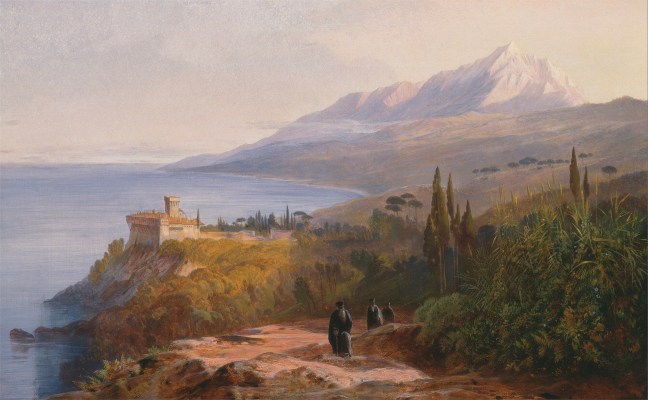
‘Mount Athos and the Monastery of Stavronikétes’ – Edward Lear, 1857 – Wikimedia

When the young Romanian Ioan Gutu arrived at Mount Athos to spend his life there as a monk, he was welcomed by his spiritual Father Elder Ilie with these few words: “Try to die here.” That’s what you do when you arrive at your true self, at your Mount Athos, you don’t form another thought about yourself, you stop looking for an identity, you don’t take refuge again in your mind, in your body. You leave all things, all identities, all beliefs behind. You stop reincarnating as a self separate from the world, for you have found that you were already fully, and wholly incarnated in being, in the selfless reality of your true nature.

In fact, the monastic life is only a metaphor for the truth of your living. You are required to spend your life and die there, because you cannot leave the reality of your own being. A monastery is a place where you reenact reality, where you know no separation, no ‘other’. You are alone, as the word ‘monk’ tells you in its etymology. It is where you know being to be the only place there is, no matter where you are, where you look. You lose your many pursuits and ambitions in being something, someone. You retire where you have never ceased to be, which is in yourself, in your nature, in the truth or reality of your infinite, undivided being. So this is the death that Ilie had in view for Ioan. “Try to die here”. Cease to be other than the One. Stay in your reality as it is, and spend your life there. Don’t leave who you are. Don’t go back to your life of separation, pursuits, hope, envy, comparison. This is prayer.

Wherever you are, try to die there. Don’t pursue your thoughts. Don’t go after anything. Don’t be enthralled by any object on the way. The way is what you are, where you are now, where you have already arrived. To die is to arrive where you are eternally, to stop believing in a destination. But this dying is a strange death. It is not the dying that you may have in mind, for there is no dying to your being. How would the One die? How would you die, if you have already ended all identification, every belief, thought, object, projection about yourself? What is left here that could die, when everything that you believed yourself to be, all your wrongdoings, have naturally, effortlessly ended? Could your essence, your deepest being die? Could that which is not a thing die? What is left here but the immortal, when everything mortal has been left behind?

Maybe there is another hidden twist in Ilie’s words. They could imply: ‘Try to die here if you can!’ You cannot. You cannot die in being, in presence. An appearance can die, but not that in which it appears. So, a monastery is where you can never die, never leave. It is where you leave behind all your many clothings of beliefs and identifications, all your wrongdoings — which is death. It is where you enter into the immortal and infinite nature of your true being — which is life. Everything else can die and follow its natural, mortal course except the One, of which the ‘everything’ is but a movement and a creation with a beginning and an end. So when you arrive at your Mount Athos, try to die here — in the One. When you enter, do your best to leave all your ‘mortals’ outside. Then find out that you can never die. John of the Cross said exactly the same thing upon ascending Mount Carmel:

When thy mind dwells upon anything,
Thou art ceasing to cast thyself upon the All
.”
~ John of the Cross (Ascent of Mount Carmel, I-13:12)

~~~

Text by Alain Joly

Title quote by Schema-Hieromonk Ilie Vulpe (1851–1928)

Quote by John of the Cross (1542-1591)

Painting by Edward Lear (1812-1888)

~~~

Websites:
– Mount Athos (Wikipedia)
– John of the Cross (Wikipedia)
– Edward Lear (Wikipedia)

Suggestion:
– Other ‘Reveries’ from the blog…

Our Last Delusion

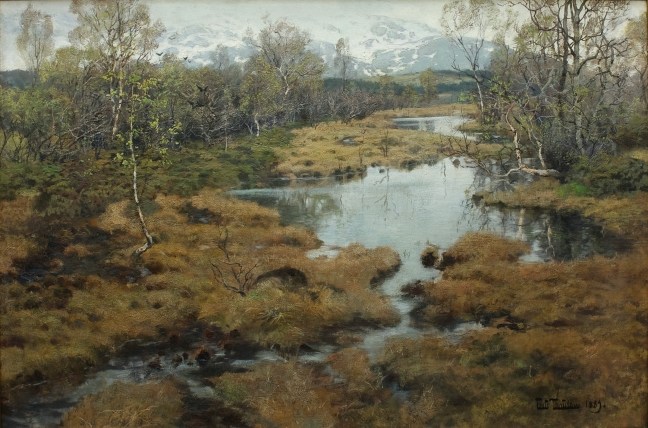
‘Løvsprett’ – Frits Thaulow, 1889 – Wikimedia

You won’t see a world outside the confines of the mind. The world is not there as an ultimate reality. It draws its many shapes out of the limitations of mind. It is sculpted by our senses. Thoughts are giving it its colour, shaping it for the purpose of a self. We blame it for our suffering, or praise it for our happiness. But its existence is a passing, illusory one, as it is for all thoughts, and for the body.

Although we as a body live in a world of limitation and finiteness, we in truth have our stand and our anchor in the deeper, conscious reality of our own undefeatable, limitless being. Happiness in the world never comes from experiencing the world. It comes from beyond the senses, beyond experience. It comes from beauty, which is the nature of the world when it is experienced from that part of ourself that is infinite.

Contentment in our mind is not given by our thoughts and our many feelings, but through experiencing them from the peaceful nature of our deepest reality as being. To live in the world is to be lost and to know suffering, but to have the world living within ourself is to know a joy that is free and independent from the ruthlessly changing nature of experience.

So free yourself from the world; it is not where you live. Rather, have the world close to your being, and see its nature as your own. This is the way to live in the world. See that it is still of the nature of mind. That it doesn’t own its own reality, but borrows it from the infinite, from the limitless, which is the nature of yourself as being.

So everything you seemingly do, you in fact never do. What you think you are, you are not. We live in a world of imagination. In fact, we only ever live in and as a reality that is shared, and that is our very nature. There, in that reality, is found the reality of our body-mind-world. This reality is the nature of everything and everyone we encounter in experience. It is our real world, our only home.

The impression that we live in a world that has its own reality is created, believed. The belief in being a body has created the world, has made it sprout out of a duality that we have ourself made up and manipulated. Outside this belief, everything re-enters the place it has never left, and the oneness it has never been separated from: infinite, eternal, seamless being.

This reality is what there only and ever is. Nothing exists beyond it, whether it is a world, a body, or a mind. To live as a body-mind in the world is to feel separate from it. It is to see ourself as a self. It is to have the arrogance of being our own self, and to see the world and circumstances as the provider of happiness. This is why we always look for contentment, security, stability, constancy. We mimic what we are before we actually know it.

And enlightenment is sill part of the world, still part of a belief. Its reality is invented, created for the sake of a self or an ego. Enlightenment is not about being enlightened. There is no such a thing as enlightenment, unless you want to cling to the reality of yourself as a body-mind. The belief in enlightenment is our last, ultimate delusion. It belongs to a non existent world, to a non existent self.

You have been the light of yourself — of selfless being — all along, but have played within the illusion of a world and a self, therefore concealing your own reality within that illusion. Re-assign yourself to your true nature. Then it doesn’t matter what you experience. It is not in what you experience — it is in what you are. It is all there. Nothing and no one exists beyond it. You have no use of enlightenment.

.

~~~

Text by Alain Joly

Painting by Frits Thaulow (1847-1906)

~~~

.

Website:
– Frits Thaulow (Wikipedia)

Suggestion:
– Other ‘Reveries’ from the blog…

The Great Concealment

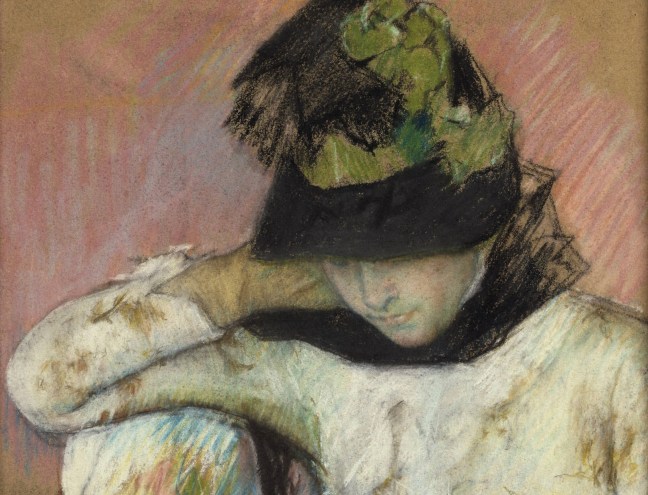
‘Young Woman in a Black and Green Bonnet’ (part) – Mary Cassatt, 1890 – Wikimedia

It is the most ingenious, virtuoso act of dissimulation that was ever put on in this world. Something that would require thousands of years of an immense and diverse body of literature and practices to cancel and bring back into the light. In fact, the story goes that, in the beginning, the world was only an undifferentiated spirit. It was all one, knowing no separation, nothing that could make it two, divided, conflictual, or with an ounce of suffering. Although insubstantial and incorporeal, it was a solid world, full to the brim with its own energy. It was a good world, a happy one, and peace was like its very essence, palpable in all circumstances. Place or time had not yet corrupted it, and there was, lingering within it, a quality of impersonal knowing that made it conscious of itself, although not as a thing to be conscious of.

Then, in this ocean of peace came trouble. Out of the growing complexities of bodies, a new idea emerged. Out of pure, undifferentiated being came the belief in a particular, separate being that can be qualified and pointed at. The one knowing presence that we are and that is the world’s essence, was slowly made into many. Entities have suddenly appeared, taking the form of separate objects. Oneness was lost and the world was made fragile, prey to the rising waters of thinking, the absurd presumption of matter, and the belief in the reality of time and place. Under the influence of the body and the senses, grew the belief in the reality of our own separate self. We started objectifying our own being, making it into a thing, a person, an entity separate from other things and entities. We have divided the one and only reality into bits and pieces, and in doing so have invited lack, incompleteness, suffering, and the many conflicts generated by such a belief.

While inventing a self where there was only the Self, we have created boundaries where there was none. While objectifying being, we have concealed the infinite nature of our being. The Infinite disappeared from our sight. We hid it, ate it, made it look as if not there, even though everything and everyone is only made of its humble presence. We have created the sense of a finite entity, and have concealed our true nature in it. Our plain desire to be was a too selfish act. It displaced infinity and made it look as the finite. It created time and concealed eternity in it. It gave us a place for our body, but made the placeless unseen. The claiming of our own personal, separate being broke the peace that is the nature of infinite being. It put truth in jeopardy, and dissimulated it inside a lie. The infinite can never be a thing. It is not in its prerogative. If we make it into one, it goes hiding. It becomes concealed under the false appearance of a separate self, under that which is not there. We have dissimulated the real in the unreal. The infinite in the finite. Happiness in suffering. And the glory of the spirit in the conflicts of a mundane life.

~~~

Text by Alain Joly

Painting by Mary Cassatt (1844-1926)

~~~

Website:
– Mary Cassatt (Wikipedia)

Suggestion:
Other ‘Ways of Being’ from the blog…

The Chamber Within

‘Woman at the piano’ (detail) – Théodule Ribot – Wikimedia

You have your own little chamber at hand, where you can retire. It is called yourself. A place which has no place to be, and is in fact your own being — what you are, where the totality of yourself is, and which gives you the space to live and act. It is a chamber without a door, without an in or an out, but where you can only be in or be out. You are out of your secret, intimate chamber when you have all your focus on the outside, which means on all the things which you are not, but appropriate as if they were an identity to you. That includes your thoughts which you cherish as being your own production, the outspoken part of yourself, but are in reality strangers that pay you a visit. That includes your perceptions which you take to be a window on the reality of the world, but are in reality facets of your own being, where your whole experience has its home and its refuge. That includes your sense of being a self separate from experience, with a thousand attributes, when of a self you have only empty being, and of attributes only the one attribute of being you, which is ‘I Am’ without an attribute.

You are in your own intimate chamber when you are aware of being. It is a chamber without walls, for it expands beyond anything that you have so far known or been aware of as objects. You are in your chamber when you have no other quality than the quality of being, and when you feel the world you live in to be but your own, shared infinite being. You are in when you have a view on the reality of yourself as being, before you have one on the ten thousand non-existent things of experience. You are in when you have not an object as your subject, which means not a body-mind as an identity. This chamber has nothing secret about it, for it is anywhere you can possibly be. It is openly yourself, though you may hide from it in an infinite number of ways. Your making it a chamber is when you are out of it, and need to go within to find it, in your being which you yourself have made a secret of — something hidden. When you are in it, well then you have no chamber to be in, for the chamber has been discovered to be plainly you, the ‘I’ that you truly and only are, which you find to be neither in nor out.

So your chamber is both within and without, both secret and revealed. You are always abiding in it and as it, though your thoughts and perceptions may have convinced you out of it. So the threshold between being in or out of your intimate chamber of being is wherever you happen to be. You are always on the threshold of being either a suffering, separate, invented entity, or the spacious, unmoved expanse of infinite being. You are always on the brink of yourself, which is you either notice that you are already within that inmost chamber of being, or you ignore, disregard, pay no heed to it. The difference between the two is in the width of a thin hair. You are always on the verge of knowing your identity as being, or of staying behind, in your thoughts, dancing with a belief, being what you are not. There is an edge at any place or moment you are in. A precipice of knowing. You either choose to cling to your living in the limitations of time and space, or free fall where only the infinite and eternal is your reality. The difference between the two is as subtle as the coming of dawn. It is the realisation — the making real — that you have been your chamber of being all along.

~~~

Text by Alain Joly

Painting by Théodule Ribot (1823-1891)

~~~

Website:
– Théodule Ribot (Wikipedia)

Suggestion:
Other ‘Ways of Being’ from the blog…

The Person

‘Self-Portrait with Dishevelled Hair’ – Rembrandt, 1628 (Rijksmuseum) – Wikimedia

There is immense pleasure in being a person when we are not a person. Then, the body-mind, the person, is not a burden anymore, it is a companion. We begin to enjoy its gentle presence, for it is rid of the constant search for happiness, peace, freedom. It is not on him anymore. She doesn’t have to bring about her joy. Doesn’t have to condition her freedom to her circumstances. The person is delivered. It doesn’t have to resist and be a fighter. Doesn’t have to struggle, suffer, hope, be in the constant grip of personal achievement and success. He can stop being a seeker, endlessly looking for what could make him good, content, relieved. She can stop having peace on her everyday agenda. These are given — naturally — as our nature, as ourself. They stop being the work of a person, his everyday load that he has to achieve, perform, be a success at — all the tyranny of it.

There is a presence that we feel is our own, our identity, that already gives us everything that we as a person would spend a lifetime looking for, and would for certain — that’s a universal secret, believe me on that — fail to secure. We already have a wonderful, pristine self in the form of our naked, unconditioned being, so the person doesn’t have to create a non existent self for itself. It doesn’t need to have this belief, that it is a self, that it is separate, that it lives inside a body and a mind. Self and identity are already provided. We share them with everyone and everything. We don’t have to be lonely. Don’t have to be limited by a form, and imprisoned by the boundaries of birth and death. Appearance and age stop being an issue. Comparison dies down. We expand as limitless being, outside even the boundaries of time. The body-mind acquires transparency.

Then we take him or her by the hand — the form, the limited body-mind, the person. Then it is like our best friend, freed from everything that made it small, separate, fearful. Then our body, although limited, will acquire and ride on the infinite nature of its beholder. Then our mind, which is bound by the boundaries of time and thought, will wander on the grounds of the eternal, where our being has its permanent home. Then our personhood shines, precisely because we are not a person. We become beautiful, attractive, and our actions bear the signature of the infinite. Then, being a person is important. And it is not a hindrance to our recognising who we are. On the contrary. The person becomes an emissary of truth, both within and without.

Then ‘what is’ is what we desire, and we don’t mind our circumstances. They satisfy us. We are free. We can be a person and find it a beauty to be so. The person is only here to pass on the impersonal desire of the infinite. It is here for God’s will, which is to be and act on God’s premises, in Its gorgeous name. Not to have a private agenda, in the name of the endless insecurities of a nonexistent, separate self. Not to be burdened by life, but to be the messenger of its secret glory. Then, she as a person is clothed in the dress of a delightful being, shining with an identity that she borrows from God’s identity, and partaking of a self that is the very self of universal being. Then he doesn’t find his person to have an existence separate from his not being a person. Person, no person, being, consciousness, God, life, existence — all one same infinite thing and being. And the person, against all odds, thrives in it.

~~~

Text by Alain Joly

Painting by Rembrandt (1606-1669)

~~~

Website:
– Rembrandt (Wikipedia)

Suggestion:
– Other ‘Reveries’ from the blog…