On Being Apart

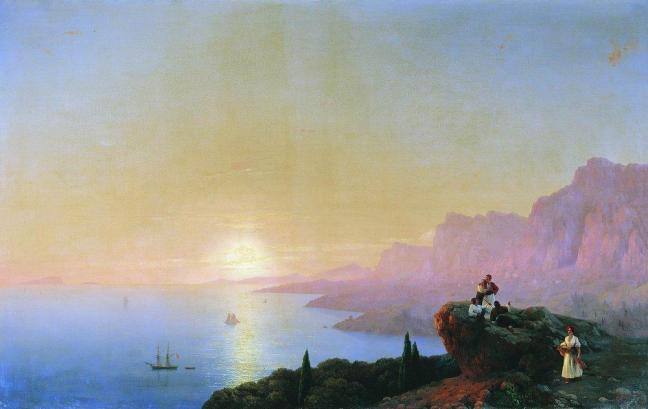
‘Two Men by the Sea’ – Caspar David Friedrich, 1817 – WikiArt

We are never far from our deepest reality. That’s a fantasy — to think that we are far, separate, apart. To think that truth is at a distance, that there is a god, a reality away from our own reality as being. Ourself is the only reality there is. We won’t find another one, something grander, truer than ourself. There isn’t. It’s all here within, already taking place in and as our own being. But we are limiting ourself with a thought. The thought that we are circumscribed to our body, restricted to our mind, and that we have our own personal being different and apart from somebody else’s being. This is how far we have gone from ourself. This is the distance we have created, the separateness we have invented. We have set ourself apart from ourself with a single thought. That’s our negligence, to have let ourself be governed by a belief, by a lie. To have drowned in our own absent-mindedness. We have, as it were, kept ourself on the sidelines.

But we can play the central role with the single thought that there is, at all time, only one reality. We are the only reality there is. Have this thought, that nothing exists outside yourself, that we have it all in our own reality as being. That we can rely on no other authority than the authority of ourself. That we can seek nothing other than our own self as being. That the world, everything, God, truth, the answer to our suffering, are all gathered within the single reality of our being present here and now. So state quietly in yourself that there is only ‘I Am’, that apart from ‘I Am’, well… there is no apart. No part separate from the totality has ever come into existence. There is only the totality playing the many parts of life, but staying itself complete, unbroken, one, whole as our own being. This is how simple we are — One. This is how much we matter. This is how close we are to the reality of everything, to this intimate, never distant truth that some have called ‘God’.

Think of your simple, everyday act of being aware as being everything, as the one and only reality there is. See what it entails, to have no projection of there being something, any kind of reality outside awareness. It means everything you need to know and understand is contained in and as your own sense of self. So watch it. Isolate it from every object that you are aware of, including your thoughts, feelings, perceptions. Feel naked awareness alone, and see how it grows, expands out of proportions, out of time and place, out of the world of objective experience. As you walk on the street, or wash the dishes, or do anything in the course of a day, remember that this simple experience of ‘being myself’ is all there is. That no reality exists outside yourself. That ‘I Am’ is all there is. Feel what it does to you, to think that you are one and alone, the only one being there is. Feel the shock of it, that nothing real, true, reliable, can be found outside yourself. And that this self of yourself encompasses everything, holds every passing, existing thing in its own reality. That you share this being of yourself with the being of everyone, and everything. Feel that you cannot be told apart.

.

~~~

Text by Alain Joly

Painting by Caspar David Friedrich (1774-1840)

~~~

.

Website:
Caspar David Friedrich (Wikipedia)

Suggestion:
Other ‘Ways of Being’ from the blog…

.
The Joy of Heaven

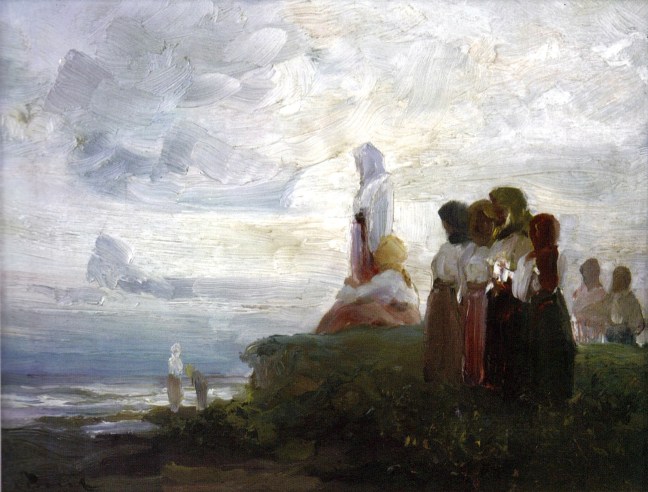
‘Rocky Bay with Figures’ – J. M. W. Turner, 1830 – WikiArt

There is a special joy in knowing who you are. And there is none like it. A joy that is here no matter what, quietly sitting in the background — you just have to see it. You just have to feel it, a presence which will never let you down. Actually it cannot. It stays with you wherever you go. There are no mistakes for it, nothing that you shouldn’t engage in. It doesn’t mind if you are sad, desperate, lost, furious. It is the best friend you ever had, for it can never leave you. Only it needs to grow, so you can notice it, engage with it, dance with the glory contained within it. You have to leave it the space it deserves, so that it can show you the extent of what you have in your heart. So you have to be still, a little quieter. You have to trust that there is behind everything that entangles you, everything that overwhelms you in experience, a space free from all that you believe yourself to be. A space that is yet your closest, most intimate, truthful self. It will show you that your nature is your friend, and that your identity contains all that you are longing for, which you discover impregnates your very soul and being.

There is a bliss in your being, an otherness in your being aware. Not the happy feeling that is only triggered with the experience that goes your way, with the desired object that you obtain, or with a matched expectation. There is a poignancy to this bliss, for it withstands every turbulence of experience. It is here for your noticing, if you stop identifying yourself with all that stirs and provokes. If you stop being something or someone, sometimes despising, sometimes enjoying your circumstances. You have to be disinterested, and stay with your naked being. You have to keep an eye on what is the deepest, unshakable part of yourself — that unmoved, steady ground. Feel that there is a bliss running behind every activity or experience you engage in. It is not a state of the mind. It is not for the person. You are not a person. You are that which is aware. So only settle for a verb. Make sure that you rejoice, that you delight in simply and only being. This is where bliss lives and thrives in all circumstances.

Bliss is a feline quietly lying in the background, watching over you. If you lose sight of it for a fascination for objects, it will doze off, turn its back on you. But give your whole attention to being solely being, and it will stare at you. You will hear its purr becoming louder and louder. You will feel the gentle breeze of bliss in whatever you do. Imperturbably accompanying every perturbation your body or mind might be the prey of. It is forgiving and compassionate. It is not quite of this world, not in the loud and the foreground. Not in the existing or the flimsy. It is the colour of the solid ground of being. This is why and how it is always here. It is essential, the very essence of what you are. You can snob it, veil it, forget it, but not altogether chase it off. So see yourself as a haven. Feel that you are big and welcoming, not a little thing tossed around. You are a heaven for yourself, the safe harbour for everything that takes place within it. You are a vault. This vault is the bliss of your own being. Some have called this bliss the joy of heaven, to separate it from the mere feeling of happiness that is of the world, dependent on circumstances. Bliss is at the source of what you are. Nothing is before it. It is the nature of everything. It can be seen everywhere, and you are the donor.

.

~~~

Text by Alain Joly

Painting by J. M. W. Turner (1775-1851)

~~~

.

Website:
J. M. W. Turner (Wikipedia)

Suggestion:
Other ‘Ways of Being’ from the blog…

.
‘Who Am I?’

‘St. Jerome kneeling’ (detail) – Rembrandt, 1630 – WikiArt

The question of who I am is a big question. It is not being asked very often though. At least not in the way it should. We do as if. As if we all knew who we are. As if it wasn’t worth asking. As if it was a waste of time to do so. When we do ask about who we are, it is to fill ourself with objects, qualities, identities. We are gathering informations about our body, our emotions, skills, idiosyncrasies, tendencies, but not about ourself. We live as if on a racing track, never actually stopping the course of our acquired, rehearsed, believed identities. We never watch, inquire as if for the first time, as if we didn’t know. We are bragging. We don’t want to be humble, and learn about something that appears to be so simple, and goes — so we believe — without saying. But the truth is: it scares us. We are afraid to know. We have picked up, from the beginning of times, that this question is a question of immense implications. It is a deadly question. One that changes you, finishes you, shakes your very ground.

It is a question for a sacred remembering, to just notice what we already are, what is already here, but that we have been too distracted to see. It is a question to prevent us from going out all the time, from escaping ourself, to help us return to where we have always been — in the home of our inner being. It is a question for which we have to let go of our bodily refuge. A question for which we have to lose the self that has been our anchor so far. It is a question for the mind, although its answer is to be found outside every consideration of mind, thought, image, memory. It is a free fall that pushes us to look beyond our limitations, and gives us the gift of our limitlessness. It is a question with no end, not because there is no answer to it, but because the answer is a living answer, whose reality can never come to an end. It is an impossible question, for even before we have the occasion to utter it, we find it already answered through the act of our simply being.

The living answer to the question ‘Who am I?’, is ‘I Am’, which contains its own undefeatable, eternal, inescapable reality. ‘I Am’ is before the question ‘Who am I?’. ‘I Am’ is the living answer which swallows every single question on our identity. It takes us into itself, and shows our identity to be only being, a being so pure that nothing can be added to it. It is the only sacred knowledge there is, which all the words and rites of every religion have sought to deliver as the name ‘God’. A knowledge that they have failed to pass on with accuracy for going too far, and postulate outside of ourself the reality that is in fact our very own self, hiding in plain sight in and as our own aware being. So ‘Who am I?’ is a prayer that is clearing the path, recalling God in ourself in the form of ‘I Am’.

It is a question that opens the door for the peace that we have been looking for in every possible direction, except in the direction of our innermost self alone. It is a question that we ask with expectation and inquiry, and answer with the peace and joy that we find already here, beyond any expectation or understanding. It is an implicit question that we cannot help asking in the secrecy of our mind, but that we fail to form explicitly, expecting the answer to be outside our own being. It is an absolute question, that needs no other answer than going to the very aware being that initiated it, because of  its longing to be freed from everything that seems to limit it and veil it. It is our returning to what we have never ceased to be, but are failing to see for reason of looking in a thousand directions outside ourself. ‘Who am I?’ is a question that takes you to ‘I Am’, which is the only accurate description there is of our true identity. 

.

~~~

Text by Alain Joly

Painting by Rembrandt (1606-1669)

~~~

.

Website:
Rembrandt (Wikipedia)

Suggestion:
Other ‘Ways of Being’ from the blog…

.
God’s Knowledge

‘The Blue Rigi Lake of Lucerne Sunrise’ – J. M. W.  Turner, 1842 – WikiArt

We know so many things. Everything is based on knowledge, and maybe that’s the way to live, as long as there is a body and a world. Knowledge is the score we need to play our part. But to know something, anything, seems presumptuous. It implies another kind of knowledge — that there is somebody here, a person at a distance, that knows and is a recipient of knowledge. Knowledge fixes us. It gives us a dubious identity — that I am a man or a woman, of a certain age, with certain qualities, and with a whole lot of knowledge, identities, beliefs. That I am unhappy, clever, stupid, happy. That I am a cook, or a carpenter. That there is a chair, a world. That I have skills and preferences. I even have the knowledge of my spiritual attainment.

But there is no knowing anything. To think we know something is a mistake. If we know something, then we haven’t looked well enough. We have stayed at the surface of our illusory world and existence. What we ought to know is the knowledge of our reality, of ourself. That’s the only knowing there is. That’s our world: Knowing. Being aware. All other knowledge is superfluous, is not real knowledge. For what would any such knowledge be, when we discover that there is no entity here with the capacity to possess that knowledge. Go only for the knowing of being, a knowledge which is owned by itself. Notice that you don’t know anything — that’s important to know. We have no knowledge other than the knowledge of our being. Apart from that, everything exists only as in a dream.

We may play the part of the one in the dream, and that’s a beautiful part. There may be a world here that is gorgeous, with many ‘things’ that are known. There may be relationships that have meanings. But this world of things borrows its beauty and making from the reality in which it exists for a time — knowing. And the meaning of relationship is found through its reality, which is love — shared being. Everything happy and true in our life is borrowed from our reality as awareness — the only knowledge there is. If we live or act while ignoring that one knowledge, the world and ourself will appear ridden with conflict and suffering. So notice that the ten thousand things of life — all our knowledge — are transparent, ephemeral, ethereal. What is here massive and solid is their reality as being — the supreme essence of everyone and everything. The truth we live in. Ourself. What is. Not somebody that knows.

There is no other real knowing than the knowing of our essence, of our true nature or identity. This knowledge of ourself is not something we can possess as a person. It is nothing more than pure, objectless, impersonal knowing, and this knowing is all there is, all we are. Everything, everyone, have died in it. That’s why we cannot know anything, for how could we know something without there being first a knower and things with their own reality. The only thing we in fact truly know is ourself, our essence. Our knowledge of anything has died inside pure knowing long ago. It is still available, but its reality is apparent. That’s why we can never be sure that there is a chair, or a world. That’s why every object passes, is not there, is only an appearance.

Even ourself cannot be known objectively. We are alone. Nobody knows us. We as a person are absent. We don’t have a reality as an entity, or a self of any kind. So we are known by God alone, who knows us by knowing Its own being. We are all in the knowledge of God. What follows after the sentence ‘we don’t know anything’ is ‘the only knowledge there is is God’s knowledge’. Or ‘know God, love god, and you will know what you ought to know’. It all boils down to ‘knowing, knowing knowing’. Paul said it all very clearly in the First Epistle to the Corinthians: “If anyone thinks that he knows anything, he doesn’t yet know as he ought to know. But anyone who loves God is known by him.” (8:2-3).

.

~~~

Text by Alain Joly

Painting by J. M. W. Turner (1775-1851)

~~~

.

Website:
J. M. W. Turner (Wikipedia)

Suggestion:
– Other ‘Reveries’ from the blog…

.

Effortless Being

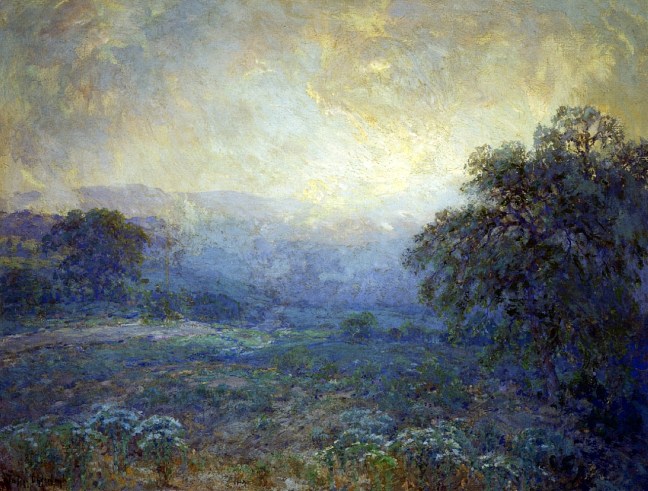
‘Quiet Moonlight (beyond Catalina Island)’ – Granville Redmond, 1907 – WikiArt

Be effortless. That’s the clue you need if you want to meet yourself. Because yourself is for ever here, a natural presence, a stillness in the background, that is your silent being. If you look, you will see it, feel it — who you are, the nature of yourself. So don’t assume too quickly that you know who you are. That who you are is in your body, in your thoughts, in being someone, an entity. Don’t believe that what you are is tied to and dependent on your body-mind, and that you find your true expression in being a person, preferably a successful one, that can be improved, and is subject to death. These are beliefs, concepts that you have learned but never took the time to verify. Don’t accept the subtle tension that is implied in being someone. Go for that part of yourself that is here without effort, that never moves or changes, that is beyond the apparent boundaries of birth and death.

Don’t even try to be spiritual, for the effort you will apply to bring that identity in, will ruin everything. Be exactly as you are, when you are not anything that can be pointed at. Learn to go beyond everything that you are not, so that you can land on the true ground of your effortless being. That may require just a little bit of effort, a redirecting, a gentle looking, the release contained in a moment of relaxation. That is enough. Don’t go for a strain, an ambition, a glory of any kind. These go too far, will take you to a self, a fake identity that will stand in the way of your innate nature. You are already yourself. Nothing new or other than what you already are is needed. Spirituality is a gentle reminder. It is for you to remember that you are almost as nothing, a breath within a breath, a spirit that you will never in a thousand years be able to own. Spirituality is only about being — being effortlessly. This is your natural, unavoidable skill — what you could never not be.

To make an effort is to pull yourself out of your natural being. It is also the veiling of yourself, for any movement that takes you away from your true nature, will own an identity that is acquired, not innate, and that will close the door in the face of your awareness of being. This little bit of effort is you trying to be a person — what you are not — and refusing to be who you are. Through the absence of effort, you will be introduced to yourself, to your true nature. There is a vast expanse there — in fact infinite — that is the very ground of your being. There is a life there, in yourself, as yourself, that some have called bliss or paradise. Not because it is giving you a new place to be, but in reason of the lack of effort or tension there is in being yourself. In effort is contained suffering, fear, lack, hope, conflict, separation, everything that makes your life a burden. To be yourself without effort is the meaning behind the word ‘bliss’. It is the sweetest fall you will ever experience — to be yourself in this free, unconstrained, unforced way. To be without strain, even of the most subtle kind. The blissful is in the absence of effort. In being carefree. Not that you don’t care. But you have your care — which is love — lodged in naturally being, and don’t need any kind of effort for it.

.

~~~

Text by Alain Joly

Painting by Granville Redmond (1871-1935)

~~~

.

Website:
Granville Redmond (Wikipedia)

Suggestion:
Other ‘Ways of Being’ from the blog…

.
Hidden Desire

If you have any desire, any craving, make sure that you crave for yourself first. Make sure that you want yourself more than anything else. Check it. That before you go for something, you have first the will for yourself, for your sweet inner being, for that which sustains you, for that which is behind every one of your desires. Make sure that the one who desires is really you, not an impostor, not a fake self that mimics you but is not you. Make sure that you desire from that part of yourself that is real, that is here, not the will of a secondary thought, of an illusory, separate self, not a fake desire. Fake desires won’t work, won’t take you where you want, won’t give you what you seek. Go for a desire that comes from real you. Check that you know who desires your desire.

How do you know who desires your desire? Well first desire yourself, give at your sweet being a loving gaze, then see if your desire is still there. If it didn’t swiftly go, escape, disappear suddenly, didn’t have the guts of showing up, let alone showing off. If your desire doesn’t stand yourself, doesn’t survive the plain looking at your inner self, at your sense of knowing, of being aware, then your desire is not worth the name, doesn’t deserve to be fulfilled. Make that simple effort first. To watch your own being, to check your presence, melt for a second in it, with it, and then welcome any desire that comes. Sometimes desire can surprise you. Sometimes desire desires the most unexpected thing. Sometimes you find yourself desiring yourself more than anything else.

So please, before having the desire for something, desire yourself first. Stay there, in yourself, with yourself, have a sweet moment in the company of your being. See that you might be desiring it with all your heart, that no desire could ever compete with the desire for your self. See that could make a life of the desire for yourself. That you’d never want to leave yourself, even for a second. That what you want is to fully inhabit yourself — being yourself, which is being your sweet being, ravishing in its presence. Make sure that it becomes your primary desire. The most important one, which you want to fulfil, expose, indulge in. Indulge in yourself first. Don’t part from yourself, break up, and then indulge in the most silly, inefficacious, incompetent things. Don’t ever do that. Indulge after you have indulged all your might in yourself. Then see what you might further indulge in.

So always see yourself as the first object of your desire. This desire doesn’t always need to be expressed. You will notice that it is fulfilled by simply being. You have all your desires — expressed or in potential — fulfilled through the act of simply being. Being is like a magical formula, a universal recipe, the desire behind all desires. Being is the sweetest object of desire. Yourself is your bliss, where peace lives, where love is like your very essence. Your many desires for so many things have concealed yourself. So it’s only a matter of desiring the only thing worth being desired — yourself. Then you may have a thousand more desires, it doesn’t matter. They are not yours anymore. They have come from the hidden, unfathomable, inexpressible place of your inner self and being. Desire this place of no desire, of completeness. Respect it. Try to fulfill it. This is God’s hidden desire. After you have fulfilled God’s desire, be wild and determined with any other desire that may remain.

.

~~~

Text and photo by Alain Joly

~~~

.

Suggestion:
– Other ‘Reveries’ from the blog…

.

A Virtue of Old

‘Portrait of an old man’ – Paul Cézanne, 1868 – WikiArt

Od age and ailments have an astonishing virtue. They teach us that our body and our mind have a weak reality, that they soften, do not last, crumble. They are like everything else. Their reality is passing, illusory, and ours is not what we have taken it to be. For we notice that as our body weakens, falls apart, we do not with it. We stay as strong as ever. We shine as something else. Not a body. Not a mind. Not an apparent self. But spirit. Our spirit strengthens. Our presence widens — if we care to look at all, to be aware, to not attach ourself to a dying object, to a withering skill. If we stay as our solid being, as that which we haven’t been attentive to so far, for reason of an irrational and obstinate fascination for our body-mind-experience, and our puny self.

So when these, that didn’t have a true reality, go; when these, that didn’t stand the mark of eternity, wither; then our fascination shifts for that which cannot go, wither, or crumble. For what stays massively behind. This reality of ourself hits us in the face — what we are, what we were even when we weren’t looking, weren’t interested, had our life within the limitations of our body-mind. Then it comes soothing us, telling us of our nature, of our grandeur. Then, what falls apart is not just our body or our skills, but also our beliefs about our mistaken reality. Our error as to what our nature is. Now we have a conversation with the infinite, and a rising love affair with the eternal. Now we have a compassion for what we believed ourself to be — body, mind, self, skill, experience — and that now have the humility to show their frail existence. Now we stop minding so much about them, and we find the peace that it is to do so.

So where do we choose to go when we cannot go anywhere, when places become fewer, when time stops being a promise, when circumstances lessen? Where is this place that our body cannot take us to, and that comprehends all that we as a body were chasing relentlessly? What is it that our thoughts cannot give us, and that we now find is here behind and before every thought, every belief, hope, or fantasy? There is a sumptuous gift behind every body or mind that loses grip on the objective world. There is a treasure in the quiet home of our self, when we are asked to stop seeking our happy self in a thousand places, practices, or experiences.

There comes a time when we cannot chase our preferences anymore. When we have to leave behind our dearest experiences. When we have no more time to become, attain, grasp that which we want to grasp, attain, become. But there is offered a time for letting go, for a sweet abandon, for uncovering that which in us can never wither, weaken, age, crumble, suffer any kind of ailment. There is a place which holds the whole world in its loving heart, and this place of love is ourself when we have renounced to find it within time, place, or circumstance. There is a virtue in not expecting from body, mind, world, experience, what they can never give us. There is a virtue in resting where we are, where we swallow body, mind, world in an instant, and are free in spite of circumstances.

.

~~~

Text by Alain Joly

Painting by Paul Cézanne (1839-1906)

~~~

.

Website:
Paul Cézanne (Wikipedia)

Suggestion:
Other ‘Ways of Being’ from the blog…

.