A Word Almighty

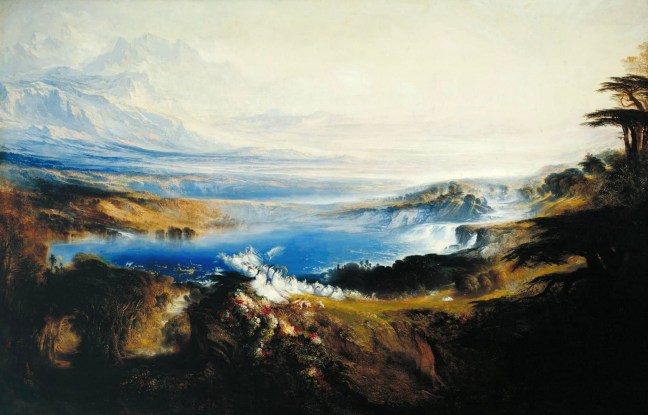
‘The Plains of Heaven’ – John Martin, 1853 – WikiArt

While all things were in quiet silence,
and night was in the midst of her course,
Thine almighty Word, O Lord,
leapt down from heaven from thy royal throne
.”
~ Book of Wisdom (Ch.18, verses 14-15)

There is a night in our life, a place dark and covered by our constant and obsessive attachment to experience. We never go there, for it has become as if inexistent, not there, not here. It is hidden, absent, and our fascination for objects, for the surface of things, for everything seen, heard, touched, has pushed it in pitch darkness, unseen, unheard, untouched, inaccessible to sense perceptions, therefore not here. This is our night, for we only care for what is exposed by the blinding light of our senses. Would we go for the night, when we have in constant access the bright day of our many and overwhelming experiences?

Yet the night has secrets to tell. Here, in the silent, invisible, unspoken part of ourself, in the deep recesses of our mind, in the night of our being, is a heavenly world. Only we have in order to see it, to go where objects have become silent, where appearance has not yet done its ruinous work, before the disgraceful influence of the senses. We have to go deeper into ourself, into our own being, into that which has become a night to our own eyes. We have to get accustomed to this darkness, to this absence. We have to let it reveal itself to us. For there is a light here, which the bright day of our many experiences is only a pale reflection. There is a light here, both immense and fragile. Immense because it is the only light in presence. Fragile because we have chosen to live exclusively where the dim glow of the senses are. We have chosen to live in the fragile, in the frail existence of things, turning away from the massive radiance of our own being. We have chosen the light of suffering and uncertainty, and we live there with our own invented certainties.

But in silence, there is a Word. In the night, there is a Radiance. It is brightly here, to be seen, contemplated, admired. It is loudly here to be heard, listened to, savoured. It is where we are — exactly there — right within the light of our many experiences, although rendered dark and mute in reason of our focusing on the objective only. We have become interested only in what is outside ourself, in what can be reached through the senses. We have given importance to mind, body, thought, world, to what can be understood, reached, grappled with, grasped, had. We have left ourself out of the picture. We have left that space of being out. So the Word is inaudible. God shouting, singing psalms after psalms for our own benefit, has no effect. We are deaf and blind to our own self and being, although learned and scholarly to everything objective. We have left behind what mattered in our life, and that forgetting is at the source of all suffering and conflict in the unfortunate realm of experience and existence. We have the royal throne of our own silent being to sit on and occupy. So let us do just that. The rest has its own, natural course — and it’s a happy one.

~~~

Text by Alain Joly

Quote from the Book of Wisdom

Painting by John Martin (1789-1854)

~~~

Websites:
John Martin (Wikipedia)
Book of Wisdom (Wikipedia)

Suggestion:
Other ‘Ways of Being’ from the blog…

The Story of It All

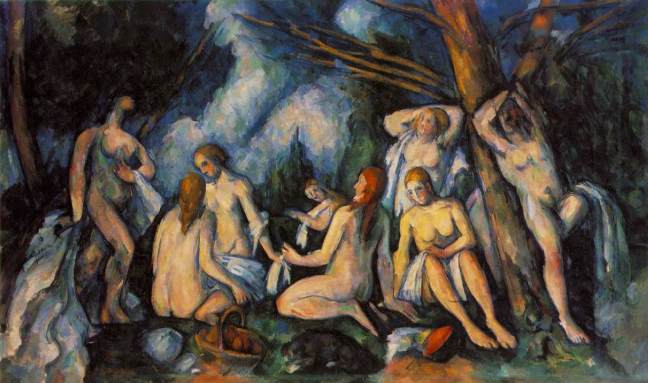
‘Large Bathers’ – Paul Cézanne, 1905 – WikiArt

There is a hidden presence everywhere we go, that hides within our experience. It is concealed within its own shining, and is the reason for our seeing and experiencing anything. It seems to be woven into our very being, to have married its being to our being. Would we want to separate ourself from it, that we wouldn’t know where to go. In fact, there is no way outside ourself. We have it all here as we are. Our life is unfolding within that which is ‘myself’. We are the garden of our self, of all our human endeavour, of our quest and of our finding, of our lack and of our glory. All that we live for, when reduced to its core target, is to be relieved from our chronic sense of not having enough. We feel there is a thing here to be found, without knowing what it is. So we become blind to ourself, and are consequently driven into the world, seeking there in the distance of time or place, what is already here in and as our very self. We are our own hidden remedy, our secret paradise. We have shrouded the infinite within ourself, and are erring within our own misconception.

In fact, we have been misled by our having a body, imagining us inside it rather than it inside us. We have belittled ourself, have lost faith, squeezing ourself into a thought that we have aggrandised to being an entity. We are a trick of the mind — nothing more — and have lived caught within our own creation, struggling inside our own mistake, wrestling with a world that we have stripped of its essence. We have divided our experience into separate objects, and have reduced ourself to being one such object. Now we are striving to unravel our own mistake, to defeat our foolish, unfortunate belief — hence our suffering and our struggling. Our life has been made into a scream for peace and justice, and the silence of simply being has retired within us, into the hiding place where we have pushed it. We have shied away from our truthful nature, and wandered off from simply being naked being. We have clothed our emptiness with the garment of a self delineated by thought and identification. We have limited the infinite to our convenience, and squeezed eternity into the burden of time.

But there is a dawn here just as we are. There is a light ready to overcome our night. For we never got lost far from our home, never took our stand away from our own being. So our journey is always only the shortest step from ourself to ourself. We have to return where we never left. We have to get acquainted with ourself, with who we truly are, and get accustomed to our being — much wider than we ever noticed. We have a sky at our disposal when we have dismissed the thousands fascinations and identifications with everything that is at a distance from ourself, and is the prey to our mind and our senses. There, curled within and prolonged without, treated so far with contempt, is our own indomitable self. There, trampled by a belief about ourself that we have imposed on everything, is a magnificence. There, is the being of our being, what we-the-seeker have sought everywhere except in its own place of living, which is ourself. We have missed it because it was the last thing investigated, the last stone lifted, for being too close and intimate. Who could have thought that the sought was the seeker?

Now we only have to be that ground of being alone, at the exception of all that is moving and changing in it, and that isn’t us, not truly us. We only have to sink beneath the moving sea of our multiple, insatiable experiences, and let ourself reach that part of ourself that cannot be known or possessed, and is yet our undeniable self and identity. Here we discover that our being is the being of everyone and everything, and that we are bound to this totality by love. Here every single thing in our experience is unraveling itself back to its essence, taking its right place within it — and that essence is found to be our essence. And god’s being too finds its right place and meaning in and as ourself — and we too have our place in god. And our so precious peace is now teeming as our own being, and justice is found right under every step we are taking. Now we have silence as our very best companion, and our seeking — which was our suffering — has been buried under it. Now we are right where we were supposed to be when the world became a world, and the son of god became a woman or a man. And now…

Now let me rest and live and walk the world as I am, alone and one, and all in I.


~~~

Text by Alain Joly

Painting by Paul Cezanne (1839-1906)

~~~

.

Website:
Paul Cezanne (Wikipedia)

Suggestion:
– Other ‘Reveries’ from the blog…

.

A Light to Yourself

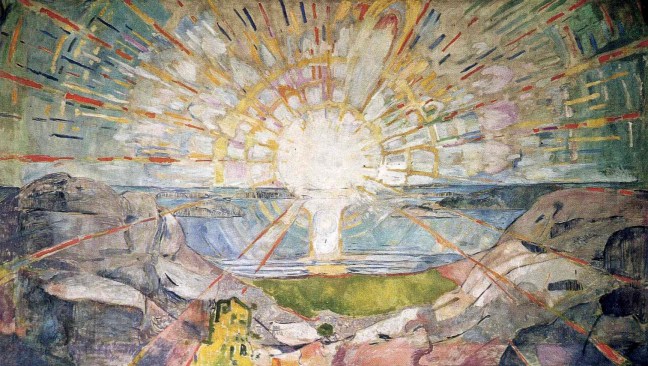
‘The Sun’ – Edvard Munch, 1911-16 – WikiArt

There will come a time when words will slow you down. When you will want to explore yourself on your own, without the help of a book or a teacher, free from explanation or guidance. You will want to follow your own trajectory, to be a grownup, and experience your beloved, impersonal, undivided self by yourself and through yourself. You will want, as Krishnamurti said, to “be a light to yourself“. You will find your own security there, in this light, at the source of your transparency, where you will find no division from where to be insecure. You will find your happiness bubbling from your infinite being, where no self can be located, and therefore no suffering. And you will be under the authority of your own being, that will show you the way, through a door eternally open and inviting. You will be on an eternal visit of yourself. And you will meditate, not to reach who you are, not to get there, but to rejoice in it, and give your whole attention to your beloved — though you already have her, have him, all day, on all occasions, near you, close, so very close to you. And you will feel her love as being so fully yours, that you will need no incentive, no set hours, to be being her own being. And you will see around you, and within you, so much beauty, that you will not have to look for it, other than by being with him, and within him. And you will be in need of no thought, of no TV show, to distract yourself from yourself, for how would you want to be distracted from being so wholly in love with the love of your life? So books will have become a bore to get you there, but you’d still read them as you read poetry. And a teacher will be of no use to you, but you’d still be eager for the company of a friend. And you’d go about your life with confidence, because you’re not alone to deal with it. Rather, your life will have become your being, and your being, your life. And at the same time, you will be alone, self-sufficient, in no need of anything, of anyone, to be fully yourself, to be happy. Therefore, you’d give yourself to all, to everything, you’d be a sharer of being, and a passionate lover of beings, and of things. Yes. That’s it. You’d be a light to yourself. A light to yourself.

.

~~~

Text by Alain Joly

Painting by Edvard Munch (1863-1944)

~~~

.

Websites:
Edvard Munch (Wikipedia)
J. Krishnamurti

Suggestion:
Other ‘Ways of Being’ from the blog…

.
That Flickering Flame

‘Mary Magdalene with Oil Lamp’ (part)  – Georges de la Tour, 1630-35 – WikiArt

The simple feeling of being — away from the contingencies of being a separate self enthralled, or assailed by objective experience — that feeling, that wee flame, needs to be attended at all costs, watched over patiently, and finally protected. Otherwise it will wither in no time, pushed by the winds of our egocentric activities, wiped out by our stubborn beliefs. Being can be such a shy being. But always remember: it is eager to shine; it is eager to warm your life up with its soft, tender flame. And it will bring you that little light you need, to find your way through the maze of existence. That flickering light is stronger than you think. At first, it might appear to be hesitant, wavering as if to die with any sudden burst of a boastful thought, or the surging of a distressing feeling. But look closer. For the apparent flickering of that little, intermittent flame is yours. You are that angry shadow threatening to shut its light off yourself. You are that cold gust ready to send its warmth far and away from your life, and leave you freezing like a lonely being. So be yourself that shyness, that hesitancy. Watch that you don’t come to disturb the flame of your self. Be that flickering entity, always ready to retire and fade your cumbersome presence off that joyous fire of being. That’s the extent of your attending: your not being there, your acceptance to die or surrender, your willing to fragilise that imposant self which you have identified yourself with along the way — that invention of yourself. That is all this wee flame needs to set fire to your existence, to inflame your being as to show it to be indestructible, and to shed a bright light on your true nature as being infinite and eternal — not that shy, fragile, flickering, coming and going presence. For presence is a wildly enthusiastic blaze if you let it be. It can burn you in a second, so as to render you inexistent. It is a firestorm that will scatter you in a thousand fluttering ashes, to leave you as you truly are: A peaceful being. A flame of happiness. Shining brightly like an ebullient sea of love. See what a little attending can do — a little nurturing! The humble succouring of a wee, flickering flame…

.

~~~

Text by Alain Joly

Painting by Georges de La Tour (1593-1652)

~~~

.

Websites:
Georges de La Tour (Wikipedia)
Magdalene with the Smoking Flame (Wikipedia)

Suggestion:
Other ‘Ways of Being’ from the blog…

.
Treasures of Grace

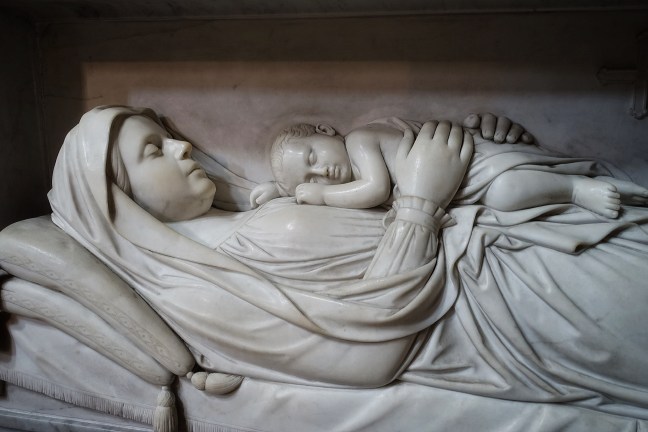
In Basilica di Santa Maria del Popolo, Rome

.“The heart is but a small vessel;
and yet dragons and lions are there,
and there likewise are poisonous creatures
and all the treasures of wickedness;
rough, uneven paths are there, and gaping chasms.

There also is God, there are the angels,
there life and the Kingdom,
there light and the apostles,
the heavenly cities and the treasures of grace:
all things are there.”

~ Macarius of Egypt (Homilies 43:7)

.

~~~

Quote by Macarius of Egypt (c. 300-391)

Photo by Alain Joly

~~~

.

Bibliography:
– ‘Fifty Spiritual Homilies of Saint Macarius the Egyptian’ – by Macarius of Egypt – (Aeterna Press)

Website:
Macarius of Egypt (Wikipedia)

Suggestions:
Sayings of the Church Fathers
Beauty in Essence (other pointers from the blog)

.

The Brush of Ecstasy

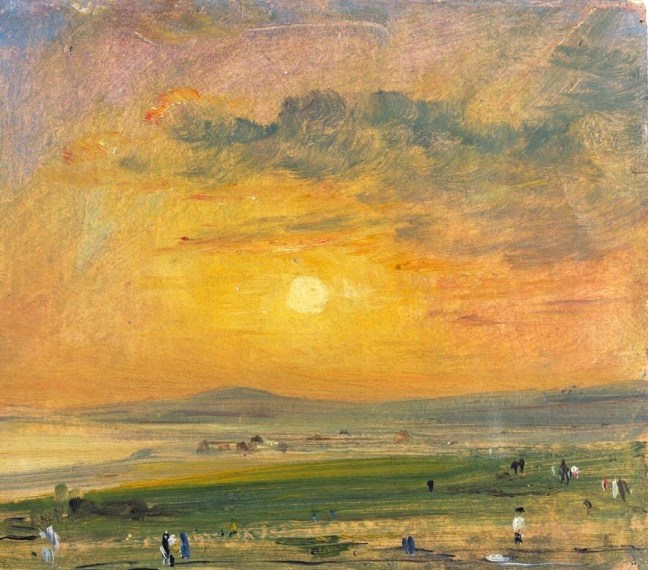
‘Shoreham Bay, Evening Sunset’ – John Constable, 1828 – WikiArt

.

There is a hidden ecstasy in your being;
Only you have — to access it — to ignore
The clamour of your endless thoughts,
Wildly thinking themselves to death;
To leave them behind, so far behind,
A thing of secondary importance,
Not that first, foolish, imaginary role.

Ecstasy has its own special requirements:
One is postponing all future goals and attainments
And envisaging yourself only in the now
Where peace can be seen to thrive,
Far and away from imagination,
Settled within the hard ground of being
Where is built a temple for yourself.

And stay there, don’t mingle with the body,
Don’t make it an essential — not more
Than necessary — it’s a fake friend;
Then, when you have built a home
Secure from the turmoil of feelings
Free from all that come to lure you into their net;
When you are — as to say —
Outside your usual self,
As the etymology concedes;
When you have recognised the world
As your own inseparable body;
When you have opened wide all windows,
Extricated yourself from the grip of time;
When you have habituated yourself
To the pure light of just being;
Then — and only then —
And only perhaps

Then might a brush of ecstasy
Come upon you — gently but noticeably;
Only beware of too much of it
Lest it will send you back to some
Old, stale beliefs about yourself — stay humble.

Then might a brush of ecstasy
Come upon you — that will make you
Leave your own dated sense of self,
And adopt that quiet remoteness of being
As your new, unmistakable home.

.

~~~

Text by Alain Joly

Painting by John Constable (1776-1837)

~~~

.

Website:
John Constable (Wikipedia)

Suggestion:
Voices from Silence (other poems from the blog)

.

The Dark Night

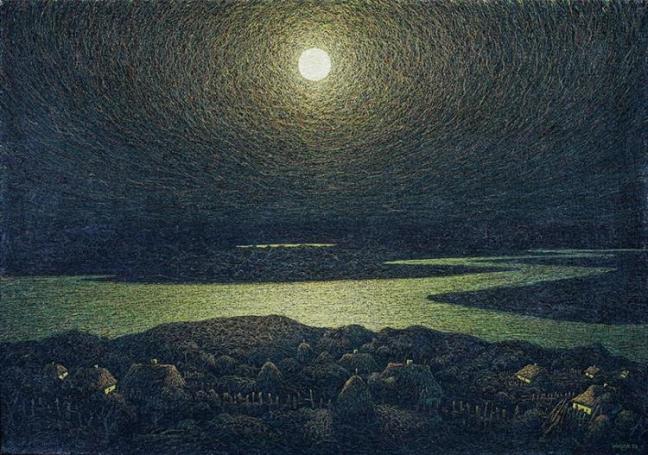
‘Night’ – Ivan Marchuk, 1981 – WikiArt

.

Being human is a complicated gig.
So give that ol’ dark night of the soul a hug.
Howl the eternal yes!

~ Friedrich Nietzsche

.

There is a poem that fed the imagination of many prestigious writers and philosophers like T. S. Eliot, Simone Weil, or Thomas Merton. Many a spiritual seeker has found in it a guiding lamp for the harsh ascent towards divine union. Its name: the ‘Dark Night of the Soul’, a short poem written by the 16th-century Spanish mystic and poet John of the Cross. It refers to the unknowable nature of both the goal and the path, and how such darkness would allow us to merge with the presence of god in ourself. As John of the Cross wrote: “In the dark night of the soul, bright flows the river of God.” I am presenting here the translation by Edgar Allison Peers. Following the poem is a short text that I wrote, words that the poem has evoked in me, the inspiration that it invoked…

.

On a dark night,
Kindled in love with yearnings — oh, happy chance! —
I went forth without being observed,
My house being now at rest.

[…]

.

Read this famous poem by John of the Cross and a few more words… (READ MORE…)

.