
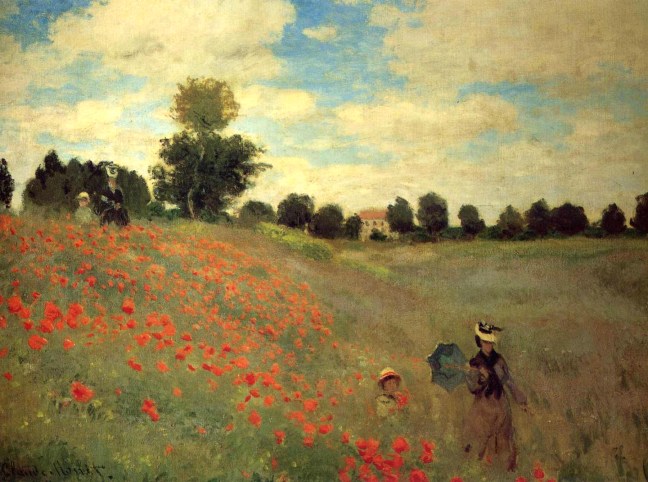
‘Field of Poppies’ – Claude Monet, 1873 – WikiArt
We can’t get hold of happiness so easily. It is elusive, coming at odd times, sneaking in surreptitiously without our noticing. When we know it, it had already been there for a while, although we realise it only now — its quiet presence — a thing that seems to come from eternity, and that we could live with for ever. It doesn’t have the crude expression of a boastful, egoistic eruption of joy, or the bourgeois, replete manifestation of satisfaction. Happiness is more charming, something rare, valuable, that comes uninvited, on a propitious moment. By the way, this is the etymology of ‘happy’: ‘hap-‘, which means ‘lucky’, ‘good fortune’. Happiness seems to come by chance, ‘falling’ on us, as the Latin ‘cadere’ for ‘chance’ conveys. There is an exception though, in Welsh, where the word ‘happy’ had once the meaning of ‘wise’. Maybe after all, being happy is not a matter of chance. Maybe it better comes with some understanding and wisdom.
So what is this chance, or this bit of luck that comes propitiously for happiness to appear? Maybe our good fortune is simply in what is present now, shining beyond any shadow of doubt. Being happy is when we have the good fortune to let ‘what is’ be, occur, without any interference. Being happy is when we let ourself plainly be. This allowing may be the best manual for happiness. And this has nothing to do with a person or entity being happy. Happiness doesn’t belong to us personally. It is not in the obtention of something we desire, but rather thrives in times of desirelessness. Happiness is a detachment. It is a permission. It is a confrontation with truth, and therefore the abandonment or removal of our idea of being a person. There, in that removal of oneself, is the advent of truth or reality, and the blooming of happiness. Truth, having no perturbation in itself, no friction, no contradiction, no lie, or illusion, or pretence, is manifesting its pure joy of being just as it is. Happiness is a manifestation of truth. An indication of presence. The bubbles of being that come at the surface with a fizzing sound of well-being.
Happiness doesn’t happen to us. It is in the air, in the essence of everything, in what makes us intimately. It is indivisible from who we are when we have removed this block of beliefs, concepts, certainties and doubts, that constitutes our alleged self, with its regiment of hopes, regrets, and resistances. Happiness has no relationship whatsoever to our body and mind, but they will find a great relaxation in experiencing its echo. Thoughts will rarify accordingly. Of course there may be an appropriation of happiness by the so-called person we have convinced ourself to be. The mind recuperates it to its advantage. The self is using this timeless moment to boast itself up. It objectifies happiness and reduces it to being simply an emotion — the equal of fear, or anger. It reduces happiness down to a form of tension that consolidates its belief in being a person, a body-object that is the only subject of its life.
In contrast to happiness, suffering belongs to us, and so do fear, anger, hatred, which are all tensions coming from a misappropriation or misapprehension of life — a violation of truth. We are mistaking ourself for what we are not. We are resisting what is with what is not. And it generates all manners of conflict and discomfort. But if we don’t react; if we let ourself feel this pure, unattached inner being, and don’t leave it, don’t conceptualise it, don’t distance ourself from it for a refuge in the comfort of our body-mind. If we stay there, in the subtle identity of our most intimate self. If we rest still and in complete harmony with our purest sense of being. If we stay humble, and enjoy the delicacy contained in just being, for no reason other than simply being. If we enclose ourself within it, and let ourself be permeated by its most subtle essence. If we feel it to be our lifeblood, and let our old sense of self be seized, or snatched away by it. If we don’t resist in any way, including through our appropriation of happiness, which is a subtle form of resistance. Then… Then happiness is revealed as just the ease of being — what comes naturally when we connect to the truth of our deepest self. It is then what we could call, our good fortune.
.
~~~
Text by Alain Joly
Painting by Claude Monet (1840-1926)
~~~
.
Website:
– Claude Monet (Wikipedia)
Suggestion:
– Other ‘Reveries’ from the blog…
.

