A Word Almighty

‘The Plains of Heaven’ – John Martin, 1853 – WikiArt

While all things were in quiet silence,
and night was in the midst of her course,
Thine almighty Word, O Lord,
leapt down from heaven from thy royal throne
.”
~ Book of Wisdom (Ch.18, verses 14-15)

There is a night in our life, a place dark and covered by our constant and obsessive attachment to experience. We never go there, for it has become as if inexistent, not there, not here. It is hidden, absent, and our fascination for objects, for the surface of things, for everything seen, heard, touched, has pushed it in pitch darkness, unseen, unheard, untouched, inaccessible to sense perceptions, therefore not here. This is our night, for we only care for what is exposed by the blinding light of our senses. Would we go for the night, when we have in constant access the bright day of our many and overwhelming experiences?

Yet the night has secrets to tell. Here, in the silent, invisible, unspoken part of ourself, in the deep recesses of our mind, in the night of our being, is a heavenly world. Only we have in order to see it, to go where objects have become silent, where appearance has not yet done its ruinous work, before the disgraceful influence of the senses. We have to go deeper into ourself, into our own being, into that which has become a night to our own eyes. We have to get accustomed to this darkness, to this absence. We have to let it reveal itself to us. For there is a light here, which the bright day of our many experiences is only a pale reflection. There is a light here, both immense and fragile. Immense because it is the only light in presence. Fragile because we have chosen to live exclusively where the dim glow of the senses are. We have chosen to live in the fragile, in the frail existence of things, turning away from the massive radiance of our own being. We have chosen the light of suffering and uncertainty, and we live there with our own invented certainties.

But in silence, there is a Word. In the night, there is a Radiance. It is brightly here, to be seen, contemplated, admired. It is loudly here to be heard, listened to, savoured. It is where we are — exactly there — right within the light of our many experiences, although rendered dark and mute in reason of our focusing on the objective only. We have become interested only in what is outside ourself, in what can be reached through the senses. We have given importance to mind, body, thought, world, to what can be understood, reached, grappled with, grasped, had. We have left ourself out of the picture. We have left that space of being out. So the Word is inaudible. God shouting, singing psalms after psalms for our own benefit, has no effect. We are deaf and blind to our own self and being, although learned and scholarly to everything objective. We have left behind what mattered in our life, and that forgetting is at the source of all suffering and conflict in the unfortunate realm of experience and existence. We have the royal throne of our own silent being to sit on and occupy. So let us do just that. The rest has its own, natural course — and it’s a happy one.

~~~

Text by Alain Joly

Quote from the Book of Wisdom

Painting by John Martin (1789-1854)

~~~

Websites:
John Martin (Wikipedia)
Book of Wisdom (Wikipedia)

Suggestion:
Other ‘Ways of Being’ from the blog…

A Manual for Happiness

‘Field of Poppies’ – Claude Monet, 1873 – WikiArt

We can’t get hold of happiness so easily. It is elusive, coming at odd times, sneaking in surreptitiously without our noticing. When we know it, it had already been there for a while, although we realise it only now — its quiet presence — a thing that seems to come from eternity, and that we could live with for ever. It doesn’t have the crude expression of a boastful, egoistic eruption of joy, or the bourgeois, replete manifestation of satisfaction. Happiness is more charming, something rare, valuable, that comes uninvited, on a propitious moment. By the way, this is the etymology of ‘happy’: ‘hap-‘, which means ‘lucky’, ‘good fortune’. Happiness seems to come by chance, ‘falling’ on us, as the Latin ‘cadere’ for ‘chance’ conveys. There is an exception though, in Welsh, where the word ‘happy’ had once the meaning of ‘wise’. Maybe after all, being happy is not a matter of chance. Maybe it better comes with some understanding and wisdom.

So what is this chance, or this bit of luck that comes propitiously for happiness to appear? Maybe our good fortune is simply in what is present now, shining beyond any shadow of doubt. Being happy is when we have the good fortune to let ‘what is’ be, occur, without any interference. Being happy is when we let ourself plainly be. This allowing may be the best manual for happiness. And this has nothing to do with a person or entity being happy. Happiness doesn’t belong to us personally. It is not in the obtention of something we desire, but rather thrives in times of desirelessness. Happiness is a detachment. It is a permission. It is a confrontation with truth, and therefore the abandonment or removal of our idea of being a person. There, in that removal of oneself, is the advent of truth or reality, and the blooming of happiness. Truth, having no perturbation in itself, no friction, no contradiction, no lie, or illusion, or pretence, is manifesting its pure joy of being just as it is. Happiness is a manifestation of truth. An indication of presence. The bubbles of being that come at the surface with a fizzing sound of well-being.

Happiness doesn’t happen to us. It is in the air, in the essence of everything, in what makes us intimately. It is indivisible from who we are when we have removed this block of beliefs, concepts, certainties and doubts, that constitutes our alleged self, with its regiment of hopes, regrets, and resistances. Happiness has no relationship whatsoever to our body and mind, but they will find a great relaxation in experiencing its echo. Thoughts will rarify accordingly. Of course there may be an appropriation of happiness by the so-called person we have convinced ourself to be. The mind recuperates it to its advantage. The self is using this timeless moment to boast itself up. It objectifies happiness and reduces it to being simply an emotion — the equal of fear, or anger. It reduces happiness down to a form of tension that consolidates its belief in being a person, a body-object that is the only subject of its life.

In contrast to happiness, suffering belongs to us, and so do fear, anger, hatred, which are all tensions coming from a misappropriation or misapprehension of life — a violation of truth. We are mistaking ourself for what we are not. We are resisting what is with what is not. And it generates all manners of conflict and discomfort. But if we don’t react; if we let ourself feel this pure, unattached inner being, and don’t leave it, don’t conceptualise it, don’t distance ourself from it for a refuge in the comfort of our body-mind. If we stay there, in the subtle identity of our most intimate self. If we rest still and in complete harmony with our purest sense of being. If we stay humble, and enjoy the delicacy contained in just being, for no reason other than simply being. If we enclose ourself within it, and let ourself be permeated by its most subtle essence. If we feel it to be our lifeblood, and let our old sense of self be seized, or snatched away by it. If we don’t resist in any way, including through our appropriation of happiness, which is a subtle form of resistance. Then… Then happiness is revealed as just the ease of being — what comes naturally when we connect to the truth of our deepest self. It is then what we could call, our good fortune.

.

~~~

Text by Alain Joly

Painting by Claude Monet (1840-1926)

~~~

.

Website:
Claude Monet (Wikipedia)

Suggestion:
– Other ‘Reveries’ from the blog…

.

On Being Apart

‘Two Men by the Sea’ – Caspar David Friedrich, 1817 – WikiArt

We are never far from our deepest reality. That’s a fantasy — to think that we are far, separate, apart. To think that truth is at a distance, that there is a god, a reality away from our own reality as being. Ourself is the only reality there is. We won’t find another one, something grander, truer than ourself. There isn’t. It’s all here within, already taking place in and as our own being. But we are limiting ourself with a thought. The thought that we are circumscribed to our body, restricted to our mind, and that we have our own personal being different and apart from somebody else’s being. This is how far we have gone from ourself. This is the distance we have created, the separateness we have invented. We have set ourself apart from ourself with a single thought. That’s our negligence, to have let ourself be governed by a belief, by a lie. To have drowned in our own absent-mindedness. We have, as it were, kept ourself on the sidelines.

But we can play the central role with the single thought that there is, at all time, only one reality. We are the only reality there is. Have this thought, that nothing exists outside yourself, that we have it all in our own reality as being. That we can rely on no other authority than the authority of ourself. That we can seek nothing other than our own self as being. That the world, everything, God, truth, the answer to our suffering, are all gathered within the single reality of our being present here and now. So state quietly in yourself that there is only ‘I Am’, that apart from ‘I Am’, well… there is no apart. No part separate from the totality has ever come into existence. There is only the totality playing the many parts of life, but staying itself complete, unbroken, one, whole as our own being. This is how simple we are — One. This is how much we matter. This is how close we are to the reality of everything, to this intimate, never distant truth that some have called ‘God’.

Think of your simple, everyday act of being aware as being everything, as the one and only reality there is. See what it entails, to have no projection of there being something, any kind of reality outside awareness. It means everything you need to know and understand is contained in and as your own sense of self. So watch it. Isolate it from every object that you are aware of, including your thoughts, feelings, perceptions. Feel naked awareness alone, and see how it grows, expands out of proportions, out of time and place, out of the world of objective experience. As you walk on the street, or wash the dishes, or do anything in the course of a day, remember that this simple experience of ‘being myself’ is all there is. That no reality exists outside yourself. That ‘I Am’ is all there is. Feel what it does to you, to think that you are one and alone, the only one being there is. Feel the shock of it, that nothing real, true, reliable, can be found outside yourself. And that this self of yourself encompasses everything, holds every passing, existing thing in its own reality. That you share this being of yourself with the being of everyone, and everything. Feel that you cannot be told apart.

.

~~~

Text by Alain Joly

Painting by Caspar David Friedrich (1774-1840)

~~~

.

Website:
Caspar David Friedrich (Wikipedia)

Suggestion:
Other ‘Ways of Being’ from the blog…

.
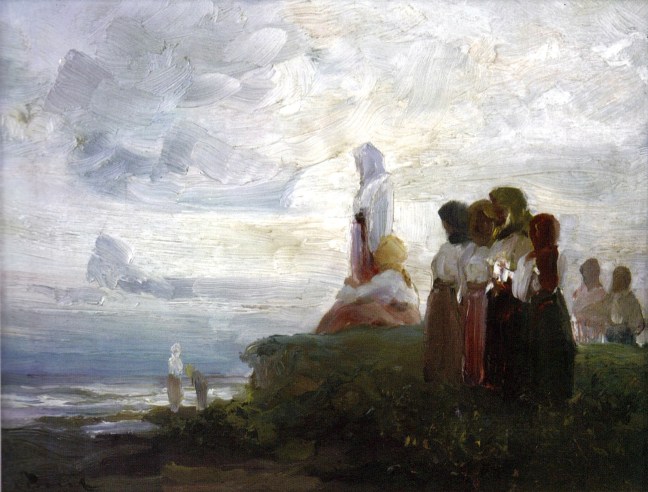
The Joy of Heaven

‘Rocky Bay with Figures’ – J. M. W. Turner, 1830 – WikiArt

There is a special joy in knowing who you are. And there is none like it. A joy that is here no matter what, quietly sitting in the background — you just have to see it. You just have to feel it, a presence which will never let you down. Actually it cannot. It stays with you wherever you go. There are no mistakes for it, nothing that you shouldn’t engage in. It doesn’t mind if you are sad, desperate, lost, furious. It is the best friend you ever had, for it can never leave you. Only it needs to grow, so you can notice it, engage with it, dance with the glory contained within it. You have to leave it the space it deserves, so that it can show you the extent of what you have in your heart. So you have to be still, a little quieter. You have to trust that there is behind everything that entangles you, everything that overwhelms you in experience, a space free from all that you believe yourself to be. A space that is yet your closest, most intimate, truthful self. It will show you that your nature is your friend, and that your identity contains all that you are longing for, which you discover impregnates your very soul and being.

There is a bliss in your being, an otherness in your being aware. Not the happy feeling that is only triggered with the experience that goes your way, with the desired object that you obtain, or with a matched expectation. There is a poignancy to this bliss, for it withstands every turbulence of experience. It is here for your noticing, if you stop identifying yourself with all that stirs and provokes. If you stop being something or someone, sometimes despising, sometimes enjoying your circumstances. You have to be disinterested, and stay with your naked being. You have to keep an eye on what is the deepest, unshakable part of yourself — that unmoved, steady ground. Feel that there is a bliss running behind every activity or experience you engage in. It is not a state of the mind. It is not for the person. You are not a person. You are that which is aware. So only settle for a verb. Make sure that you rejoice, that you delight in simply and only being. This is where bliss lives and thrives in all circumstances.

Bliss is a feline quietly lying in the background, watching over you. If you lose sight of it for a fascination for objects, it will doze off, turn its back on you. But give your whole attention to being solely being, and it will stare at you. You will hear its purr becoming louder and louder. You will feel the gentle breeze of bliss in whatever you do. Imperturbably accompanying every perturbation your body or mind might be the prey of. It is forgiving and compassionate. It is not quite of this world, not in the loud and the foreground. Not in the existing or the flimsy. It is the colour of the solid ground of being. This is why and how it is always here. It is essential, the very essence of what you are. You can snob it, veil it, forget it, but not altogether chase it off. So see yourself as a haven. Feel that you are big and welcoming, not a little thing tossed around. You are a heaven for yourself, the safe harbour for everything that takes place within it. You are a vault. This vault is the bliss of your own being. Some have called this bliss the joy of heaven, to separate it from the mere feeling of happiness that is of the world, dependent on circumstances. Bliss is at the source of what you are. Nothing is before it. It is the nature of everything. It can be seen everywhere, and you are the donor.

.

~~~

Text by Alain Joly

Painting by J. M. W. Turner (1775-1851)

~~~

.

Website:
J. M. W. Turner (Wikipedia)

Suggestion:
Other ‘Ways of Being’ from the blog…

.
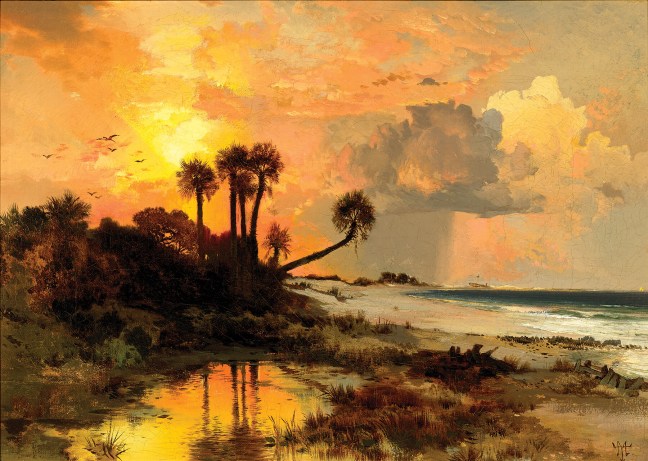
Love Actually

‘Sarbatoarea primaverii’ – Arthur Verona – Wikimedia

Love is the essence of everything, and our very nature. Because we don’t live separate and afar. We are not distant from each other. Nothing is. We have a natural intimacy with everything and everyone. This is not a theory, or a philosophical argument that we posit. This intimacy is our deepest reality, what we are, the property of our natural being, which we can feel, see, experience, but whose evidence has disappeared from our eyes. The reason is, we have preferred a theory to the reality, an illusion to the truth. Our life has stopped being natural. We have been faking it, living it according to beliefs, habits, conformity. But here, blatant in and as our very being, is a reality in which there is no time or place, no distance or separation, no otherness. And as we all know from experience, love is the abolition of time, of distance. Love is the end of separation, of otherness.

Love, which we may call beauty, for everything that we love is beautiful. Love, which we may call understanding, for to see love as the essence of life is the ultimate form of understanding. Love is to ‘stand in the midst of’. It is to stand with everything that is under, everything that is existing in our reality. It is to be connected, to be together with, to be of the same essence. So love is an expression of oneness, of our nature as the one and only reality there is. In the absence of separation — which is truth — we find love. In the absence of otherness — which is our reality — we find intimacy. We make love every time we are aware of our reality as only being. We manufacture love when time is discovered to be an idea, and separation a belief. To be in love is to realise our nature as being one with everything and everyone. It is to be unable to part with anything. It is humility at work. It is where division is only possible in a figment of our imagination. It is to be with what is, with no pulsion of escape or resistance. Love is both in the ache of separation and in the desire to be reunited. All seeking is done in the name of love.

To love is to stand in the midst of, to see no separation between an ‘I’ and a ‘he’ or a ‘she or a ‘it’. The more we stand as the quality of being aware, as that which knows all things, the more we have love as our daily companion. It is extraordinary that we can feel to be a body and a mind, when there is before these, in the subjective, the vast and unmissable expanse of that which is aware of them, which we have pushed away as a mere function of that body-mind. The body is something that we are aware of. We are not in the body. We are in the ‘aware of’. This being aware is our home, where we live, where we have our life. This is our placeless place. That which we cannot not be in. That which we cannot part from — our most intimate, unchanging identity. To be that knowingly, to live as that, is to love naturally and unconditionally. Every time we notice that there is a reality, a consciousness, a knowing presence before our body, thoughts, feelings, experience, world, then love appears to be the very material we and the world are made of. The first and last brick of our house. Our everything.

.

~~~

Text by Alain Joly

Painting by Arthur Verona (1868-1946)

~~~

.

Website:
Arthur Verona

Suggestion:
– Other ‘Reveries’ from the blog…

.

‘Who Am I?’

‘St. Jerome kneeling’ (detail) – Rembrandt, 1630 – WikiArt

The question of who I am is a big question. It is not being asked very often though. At least not in the way it should. We do as if. As if we all knew who we are. As if it wasn’t worth asking. As if it was a waste of time to do so. When we do ask about who we are, it is to fill ourself with objects, qualities, identities. We are gathering informations about our body, our emotions, skills, idiosyncrasies, tendencies, but not about ourself. We live as if on a racing track, never actually stopping the course of our acquired, rehearsed, believed identities. We never watch, inquire as if for the first time, as if we didn’t know. We are bragging. We don’t want to be humble, and learn about something that appears to be so simple, and goes — so we believe — without saying. But the truth is: it scares us. We are afraid to know. We have picked up, from the beginning of times, that this question is a question of immense implications. It is a deadly question. One that changes you, finishes you, shakes your very ground.

It is a question for a sacred remembering, to just notice what we already are, what is already here, but that we have been too distracted to see. It is a question to prevent us from going out all the time, from escaping ourself, to help us return to where we have always been — in the home of our inner being. It is a question for which we have to let go of our bodily refuge. A question for which we have to lose the self that has been our anchor so far. It is a question for the mind, although its answer is to be found outside every consideration of mind, thought, image, memory. It is a free fall that pushes us to look beyond our limitations, and gives us the gift of our limitlessness. It is a question with no end, not because there is no answer to it, but because the answer is a living answer, whose reality can never come to an end. It is an impossible question, for even before we have the occasion to utter it, we find it already answered through the act of our simply being.

The living answer to the question ‘Who am I?’, is ‘I Am’, which contains its own undefeatable, eternal, inescapable reality. ‘I Am’ is before the question ‘Who am I?’. ‘I Am’ is the living answer which swallows every single question on our identity. It takes us into itself, and shows our identity to be only being, a being so pure that nothing can be added to it. It is the only sacred knowledge there is, which all the words and rites of every religion have sought to deliver as the name ‘God’. A knowledge that they have failed to pass on with accuracy for going too far, and postulate outside of ourself the reality that is in fact our very own self, hiding in plain sight in and as our own aware being. So ‘Who am I?’ is a prayer that is clearing the path, recalling God in ourself in the form of ‘I Am’.

It is a question that opens the door for the peace that we have been looking for in every possible direction, except in the direction of our innermost self alone. It is a question that we ask with expectation and inquiry, and answer with the peace and joy that we find already here, beyond any expectation or understanding. It is an implicit question that we cannot help asking in the secrecy of our mind, but that we fail to form explicitly, expecting the answer to be outside our own being. It is an absolute question, that needs no other answer than going to the very aware being that initiated it, because of  its longing to be freed from everything that seems to limit it and veil it. It is our returning to what we have never ceased to be, but are failing to see for reason of looking in a thousand directions outside ourself. ‘Who am I?’ is a question that takes you to ‘I Am’, which is the only accurate description there is of our true identity. 

.

~~~

Text by Alain Joly

Painting by Rembrandt (1606-1669)

~~~

.

Website:
Rembrandt (Wikipedia)

Suggestion:
Other ‘Ways of Being’ from the blog…

.
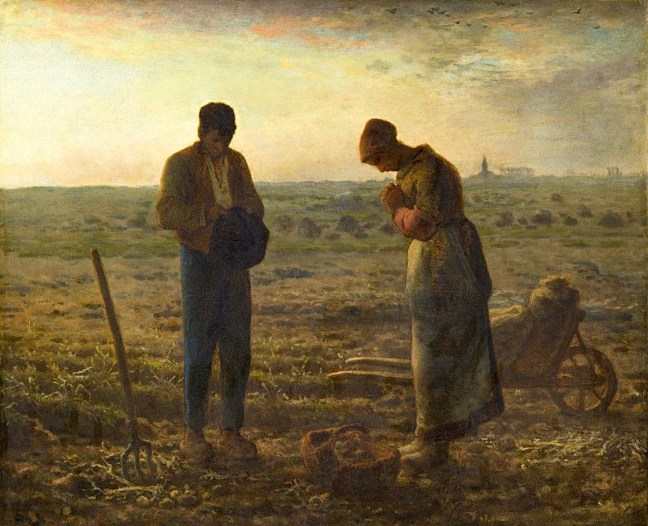
God’s Knowledge

‘The Blue Rigi Lake of Lucerne Sunrise’ – J. M. W.  Turner, 1842 – WikiArt

We know so many things. Everything is based on knowledge, and maybe that’s the way to live, as long as there is a body and a world. Knowledge is the score we need to play our part. But to know something, anything, seems presumptuous. It implies another kind of knowledge — that there is somebody here, a person at a distance, that knows and is a recipient of knowledge. Knowledge fixes us. It gives us a dubious identity — that I am a man or a woman, of a certain age, with certain qualities, and with a whole lot of knowledge, identities, beliefs. That I am unhappy, clever, stupid, happy. That I am a cook, or a carpenter. That there is a chair, a world. That I have skills and preferences. I even have the knowledge of my spiritual attainment.

But there is no knowing anything. To think we know something is a mistake. If we know something, then we haven’t looked well enough. We have stayed at the surface of our illusory world and existence. What we ought to know is the knowledge of our reality, of ourself. That’s the only knowing there is. That’s our world: Knowing. Being aware. All other knowledge is superfluous, is not real knowledge. For what would any such knowledge be, when we discover that there is no entity here with the capacity to possess that knowledge. Go only for the knowing of being, a knowledge which is owned by itself. Notice that you don’t know anything — that’s important to know. We have no knowledge other than the knowledge of our being. Apart from that, everything exists only as in a dream.

We may play the part of the one in the dream, and that’s a beautiful part. There may be a world here that is gorgeous, with many ‘things’ that are known. There may be relationships that have meanings. But this world of things borrows its beauty and making from the reality in which it exists for a time — knowing. And the meaning of relationship is found through its reality, which is love — shared being. Everything happy and true in our life is borrowed from our reality as awareness — the only knowledge there is. If we live or act while ignoring that one knowledge, the world and ourself will appear ridden with conflict and suffering. So notice that the ten thousand things of life — all our knowledge — are transparent, ephemeral, ethereal. What is here massive and solid is their reality as being — the supreme essence of everyone and everything. The truth we live in. Ourself. What is. Not somebody that knows.

There is no other real knowing than the knowing of our essence, of our true nature or identity. This knowledge of ourself is not something we can possess as a person. It is nothing more than pure, objectless, impersonal knowing, and this knowing is all there is, all we are. Everything, everyone, have died in it. That’s why we cannot know anything, for how could we know something without there being first a knower and things with their own reality. The only thing we in fact truly know is ourself, our essence. Our knowledge of anything has died inside pure knowing long ago. It is still available, but its reality is apparent. That’s why we can never be sure that there is a chair, or a world. That’s why every object passes, is not there, is only an appearance.

Even ourself cannot be known objectively. We are alone. Nobody knows us. We as a person are absent. We don’t have a reality as an entity, or a self of any kind. So we are known by God alone, who knows us by knowing Its own being. We are all in the knowledge of God. What follows after the sentence ‘we don’t know anything’ is ‘the only knowledge there is is God’s knowledge’. Or ‘know God, love god, and you will know what you ought to know’. It all boils down to ‘knowing, knowing knowing’. Paul said it all very clearly in the First Epistle to the Corinthians: “If anyone thinks that he knows anything, he doesn’t yet know as he ought to know. But anyone who loves God is known by him.” (8:2-3).

.

~~~

Text by Alain Joly

Painting by J. M. W. Turner (1775-1851)

~~~

.

Website:
J. M. W. Turner (Wikipedia)

Suggestion:
– Other ‘Reveries’ from the blog…

.