The Ladder of Love

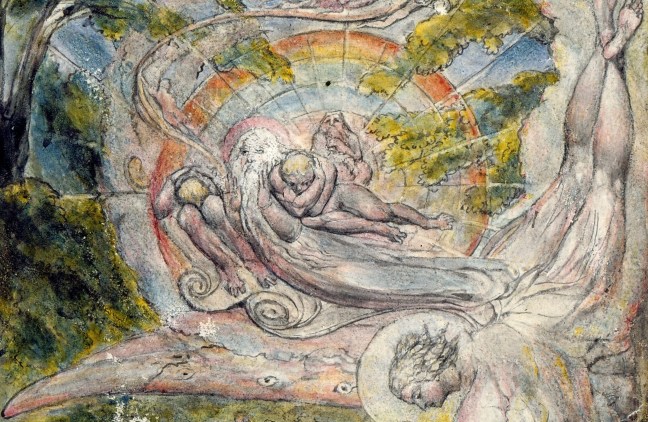
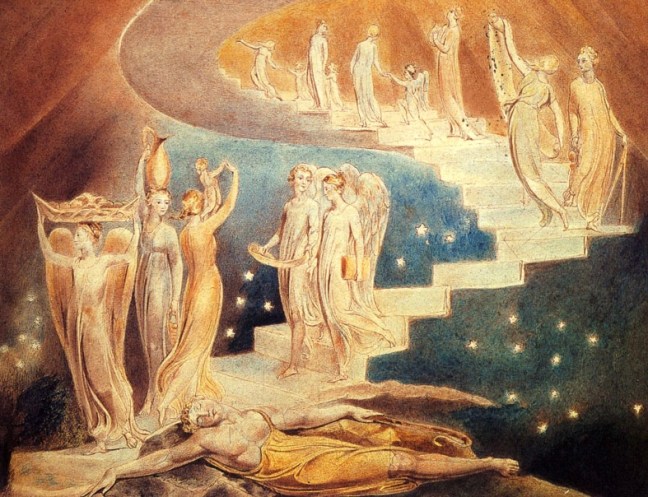
‘Jacob’s Ladder’ – William Blake, c.1799-1806 (part) – WikiArt

You shouldn’t waste even the smallest portion of beauty. You know, the landscape that happens to be before your eyes, or the colours of autumn, the glistening leaves after the rain. There is beauty everywhere, in a sky, a movement, the drifting of clouds, the smile that you catch in a street. There is nothing small in the noticing of it, for it extends far beyond what you have been encouraged to believe. Beauty doesn’t come randomly, or by accident. It is in the nature of things. It takes its source in the infinite, which is everywhere your eyes land on, every time your mind is willing to notice its own boundless nature.

The same goes for love. A tiny love is to be treated with honour and awe. For every love is the birth of a love that pervades the totality of experience and nourishes your very soul and being. So don’t despise a smaller love for want of a better, grander, desired Love. Every experience carries within itself everything that you have longed for. Every desire for peace, love, or beauty is already fulfilled within your very own being, which you carry with you in every imperfect situation, in every random, fleeting moment of beauty, in every broken, shaky surging of a shy expression of love. Experience is constantly nourishing you with everything you need to converse and blend with your own divine, eternal nature.

So be interested in beauty itself, not in what is beautiful, not in the form. Go for the quality itself, for what will lead you to yourself. Be fascinated by love, not by the object of love. It will lead you to discover that love is your very nature, and has no true object except itself. Rest in every tiny moment of peace, between two thoughts, between two fascinations for an object. You will come to see that peace in fact pervades your very nature, and that this peace is another name for beauty, or love, or understanding. Make your whole life a prayer for one form only, which is the very form of your own nature, which you will recognise not in the many, but in the one nature that gives rise to the many. That one nature is your true and only Self.

There is nothing new here. This teaching is mentioned in Plato’s Symposium, through the words of an ancient priestess called Diotima. She referred to it as the ‘Ladder of Love’, for you are led to see that it is beauty which you have to pursue now — not the form — and that pursuing beauty, you will come to its essence. Of one such seeker, it is said in ‘The Ascent, 210a-e’ and ‘The Vision, 210e-211b’, through the voice of Diotima:

“Soon he will of himself perceive that the beauty of one form is truly related to the beauty of another; and then if beauty of form in general is his pursuit, how foolish would he be not to recognize that the beauty in every form is one and the same!”

“In the next stage he will consider that the beauty of the mind is more honourable than the beauty of the outward form.”

“[He will] understand that all is of one kindred, and that personal beauty is only a trifle.”

“[He will be] not like a servant in love with the beauty of one youth or man or institution, himself a slave mean and narrow-minded, but drawing towards and contemplating the vast sea of beauty.”

“Until on that shore he grows and waxes strong, and at last the vision is revealed to him of a single science, which is the science of beauty everywhere.”

“[He] will suddenly perceive a nature of wondrous beauty, a nature which in the first place is everlasting, not growing and decaying, or waxing and waning.”

“And the true order of going, or being led by another, to the things of love, is to begin from the beauties of earth and mount upwards for the sake of that other beauty, using these as steps only, and from one going on to two, and from two to all fair forms, and from fair forms to fair practices, and from fair practices to fair notions, until from fair notions he arrives at the notion of absolute beauty, and at last knows what the essence of beauty is.”

~~~

Text by Alain Joly

Quotes by Plato in ‘Symposium’ (c.428–347 BC)

Painting by William Blake (1757-1827)

~~~

Bibliography:
– ‘The Symposium’ – by Plato (trans. Benjamin Jowett) – CreateSpace Independent Publishing Platform

Websites:
– Diotima of Mantinea (Wikipedia)
– Symposium (Wikipedia)
– William Blake (Wikipedia)

Suggestion:
– Other ‘Shreds of Infinity’ from the blog…

Love Actually

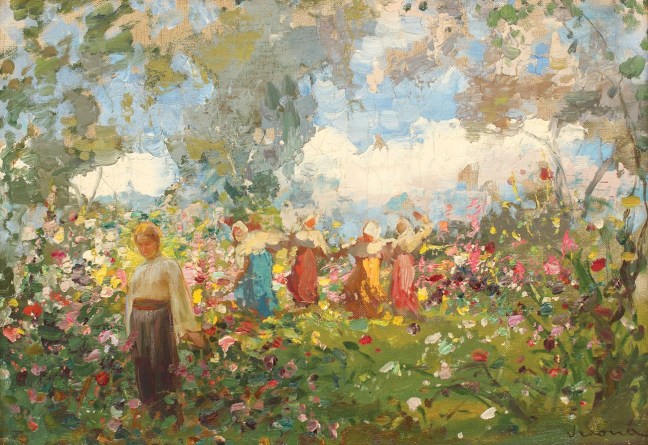
‘Sarbatoarea primaverii’ – Arthur Verona – Wikimedia

Love is the essence of everything, and our very nature. Because we don’t live separate and afar. We are not distant from each other. Nothing is. We have a natural intimacy with everything and everyone. This is not a theory, or a philosophical argument that we posit. This intimacy is our deepest reality, what we are, the property of our natural being, which we can feel, see, experience, but whose evidence has disappeared from our eyes. The reason is, we have preferred a theory to the reality, an illusion to the truth. Our life has stopped being natural. We have been faking it, living it according to beliefs, habits, conformity. But here, blatant in and as our very being, is a reality in which there is no time or place, no distance or separation, no otherness. And as we all know from experience, love is the abolition of time, of distance. Love is the end of separation, of otherness.

Love, which we may call beauty, for everything that we love is beautiful. Love, which we may call understanding, for to see love as the essence of life is the ultimate form of understanding. Love is to ‘stand in the midst of’. It is to stand with everything that is under, everything that is existing in our reality. It is to be connected, to be together with, to be of the same essence. So love is an expression of oneness, of our nature as the one and only reality there is. In the absence of separation — which is truth — we find love. In the absence of otherness — which is our reality — we find intimacy. We make love every time we are aware of our reality as only being. We manufacture love when time is discovered to be an idea, and separation a belief. To be in love is to realise our nature as being one with everything and everyone. It is to be unable to part with anything. It is humility at work. It is where division is only possible in a figment of our imagination. It is to be with what is, with no pulsion of escape or resistance. Love is both in the ache of separation and in the desire to be reunited. All seeking is done in the name of love.

To love is to stand in the midst of, to see no separation between an ‘I’ and a ‘he’ or a ‘she or a ‘it’. The more we stand as the quality of being aware, as that which knows all things, the more we have love as our daily companion. It is extraordinary that we can feel to be a body and a mind, when there is before these, in the subjective, the vast and unmissable expanse of that which is aware of them, which we have pushed away as a mere function of that body-mind. The body is something that we are aware of. We are not in the body. We are in the ‘aware of’. This being aware is our home, where we live, where we have our life. This is our placeless place. That which we cannot not be in. That which we cannot part from — our most intimate, unchanging identity. To be that knowingly, to live as that, is to love naturally and unconditionally. Every time we notice that there is a reality, a consciousness, a knowing presence before our body, thoughts, feelings, experience, world, then love appears to be the very material we and the world are made of. The first and last brick of our house. Our everything.

.

~~~

Text by Alain Joly

Painting by Arthur Verona (1868-1946)

~~~

.

Website:
– Arthur Verona

Suggestion:
– Other ‘Reveries’ from the blog…

.

The Dream of a World

‘Milton`s Mysterious Dream’ (part) – William Blake, 1816-20 – WikiArt

There is a fraud in our life. An illusion that makes us feel that life is going to get better. That time or circumstance will bring us to a place of understanding, where our troubles will come to an end, where there will be betterment, improvement, change. To believe this will make us miss that we are already here and now in a place of no change, of no betterment, where nothing can improve or get better. This place is our very self, our sense of being that we have never been able to affect or modify, no matter how relentless our life has been, no matter our despair, our sorrow, our losses. Nothing we have gone through has touched it in any way. All our stories and sufferings have taken the shape of our thoughts and beliefs about them. But while we are desperately trying to give a form to our life, a solidity to our body, a reality to our problems, and a truth to our beliefs, right here and now, right where it all is seemingly taking place, hidden within experience, enveloping it all, is already a presence, a vastness, a reality that is embracing everything, and that is our only reality, our only place, our only possible self in this living experience.

For there is not a world there where we could be in. That would be a lovely idea, but the fact is: there is no possibility to prove the existence of such a world. We can only assert it, marvel at it through our senses, study it, analyse it, but of a solid proof there is none. The existence of a world is dependent on our perceiving it, and perceptions are contained in our knowing them. Without the knowing faculty, there cannot be a world. The whole glory and misery of the world, of the whole universe, is all gathered in that fathomless fraction of knowing, or awareness. Without that simple, ungraspable, dimensionless, ethereal element of knowing, no world could ever come into existence. So in fact, knowing is all there is, consciousness is the essence of every single appearance that comes to be seen, heard, touched, or experienced. The world is shaped, or its appearance created, through our being aware of it. So the whole of our living experience is but a dream in consciousness, a game that can be played and enjoyed at the level of our body-mind, but whose reality is only the awareness of it.

Now, where are we if we are not in a world? Where are we if the world is not even there? What is this something that we feel we are in, and exists, and is undoubtedly? What is a world, an experience, when we have passed through all illusions, all beliefs, all shaky appearances? What is left here that holds our experience, that is indomitable, indestructible, present without a shadow of doubt? This place is our self, what we are, our very essence, the reason behind our saying ‘I’. So we live in our self, not in a world. We see our limited existence pass and consume itself within that which is creating it, which is our own aware being, the knowing that we are and could never not be. And there, in ourself, in being, where the world takes its apparent form, is found what we have been looking for in every direction, in a non-existing world, in experience: a sense of relief, peace, beauty, love, and the understanding of our essence, the explanation of it all. An explanation that is not conceptual, but a living one, a subjective one, something made plain by being it. We and life then become self-explanatory. The fraud has been diluted. All imagination has died down. Now our living experience has acquired the rawness of truth. Something that is, unlike the world or our experience, beyond doubt and absolute.

.

~~~

Text by Alain Joly

Painting by William Blake (1757-1827)

~~~

.

Website:
– William Blake (Wikipedia)

Suggestion:
– Other ‘Reveries’ from the blog…

.

A Treasure of Understanding

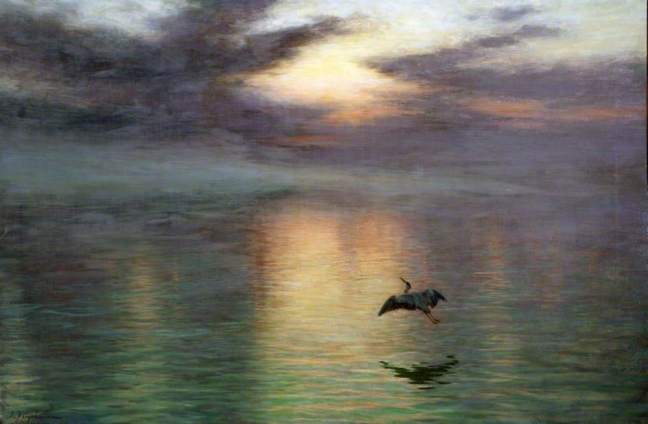
‘Dawn’ – Joseph Farquharson, 1903 – WikiArt

There is no such a thing as conceptual understanding in matters of spirituality. As soon as we form an idea, a concept, an image, a projection about ourself, we are still where we have always been: in our mind, in the known, in grounds we have already trodden a thousand times. These grounds are the grounds of our misunderstanding, where beliefs have already shaped and conditioned the idea we have about ourself. An idea that we rehearse and consolidate with every thought or act springing out of the field of our conceptual world. No understanding can ever come from this barren field. For one good, essential reason, which is that our understanding comes from only being. Being is the field of our understanding. Being is understanding itself. And the mind — with the ego which it gives rise to — is the only thing that is hindering our coming in contact with being in its purest form. That’s why concepts and ideas can never be understanding itself. They hide our clarity. In fact, they trample it.

So, should you ever want to come in contact with the pristine vibe contained in understanding, then a little digging is a necessary prerequisite. Don’t stay in your mind, take a new breath, be an explorer. You may use the tool of mind as you use a spear to dig a treasure. But please don’t take the spear for the treasure. This treasure is the treasure of being that stands unseen below the surface of your wrestling with concepts and ideas. Don’t let being be undermined by the description or explanation of the method. A beautiful image of truth will never be truth itself. It won’t hold the true taste of it. You won’t get its exquisite perfume, unless you see what stands under your mind and your ego. Understand your being by being only being. Throw the spear out. Finish the digging with your bare hands if required. Be yourself your treasure.

You come to an understanding when you stand under everything that is appearing or forming in your experience. Being is what stands under. It is the one thing that doesn’t change, that can never die or dis-appear, and out of which everything objective or knowable come into existence, and is under the scrutiny of your senses. But objective experience can never lead you to any understanding. Not out of its own will. You have to coerce yourself, make your own acquired, conceptual idea of reality recede and reveal its illusory, invented nature. You have to make what was, what will be, what should be, and what seems to be, into what is. That’s where understanding lives, in what is, in the here and now of your essential being. Understanding is implicit to being, and being explicit in understanding. Feel your being in its purest form, and see that you are yourself the understanding that you have craved to achieve through your mind.

So being stands under your apparent self which, in its light, is discovered to be non-existent, or rather only existent as being. That being is your true support, deserving all your praises. Actually, it is the support of everything, the great pervader — that’s why some have called it the creator. Not that it creates while being outside of its creation, but rather it is the substantial essence of everything — what makes a world possible and viable. So to understand yourself is to touch this essence through your being it, and to praise that part of yourself which you can never not be with, and which comes with a special flavour of well-being. That’s how you feel your true nature, through that subtle yet indestructible joy of simply being, which your never satisfied body-mind-self could never give you other than fleetingly. Understanding as being comprehends everything. It holds and embraces all life in the fullness of its presence. So to understand is to rest in your natural being, which requires no commenting or even understanding. You are, and this is that.

.

~~~

Text by Alain Joly

Painting by Joseph Farquharson (1846-1935)

~~~

.

Website:
– Joseph Farquharson (Wikipedia)

Suggestion:
– Other ‘Reveries’ from the blog…

.

A False Impression

There is an impression that I am the one who knows, or is aware. But this is a false impression and an unfortunate one. In fact, we as a body-mind don’t know anything, for the good reason that there is no one here that is in charge of the knowing. We don’t have this ability. It is not for us to know anything. Knowing doesn’t belong to an individual, separate self. We owe our knowing to something that knows us first, and lends us that potential. That really gives a totally different perspective to our existence, and grants us a gorgeous humbleness: Knowing is without a knower. The knower is but a set of thoughts that we have superimposed on awareness. It is entirely made up. It is of our invention, to give us a wee importance — after all, we all want a little attention. Knowing is in the nature of being. And being is the nature of everything. Knowing is all there is. It is the light of our world, indissociable from our experience. We as selves are just shadows. Everything is dancing and taking place without our being in any way party to it. At best, we are just a colouring, a point of view, an avatar governed by some divine rules which we have perilously chosen to ignore. This is our feebleness: wanting to own and appropriate, being more than what we already are. But in doing so, we have in fact belittled ourself. We have made ourself separate from the life we live in. We have created a self where there is none. We have awakened the devil of suffering in us.

So leave the knowing in some more skilful hands. It will spare you a lot of trouble and misunderstanding. You won’t have to be a person — all the heaviness contained in it. You won’t have to be a self that knows, but knowing will appear to be your one and only self — the entirety of your being. This pure and sublime knowing will give a measure of beauty and happiness in your life. It will encompass everything. It will widen your perspective and make you profoundly secure. You will know your being with precision and clarity, and live both in remoteness and intimacy — remoteness for a serene view on your experience, and intimacy for the delight contained in oneness. And love will be your everyday companion, the deepest essence of your being. And you will be clothed in understanding, which you believed could be achieved through your being a knower. Not at all. Understanding comes when you cease being a self, a knower, when you let go of all identities and egoistic purposes. Then it comes: the understanding — the knowing that knowing is all there is, and that you don’t need to be any more than that. So learn to keep at bay all private, egoistic desires to be anything other than this impersonal, undivided presence of yourself, that has the capacity of being and knowing. You have no need to be a knower, or a doer of anything in your life. Let the show run by itself. Only give it your golden, loving indifference. That’s the most glorious thing you can do in this life. You will be showered by the benefits of it.

.

~~~

Text and photo by Alain Joly

~~~

.

Read this essay from the blog ‘The Impossibility of Knowing’…

Suggestion:
Other ‘Ways of Being’ from the blog…

.

The Scrutiny of Now

You cannot understand truth in the future. For one good reason which is simply: there is no such thing as a future. The future is forever doomed to be a projection of thought. In reality, you will never meet anything that is not now. You are eternally married to the now as presence. The now is where you are, when you are, and also what you are. The now is encircling you from all directions, and you are bound to it, caught in its perpetual enchantment. So if you long to understand who you are, look at yourself now. Don’t postpone it for another moment that exists only in your imagination. To postpone truth is to never come anywhere near it. Understanding will never happen in another place than the place where you happen to be now. Now is your cathedral of understanding. You are being showered by its benefits every time you look for its presence within, for this presence of now is nothing but who you are, what you are. So if you think of the now as a moment that exists outside or independently of yourself, you haven’t looked well enough. For you are in fact the now. I mean it: you, the totality of who you are, your purest essence, is that thing which is called, amongst various other names, now. The now is that which you refer to when you say simply ‘I’. I know it doesn’t look like it, but you actually draw your identity from the now, for there exists nothing under the sun but this timeless presence whose place of living is in and as the now. This is why you can only understand yourself now. No other moment is fit for it, for any other moment is nothing but your hiding place, your desperate attempt to avoid drowning into the timelessness of now.

So don’t ever run away from now. Face it now — the now. Don’t think you can meet it again tomorrow. Now is a rendezvous that you can never miss. It will happen only once, which is now. But the good news is that you have never been anywhere but now. You are under the scrutiny of now. You live by its rule. Only you have to see that, and to see it now. Don’t think about it, for any thought you may have about anything — including the now — belongs to the past or the future, which actually don’t exist outside thought. Don’t think that you live separate from the now, as an entity bound to the effects of time. So let us not be so malleable, so easily cheated on. We all play so many tricks to avoid being now — which we are anyway, and anyhow. Oh! The silliness of it all — that constant stepping away from that which we are; that repeated removal from our being simply now; and the fear and suffering involved in not abiding as and by the now. The effort that it takes — to be away from home, displaced, a self in denial of its true and inescapable identity, refusing to die in the grip of truth. ‘Not now! Not now!’ Well, ok… But when if not now? Truth is for every-where and for every-when. It has no place to live outside of now. We are an ocean of presence that is so inevitably present and pregnant, that it appears to be not here. The reason is: it has lent its being to timelessness. Now is the Eternal that we have mistakenly taken to be a moment. A mishap that hides only one thing: Myself — the ‘I’ that is the now, for times eternal.

.

~~~

Text by Alain Joly

Photo by Elsebet Barner

~~~

.

Suggestion:
Other ‘Ways of Being’ from the blog…

.

The Reluctant Messiah

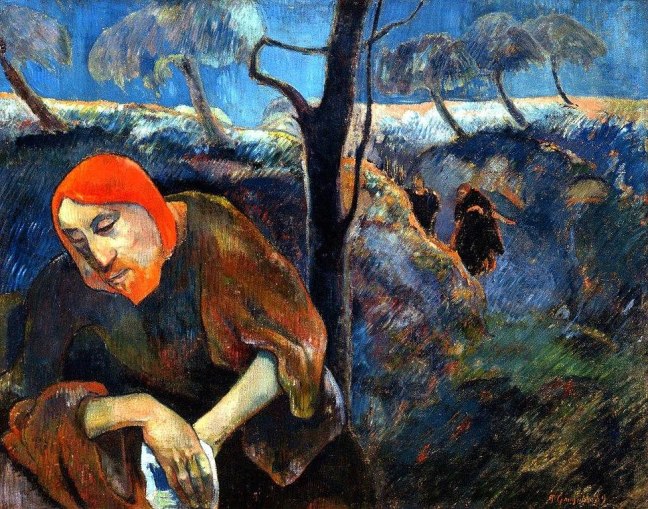
‘Christ on the Mount of Olives’ – Paul Gauguin, 1889 – Wikimedia

.

“Father, if thou be willing, remove this cup from me:
nevertheless not my will, but thine, be done.”
~ Luke, 22:42

.

Maybe it is more serious than you think. Maybe the line has been crossed without your noticing. Maybe there is no return to being what you imagined to be: A self, a person, self-contained in a body, armed with all the thoughts needed to represent you. Maybe there is no memory left of this old belief, and that you have to let it all go, all the kaleidoscope of separation, all the daunting suffering, all the interplay and thrill contained in being just one piece in the puzzle of life. Now all pieces have been joined to fade into one single presence with no pieces in it, a presence that you have espoused, that you have recognised to be your home — inherited and inhabited since before the dawn of time. Now you may have to move in with fear and reverence, for living in that new identity has consequences. It might transform you beyond your recognising, and in more drastic ways than you had expected.

It might shatter your dearest hopes and expectations, that were here in your heart, entertained to the point of cultivation. It might give you what you have sought all along, and stop dead every single desire for an ‘other’ to satisfy and fulfil you. It might demolish a dream, and disintegrate the map of yourself, that described who you were in such lively, never-ending details. It might silence you, when you so much enjoyed the delightful babbling of your anxious mind. And I won’t mention all your intimately held treasures of belief, all your ideas and opinions, that have put together that carefully built image of yourself: how they might be dampened, damaged, discarded for being found redundant.

[…]

Read more about how our resistance can be made into surrender… (READ MORE…)

.