The Prayer of the Devotee

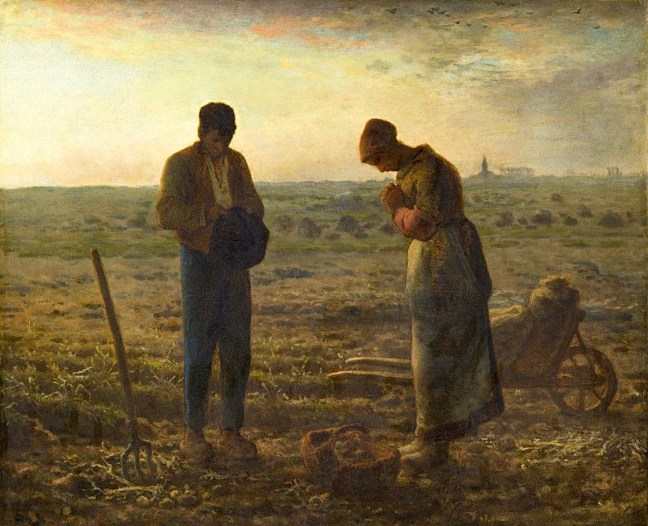
‘The Angelus’ – Jean-François Millet, 1857 – Wikimedia

Nowadays, we never think too much of the bells ringing from a distant church. Yet they were once set for a reason. They are the reminder of a practice of prayer called the ‘Angelus’. And it was precisely named so, after the moment when ‘The Angel of the Lord declared unto Mary, and she conceived of the Holy Spirit’: “Angelus Domini nuntiavit Mariæ”. So it is a message from a messenger of grace, lifting our spirit from the body, taking our experience at the level of what it truly is. It wasn’t just the recitation of a prayer. It was for our recalling. It was for being — for being held for a while in God’s bosom. It was for being reminded of our true nature, of our being the children of a deeper, forgotten presence which we are the incarnation of. It was an opportunity to remember. An invocation. A call from within.

This is a unique prayer, that some have named the ‘prayer of the devotee’. It was a prayer meant to be pronounced three times a day: in the morning, at noon and in the evening, accompanied by the ringing bells of the Angelus. A prayer inside which a few words strike with a special resonance. “And the Word was made flesh, and dwelt among us“. It was a testament to the sacrifice whereby God has made sure to leave in us a part of himself — his Son. A part of himself within ourself, which is more than our body and our qualifications, more than our mind and our many thoughts, beliefs, and identifications. It is that naked being or consciousness that is hidden in the maze of our many experiences, but is in fact our own, still, peaceful, never born identity.

So Mary has procreated while staying virgin, for the object of her nativity was herself, her true being which she has shown to the world to be the being of every other being. Jesus was a man, but Christ was that part of the man, and of us all, that didn’t need to be given a birth. It is the infinite, naked, ever-present being that is at the source of our sentiment of existing, of that very unique sense which is meant every time we say simply ‘I Am’, — I am, being, throbbing, living, never departing of that pure, godly, unqualified, indestructible essence, where infinity and eternity are like our most fitting attire. Nothing grandiose in these two words. They simply mean that I am not bound by time and place, by birth and death, by now and then, by here and there.

So three times a day, be it in the field as we were gleaning the wheat, or on the fishing boat in the middle of a river, we were called to stop and become a devotee for a timeless moment. Time and place were suspended, and our being recollected. It wasn’t anymore about harvesting the grain, or lifting the fish on the boat. It was for recognising in ourself the true nature of our being, and that special grace contained in being human — the child of a presence that abides in our very sense of being aware. For this apparently fleeting consciousness that is ourself is in fact the solid presence of God’s being, that is both sheltering and giving form to our body-mind-world. In this presence lives the peace that we are seeking everywhere, and that was placed here where it could never be missed, if only we are willing to listen to our inner call.

As very often in the religious world, there is the meaning intended, hidden, and the actual practice. The teaching, the message, and the poor understanding. The lifting grace, and the descent into belief and imagination. Here, the meaning intended, the teaching is: “Just be”. It is a prophetic, loving injunction for our sake, for our knowing, for our recognising. It is saying: notice that there is here and now, in and as yourself, a quality of being in which is contained life itself. It is saying: ‘God is with us’, which by the way is the meaning of one of the names given to Jesus, ‘Emmanuel’. So every time you hear the sound of a bell from a distant church, or the softer chime of your heart aching for peace, treat yourself with an Angelus, be like a devotee of your own being. Pause and go within, where you are forever being given a new birth, kneeling and offering your illusory identity in front of your one and true reality as being.

~~~

Text by Alain Joly

Painting by Jean-François Millet (1814-1875)

~~~

Website:
– Jean-François Millet (Wikipedia)

Suggestion:
Other ‘Ways of Being’ from the blog…

The Second Coming

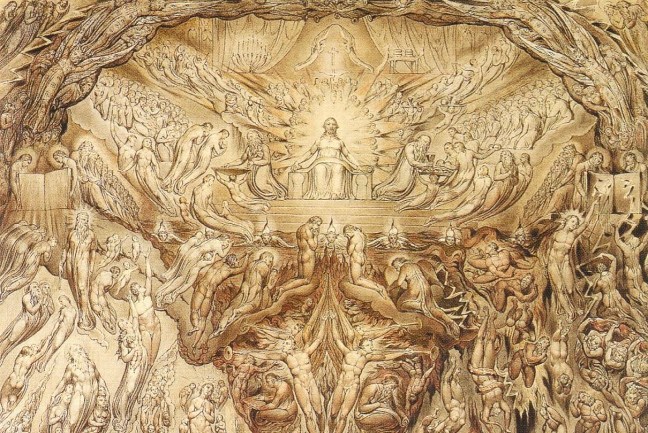
‘Last Judgement’ (detail) – William Blake, 1808 – WikiArt

There has been a seed planted, a first coming. There has been for all appearances to exist, for the world of things to expand, the creative and pervading quality of a ground. This is where all beings and all things have tapped in for their own being. We have all sheltered it without our knowing it, for the ground of being is invisible to our eyes, not accessible to our senses. We have believed ourself to be a body and a mind, and have consequently been busy with the objective world, taking as a fact that our senses were reflecting back to us a true image of a dual universe. We have tried to conform to this idea, to this consensual representation of our reality, and this is the reason for our suffering and our innumerable conflicts. We have accepted our body-mind as an identity, and our life as the toiling for our security and happiness in a generally hostile, mindless, material world. We couldn’t be farther from the truth.

So there has been the promise of a Second Coming. The ‘returning of the Saviour at the end of time’, as some religions have stated. Well, maybe that formula bears some truth, if it wasn’t taken for what it is not. But there won’t be the first sign of a separate entity coming again in the world to free us. The Second Coming is taking place in our heart. This is where it lives and has its home, waiting for our realising, longing for our returning. This is the ground set for a meeting with ourself, with our reality. A truth unmoved, still, unqualified, that is abiding here in and as ourself, but has been forgotten, neglected, therefore left unnoticed. The remembering of it gives us the illusory impression of its coming again. But no. Its coming again is us coming out of our self-imposed dream. It is us seeing the world and everything in it as the many faces of God, which means the world exchanging its believed reality as matter for the luminous vibrancy of infinite consciousness.

So there is a Second Coming. It is only an apparent one for we have in fact never moved out of it. It is our infinite, eternal reality — in fact God’s very being — which we could never part from. This ‘coming’ is rather a revelation, an ‘epiphany’, as the Greek word for the coming again of Christ indicates. In Islam, this is called the ‘return’ (al-raj’ah), the ‘turning again’ towards ourself, our knowing of ourself — consciousness. It is a revolution, the ‘rolling back’ of a false idea, of a belief, to reveal, or return to our own reality as aware being. It is the coming into view of something that was here, but hidden by our looking in the wrong direction. It is our true nature or reality becoming perceptible again, a new light sprouting out of our lazy, habitual, and a thousand times rehearsed imagined identity as body and mind.

In fact, the Second Coming was simply called ‘Parousia’ in Greek, which literally means ‘being present’ — how could we have missed such level of clarity! So now the traditional, religious promise of the ‘returning of the Saviour at the end of time’ could be read in its new light of truth. It is our true nature as God’s being, or infinite consciousness, and its becoming perceptible again when all idea of time, sequence, saviour, hope or belief has left us. It is the ground of being, being present, and shining as our one and only peaceful reality, saving us from a lethal misunderstanding. The last judgment being nothing but the punishment given to the separate self, the fatal blow of its being non existent, and the rise of infinite consciousness as the only self there is, the reward of its quietly blissful nature.

~~~

Text by Alain Joly

Painting by William Blake (1757-1827)

~~~

Websites:
– Second Coming (Wikipedia)
– William Blake (Wikipedia)

Suggestion:
– Other ‘Reveries’ from the blog…

On Retreat

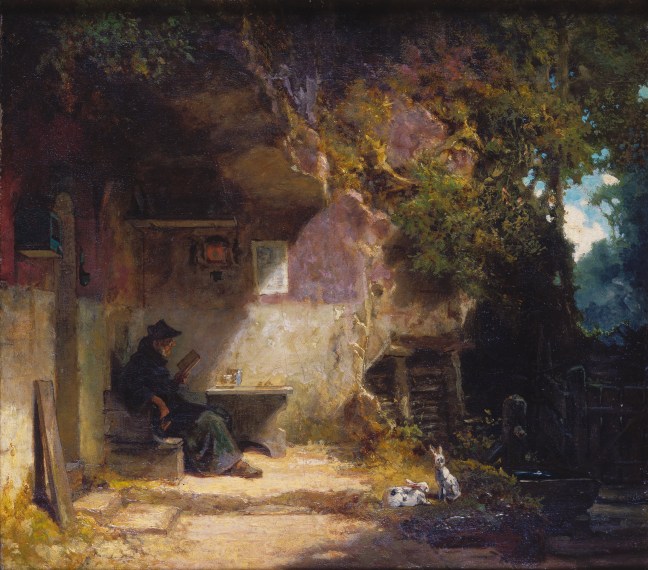
‘The Hermit in front of His Retreat’ – Carl Spitzweg, 1844 – Wikimedia

There is nothing innocent about going on a spiritual retreat. We come to plead guilty. We want to be delivered from a wrongdoing, to be free from a form of captivity. We come here to be disentangled. To take a step back. Not only from our busy life, from our problems, but from our many false identities. We have too many of them, and we are willing to undress, to disengage for a while from everything that we have wrongly taken to be ourself. From our habitual, rehearsed, believed identification with our mind, our body, and our many thoughts. From our obsession and addiction with the objects of the perceived world, which we think bear the promise of our happiness. From our endless hopes, fears, projections, and our constant seeking. We retreat from the battle that it is to be somebody, and to live in the limitations of the known. We come to be courageous, and to wrestle with what we don’t know. To discover a way of living that is fresh. To be in awe.

We have come to pull back. To leave the periphery of our life — where the superficial is our only landscape — for the deeper ground of our true nature. We are willing to be wronged, to show our vulnerabilities, our ignorance, in a life where we are prompted to pretend. There can be nothing new in staying with what we know. So our retreat is a process of unknowing. It is the journey from what we know to the unknowable. And we know the unknowable by not being qualified. By remembering our primary, unborn identity, which finds its ground in the ground of being, before it is coloured by qualities and identifications. We journey until we fully inhabit experience. Until our retreat is not a retreat anymore.

We have been retreating all our life, resisting from experience, which we call suffering. Our life is mostly the result of our not wanting to engage fully, of our taking refuge in thoughts, feelings, to not fully face the pain contained in experience. We retreat in what we think is our security. So we also come on a retreat to stop retreating. We want to be relieved from the load of our many resistances, from the unbearable weight that it is to constantly retreat from the fullness of living. That’s why we feel so good on a retreat. We put an end to our many retreats. We suspend our journey away from ourself. We come home, where there is no need of a retreat anymore. Where we finally know ourself — who we are truly — and can rest there. Where we can fully and only be, embracing everything, knowing that being is all there is. We cannot retreat from what we are. We come to retreat until we can retreat no more.

Out of our constant worry, of our restless seeking, we happen to have retreated in our mind. We have withdrawn from our heart. We have identified with our thoughts. So we have come here to stop retreating where we do not belong, and return to our heart. A retreat is a stage set for this discovery. That mind is not an identity but a tool. That love is our natural identity — the treasure under the many stones of our false identifications. We have come to be open, to end our many retreats — the shrinking of our heart, and know the meaning of friendship. We did not come here to pull back, to disengage. We have come to remember, and to forget that we have remembered. We have come to be present, full of our own true and gorgeous identity of being. So we both retreat, and stop retreating. We disengage, and engage fully. We come to be both still, and in movement. To disincarnate, and find our natural incarnation in being.

We end our mere existing to re-engage with the aliveness contained in simply and only being. We have come to retreat from our many retreats, to invest the placeless place of being, where there is no need anymore of a retreat. We have come to move from matter to spirit, from being something, somewhere, sometime, to being in the unlocated land of our formless, infinite presence. We have come to be but an eternal now, in which time has now surrendered. We have come where seclusion in being is found to be our openness and our freedom. Where we acquire the dimension of a whole world. Where there is no more path, no more retreating. We have found our home in being, which happens to be not a retreat at all, but the place of a total surrender. Home is not the place where we are, but is found to be what we are. We have come to end every possibility of a retreat.

~~~

Text by Alain Joly

Painting by Carl Spitzweg (1808-1885)

~~~

Website:
– 
Carl Spitzweg (Wikipedia)

Suggestion:
– Other ‘Reveries’ from the blog…

‘God Runs After You’

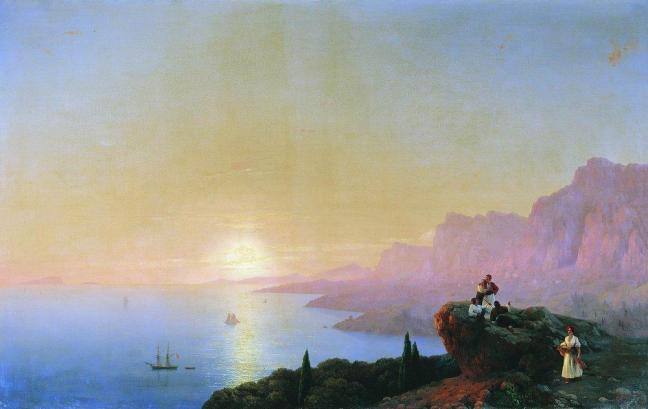
‘Sea bay’ – Ivan Aivazovsky, 1842 – WikiArt

Through our constant effort, we keep the effortless at bay. Even if we seemingly don’t do anything, we are always after something. So this constant, subtle pleading, asking, begging is closing all doors for truth to come in, to reveal itself to us. We are already dating someone else. Our mind is full of its rushing out in direction of an object, something that is going to satisfy us, to give us an identity, to fulfil us in some way. We are never truly longing. We are never an empty shell — always seeking, filling ourself with one thing or another. We don’t dare giving up, being vulnerable. We think we have to be someone, an entity in charge, a doer, a knower. We live with an armour, with layers that are concealing our true nature, even repelling it.

We have identities. We are full of them. The body is one, which we believe to be and be limited by. The mind is another, which we have adopted as being ourself — the ‘I’ that I am. We too believe in our thoughts, that we think define us, shape our identity. We are in a prison of our own making, made of bricks of memories, beliefs, hopes, desires, fears, that all concur to build a non-existing self of which we have now become the slave, and with which we have a dysfunctional, love-hate relationship. Even our ambition for truth is too much of an identity. Our desire for enlightenment is still a desire for fulfilment, another thing to achieve, a someone to be. Our true identity as pure, infinite being is not a new identity. It is not concealed or limited. It is not resisting, desiring, lacking anything. It is its own fulfilment — an identity that cannot be had, named or measured.

That’s what a true longing is — to be without ambition or desire of our own. To have even not a desire for truth, for which we will need an ego, and which still is a wall against the truth we seek — maybe the thinnest of all, but still a wall. Reality is to be realised, not achieved. It is in the word: ‘reality’ — which is we are that which is. There is no need of even the subtlest move towards it. It is all in the way we long for it. All in the way we build nothing that can go against it, or that could conceal it. This is the meaning of humility. We have to be lowly, on the ground, at the root of ourself, which is to be with our selfless being. We have it already — the being that we are after. It is all a matter of how quiet and accessible we can be. How we can be without a wall, without an identity. This is the most powerful longing there is — to be without any longing of our own making. To be without imagination or belief. To be watching only. Present. Already being — which we are anyhow. Not being an ambitious of some kind. There is no need to run after God. As Krishnamurti once put it so beautifully, “God runs after you.”

.

~~~

Text by Alain Joly

Quote by J. Krishnamurti (1895-1986)

Painting by Ivan Aivazovsky (1817-1900)

~~~

.

The quote is the title of a book consisting of eight hitherto unpublished discussions with Krishnamurti held in Malibu, California in 1970.

Bibliography:
– ‘God Runs After You’ – by J. Krishnamurti – (Krishnamurti Foundation India)

Websites:
– Jiddu Krishnamurti
– Ivan Aivazovsky (Wikipedia)

Suggestion:
Other ‘Ways of Being’ from the blog…

In a Room Quietly

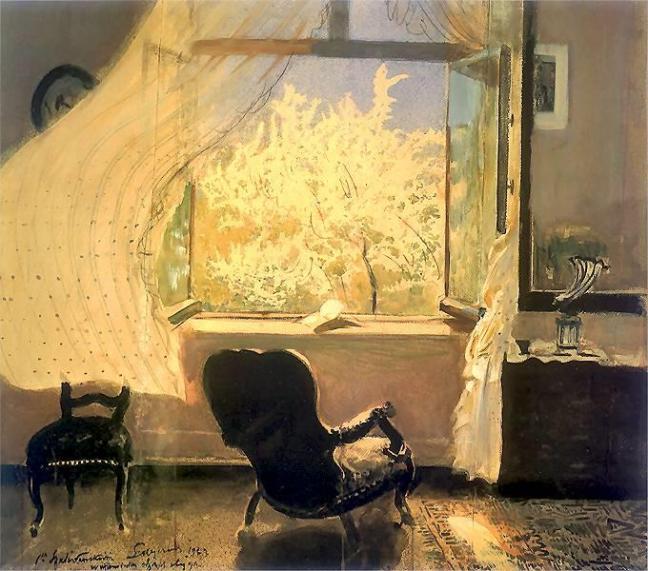
‘Gościeradz’ – Leon Wyczółkowski, 1933 – WikiArt

.
“All of humanity’s problems
stem from man’s inability to
sit quietly in a room alone.”
~ Blaise Pascal (‘Pensées’)

.

We have always our mind racing, going after something. Stillness is resisted. Staying in a room quietly is avoided. Being alone is dreaded. We want to be occupied. We’d rather not be made empty, so we always have a war raging. Is it that we want to be something, someone? Is it that we have judged only being to be not enough? That we have to pursue something, whether it is an identity, a belief, or an idea? We are chasing our own self — what we should have, what we should be. We are on a mission, therefore we can never be quiet. We need to achieve, arrive, get somewhere, be something. We want to satisfy and be satisfied. We won’t rest before we are fulfilled. We won’t stay in a room quietly. We will have our wars to obtain peace. Our escapes to not be where we are. Our resistances to not have what we have. We prefer to possess, which is to sit in the throne of power — in the Lord’s seat — and wonder where God is, or have a belief about Him. We are chasing experiences and circumstances. Anything but only and plainly being.

In fact, we are always in a room quietly. We just don’t want to see it, or don’t know how to notice it. Ourself is that space where we live and have our many experiences. Ourself is our circumstance. It is where we are, what we have, the peace that we are chasing everywhere but where it actually is, which is in our humble presence — in and as our being. So peace is our nature, if we don’t put it at a distance, if we don’t wish to have it. So don’t start a war. Stay quietly where and as you are, and your nature will slowly be revealed to you. You will find that your identity is in your nature. That you have already what you are chasing. That the experience of being is your so perfect circumstance. And that in the throne of your being is sitting God, for which you now need no belief. You have mastery over your life, not because you control it, but because you know the nature of it and of yourself, and in that process have put an end to your own seeking. You have quietened down, ended a war, and placed yourself in the only place worth sitting, which is in and as your own glorious being.

Now never leave it. That place of yourself. Never be dissuaded that you don’t have it. Never be influenced again that you need to be something other than what you already are. If you have moved away from home, go sit quietly where you are and stay there long enough to be persuaded again in the inevitability of your own being. It’s enough not to wish to be other. It’s plenty to stay unmoved, a humble watcher. To be in a room quietly. To close every exit. To be fascinated by yourself — not escaping the fact of your being. Don’t move away from the way you simply are. From the possibility that being is all there is. From the room you are forever in. Don’t give yourself an escape — there is no escape. Don’t buy the illusion that you can be something other than that — what you are now, what you are in, that very circumstance of your being. So begin where you are. It will bring a rebellion, an insurrection, a mutiny. It will stop you from being just a person. It will make you free, and bring stillness in your life. Resistance will recede, and you might even enjoy your circumstances, that are now pervaded with being. You will notice your aloneness, and have a gorgeous life in it. You will be aware of being as the one and only place you are in. You will have solved your most urgent problem — which is humanity’s too. 

.

~~~

Text by Alain Joly

Quote by Blaise Pascal (1623-1662)

Painting by Leon Wyczółkowski (1852-1936)

~~~

.

Websites:
– Blaise Pascal (Wikipedia)
– Leon Wyczółkowski (Wikipedia)

Suggestion:
Other ‘Ways of Being’ from the blog…

The Great Concealment

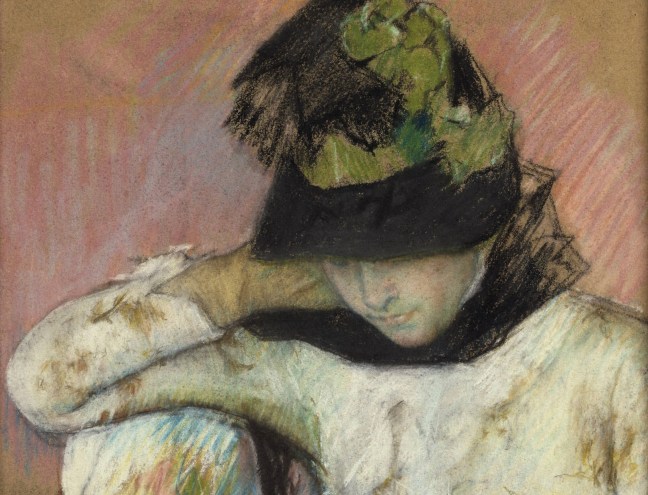
‘Young Woman in a Black and Green Bonnet’ (part) – Mary Cassatt, 1890 – Wikimedia

It is the most ingenious, virtuoso act of dissimulation that was ever put on in this world. Something that would require thousands of years of an immense and diverse body of literature and practices to cancel and bring back into the light. In fact, the story goes that, in the beginning, the world was only an undifferentiated spirit. It was all one, knowing no separation, nothing that could make it two, divided, conflictual, or with an ounce of suffering. Although insubstantial and incorporeal, it was a solid world, full to the brim with its own energy. It was a good world, a happy one, and peace was like its very essence, palpable in all circumstances. Place or time had not yet corrupted it, and there was, lingering within it, a quality of impersonal knowing that made it conscious of itself, although not as a thing to be conscious of.

Then, in this ocean of peace came trouble. Out of the growing complexities of bodies, a new idea emerged. Out of pure, undifferentiated being came the belief in a particular, separate being that can be qualified and pointed at. The one knowing presence that we are and that is the world’s essence, was slowly made into many. Entities have suddenly appeared, taking the form of separate objects. Oneness was lost and the world was made fragile, prey to the rising waters of thinking, the absurd presumption of matter, and the belief in the reality of time and place. Under the influence of the body and the senses, grew the belief in the reality of our own separate self. We started objectifying our own being, making it into a thing, a person, an entity separate from other things and entities. We have divided the one and only reality into bits and pieces, and in doing so have invited lack, incompleteness, suffering, and the many conflicts generated by such a belief.

While inventing a self where there was only the Self, we have created boundaries where there was none. While objectifying being, we have concealed the infinite nature of our being. The Infinite disappeared from our sight. We hid it, ate it, made it look as if not there, even though everything and everyone is only made of its humble presence. We have created the sense of a finite entity, and have concealed our true nature in it. Our plain desire to be was a too selfish act. It displaced infinity and made it look as the finite. It created time and concealed eternity in it. It gave us a place for our body, but made the placeless unseen. The claiming of our own personal, separate being broke the peace that is the nature of infinite being. It put truth in jeopardy, and dissimulated it inside a lie. The infinite can never be a thing. It is not in its prerogative. If we make it into one, it goes hiding. It becomes concealed under the false appearance of a separate self, under that which is not there. We have dissimulated the real in the unreal. The infinite in the finite. Happiness in suffering. And the glory of the spirit in the conflicts of a mundane life.

~~~

Text by Alain Joly

Painting by Mary Cassatt (1844-1926)

~~~

Website:
– Mary Cassatt (Wikipedia)

Suggestion:
Other ‘Ways of Being’ from the blog…

‘Come to Me’

‘Norham Castle, Sunrise’ – J.M.W. Turner, 1845 – WikiArt

Sometimes you’re left with just three words. I read them under a statue of Christ in a cathedral, three simple words from the Gospel of Matthew, but a whole teaching if you listen. “Come to Me”. There is immense simplicity and clarity in these three words. They have a vertiginous meaning, if you follow the course of their true destination. If you accept the invitation. Not from a somebody, a person that existed. Not from a God, or a Son of God. Not from anything in particular, any objective presence which you could go to. The invitation is from yourself to yourself. In fact, ‘Come to Me’ is better read as ‘Come to the me’. Go to the ‘I’. Abide in what you are, be that presence of yourself. Be just as you are — don’t add a thing to yourself, don’t play the game of projection or belief. Don’t give yourself to somebody or something that is not you. Stay right there, right in what you already are, just as you already are. But still, there is a movement implied — a solicitation, a passage from place to placeless place. It says ‘Come to Me’ for a reason. In that paradoxe is contained the totality of our spiritual endeavour.

It is not a place you have to go to, but rather the noticing of the place you are in. The beholding of your true nature. What is this ‘I’ that we stumble on every time we say ‘I’? What is this being conscious, this being aware that I am? Did we look well enough? Did we miss something that we have to come to it, take a new invitation, be encouraged? See that you have made your ‘I’ into an assumption, a pretence, an affectation, something not worth a visit, not worth a discovery or an enquiry. In fact, we have been asked to function and obey, which means to follow. The rest has been wisely swept under the carpet of belief or religion. As if we had already discovered everything about what we are. As if consciousness wasn’t worth a second look. As if from then on, for our nature, we had to rely only on imagination, belief, things fancy, whimsical, hopeful, devoid of reality. Reality has been covered — so we think. There is no new land here, no new discovery or journey within, nothing that hasn’t already been charted.

But there is a coming that is subtle to the point of not implying time or place. A coming that cannot be measured by instruments, that cannot be objectified, seen by the senses. There is a coming where we already are, but with a new light shed on it. A light that we have missed for directing it all on objects, with the complicity of the senses. So the light of what we truly are was lost in its being misdirected. Our true nature was lost in our belief in being a body, a self, a person. Our purity of being was hidden inside our fascination for qualifications and objects. Our happiness was lost in our suffering. Our peace squandered by our restless seeking. So there is a journey within. A journey with no distance to be covered. A coming to where we already are. A coming or moving into view. A becoming perceptible. A coming back to ourself.

‘Come to me’. You may discover that you have God within. That this is what the God of religion is — what they meant — the ‘I’ within, your true being. Come back to yourself. Become perceptible. Come into view. Know yourself as you are. Come into the light which you are already in. See that you are, and who you are. Abide in the purity of plainly being. Be yourself for the first time. Be ‘I Am’ alone. ‘Come to me’.

~~~

Text by Alain Joly

Painting by J. M. W. Turner (1775-1851)

~~~

Website:
– J. M. W. Turner (Wikipedia)

Suggestion:
– Other ‘Reveries’ from the blog…