A Manual for Happiness

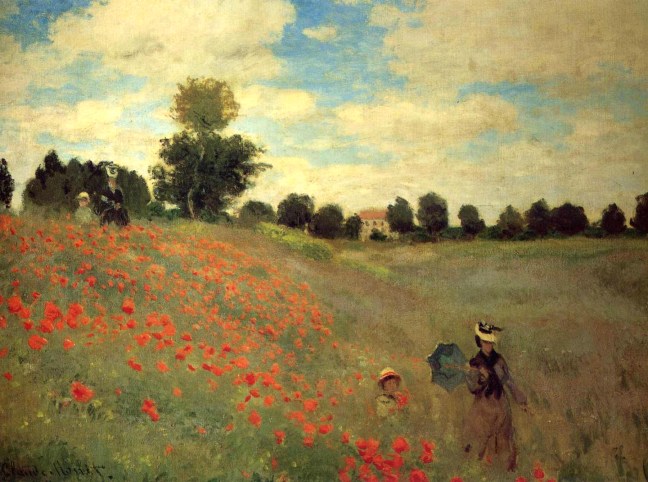
‘Field of Poppies’ – Claude Monet, 1873 – WikiArt

We can’t get hold of happiness so easily. It is elusive, coming at odd times, sneaking in surreptitiously without our noticing. When we know it, it had already been there for a while, although we realise it only now — its quiet presence — a thing that seems to come from eternity, and that we could live with for ever. It doesn’t have the crude expression of a boastful, egoistic eruption of joy, or the bourgeois, replete manifestation of satisfaction. Happiness is more charming, something rare, valuable, that comes uninvited, on a propitious moment. By the way, this is the etymology of ‘happy’: ‘hap-‘, which means ‘lucky’, ‘good fortune’. Happiness seems to come by chance, ‘falling’ on us, as the Latin ‘cadere’ for ‘chance’ conveys. There is an exception though, in Welsh, where the word ‘happy’ had once the meaning of ‘wise’. Maybe after all, being happy is not a matter of chance. Maybe it better comes with some understanding and wisdom.

So what is this chance, or this bit of luck that comes propitiously for happiness to appear? Maybe our good fortune is simply in what is present now, shining beyond any shadow of doubt. Being happy is when we have the good fortune to let ‘what is’ be, occur, without any interference. Being happy is when we let ourself plainly be. This allowing may be the best manual for happiness. And this has nothing to do with a person or entity being happy. Happiness doesn’t belong to us personally. It is not in the obtention of something we desire, but rather thrives in times of desirelessness. Happiness is a detachment. It is a permission. It is a confrontation with truth, and therefore the abandonment or removal of our idea of being a person. There, in that removal of oneself, is the advent of truth or reality, and the blooming of happiness. Truth, having no perturbation in itself, no friction, no contradiction, no lie, or illusion, or pretence, is manifesting its pure joy of being just as it is. Happiness is a manifestation of truth. An indication of presence. The bubbles of being that come at the surface with a fizzing sound of well-being.

Happiness doesn’t happen to us. It is in the air, in the essence of everything, in what makes us intimately. It is indivisible from who we are when we have removed this block of beliefs, concepts, certainties and doubts, that constitutes our alleged self, with its regiment of hopes, regrets, and resistances. Happiness has no relationship whatsoever to our body and mind, but they will find a great relaxation in experiencing its echo. Thoughts will rarify accordingly. Of course there may be an appropriation of happiness by the so-called person we have convinced ourself to be. The mind recuperates it to its advantage. The self is using this timeless moment to boast itself up. It objectifies happiness and reduces it to being simply an emotion — the equal of fear, or anger. It reduces happiness down to a form of tension that consolidates its belief in being a person, a body-object that is the only subject of its life.

In contrast to happiness, suffering belongs to us, and so do fear, anger, hatred, which are all tensions coming from a misappropriation or misapprehension of life — a violation of truth. We are mistaking ourself for what we are not. We are resisting what is with what is not. And it generates all manners of conflict and discomfort. But if we don’t react; if we let ourself feel this pure, unattached inner being, and don’t leave it, don’t conceptualise it, don’t distance ourself from it for a refuge in the comfort of our body-mind. If we stay there, in the subtle identity of our most intimate self. If we rest still and in complete harmony with our purest sense of being. If we stay humble, and enjoy the delicacy contained in just being, for no reason other than simply being. If we enclose ourself within it, and let ourself be permeated by its most subtle essence. If we feel it to be our lifeblood, and let our old sense of self be seized, or snatched away by it. If we don’t resist in any way, including through our appropriation of happiness, which is a subtle form of resistance. Then… Then happiness is revealed as just the ease of being — what comes naturally when we connect to the truth of our deepest self. It is then what we could call, our good fortune.

.

~~~

Text by Alain Joly

Painting by Claude Monet (1840-1926)

~~~

.

Website:
Claude Monet (Wikipedia)

Suggestion:
– Other ‘Reveries’ from the blog…

.

Salvation

‘Storm by a Lake’ – Pierre-Henri de Valenciennes, 1780 – WikiArt

Many religions have spoken of salvation, but the idea of being ‘saved’ is not fancied by most people. We don’t like it. People have their self-esteem. They want to feel that they can be responsible for themselves, that they have the resources to overcome whatever needs to be overcome in their life. They don’t want to rely on a god, or an external agency, or even a power. They don’t like to be put down, don’t fancy being a poor thing in need of being saved.

The good news is that there is no such external power or entity. We have it all in and as ourself, as our own being. Nothing exists or stands beyond or aside our being. This simple being that we are, which we are made of, which we draw our very existence from, is the only thing that has a reality. We won’t find a reality at a distance of our own being. The idea that there is a reality other than our own reality as being is only a belief. We won’t find a power beyond our own power, that could come to save us. This world of ourself was perfectly designed. It was made whole and one, so that we hold within ourself our own resource, our salvation, everything needed to live a gorgeous, peaceful, meaningful life.

So the idea of a salvation took us on the wrong track. It had us waiting, hoping, praying, expecting, while at the same time abhorring the idea of needing help. It gave us the idea or impression that we were an entity, a person with its own personal, separate being. It manipulated us to think that we were our story, and that we needed to be fixed, aggrandised, improved, saved. For after all, let’s be honest, we do need to be rescued from a peril. We do need to be delivered from the danger of suffering, of separation, loneliness, conflict. We do need to save ourself from our belief, idea, concept that we are squeezed in our body-mind, and limited by it.

With such an idea in mind, we have but the semblance of a life, but not life itself. We have been simulating having a life, pretending to know who we are, and then acting as if everything is as it should, as if suffering couldn’t be avoided, as if it were intrinsic to living. We have in fact ourself created the idea of a salvation, of a person at a loss, needing help. But the truth is, there is really no such a thing as salvation. Salvation is implied, or contained in being. Salvation means ending a belief. It means not taking ourself to be what we are not. It is the returning to our natural state of simply being.

This conceptualisation of our being into being a self, an entity, a separate being, is the road towards separation, isolation, suffering, conflict, and therefore salvation. It is our wrongdoing, our ‘sin’. But the sinner is an entity that we have created. We have made a sufferer, a sinner where there was only the peace of being. Through this creation of an illusory self, we have invited separation, duality, and have divided being into a self separate from other selves and things. We have given the world a reality independent of our own, and have made the glory of being into a self that has retired into the limits of the body-mind.

Our salvation is in the sin itself, in its ending. It is in being, before the birth of the idea that being requires being something, or someone. Before our identification with our body and mind, which has made suffering and conflict our daily companions. So salvation is always only an acknowledgment, a noticing. It is the knowing of our being as it is, and not as we have made it, through belief and habit. This is how we are doomed, in being a self separate from everything. And this is how we are saved, in being only being. This understanding does save for it tells to a mortal that he is immortal, and it assures a suffering self that she is blessed with a peaceful being. A sin is an unfortunate addition to plainly being. It is a simple exaggeration. We have created, invented a sinner where there was nothing but our gorgeous, infinite being.

But this is something that can be reversed. Salvation is natural, already here, achieved, contained in and as our own being. Salvation is being. The one in need of being saved is not there, has no reality other than in our mind. The idea of salvation or deliverance itself must go. It had found its use and meaning when we were but the thought of being someone. When this idea of being someone goes, when the qualification withers, being stays behind, resplendent, in no need of being saved whatsoever.

All this, the whole spiritual enchilada, is only a convenient story for the poor me. Deliverance is achieved in being. The sinner is an illusory superimposition on being, which is intrinsically already free. We have limited being, have made it an impotent thing. So there is ultimately no sinner, and no salvation. This is why we say that God is forgiving, because there is always at hand the realisation that there is in ourself, in being, no room or possibility for an entity separate from experience, and therefore for a sinner. In this discovery of our being whole, and One, is the birth of a love and a peace that is beyond understanding, beyond any making. In fact, we have been saved and safe all along. 

.

~~~

Text by Alain Joly

Painting by Pierre-Henri de Valenciennes (1750-1819)

~~~

.

Website:
Pierre-Henri de Valenciennes (Wikipedia)

Suggestion:
– Other ‘Reveries’ from the blog…

.
The Word ‘God’

‘Italienische Landschaft’ – Pierre-Henri de Valenciennes – WikiArt

Long before any idea of a God, before any belief or possibility of a deity, of a divine command, God is already here, hiding within yourself. Or rather you yourself have just come hiding God. It means, don’t make God into an idea, a form, a projection born of your fears, of your eagerness for peace or relief. God is not ahead of you, or before you, or above you. God is not an entity, or anything that would not be your own.

God wouldn’t be God if it were an idea, a conceptual form far away from your self. For God is not something abstract, vague, distant. God is resplendent. God is shining. Not in a far away, unreachable place. God is brightly here, just as you are. You are, because of God. Because God is, you are. God is the very essence and quality of your being.

There is nothing above or beyond your being. It seems that there is, because you have limited your being by giving it a qualification. You have found it better to clothe your being with something. Then God goes hiding. Or you yourself are hiding your own divine self or essence, the possibility of your being only being. For there — in being — is the key to god.

In that being, God is. God is doing your being. That’s the extent of the presence of God in your life. In that, there is not even the possibility of a belief in God. In that, you feel God’s presence every time you feel your own presence, which makes God very present indeed in your life. In that, a belief in God would in fact trample God. It would make it an entity. A distant thing. A poor meaning. Not God at all.

Who do you think is ‘doing’ your being right here, right now? Think of that for a while. What is this being that I am? What is this I am that I am? Answer that in verity, through your actual experience, and God won’t be a secret to you anymore. God will cease being distant. You will be yourself made of the presence of God. No belief in God could ever match that.

But remember that once God’s being is recognised to be your being, then you won’t find room anymore to have your own personal being. Your own being will be lost to God. Now there is only God, which actually means there is no God at all. The idea of God is for when you have distanced yourself from God, when you don’t know yourself — that you are God’s being. In recognising yourself as God’s being, you will have lost both your being, and the idea of a God. It is a form of death.

So think twice before you say that you want to know God, or to know yourself. For this knowledge will leave you with being only. There won’t be a you. And there won’t be a God. There will be the purity of being, which is the everlasting life in death, which is to live as the One. You will lose your apparent doership, the control that you think you have, every objective identity that you believe makes you.

But in that loss is the finding of yourself, of who you are. In that loss is the end of your suffering, and the discovery of your nature as peace. This finding of your essence is the meaning behind the word ‘God’. In finding God, you will have rid of God, and of yourself. What is left is more than any word can tell. More than the word ‘God’ could ever convey. There would be no word at all. Except you. You would be the living word for ‘God’. 

.

~~~

Text by Alain Joly

Painting by Pierre-Henri de Valenciennes (1750-1819)

~~~

.

Website:
Pierre-Henri de Valenciennes (Wikipedia)

Suggestion:
– Other ‘Reveries’ from the blog…

.
The Treasure Within

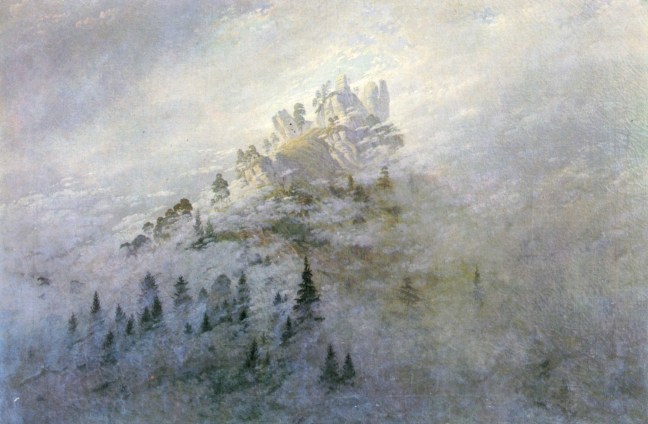
‘Morning mist in the mountains’ – Caspar David Friedrich, 1808 – WikiArt

There is something in us, a presence, a feeling of being, that can say I Am. Nothing else can. No body can. For how could a body say I Am, which is but a bundle of tissues, a physical structure that can only be seen as an object, at a distance. That which is at a distance cannot say I Am. I Am is for the innermost of your being, for what is here beyond a shadow of doubt, in you, as you, indissociable of yourself. Feel that I Am is for that which never moves, is never tired or sick, is never concerned by age, or beliefs, or any passing content of the mind. Go for what in yourself is indestructible, constant, that could never be hurt, and notice that that is the thing which is necessary, responsible for your being able to say I Am. I Am is your anchor, the lighthouse you must never depart from. If you do, you will be plagued with suffering and grab the first thing you could identify with, amongst others your body, and your mind content. Thought is a good client for providing you with a fake identity. It mimics a self to perfection where there is none, where there is only here a presence infinite, borderless, shared by all. Without that, no I Am would be possible. No I Am would be there, and no humans either, no beings, nothing at all, just a black, empty void.

I Am is the light that makes life possible, that renders it palpable, sensible, experienced. You could say that for an object to find its isness, its existence, there would have to be an I Am first, there would have to be an essence, a ground that gives all things and all beings their shape, length, width, and existence. This essence is that without which there’d be no you, no possibility to say I Am. That without which there’d be no support for your thoughts. That without which your body could not in a zillion aeons find its ground, its birth, its death, and its life and beating heart. Thought has nothing to do with your asserting I Am. It is in no way involved in it. It will try to convince you, that thought is behind it all, is the voice of your being, the one that can say I Am. The body has convincing arguments too. They two form a good pair. But don’t be deceived. These are not where you draw your sense I Am from. I Am is deeper. I Am is fundamental, not a passing thought or feeling, bound to an object, to a body. I Am embraces all things and all beings. Even the world could not be thriving and bubbling without having its grounding essence. It needs, for its rising and falling, for its being seen, heard, felt, a something that holds it and creates it, like the content of a dream needs the mind of a dreamer. The world would be at a loss without I Am.

And in fact it is: at a loss. For why do you think the world is plagued with suffering and conflict? If you ever find yourself suffering or in conflict, it is that you have lost your I Am. You have given it, bargained it to a body, or a story, or some mere random thoughts. You have exchanged it for an ambition, an eagerness to be something, somebody, and to feel the reward of it. I Am is without a reward, without a body, faultless, pristine. It doesn’t know the meaning of suffering, or conflict, or confusion. So keep it always close to you, don’t lose its splendid gaze. For your body, mind, and random thoughts are all craving to take on the role of a self and blind you, conceal in the process your gorgeous, inborn, god given identity. They’ll happily send I Am to the wrong place, to keep it unnoticed, forgotten. But I Am is always here, like a patient presence, holding even your ignorance in its benevolent hands. It will wait for your looking, your noticing, the better days of your realising who you are, that is found here nestled within I Am. You owe I Am everything, right to your feeling of being, behind the mere words.

For there is a Word behind the words, which I Am is the pointer to. A living, pulsating reality. Call it being, call it god, call it Word. We have made I Am into a mere body, a limited self, and have therefore compelled ourself to look outside for our peace and completeness. The seeking for our lost completeness is what is called suffering. But the way to overcome suffering and conflict in our lives lies within, in our very being, in what is hidden in plain sight every time we say I Am. A human being can never have its private sense of I Am, for being is shared in equal measure by all beings and things. It is boundless and has within it the peace and completeness that you had been looking for without, as a result of your misplacing I Am. I Am owns its peace and completeness through its being alone, whole, One, and therefore unable to be parted, or lost, or forgotten. So have a good look every time you say simply I Am, and recognise it for what it is, and not what you believe it is. Don’t limit I Am to a projected, illusory, made up entity. I Am is the gorgeously carved door to your being happy and whole, and to have the world reflecting that wholeness and happiness. It is your treasure within, that you have ignored, or misused. So repair the sense I Am in yourself, and give it back to its original, initial, pristine glory and undefeatable reality.

.

~~~

Text by Alain Joly

Painting by Caspar David Friedrich (1774-1840)

~~~

.

Website:
Caspar David Friedrich (Wikipedia)

Suggestion:
– Other ‘Reveries’ from the blog…

.
Intimacy

‘Untitled’ – Charles-Francois Daubigny – WikiArt

Spirituality is about intimacy. Nothing else. That is all you will feel, when you go to the right place, when your most tender being comes towering in your life: intimacy. Intimacy with everyone and everything. When you are not content about being a person, about only living the life of body and senses, about all things objective that can be seen, heard, felt, then is left something that you could never comprehend. Then comes that innermost part of yourself which is now found to impress and impregnate both you and your experience. Then comes something measureless. This was already your most familiar experience, although you have made it a stranger in your life, for engaging only with the shallow, with the surface, the easy, the habitual, the measurable. These will never take you to intimacy but to separation, remoteness, distance, and finally discord. So go to what is not only passing, but to what is inmost, intrinsic, that cannot be discarded and dispensed with. Your world will open to something precious beyond understanding, which is the intimacy contained in experience as a whole, when it is not dampened by your insistence in being something separate from experience.

Intimacy feels like being with a close friend, when nothing needs to be said other than simply to live, enjoy, and taste presence. Intimacy is to make yourself and experience as precious as a lover. In that process, it melts you down, so that you are nowhere to be found. This absence of yourself is love, which is your freedom, and the thriving of this presence which you are and have always been without your noticing. It will bring everybody and everything — the whole world — close to your self. So close that you won’t see a difference between your experience and your own self. You will be revealed as one boundless presence — the undefeatable essence of your being, before the thousands things of experience come to soil it, dampen it. You will be in love, inside love, for intimacy is just another word for it. Intimacy is about shared being. It may seem personal, but it is not. What makes it seem personal is that we involve the body-mind, that we think binds it. In fact, intimacy has nothing to do with the body and the mind. It is a warmth without limit or end.

In its purest form, being sends us in a place of immediate intimacy with everyone and everything, a sense of togetherness, of belonging that cannot be helped. Intimacy is a gathering in and as being, whether we are two people, or ten, or a hundred. We feel an absence of plurality, or otherness. It can be informed in a split of a second, deploying itself from a place unknown and unknowable. Its appearance is free, unconditioned by time. Its disappearance is impossible, only apparent or believed. It comes from a place which has neither a beginning nor an end, and is not bound to the limitations of space. It reveals itself as something fundamental to our living this life, but which we have failed to notice was here. It is the highest degree of your essence. Being intimate is the last place in yourself you will ever visit. There is no beyond it. It will come as your last day, your final breath, for there is no living as a separate entity, as a private being, once you have drunken at its source, and suffered its irrevocable implications. To be intimate is to die to yourself, and disappear in the radiance of only and simply being.

.

~~~

Text by Alain Joly

Painting by Charles-François Daubigny (1817-1878)

~~~

.

Website:
Charles-François Daubigny (Wikipedia)

Suggestion:
– Other ‘Reveries’ from the blog…

.
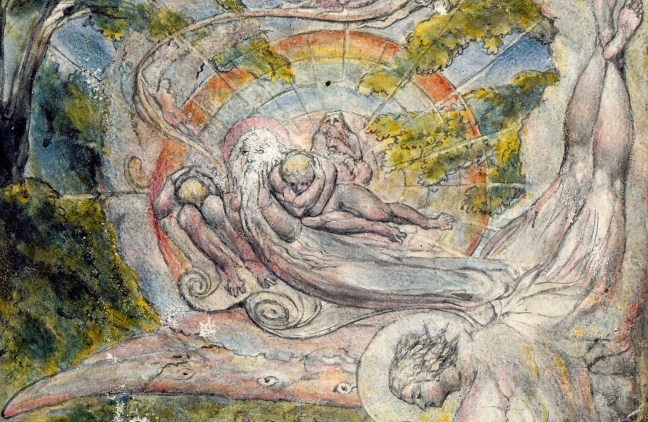
The Dream of a World

‘Milton`s Mysterious Dream’ (part) – William Blake, 1816-20 – WikiArt

There is a fraud in our life. An illusion that makes us feel that life is going to get better. That time or circumstance will bring us to a place of understanding, where our troubles will come to an end, where there will be betterment, improvement, change. To believe this will make us miss that we are already here and now in a place of no change, of no betterment, where nothing can improve or get better. This place is our very self, our sense of being that we have never been able to affect or modify, no matter how relentless our life has been, no matter our despair, our sorrow, our losses. Nothing we have gone through has touched it in any way. All our stories and sufferings have taken the shape of our thoughts and beliefs about them. But while we are desperately trying to give a form to our life, a solidity to our body, a reality to our problems, and a truth to our beliefs, right here and now, right where it all is seemingly taking place, hidden within experience, enveloping it all, is already a presence, a vastness, a reality that is embracing everything, and that is our only reality, our only place, our only possible self in this living experience.

For there is not a world there where we could be in. That would be a lovely idea, but the fact is: there is no possibility to prove the existence of such a world. We can only assert it, marvel at it through our senses, study it, analyse it, but of a solid proof there is none. The existence of a world is dependent on our perceiving it, and perceptions are contained in our knowing them. Without the knowing faculty, there cannot be a world. The whole glory and misery of the world, of the whole universe, is all gathered in that fathomless fraction of knowing, or awareness. Without that simple, ungraspable, dimensionless, ethereal element of knowing, no world could ever come into existence. So in fact, knowing is all there is, consciousness is the essence of every single appearance that comes to be seen, heard, touched, or experienced. The world is shaped, or its appearance created, through our being aware of it. So the whole of our living experience is but a dream in consciousness, a game that can be played and enjoyed at the level of our body-mind, but whose reality is only the awareness of it.

Now, where are we if we are not in a world? Where are we if the world is not even there? What is this something that we feel we are in, and exists, and is undoubtedly? What is a world, an experience, when we have passed through all illusions, all beliefs, all shaky appearances? What is left here that holds our experience, that is indomitable, indestructible, present without a shadow of doubt? This place is our self, what we are, our very essence, the reason behind our saying ‘I’. So we live in our self, not in a world. We see our limited existence pass and consume itself within that which is creating it, which is our own aware being, the knowing that we are and could never not be. And there, in ourself, in being, where the world takes its apparent form, is found what we have been looking for in every direction, in a non-existing world, in experience: a sense of relief, peace, beauty, love, and the understanding of our essence, the explanation of it all. An explanation that is not conceptual, but a living one, a subjective one, something made plain by being it. We and life then become self-explanatory. The fraud has been diluted. All imagination has died down. Now our living experience has acquired the rawness of truth. Something that is, unlike the world or our experience, beyond doubt and absolute.

.

~~~

Text by Alain Joly

Painting by William Blake (1757-1827)

~~~

.

Website:
William Blake (Wikipedia)

Suggestion:
– Other ‘Reveries’ from the blog…

.
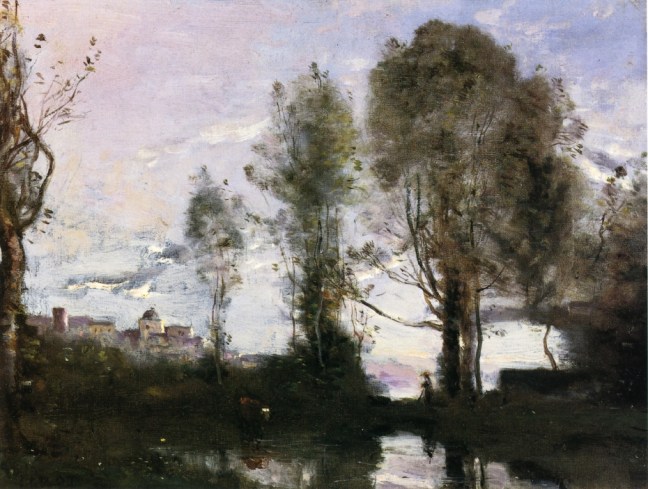
Overflowing Questions

‘Edge of a Lake (Souvenir of Italy)’ – Camille Corot, c.1855-60 – WikiArt

Wouldn’t you like to have a knowledge which cannot be surpassed, which amounts to everything? That has in its core the truth of living, the philosopher’s stone from which everything springs, and to which all appearances owe their existence to? Actually, don’t you already long for it, and have done so for as long as you can remember? Is it not what you secretly hope for in your life? To have this knowledge, this direct access to the peace of your being? To have it here at hand, like a secret bond which you can find under and within every difficult situation, every outrage, every burst of suffering? And wouldn’t you love to harvest what this intimate knowledge contains? Its most reliable sense of joy, of contentment, and see yourself plentiful, complete, enough, in an absence of need? Wouldn’t that be great? To uncover it, and let it find its natural place in you, and as you, easily, without your doing very much about it? Wouldn’t that be great? Would anything be more valuable to you? Would that not be worth a life? Any life?

And what if you were told that you are not this bunch of objects which you have believed yourself to be — these endless qualifications, and the myriad of thoughts and feelings to which you have tied yourself with? Wouldn’t that give you freedom, a sense of release? To be unattached, not bound to your body-mind, at least not in a fundamental way? Wouldn’t that be healing, to be not the body but what holds it in its embrace? Wouldn’t that be soothing, to be not the mind but that which lends it the space to wander about? What is to you more elating and convincing than finding yourself naturally, effortlessly, in a place of health and vigour? The body’s ailments? The mind’s silly wanderings? Well, what if they were not really yours? Wouldn’t you like to find out, what would be their fate when left alone? What could be their trajectory when you rest peaceful in your own healthy, infinite body of awareness? Wouldn’t that be great to make this discovery? To have the final answer behind all that has been troubling you for so long?

And what if you were to uncover some even bigger findings? That behind your long, busy, eventful, suffering life, there has been a stillness, a silence which couldn’t be stirred or broken? And that nothing truly ever happened in your life? That it has been just a passing dream? What would be the implications of that ? And what if you were to find out that the world is just only clothed by the awareness of it? That it is not there in the way you had imagined so far? And that behind it all was also dawning the certainty, the knowing of your immortal, undefeatable nature? Wouldn’t that be wonderful? To see, feel, touch the truth of it with your hands, that death is a myth? That it is not there? Not in the least? Wouldn’t that be extraordinary? That things do die but not you? That body does become ashes but not you — not that which you truly are? That mind withers away but not you — not your primal being which you have to concede is eternal, is infinite? Wouldn’t that take your breath away? Wouldn’t that blow your mind?

.

~~~

Text by Alain Joly

Painting by Camille Corot (1796-1875)

~~~

.

Website:
Jean-Baptiste-Camille Corot (Wikipedia)

Suggestion:
– Other ‘Reveries’ from the blog…

.