‘Try to Die Here’

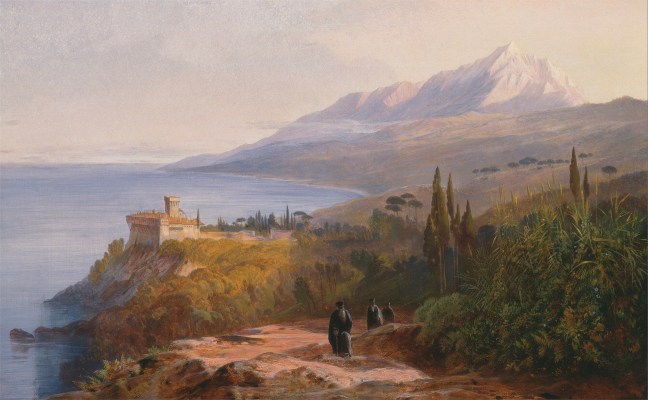
‘Mount Athos and the Monastery of Stavronikétes’ – Edward Lear, 1857 – Wikimedia

When the young Romanian Ioan Gutu arrived at Mount Athos to spend his life there as a monk, he was welcomed by his spiritual Father Elder Ilie with these few words: “Try to die here.” That’s what you do when you arrive at your true self, at your Mount Athos, you don’t form another thought about yourself, you stop looking for an identity, you don’t take refuge again in your mind, in your body. You leave all things, all identities, all beliefs behind. You stop reincarnating as a self separate from the world, for you have found that you were already fully, and wholly incarnated in being, in the selfless reality of your true nature.

In fact, the monastic life is only a metaphor for the truth of your living. You are required to spend your life and die there, because you cannot leave the reality of your own being. A monastery is a place where you reenact reality, where you know no separation, no ‘other’. You are alone, as the word ‘monk’ tells you in its etymology. It is where you know being to be the only place there is, no matter where you are, where you look. You lose your many pursuits and ambitions in being something, someone. You retire where you have never ceased to be, which is in yourself, in your nature, in the truth or reality of your infinite, undivided being. So this is the death that Ilie had in view for Ioan. “Try to die here”. Cease to be other than the One. Stay in your reality as it is, and spend your life there. Don’t leave who you are. Don’t go back to your life of separation, pursuits, hope, envy, comparison. This is prayer.

Wherever you are, try to die there. Don’t pursue your thoughts. Don’t go after anything. Don’t be enthralled by any object on the way. The way is what you are, where you are now, where you have already arrived. To die is to arrive where you are eternally, to stop believing in a destination. But this dying is a strange death. It is not the dying that you may have in mind, for there is no dying to your being. How would the One die? How would you die, if you have already ended all identification, every belief, thought, object, projection about yourself? What is left here that could die, when everything that you believed yourself to be, all your wrongdoings, have naturally, effortlessly ended? Could your essence, your deepest being die? Could that which is not a thing die? What is left here but the immortal, when everything mortal has been left behind?

Maybe there is another hidden twist in Ilie’s words. They could imply: ‘Try to die here if you can!’ You cannot. You cannot die in being, in presence. An appearance can die, but not that in which it appears. So, a monastery is where you can never die, never leave. It is where you leave behind all your many clothings of beliefs and identifications, all your wrongdoings — which is death. It is where you enter into the immortal and infinite nature of your true being — which is life. Everything else can die and follow its natural, mortal course except the One, of which the ‘everything’ is but a movement and a creation with a beginning and an end. So when you arrive at your Mount Athos, try to die here — in the One. When you enter, do your best to leave all your ‘mortals’ outside. Then find out that you can never die. John of the Cross said exactly the same thing upon ascending Mount Carmel:

When thy mind dwells upon anything,
Thou art ceasing to cast thyself upon the All
.”
~ John of the Cross (Ascent of Mount Carmel, I-13:12)

~~~

Text by Alain Joly

Title quote by Schema-Hieromonk Ilie Vulpe (1851–1928)

Quote by John of the Cross (1542-1591)

Painting by Edward Lear (1812-1888)

~~~

Websites:
– Mount Athos (Wikipedia)
– John of the Cross (Wikipedia)
– Edward Lear (Wikipedia)

Suggestion:
– Other ‘Reveries’ from the blog…

An Impeccable Death

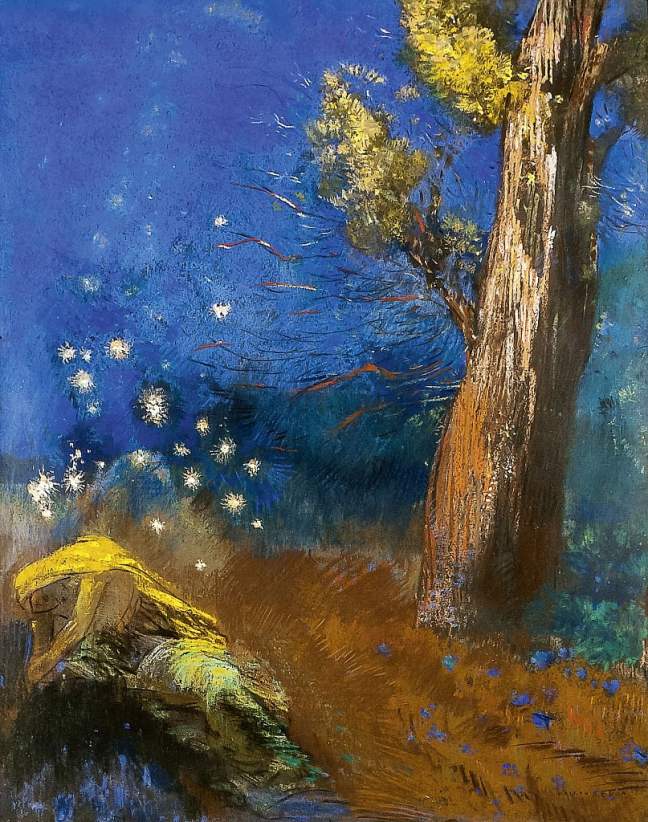
‘The Death of Buddha’ – Odilon Redon, circa 1899 – Wikimedia

It is striking to think that the day when we die is always today. It is not happening tomorrow, will not take place in the future. Death is for now. This is where and when it takes place. In the present. In presence. The death of the body, its ending, may take place in the future, but is not death. It doesn’t have the implications, the magnitude of it. The death of the body is like a wave that ceases to undulate, to imagine its difference, its conflicting attributes, and finally breaks before we notice that it is not what we are, that there is here, before it, as our very making and identity, an ocean of peace. This ocean is what death is — before we imagine to be a self that thinks itself separate.

We have been moulded in and as a presence that was never born and could never die. This inability to exist or appear as something distinct, or different, is real death. This incapacity to cease or find an ending at our being, is true ending. It is a place where we can never go. This place of being has no objectivity. It is nothing that we can be or project ourself to be. It is pure being, done, final, already perfected, unattached, a free fall. It is a death so complete that it has no object. It is not the death of something, of an object, of an entity — for such death is not truly death. It is the realisation that we are not what we have believed ourself to be. That there is not here an entity, a self that could be dying, that has an existence of its own. That realisation, and above all what is left here to be and live by, truly is death. And in that death is contained, concentrated, achingly shining, the whole of life.

So death is now. It is happening now without our noticing. It is achieved — our death, the one that we fear, that we have pushed away, that we don’t want to envisage, envision, is done, gone through already. It’s a matter of noticing what is — that we are not here, that nothing was born, that it would be curious to die, that what we are has no other attributes than being. How would you put to death something that is without attributes or qualities? How would you end something that was never born? Moreover, no appearance, or thing, or body, could ever die without it being the expression or the modulation of something untouched by death. That something exists deathless is the sine qua non for the existence of death itself. That’s why life itself thrives through the exercice of death. What is deathless is our being. It is being — that which we all share in, which we call eternity, or the infinite, for it is one, and being one, it cannot be measured, qualified, or put to death. That’s how we are immortal — through only being, which we share as the experience of love. Death is when we cannot die anymore. It is obliterating objectivity — therefore our existence as an entity. An impeccable death comes at this price.

.

~~~

Text by Alain Joly

Painting by Odilon Redon (1840-1916)

~~~

.

Website:
Odilon Redon (Wikipedia)

Suggestion:
Other ‘Ways of Being’ from the blog…

.

Overflowing Questions

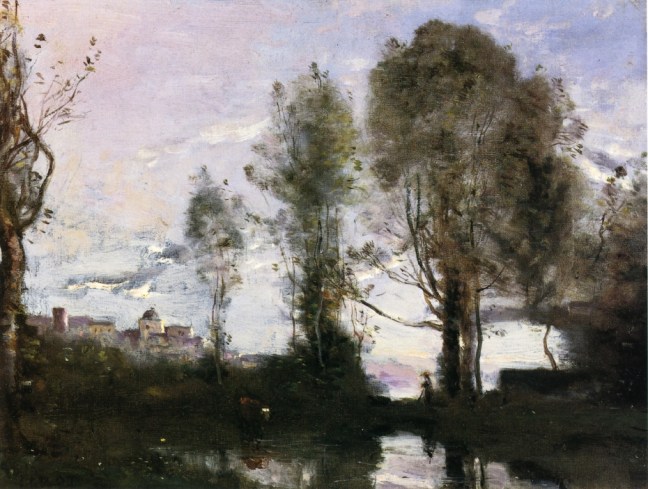
‘Edge of a Lake (Souvenir of Italy)’ – Camille Corot, c.1855-60 – WikiArt

Wouldn’t you like to have a knowledge which cannot be surpassed, which amounts to everything? That has in its core the truth of living, the philosopher’s stone from which everything springs, and to which all appearances owe their existence to? Actually, don’t you already long for it, and have done so for as long as you can remember? Is it not what you secretly hope for in your life? To have this knowledge, this direct access to the peace of your being? To have it here at hand, like a secret bond which you can find under and within every difficult situation, every outrage, every burst of suffering? And wouldn’t you love to harvest what this intimate knowledge contains? Its most reliable sense of joy, of contentment, and see yourself plentiful, complete, enough, in an absence of need? Wouldn’t that be great? To uncover it, and let it find its natural place in you, and as you, easily, without your doing very much about it? Wouldn’t that be great? Would anything be more valuable to you? Would that not be worth a life? Any life?

And what if you were told that you are not this bunch of objects which you have believed yourself to be — these endless qualifications, and the myriad of thoughts and feelings to which you have tied yourself with? Wouldn’t that give you freedom, a sense of release? To be unattached, not bound to your body-mind, at least not in a fundamental way? Wouldn’t that be healing, to be not the body but what holds it in its embrace? Wouldn’t that be soothing, to be not the mind but that which lends it the space to wander about? What is to you more elating and convincing than finding yourself naturally, effortlessly, in a place of health and vigour? The body’s ailments? The mind’s silly wanderings? Well, what if they were not really yours? Wouldn’t you like to find out, what would be their fate when left alone? What could be their trajectory when you rest peaceful in your own healthy, infinite body of awareness? Wouldn’t that be great to make this discovery? To have the final answer behind all that has been troubling you for so long?

And what if you were to uncover some even bigger findings? That behind your long, busy, eventful, suffering life, there has been a stillness, a silence which couldn’t be stirred or broken? And that nothing truly ever happened in your life? That it has been just a passing dream? What would be the implications of that ? And what if you were to find out that the world is just only clothed by the awareness of it? That it is not there in the way you had imagined so far? And that behind it all was also dawning the certainty, the knowing of your immortal, undefeatable nature? Wouldn’t that be wonderful? To see, feel, touch the truth of it with your hands, that death is a myth? That it is not there? Not in the least? Wouldn’t that be extraordinary? That things do die but not you? That body does become ashes but not you — not that which you truly are? That mind withers away but not you — not your primal being which you have to concede is eternal, is infinite? Wouldn’t that take your breath away? Wouldn’t that blow your mind?

.

~~~

Text by Alain Joly

Painting by Camille Corot (1796-1875)

~~~

.

Website:
Jean-Baptiste-Camille Corot (Wikipedia)

Suggestion:
– Other ‘Reveries’ from the blog…

.
The Price of Immortality

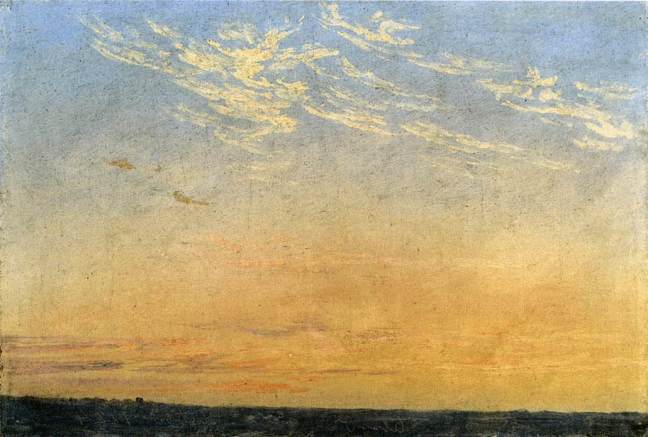
‘Evening’ – Caspar David Friedrich, 1824 – WikiArt

.

Death doth not trouble me. 
‘Tis through that door I come
Unto the place which long 
hath been my spirit’s home
.”
~ Angelus Silesius 

.

There is one thing in life that is haunting us. This is the fact of our certain death. And yet, considering that we all know that we are going to die, most people don’t actually worry that much about it. How come that people who believe that they are solely their body can stay so cool when waiting for a certain death? They should be terrified. This should come as some unbearable news. But it’s not. Even though we don’t look forward to dying, we nevertheless take the news with a remarkable composure. We don’t mind that much if you ask me. Why is that? 

Is it that we have deep down the intuition of our immortality? If I say ‘I’m going to die’, how does it feel? Am I saying the truth? Do I really know this for certain? Or am I casually repeating something that I have learned and has now become a deeply ingrained belief? But this being said, don’t let us be mistaken. Most of the time, we push death far away and numb ourself to its dreadful reality. And the fear of death is conditioning and bending our lives in the most ruthless manner. What a paradox it all is! But in that paradox lies the whole riddle of life and death, of suffering and happiness, of love and God. Death is a portal to our true nature. One that is inescapable. Who is it that is going to die? Or rather what is it? Let’s have a look at it…

[…]

An exploration of the nature and meaning of death… (READ MORE…)

..