The Odyssey

‘Odysseus questions the seer Tiresias’ – Alessandro Allori, 1580 – Wikimedia

No doubt that our life feels like an odyssey. It does for everybody. In the ancient, epic poem of Homer, the Odyssey is a journey home. It is with us too. But the fact that we are on a journey home is not always apparent. At least not to begin with. We’re too busy to see anything. We’re fighting demons. We’re full of desires, many of them, constantly assailing us. We think we’re going somewhere, without seeing very well where that is. We’re wrestling with the gods. We have many ideas, beliefs, hopes, sufferings. We feel we are a person in a world, who needs to reach a happy place that never comes. The reason is: home is within. The happy place is in ourself. It is not out there. It is in the ending of a belief, of a misunderstanding, of a bad judgement as to what we truly are. We are stuck in a place that doesn’t exist. We are stuck in a belief.

It eventually dawns on us that our happy place is where we are finally reunited with our inner peace. That’s the journey home: the journey within. But it takes a long and difficult travel of sufferings and errands to understand that there is no travelling back home outside ourself, in the diversity of the world. Home is within. Once we go within, the journey becomes shorter. The odyssey is in fact only the journey to the journey home. But to go back home implies that we were already there, and have left it at some point. So it appears that our going home, our odyssey, is an illusion of some kind. We are going in search of what we already have. We have gone on a war. For to seek what we already are is always a war. It always brings suffering, lack, and the such. It separates us from home. It multiplies monsters. That’s an easy thing to see. There is no need of a long odyssey.

We have the belief that reality is in appearances and forms, when it is in fact in the formless. We have the belief that our body-mind is our identity, when we are only contained in the infinite awareness of being. We have the belief that we need to adjust to a world that is separate from our own being, when we and the world are one being alone, perfectly adjusted to each other. We indulge in the comfort of our illusory view on existence, when this comfort is only the postponing of our journey home, and the fuelling for our own suffering. ‘There’ is our journey within — to go from an illusion to the reality hidden within the illusion. To go from what we are not to what our nature truly is — which really is only to go from what we are to what we are.

Now, if we’re struggling within, it means we are still without. We still see the within as the without. We still have monsters there, and a difficult trip to be engaged in. We’re still on an odyssey. We’re still intoxicated by the Lotus-eaters, who make us forget about our journey home. We’re still captured by the cyclops Polyphemus. Still fighting some giant cannibals; or wrestling with the goddess Circe, who turns us into what we are not. We’re still resisting the enticing song of the Sirens, who keeps us mortal beings. Still being held captive by the false promise of the nymph Kalypso who, by the way, is literally ‘she who conceals’. We’re not yet in a journey within — not yet in a journey home.

Once we have understood that our home is only within, in and as our innermost being, we must be there as a beggar. We never enter our own being, our happy place, as a king in its kingdom. We have to be a beggar, a nobody. That’s what Odysseus does when he reaches home: he comes as a beggar, unknown to all. That’s the way to be home. We leave being a person of any kind, of any rank. Then, the last fights with our few remaining demons is quickly done — not a big deal. It doesn’t take time or distance. Doesn’t take endless coming and going, reaching and leaving, being on the journey. Home is home. We cannot go where we are. Home is an easy place to be in. That’s where we have seemingly started, and find ourself naturally in.

In our own Odyssey, there is always a twist at the end. In fact, we realise that there was no danger or difficulty, no storms or monsters, no length of time, no far-off countries. We had been on a quiet, mirror-like mountain lake all along — just didn’t notice it. The whole story was invented. Beautiful, exciting, painful, maybe necessary, but invented.

.

~~~

Text by Alain Joly

Painting by Alessandro Allori (1535-1607)

~~~

.

Website:
– Alessandro Allori (Wikipedia)

Suggestion:
– Other ‘Reveries’ from the blog…

Our Last Delusion

‘Løvsprett’ – Frits Thaulow, 1889 – Wikimedia

You won’t see a world outside the confines of the mind. The world is not there as an ultimate reality. It draws its many shapes out of the limitations of mind. It is sculpted by our senses. Thoughts are giving it its colour, shaping it for the purpose of a self. We blame it for our suffering, or praise it for our happiness. But its existence is a passing, illusory one, as it is for all thoughts, and for the body.

Although we as a body live in a world of limitation and finiteness, we in truth have our stand and our anchor in the deeper, conscious reality of our own undefeatable, limitless being. Happiness in the world never comes from experiencing the world. It comes from beyond the senses, beyond experience. It comes from beauty, which is the nature of the world when it is experienced from that part of ourself that is infinite.

Contentment in our mind is not given by our thoughts and our many feelings, but through experiencing them from the peaceful nature of our deepest reality as being. To live in the world is to be lost and to know suffering, but to have the world living within ourself is to know a joy that is free and independent from the ruthlessly changing nature of experience.

So free yourself from the world; it is not where you live. Rather, have the world close to your being, and see its nature as your own. This is the way to live in the world. See that it is still of the nature of mind. That it doesn’t own its own reality, but borrows it from the infinite, from the limitless, which is the nature of yourself as being.

So everything you seemingly do, you in fact never do. What you think you are, you are not. We live in a world of imagination. In fact, we only ever live in and as a reality that is shared, and that is our very nature. There, in that reality, is found the reality of our body-mind-world. This reality is the nature of everything and everyone we encounter in experience. It is our real world, our only home.

The impression that we live in a world that has its own reality is created, believed. The belief in being a body has created the world, has made it sprout out of a duality that we have ourself made up and manipulated. Outside this belief, everything re-enters the place it has never left, and the oneness it has never been separated from: infinite, eternal, seamless being.

This reality is what there only and ever is. Nothing exists beyond it, whether it is a world, a body, or a mind. To live as a body-mind in the world is to feel separate from it. It is to see ourself as a self. It is to have the arrogance of being our own self, and to see the world and circumstances as the provider of happiness. This is why we always look for contentment, security, stability, constancy. We mimic what we are before we actually know it.

And enlightenment is sill part of the world, still part of a belief. Its reality is invented, created for the sake of a self or an ego. Enlightenment is not about being enlightened. There is no such a thing as enlightenment, unless you want to cling to the reality of yourself as a body-mind. The belief in enlightenment is our last, ultimate delusion. It belongs to a non existent world, to a non existent self.

You have been the light of yourself — of selfless being — all along, but have played within the illusion of a world and a self, therefore concealing your own reality within that illusion. Re-assign yourself to your true nature. Then it doesn’t matter what you experience. It is not in what you experience — it is in what you are. It is all there. Nothing and no one exists beyond it. You have no use of enlightenment.

.

~~~

Text by Alain Joly

Painting by Frits Thaulow (1847-1906)

~~~

.

Website:
– Frits Thaulow (Wikipedia)

Suggestion:
– Other ‘Reveries’ from the blog…

Love Actually

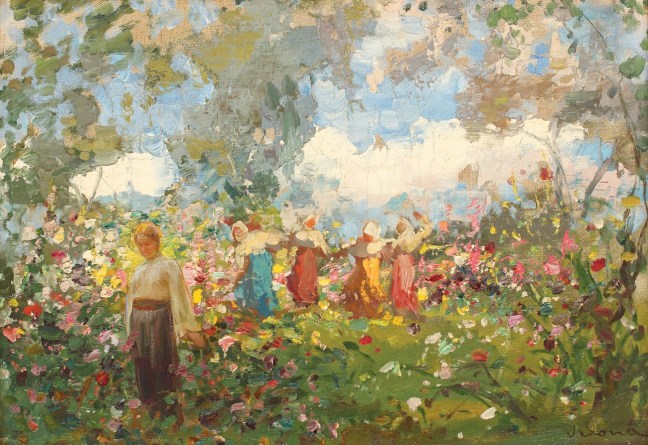
‘Sarbatoarea primaverii’ – Arthur Verona – Wikimedia

Love is the essence of everything, and our very nature. Because we don’t live separate and afar. We are not distant from each other. Nothing is. We have a natural intimacy with everything and everyone. This is not a theory, or a philosophical argument that we posit. This intimacy is our deepest reality, what we are, the property of our natural being, which we can feel, see, experience, but whose evidence has disappeared from our eyes. The reason is, we have preferred a theory to the reality, an illusion to the truth. Our life has stopped being natural. We have been faking it, living it according to beliefs, habits, conformity. But here, blatant in and as our very being, is a reality in which there is no time or place, no distance or separation, no otherness. And as we all know from experience, love is the abolition of time, of distance. Love is the end of separation, of otherness.

Love, which we may call beauty, for everything that we love is beautiful. Love, which we may call understanding, for to see love as the essence of life is the ultimate form of understanding. Love is to ‘stand in the midst of’. It is to stand with everything that is under, everything that is existing in our reality. It is to be connected, to be together with, to be of the same essence. So love is an expression of oneness, of our nature as the one and only reality there is. In the absence of separation — which is truth — we find love. In the absence of otherness — which is our reality — we find intimacy. We make love every time we are aware of our reality as only being. We manufacture love when time is discovered to be an idea, and separation a belief. To be in love is to realise our nature as being one with everything and everyone. It is to be unable to part with anything. It is humility at work. It is where division is only possible in a figment of our imagination. It is to be with what is, with no pulsion of escape or resistance. Love is both in the ache of separation and in the desire to be reunited. All seeking is done in the name of love.

To love is to stand in the midst of, to see no separation between an ‘I’ and a ‘he’ or a ‘she or a ‘it’. The more we stand as the quality of being aware, as that which knows all things, the more we have love as our daily companion. It is extraordinary that we can feel to be a body and a mind, when there is before these, in the subjective, the vast and unmissable expanse of that which is aware of them, which we have pushed away as a mere function of that body-mind. The body is something that we are aware of. We are not in the body. We are in the ‘aware of’. This being aware is our home, where we live, where we have our life. This is our placeless place. That which we cannot not be in. That which we cannot part from — our most intimate, unchanging identity. To be that knowingly, to live as that, is to love naturally and unconditionally. Every time we notice that there is a reality, a consciousness, a knowing presence before our body, thoughts, feelings, experience, world, then love appears to be the very material we and the world are made of. The first and last brick of our house. Our everything.

.

~~~

Text by Alain Joly

Painting by Arthur Verona (1868-1946)

~~~

.

Website:
Arthur Verona

Suggestion:
– Other ‘Reveries’ from the blog…

.
God’s Knowledge

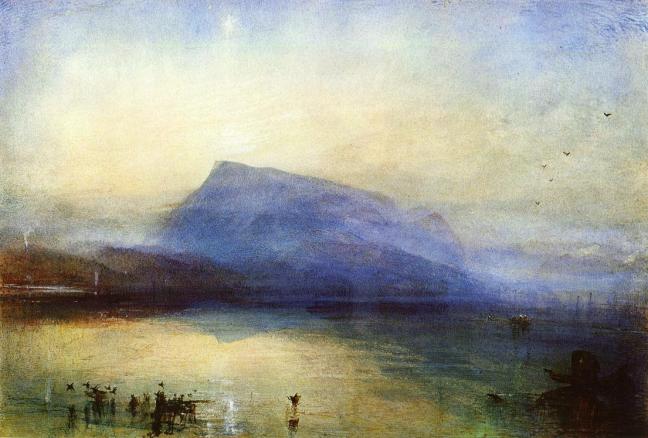
‘The Blue Rigi Lake of Lucerne Sunrise’ – J. M. W.  Turner, 1842 – WikiArt

We know so many things. Everything is based on knowledge, and maybe that’s the way to live, as long as there is a body and a world. Knowledge is the score we need to play our part. But to know something, anything, seems presumptuous. It implies another kind of knowledge — that there is somebody here, a person at a distance, that knows and is a recipient of knowledge. Knowledge fixes us. It gives us a dubious identity — that I am a man or a woman, of a certain age, with certain qualities, and with a whole lot of knowledge, identities, beliefs. That I am unhappy, clever, stupid, happy. That I am a cook, or a carpenter. That there is a chair, a world. That I have skills and preferences. I even have the knowledge of my spiritual attainment.

But there is no knowing anything. To think we know something is a mistake. If we know something, then we haven’t looked well enough. We have stayed at the surface of our illusory world and existence. What we ought to know is the knowledge of our reality, of ourself. That’s the only knowing there is. That’s our world: Knowing. Being aware. All other knowledge is superfluous, is not real knowledge. For what would any such knowledge be, when we discover that there is no entity here with the capacity to possess that knowledge. Go only for the knowing of being, a knowledge which is owned by itself. Notice that you don’t know anything — that’s important to know. We have no knowledge other than the knowledge of our being. Apart from that, everything exists only as in a dream.

We may play the part of the one in the dream, and that’s a beautiful part. There may be a world here that is gorgeous, with many ‘things’ that are known. There may be relationships that have meanings. But this world of things borrows its beauty and making from the reality in which it exists for a time — knowing. And the meaning of relationship is found through its reality, which is love — shared being. Everything happy and true in our life is borrowed from our reality as awareness — the only knowledge there is. If we live or act while ignoring that one knowledge, the world and ourself will appear ridden with conflict and suffering. So notice that the ten thousand things of life — all our knowledge — are transparent, ephemeral, ethereal. What is here massive and solid is their reality as being — the supreme essence of everyone and everything. The truth we live in. Ourself. What is. Not somebody that knows.

There is no other real knowing than the knowing of our essence, of our true nature or identity. This knowledge of ourself is not something we can possess as a person. It is nothing more than pure, objectless, impersonal knowing, and this knowing is all there is, all we are. Everything, everyone, have died in it. That’s why we cannot know anything, for how could we know something without there being first a knower and things with their own reality. The only thing we in fact truly know is ourself, our essence. Our knowledge of anything has died inside pure knowing long ago. It is still available, but its reality is apparent. That’s why we can never be sure that there is a chair, or a world. That’s why every object passes, is not there, is only an appearance.

Even ourself cannot be known objectively. We are alone. Nobody knows us. We as a person are absent. We don’t have a reality as an entity, or a self of any kind. So we are known by God alone, who knows us by knowing Its own being. We are all in the knowledge of God. What follows after the sentence ‘we don’t know anything’ is ‘the only knowledge there is is God’s knowledge’. Or ‘know God, love god, and you will know what you ought to know’. It all boils down to ‘knowing, knowing knowing’. Paul said it all very clearly in the First Epistle to the Corinthians: “If anyone thinks that he knows anything, he doesn’t yet know as he ought to know. But anyone who loves God is known by him.” (8:2-3).

.

~~~

Text by Alain Joly

Painting by J. M. W. Turner (1775-1851)

~~~

.

Website:
J. M. W. Turner (Wikipedia)

Suggestion:
– Other ‘Reveries’ from the blog…

.

The Immeasurable

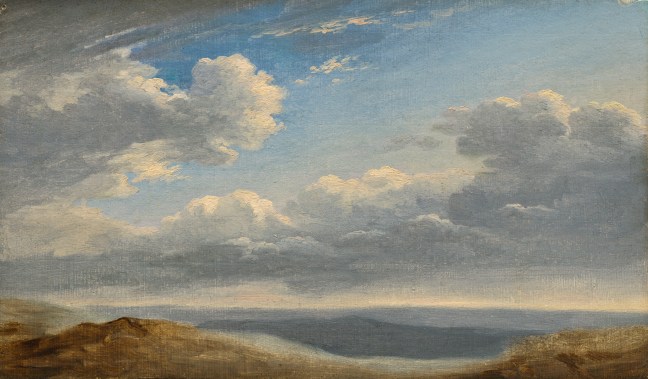
‘Study of Clouds over the Roman Campagna’ – Pierre-Henri de Valenciennes, 1782 – Wikimedia

There is a vast empty field of knowing within our experience, if we’re looking for it. It is vast not in regard to its sheer dimension, for it has none. Its vastness comes from its being without dimension, limit or edge. It is behind or before everything that we have taken to be ourself, including our body, our thoughts, our alleged self. It is here, motionless, massive, lending its very essence to everyone and everything. It’s easy to miss it, for it has not the objective quality that everything has in experience. We live in a field of objects that we can see, hear, touch, measure, be aware of. We are so fond of them that we have made ourself an object too, pretending to be our body, our mind, our thoughts. We have such a fascination for objects that we have become blind to that which holds them, and pervades everything. We are blind to our own essence, to our vastness, limitlessness — to that which makes objects experienced.

The consistency of objects around us has only the consistency of that which is aware of them. Objects do not own their own private essence, and neither do we. They find their essence and habitation in that which knows them. So we live in a world that is not defined by its edges, its limits. We should always understand that we live in vastness. That our world is empty of its own essence, and is only the expression of our being aware of it. It will never have another substance than the substance of knowing. So we live in emptiness, in infinity. The body may have its limits and constraints, but we do not.

We are devoid of what binds and limits our body-mind-world. So we should live our life as if there were around us only an empty knowing. Try it, to live as if unconstrained, unlimited, expanded. See that this is the truth of your being, this being not limited by time or place, this being free. Don’t engage your thoughts as if they were objects, but see them as an emanation of the silence they are made of. Thoughts are variations of silence. They are silence’s oscillations. If we are unaware of that silence, thoughts will come to veil it. If we see silence as our own nature, they will be messengers of its eloquent wisdom.

So the reality of thoughts is only the reality of the silence that holds them. Just as objects have only the reality of the knowing that knows them. And just as we ourself have only the reality of our nature as pure knowing — not as a body, nor as a mind, nor as anything limited. Limitation too is borrowed from the infinity that holds it and allows it, as eternity holds time. Where would an idea of time be, if it wasn’t within the eternity out of which it can be divided in past, present, future? Where would an idea of place be, if it wasn’t in the very infinity that permits it to exist? The structure of time and space is only for the convenience of a body and mind. We ourself have no such convenience, no such limits.

The world has beauty for it borrows its essence from the beauty and purity of that which holds it, and builds its form and structure with bricks after bricks of empty being. Emptiness is the body of this world of beings and things, which it moulds or shapes with its creative fullness. For emptiness can only exist in the fullness of being. We are only because of our being ‘being’. We are full of our own being, which is revealed as the being of everyone and everything. So there is in ourself and of ourself only an immensity. We are immense when we cannot be measured or limited in any way by our thoughts, body, or self. If we notice that this is so, that we are made of that immensity, that we are immeasurable, then we will lend to the world that same immensity of ourself, and we will notice between everyone and everything an impenetrable likeness. This likeness is born of the oneness that is the secret core of everything, and of all apparent multitude.

.

~~~

Text by Alain Joly

Painting by Pierre-Henri de Valenciennes (1750-1819)

~~~

.

Website:
Pierre-Henri de Valenciennes (Wikipedia)

Suggestion:
– Other ‘Reveries’ from the blog…

.
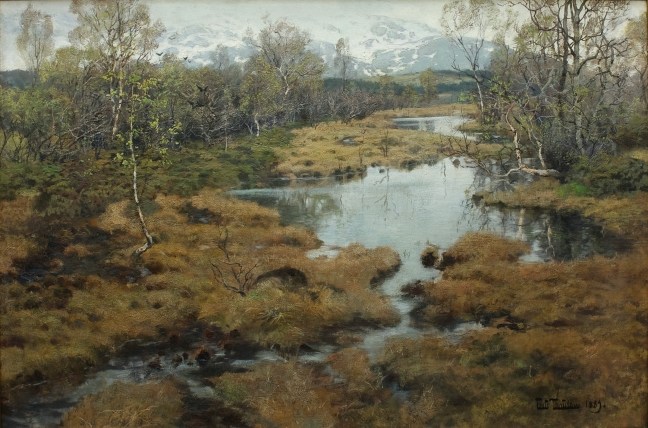
Our Sole Horizon

‘The Forest Distant Views’ – Ivan Shishkin, 1884 – WikiArt

The key in spiritual matters, is that we have to keep it very simple. We must not blow it out of proportion, exaggerate it, make a conundrum out of it. It is just a matter of looking, of breaking a little, stubborn habit. Nothing extraordinary. We keep looking away from our own being. We act as if we knew all about who we are, as if it were understood, that we are our body, that we are these thoughts that keep coming, which we judge, influence, direct according to what other thoughts say. We live in a little corner of ourself, feeling like a little king in our kingdom. We are so used to our own ways, to our concepts and explanations, to our beliefs and repetitive actions, that we have taken for granted to be just a person in a world. That’s what we were taught. That’s what we were conditioned to think. In fact, we are only followers. We play small. We are protecting our own establishment.

But we know more than that. In fact, we are all experts at being, without our realising. We are masters of freedom. We know that with just a little looking, a little asking, we could rock our lifeboat. We could make our life sensational, attractive, happy, tranquil. We have that hint in ourself, otherwise we wouldn’t be seeking, or working for happiness, improvement, progress, with such undeterred faith. We know that in spite of everything, the world has magic, and our life keeps inside it secrets of glory. That’s how we can face unspeakable suffering, trauma, violence, and the looming threat of death. Because we have in ourself the warmth and security of being, which we try to reenact in every possible and unreasonable ways, in our pleasures and our hopes, in our beliefs and our addictions.

The problem is that we have put a belief in front of what is. We have invented a self where there is only the wide expanse of being. Our whole identity is in being. We have no space to be anything else than being. Our whole life is being. Our body doesn’t even come close to being what we are, and neither does our mind. Being as consciousness takes it all, the whole of what we are, and of what everything is. Every appearance finds its essence in it, and lives in the gorgeous space it provides. We have all our senses embedded in being, and the world finds its reality in the reality of being. Consciousness has it all. It is all we will ever find. All that ever is. It may hide from our gaze, that being is our only landscape, our sole horizon, but it shows blatantly in every corner of experience, if we are willing to look.

In fact, it is so much here, so reachable, so knowable, that we are blind to it, unable to know it. That’s because we have attached ourself to another pseudo reality inside our own reality of being. We have chosen the lie of being somebody over the truth of being only being. We have chosen to be something, a body, a thought, an idea, a self, and have as a result lost, forgotten, limited the infinity of being, that is pervading our life to the point of being the only thing in presence. The truth is that we can never be something other than being. It’s a nice try to believe it, but it won’t happen, to be a suffering self, a limited body, and a mind with its own separate agenda. Everything that we think we are, we are not. We have to distance ourself from every qualification, from every belief, from every identity. We have to be naked of every addition to being in order to see our naked being, and to be in its gorgeous grip.

.

~~~

Text by Alain Joly

Painting by Ivan Shishkin (1832-1898)

~~~

..

Website:
Ivan Shishkin (Wikipedia)

Suggestion:
Other ‘Ways of Being’ from the blog…

.

Not A Thing

‘Seascape’ – Théodore Rousseau, 1831 – WikiArt

Although we feel to be inside the world, there is an identity in us that is not of the world. Rather the world is in that identity. The world — everything — has been made the likeness of ourself, should ourself be seen not as a thing, but as that which could never be made into a form of any kind. That’s how and when you know who you are, when you are not a thing, not an entity, not anything that can be named or qualified. There is not a thing here that you can be. We have inherited this habit, this insistence in being something. So we have pinpointed ourself and have given it a substance of its own. In this trying to be something, we have been rendered suffering adults, drenched in belief and habit, in fear and hope, addicted to security. We have lost our childhood, what is here before every qualification, and that we only worship remotely, as something precious and lost — our innocence, the playfulness contained in living, the not knowing, the absence of urge, the sense of awe, the leisure contained in plainly and simply being.

So be like a child, who has it all. Be like before every incarnation that you have been forced to identify with, in order to fit in, to feel aggrandised. Our urge to be something has deprived us from our being sufficient, fulfilled in and as our own being. By adding to being, we have lost what gave us our true essence, our identity, our security. It all came from that acquired, mindlessly rehearsed, and deeply ingrained belief that we are not enough, that we are separate, that we have to achieve, progress, be competent. There is no joy in fitting, in being proper. There is no competence involved in being who you are. Any child knows it. Babies are masters in knowing being. We’re just the bragging ones, the ones who have made life a travail, an ordeal, for silly reasons of being something. We spend all our precious time in alleviating the suffering and inadequacy we have ourself created.

There is no suffering in being. We should have left it there, when we were only being, contented in our own presence, before the thought arose that there had to be more and better than just being. The thought of it has made a mess. Now we are in the world rather than the world is inside us. Now we are something or someone, rather that being nothing that can be named, objectified, personalised, belittled or limited. Now we have created travail and conflict rather than staying quietly in the joy and peace contained in being only being. Now we are isolated beings rather than all gathered in our one shared being. Now we are many, divided, scattered, broken up, instead of being one before oneness itself, which is like being the one child of God’s undivided, unbroken, one being. This not being something is not a posture of the mind. It is the noticing of our true nature, of what is here in and as ourself that could never be made something. Our sense of being imperfect, isolated beings is born of a simple lack of attention. We have not seen the obvious. That we are the unborn, the infinite, the ‘not a thing’, and that as that, we hold in one single embrace everything that can be named and exists in time and place, everything that can be given a birth and a death, and that is now like the One inside the One. 

.

~~~

Text by Alain Joly

Painting by Théodore Rousseau (1812-1867)

~~~

.

Website:
Théodore Rousseau (Wikipedia)

Suggestion:
Other ‘Ways of Being’ from the blog…

.