A Manual for Happiness

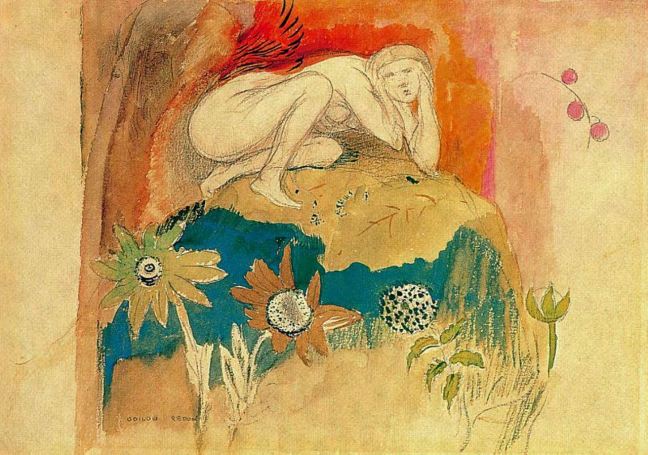
‘Field of Poppies’ – Claude Monet, 1873 – WikiArt

We can’t get hold of happiness so easily. It is elusive, coming at odd times, sneaking in surreptitiously without our noticing. When we know it, it had already been there for a while, although we realise it only now — its quiet presence — a thing that seems to come from eternity, and that we could live with for ever. It doesn’t have the crude expression of a boastful, egoistic eruption of joy, or the bourgeois, replete manifestation of satisfaction. Happiness is more charming, something rare, valuable, that comes uninvited, on a propitious moment. By the way, this is the etymology of ‘happy’: ‘hap-‘, which means ‘lucky’, ‘good fortune’. Happiness seems to come by chance, ‘falling’ on us, as the Latin ‘cadere’ for ‘chance’ conveys. There is an exception though, in Welsh, where the word ‘happy’ had once the meaning of ‘wise’. Maybe after all, being happy is not a matter of chance. Maybe it better comes with some understanding and wisdom.

So what is this chance, or this bit of luck that comes propitiously for happiness to appear? Maybe our good fortune is simply in what is present now, shining beyond any shadow of doubt. Being happy is when we have the good fortune to let ‘what is’ be, occur, without any interference. Being happy is when we let ourself plainly be. This allowing may be the best manual for happiness. And this has nothing to do with a person or entity being happy. Happiness doesn’t belong to us personally. It is not in the obtention of something we desire, but rather thrives in times of desirelessness. Happiness is a detachment. It is a permission. It is a confrontation with truth, and therefore the abandonment or removal of our idea of being a person. There, in that removal of oneself, is the advent of truth or reality, and the blooming of happiness. Truth, having no perturbation in itself, no friction, no contradiction, no lie, or illusion, or pretence, is manifesting its pure joy of being just as it is. Happiness is a manifestation of truth. An indication of presence. The bubbles of being that come at the surface with a fizzing sound of well-being.

Happiness doesn’t happen to us. It is in the air, in the essence of everything, in what makes us intimately. It is indivisible from who we are when we have removed this block of beliefs, concepts, certainties and doubts, that constitutes our alleged self, with its regiment of hopes, regrets, and resistances. Happiness has no relationship whatsoever to our body and mind, but they will find a great relaxation in experiencing its echo. Thoughts will rarify accordingly. Of course there may be an appropriation of happiness by the so-called person we have convinced ourself to be. The mind recuperates it to its advantage. The self is using this timeless moment to boast itself up. It objectifies happiness and reduces it to being simply an emotion — the equal of fear, or anger. It reduces happiness down to a form of tension that consolidates its belief in being a person, a body-object that is the only subject of its life.

In contrast to happiness, suffering belongs to us, and so do fear, anger, hatred, which are all tensions coming from a misappropriation or misapprehension of life — a violation of truth. We are mistaking ourself for what we are not. We are resisting what is with what is not. And it generates all manners of conflict and discomfort. But if we don’t react; if we let ourself feel this pure, unattached inner being, and don’t leave it, don’t conceptualise it, don’t distance ourself from it for a refuge in the comfort of our body-mind. If we stay there, in the subtle identity of our most intimate self. If we rest still and in complete harmony with our purest sense of being. If we stay humble, and enjoy the delicacy contained in just being, for no reason other than simply being. If we enclose ourself within it, and let ourself be permeated by its most subtle essence. If we feel it to be our lifeblood, and let our old sense of self be seized, or snatched away by it. If we don’t resist in any way, including through our appropriation of happiness, which is a subtle form of resistance. Then… Then happiness is revealed as just the ease of being — what comes naturally when we connect to the truth of our deepest self. It is then what we could call, our good fortune.

.

~~~

Text by Alain Joly

Painting by Claude Monet (1840-1926)

~~~

.

Website:
Claude Monet (Wikipedia)

Suggestion:
– Other ‘Reveries’ from the blog…

.

A Virtue of Old

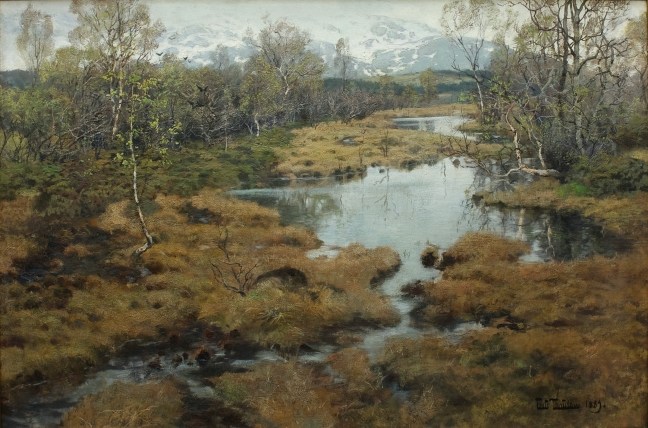
‘Portrait of an old man’ – Paul Cézanne, 1868 – WikiArt

Od age and ailments have an astonishing virtue. They teach us that our body and our mind have a weak reality, that they soften, do not last, crumble. They are like everything else. Their reality is passing, illusory, and ours is not what we have taken it to be. For we notice that as our body weakens, falls apart, we do not with it. We stay as strong as ever. We shine as something else. Not a body. Not a mind. Not an apparent self. But spirit. Our spirit strengthens. Our presence widens — if we care to look at all, to be aware, to not attach ourself to a dying object, to a withering skill. If we stay as our solid being, as that which we haven’t been attentive to so far, for reason of an irrational and obstinate fascination for our body-mind-experience, and our puny self.

So when these, that didn’t have a true reality, go; when these, that didn’t stand the mark of eternity, wither; then our fascination shifts for that which cannot go, wither, or crumble. For what stays massively behind. This reality of ourself hits us in the face — what we are, what we were even when we weren’t looking, weren’t interested, had our life within the limitations of our body-mind. Then it comes soothing us, telling us of our nature, of our grandeur. Then, what falls apart is not just our body or our skills, but also our beliefs about our mistaken reality. Our error as to what our nature is. Now we have a conversation with the infinite, and a rising love affair with the eternal. Now we have a compassion for what we believed ourself to be — body, mind, self, skill, experience — and that now have the humility to show their frail existence. Now we stop minding so much about them, and we find the peace that it is to do so.

So where do we choose to go when we cannot go anywhere, when places become fewer, when time stops being a promise, when circumstances lessen? Where is this place that our body cannot take us to, and that comprehends all that we as a body were chasing relentlessly? What is it that our thoughts cannot give us, and that we now find is here behind and before every thought, every belief, hope, or fantasy? There is a sumptuous gift behind every body or mind that loses grip on the objective world. There is a treasure in the quiet home of our self, when we are asked to stop seeking our happy self in a thousand places, practices, or experiences.

There comes a time when we cannot chase our preferences anymore. When we have to leave behind our dearest experiences. When we have no more time to become, attain, grasp that which we want to grasp, attain, become. But there is offered a time for letting go, for a sweet abandon, for uncovering that which in us can never wither, weaken, age, crumble, suffer any kind of ailment. There is a place which holds the whole world in its loving heart, and this place of love is ourself when we have renounced to find it within time, place, or circumstance. There is a virtue in not expecting from body, mind, world, experience, what they can never give us. There is a virtue in resting where we are, where we swallow body, mind, world in an instant, and are free in spite of circumstances.

.

~~~

Text by Alain Joly

Painting by Paul Cézanne (1839-1906)

~~~

.

Website:
Paul Cézanne (Wikipedia)

Suggestion:
Other ‘Ways of Being’ from the blog…

.
Our Sole Horizon

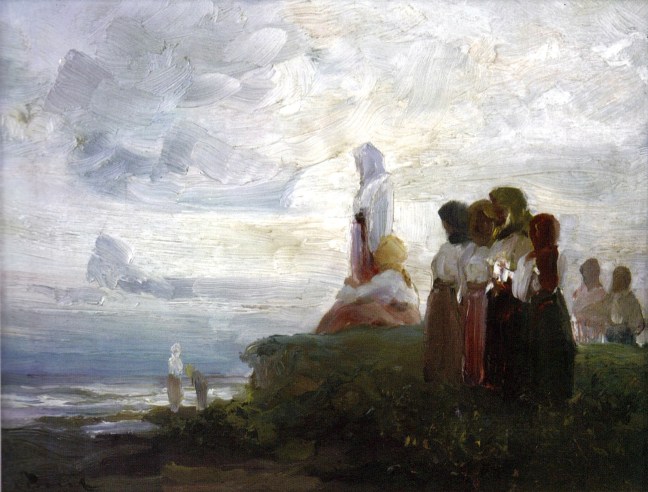
‘The Forest Distant Views’ – Ivan Shishkin, 1884 – WikiArt

The key in spiritual matters, is that we have to keep it very simple. We must not blow it out of proportion, exaggerate it, make a conundrum out of it. It is just a matter of looking, of breaking a little, stubborn habit. Nothing extraordinary. We keep looking away from our own being. We act as if we knew all about who we are, as if it were understood, that we are our body, that we are these thoughts that keep coming, which we judge, influence, direct according to what other thoughts say. We live in a little corner of ourself, feeling like a little king in our kingdom. We are so used to our own ways, to our concepts and explanations, to our beliefs and repetitive actions, that we have taken for granted to be just a person in a world. That’s what we were taught. That’s what we were conditioned to think. In fact, we are only followers. We play small. We are protecting our own establishment.

But we know more than that. In fact, we are all experts at being, without our realising. We are masters of freedom. We know that with just a little looking, a little asking, we could rock our lifeboat. We could make our life sensational, attractive, happy, tranquil. We have that hint in ourself, otherwise we wouldn’t be seeking, or working for happiness, improvement, progress, with such undeterred faith. We know that in spite of everything, the world has magic, and our life keeps inside it secrets of glory. That’s how we can face unspeakable suffering, trauma, violence, and the looming threat of death. Because we have in ourself the warmth and security of being, which we try to reenact in every possible and unreasonable ways, in our pleasures and our hopes, in our beliefs and our addictions.

The problem is that we have put a belief in front of what is. We have invented a self where there is only the wide expanse of being. Our whole identity is in being. We have no space to be anything else than being. Our whole life is being. Our body doesn’t even come close to being what we are, and neither does our mind. Being as consciousness takes it all, the whole of what we are, and of what everything is. Every appearance finds its essence in it, and lives in the gorgeous space it provides. We have all our senses embedded in being, and the world finds its reality in the reality of being. Consciousness has it all. It is all we will ever find. All that ever is. It may hide from our gaze, that being is our only landscape, our sole horizon, but it shows blatantly in every corner of experience, if we are willing to look.

In fact, it is so much here, so reachable, so knowable, that we are blind to it, unable to know it. That’s because we have attached ourself to another pseudo reality inside our own reality of being. We have chosen the lie of being somebody over the truth of being only being. We have chosen to be something, a body, a thought, an idea, a self, and have as a result lost, forgotten, limited the infinity of being, that is pervading our life to the point of being the only thing in presence. The truth is that we can never be something other than being. It’s a nice try to believe it, but it won’t happen, to be a suffering self, a limited body, and a mind with its own separate agenda. Everything that we think we are, we are not. We have to distance ourself from every qualification, from every belief, from every identity. We have to be naked of every addition to being in order to see our naked being, and to be in its gorgeous grip.

.

~~~

Text by Alain Joly

Painting by Ivan Shishkin (1832-1898)

~~~

..

Website:
Ivan Shishkin (Wikipedia)

Suggestion:
Other ‘Ways of Being’ from the blog…

.
Lightness On End

Angel of Light’ – Salvador Dali, 1960 – WikiArt

I can be me forever
There is no limit to being myself
I don’t have a home in a body
In the limitations contained
In a mind.

I don’t want to refer to anything
In order to describe myself, I can describe
My body, my thoughts or my actions
My hopes and my desires
But not myself.

Myself is for the infinite
I am not to be squeezed by words
Not to be qualified or situated
I won’t appear in the world
Of appearances.

Rather all things find a home
In my infinite embrace
So I am a universal home
I am a shelter for everything
That is finite.

I am not to be divided, I cannot be
disunited, driven apart, isolated,
Alienated — my fate is to be whole
My destiny is to have peace
As my horizon.

I cannot be suffering
For suffering knows boundaries
Is born of the finite; I know only
An expanse without end — definition
Of happiness.

How could one-you-I
Bear the infinite
Or find it has a weight
The infinite is for being,
It is for lightness on end. 

.

~~~

Text by Alain Joly

Painting by Salvador Dalí (1904-1989)

~~~

.

Website:
Salvador Dalí (Wikipedia)

Suggestion:
Voices from Silence (other poems from the blog)

.

The Treasure Within

‘Morning mist in the mountains’ – Caspar David Friedrich, 1808 – WikiArt

There is something in us, a presence, a feeling of being, that can say I Am. Nothing else can. No body can. For how could a body say I Am, which is but a bundle of tissues, a physical structure that can only be seen as an object, at a distance. That which is at a distance cannot say I Am. I Am is for the innermost of your being, for what is here beyond a shadow of doubt, in you, as you, indissociable of yourself. Feel that I Am is for that which never moves, is never tired or sick, is never concerned by age, or beliefs, or any passing content of the mind. Go for what in yourself is indestructible, constant, that could never be hurt, and notice that that is the thing which is necessary, responsible for your being able to say I Am. I Am is your anchor, the lighthouse you must never depart from. If you do, you will be plagued with suffering and grab the first thing you could identify with, amongst others your body, and your mind content. Thought is a good client for providing you with a fake identity. It mimics a self to perfection where there is none, where there is only here a presence infinite, borderless, shared by all. Without that, no I Am would be possible. No I Am would be there, and no humans either, no beings, nothing at all, just a black, empty void.

I Am is the light that makes life possible, that renders it palpable, sensible, experienced. You could say that for an object to find its isness, its existence, there would have to be an I Am first, there would have to be an essence, a ground that gives all things and all beings their shape, length, width, and existence. This essence is that without which there’d be no you, no possibility to say I Am. That without which there’d be no support for your thoughts. That without which your body could not in a zillion aeons find its ground, its birth, its death, and its life and beating heart. Thought has nothing to do with your asserting I Am. It is in no way involved in it. It will try to convince you, that thought is behind it all, is the voice of your being, the one that can say I Am. The body has convincing arguments too. They two form a good pair. But don’t be deceived. These are not where you draw your sense I Am from. I Am is deeper. I Am is fundamental, not a passing thought or feeling, bound to an object, to a body. I Am embraces all things and all beings. Even the world could not be thriving and bubbling without having its grounding essence. It needs, for its rising and falling, for its being seen, heard, felt, a something that holds it and creates it, like the content of a dream needs the mind of a dreamer. The world would be at a loss without I Am.

And in fact it is: at a loss. For why do you think the world is plagued with suffering and conflict? If you ever find yourself suffering or in conflict, it is that you have lost your I Am. You have given it, bargained it to a body, or a story, or some mere random thoughts. You have exchanged it for an ambition, an eagerness to be something, somebody, and to feel the reward of it. I Am is without a reward, without a body, faultless, pristine. It doesn’t know the meaning of suffering, or conflict, or confusion. So keep it always close to you, don’t lose its splendid gaze. For your body, mind, and random thoughts are all craving to take on the role of a self and blind you, conceal in the process your gorgeous, inborn, god given identity. They’ll happily send I Am to the wrong place, to keep it unnoticed, forgotten. But I Am is always here, like a patient presence, holding even your ignorance in its benevolent hands. It will wait for your looking, your noticing, the better days of your realising who you are, that is found here nestled within I Am. You owe I Am everything, right to your feeling of being, behind the mere words.

For there is a Word behind the words, which I Am is the pointer to. A living, pulsating reality. Call it being, call it god, call it Word. We have made I Am into a mere body, a limited self, and have therefore compelled ourself to look outside for our peace and completeness. The seeking for our lost completeness is what is called suffering. But the way to overcome suffering and conflict in our lives lies within, in our very being, in what is hidden in plain sight every time we say I Am. A human being can never have its private sense of I Am, for being is shared in equal measure by all beings and things. It is boundless and has within it the peace and completeness that you had been looking for without, as a result of your misplacing I Am. I Am owns its peace and completeness through its being alone, whole, One, and therefore unable to be parted, or lost, or forgotten. So have a good look every time you say simply I Am, and recognise it for what it is, and not what you believe it is. Don’t limit I Am to a projected, illusory, made up entity. I Am is the gorgeously carved door to your being happy and whole, and to have the world reflecting that wholeness and happiness. It is your treasure within, that you have ignored, or misused. So repair the sense I Am in yourself, and give it back to its original, initial, pristine glory and undefeatable reality.

.

~~~

Text by Alain Joly

Painting by Caspar David Friedrich (1774-1840)

~~~

.

Website:
Caspar David Friedrich (Wikipedia)

Suggestion:
– Other ‘Reveries’ from the blog…

.

A Ceremony for Peace

– ‘Full Moon’ – Andrew Wyeth, 1980 – WikiArt

When you have discarded everything in yourself that is not consistent, that will let you down, or change, or leave, or won’t meet your most profound aspirations, then look carefully at what is left behind, that could never let you down, or change, or leave. What is here no matter what, beyond expectations, beyond the agitation of the mind, and your fascination for experience. What is here that cannot be attained, or obtained, for you can only obtain what you don’t already have. Look at that. Look at what is left in you, as you, that cannot be manipulated or bargained for. Feel it, let it acquire prominence, allow it to reveal itself to your attention.

This is what matters: this deeper part of yourself which is untouched, pristine, unconditioned. It matters tremendously. In fact, this is what all spiritual and religious traditions have been calling you to understand or realise. But it isn’t an easy thing to see, for it blends within your experience and hides inside it. Yet, if you look with the right amount of purpose and focus, it will blow your mind as something which is filling the space as your very own identity and being, and had been here always, unnoticed, silent. Now it is revealed as the peace and happiness which you have been looking for in the content of experience, and are now blessing your heart through the simple experience of being only being, which you discover is your natural, and effortless condition.

Everybody knows that he is, or she is. It is an obvious sensation: to be. But then we forget it, take it for granted, stop paying attention. We become obsessed by everything objective, by everything in experience that we can see, hear, touch, feel. We become preoccupied, consumed, tormented by our body and mind, by our circumstances and life events, by what makes us happy or sad, by prestige, failure, pride or shame. We forget that we have left behind, now hidden in the background, one simple thing, one simple fact of living, which is the knowing of our being, this road back to our green pastures, that is here quietly present, every time we say ‘I Am’.

Through force of habit, we let that down, judge it irrelevant, certain that this has only a secondary importance, maybe even no importance at all, that we are, that we know our being, that we can say with certainty and absolute confidence: ‘I Am’. We fly off to dangerous countries, clinging to suffering and uncertainty, navigating between hope and disappointment, making happiness or peace a thing to obtain, gain, deserve. We’re not seeing that it is our identity, our given essence, to be contented, peaceful, creative. That we must not bypass happiness, or pass by it, through it, near it, without even a second glance. That our quiet sense of being is our chance, our remedy, our secret longing granted.

Happiness is simply the knowing of being, the shining of this simple, gorgeous sensation of our being present outside all consideration of body, mind, senses, and world. It is that simple if we are willing to look. In fact, god has placed the secret for happiness, the recipe for peace, right under our nose, on a silver plate, wrapped with a golden ribbon. We can unwrap it every time we become aware of being. Every time we slow down and rest there, in the simple, naked experience ‘I Am’. And then it opens up, it becomes evident, that peace is in being, that joy is in ‘I Am’, that life is spent here, under the gorgeous vault of simply and only being. Then being becomes a ceremony for peace, joy, or love. And then… Well then, everything is for the first time.

.

~~~

Text by Alain Joly

Painting by Andrew Wyeth (1917-2009)

~~~

.

Website:
Andrew Wyeth (Wikipedia)

Suggestion:
– Other ‘Reveries’ from the blog…

.

On Desperation

‘Jeremiah mourning over the Destruction of Jerusalem’ (part) – Rembrandt, 1630 – WikiArt

What needs to be seen and understood is that the story of humanity, the story of every life lived here under the sun, is the story of a desperation. We are fighting off the feeling that something is lacking. We want to reach or attain something, and this something that we are looking for is the same thing for everybody. Whatever form may take our life search, our drives, our dreams, our desires, our pleasures, they are all here to make us feel at peace, content, whole. They are here to free us from ourself, from our search, from our never-ending desperation. Outside, we may put on the appearance of control, normality, and responsibility, but inside we are burning, seeking, longing for that which we have never been able to put into words, explain, rationalise, or make sense of. But in fact, we are looking for something that we already possess in infinite quantity, although unknowingly. We are craving for the abundance that we already have, searching for a peace that is already given, begging for a joy that is throbbing unnoticed in the background of our everyday experience.

Our suffering or desperation is the symptom of this misunderstanding. We fail to notice that we have what we are looking for, that it is here in plain view, already achieved, already formed in and as our most intimate identity. Our self is made of that sweet fire of peace, contentment, and sufficiency. So the misery we are in is only apparent, imagined, made up by our thinking about it, and by our looking for peace unnecessarily, out there, in the wrong place, in experience. There is no amount of effort that will ever help us to attain something that is already attained. On the contrary, the disturbance involved in seeking what we have will cause us misery, in the form of a desperate, separate sense of self. We are too eager. We never sit still, always foraging our experience to harvest some scattered drops of peace or joy, when our very being is already overflowing with them.

The only necessity, or even possibility of being a self separate from experience is through managing the tension involved in seeking a peace that is already our most intimate nature. Our self is the story, the memory of this seeking. When peace is here, there is no self present, no tension that could make us a suffering entity. In fact, we seem to proceed by distraction. We are not looking, and then we complain that it is not there. All our efforts to obtain an enduring peace in our life are vain and doomed to failure for the simple reason that peace is not a thing that can be had. Peace is something that we have to realise is present here and now. It is our vey being, what we are made of, our unborn reality. So there is no real, substantial suffering here to be rid of. It is not that suffering is not experienced. It is that its only reality is only in and as our imagined self. It is but the friction that goes with believing to be a separate entity. Suffering is essentially made of our believed self, which is but our constant seeking to alleviate this apparent misery. The ending of the belief in being a self, which is also the ending of time, space, and separation, will make fully apparent our nature as peace and happiness, in which there can be no suffering, no self, no seeking, no desperation.

.

~~~

Text by Alain Joly

Painting by Rembrandt (1606-1669)

~~~

.

Website:
Rembrandt (Wikipedia)

Suggestion:
– Other ‘Reveries’ from the blog…

.