‘Who Am I?’

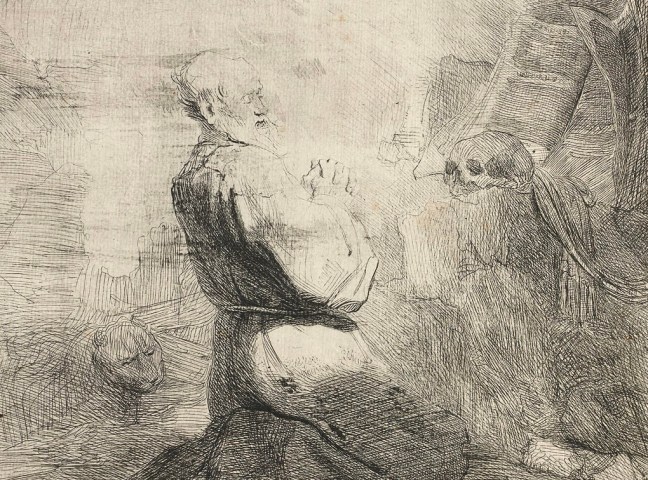
‘St. Jerome kneeling’ (detail) – Rembrandt, 1630 – WikiArt

The question of who I am is a big question. It is not being asked very often though. At least not in the way it should. We do as if. As if we all knew who we are. As if it wasn’t worth asking. As if it was a waste of time to do so. When we do ask about who we are, it is to fill ourself with objects, qualities, identities. We are gathering informations about our body, our emotions, skills, idiosyncrasies, tendencies, but not about ourself. We live as if on a racing track, never actually stopping the course of our acquired, rehearsed, believed identities. We never watch, inquire as if for the first time, as if we didn’t know. We are bragging. We don’t want to be humble, and learn about something that appears to be so simple, and goes — so we believe — without saying. But the truth is: it scares us. We are afraid to know. We have picked up, from the beginning of times, that this question is a question of immense implications. It is a deadly question. One that changes you, finishes you, shakes your very ground.

It is a question for a sacred remembering, to just notice what we already are, what is already here, but that we have been too distracted to see. It is a question to prevent us from going out all the time, from escaping ourself, to help us return to where we have always been — in the home of our inner being. It is a question for which we have to let go of our bodily refuge. A question for which we have to lose the self that has been our anchor so far. It is a question for the mind, although its answer is to be found outside every consideration of mind, thought, image, memory. It is a free fall that pushes us to look beyond our limitations, and gives us the gift of our limitlessness. It is a question with no end, not because there is no answer to it, but because the answer is a living answer, whose reality can never come to an end. It is an impossible question, for even before we have the occasion to utter it, we find it already answered through the act of our simply being.

The living answer to the question ‘Who am I?’, is ‘I Am’, which contains its own undefeatable, eternal, inescapable reality. ‘I Am’ is before the question ‘Who am I?’. ‘I Am’ is the living answer which swallows every single question on our identity. It takes us into itself, and shows our identity to be only being, a being so pure that nothing can be added to it. It is the only sacred knowledge there is, which all the words and rites of every religion have sought to deliver as the name ‘God’. A knowledge that they have failed to pass on with accuracy for going too far, and postulate outside of ourself the reality that is in fact our very own self, hiding in plain sight in and as our own aware being. So ‘Who am I?’ is a prayer that is clearing the path, recalling God in ourself in the form of ‘I Am’.

It is a question that opens the door for the peace that we have been looking for in every possible direction, except in the direction of our innermost self alone. It is a question that we ask with expectation and inquiry, and answer with the peace and joy that we find already here, beyond any expectation or understanding. It is an implicit question that we cannot help asking in the secrecy of our mind, but that we fail to form explicitly, expecting the answer to be outside our own being. It is an absolute question, that needs no other answer than going to the very aware being that initiated it, because of  its longing to be freed from everything that seems to limit it and veil it. It is our returning to what we have never ceased to be, but are failing to see for reason of looking in a thousand directions outside ourself. ‘Who am I?’ is a question that takes you to ‘I Am’, which is the only accurate description there is of our true identity. 

.

~~~

Text by Alain Joly

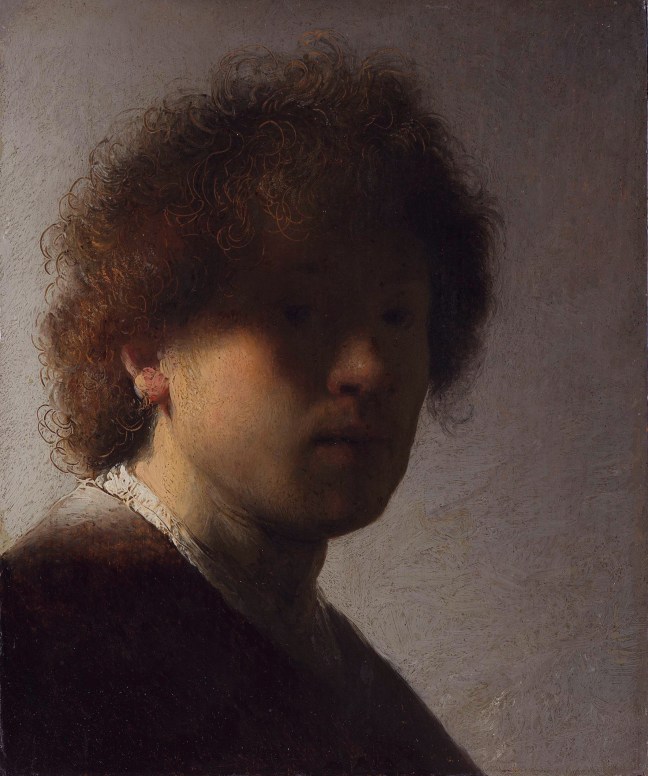
Painting by Rembrandt (1606-1669)

~~~

.

Website:
Rembrandt (Wikipedia)

Suggestion:
Other ‘Ways of Being’ from the blog…

.

On Desperation

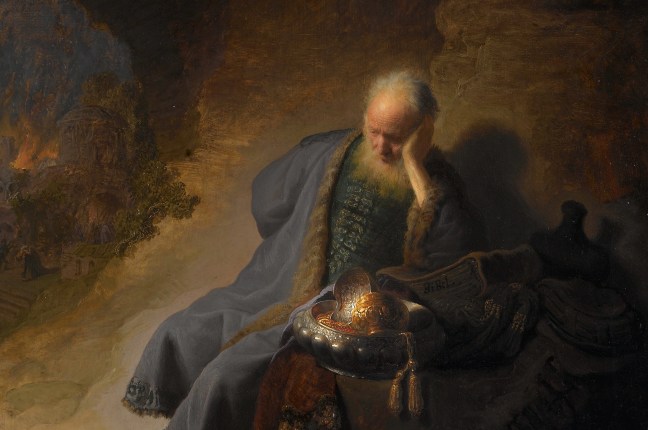
‘Jeremiah mourning over the Destruction of Jerusalem’ (part) – Rembrandt, 1630 – WikiArt

What needs to be seen and understood is that the story of humanity, the story of every life lived here under the sun, is the story of a desperation. We are fighting off the feeling that something is lacking. We want to reach or attain something, and this something that we are looking for is the same thing for everybody. Whatever form may take our life search, our drives, our dreams, our desires, our pleasures, they are all here to make us feel at peace, content, whole. They are here to free us from ourself, from our search, from our never-ending desperation. Outside, we may put on the appearance of control, normality, and responsibility, but inside we are burning, seeking, longing for that which we have never been able to put into words, explain, rationalise, or make sense of. But in fact, we are looking for something that we already possess in infinite quantity, although unknowingly. We are craving for the abundance that we already have, searching for a peace that is already given, begging for a joy that is throbbing unnoticed in the background of our everyday experience.

Our suffering or desperation is the symptom of this misunderstanding. We fail to notice that we have what we are looking for, that it is here in plain view, already achieved, already formed in and as our most intimate identity. Our self is made of that sweet fire of peace, contentment, and sufficiency. So the misery we are in is only apparent, imagined, made up by our thinking about it, and by our looking for peace unnecessarily, out there, in the wrong place, in experience. There is no amount of effort that will ever help us to attain something that is already attained. On the contrary, the disturbance involved in seeking what we have will cause us misery, in the form of a desperate, separate sense of self. We are too eager. We never sit still, always foraging our experience to harvest some scattered drops of peace or joy, when our very being is already overflowing with them.

The only necessity, or even possibility of being a self separate from experience is through managing the tension involved in seeking a peace that is already our most intimate nature. Our self is the story, the memory of this seeking. When peace is here, there is no self present, no tension that could make us a suffering entity. In fact, we seem to proceed by distraction. We are not looking, and then we complain that it is not there. All our efforts to obtain an enduring peace in our life are vain and doomed to failure for the simple reason that peace is not a thing that can be had. Peace is something that we have to realise is present here and now. It is our vey being, what we are made of, our unborn reality. So there is no real, substantial suffering here to be rid of. It is not that suffering is not experienced. It is that its only reality is only in and as our imagined self. It is but the friction that goes with believing to be a separate entity. Suffering is essentially made of our believed self, which is but our constant seeking to alleviate this apparent misery. The ending of the belief in being a self, which is also the ending of time, space, and separation, will make fully apparent our nature as peace and happiness, in which there can be no suffering, no self, no seeking, no desperation.

.

~~~

Text by Alain Joly

Painting by Rembrandt (1606-1669)

~~~

.

Website:
Rembrandt (Wikipedia)

Suggestion:
– Other ‘Reveries’ from the blog…

.
The State of Things

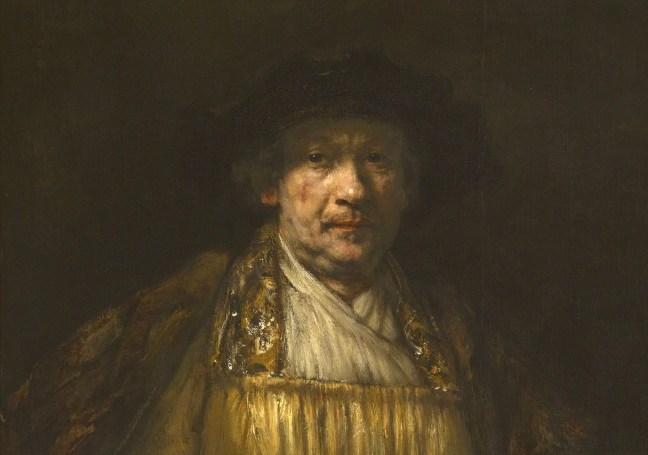
‘Self-portrait’ (detail) – Rembrandt, 1658 (Frick Collection) – WikiArt

It is crucial in life to have a clear view of the state of things. Not to be left behind with an erroneous understanding or interpretation. For there are wolves out there, that want you to go astray. They will lure you to adopt their own inherited beliefs. They will push you in the direction of your fall. So be watchful of everything you don’t fully understand.

They will want you to believe that you are surrounded by people or others. That these ‘others’ are objects of fear, pain or pleasure, that you will be drawn to either avoid or use for your own happiness. Nothing could be more remote from the truth. At no time or place will you be asked to meet anybody but yourself. Your own glorious self who happens to be also the self of all apparent others. People are but the varied and beautiful expressions of the one being that stands as your being too. In consequence, they will become colleagues, partners, sharers of that same one being, and therefore beloveds. You will see them as blooming flowers that belong to the same aware field of consciousness. This field is the only self there is, present in everyone and every being as your very own being too. This, truly is the state of things.

[…]

A meditative reflexion on the state of things in our experience… (READ MORE…)

.