The Hand of God

‘Hand of God, stained glass – Dayton Saint Mary Catholic Church – Wikimedia

Isn’t it extraordinary that our whole life is spent in the present ? That no part of it, ever, happened somewhere, sometime, that was not the time or place of now ? We speak of the past or the future all the time, but in fact, we are prisoner of the now. We can never leave the present, which is in reality nothing but presence. It would be tempting to think that we are a body, somebody progressing in time through a succession of moments. But it is a naive way of thinking, for we can never find that moment — that ‘now’ — in time. It is elusive, doesn’t know a border, is reluctant to have a beginning and an end. The now has a smooth, timeless reality. It cannot move, cannot know place or time. The now is of the order of essence. It is a fundament. You can never go beyond it, or before it. It is you. You are not in the now — you ‘are’ the now. You are yourself where you live in. ‘I Am’ is the only time there is, which is no time at all. And you are not a prisoner, for there is an infinite amount of freedom in the absence of time, an infinite amount of space in the absence of place.

Time is for objects, not for you. If you think to be one such object, then you are in its claws. For your body has a beginning and an end, just like every object in existence. So choose who you are carefully. Don’t be tempted to be exclusively your body and mind, for time will affect you in the most vicious way. It will lie to you, telling you that you have an age and a limit, that you are as fragile as your body or mind can be, destined to wither and die. Time is a handy construct of thought that measures activity, movement, appearance, decay. But before the appearance of body, mind, world, is a space which is immovable, inalterable, inalienable. This space is not to be found outside yourself. It is your very essence, who you are at your deepest, when you have ceased giving your attention to what is only living and thriving at the surface, and are willing to dive in the most substantial essence of who you are.

So notice that where and when you live is only experienced now. This is no accident. See that the future is unattainable, except in the now. Understand that there was only a past as the experience of ‘now’. So now is the only reality — not time, not place, which are only appearances created by thought and sense perception. See through the many appearances of life, to land where and when you have always been — in your own inescapable presence here and now. The now is not a fleeting moment, it is massively here. It is stretching itself to infinite proportions, and renders time a ridiculous, though necessary passing notion. The now has the flavour of something new, for without the conditioning of the past and the expectation of the future, is a life that is fresh, embedded in unknowing — notice that you can only know the past or the future. The now is also something that stands right in the middle of yourself, that is at no distance, that knows no separation as past or future, whose immediacy is total for it is blended in and as your very essence. So comes a time when the now loses its time-related signification to expose its true nature as presence. The now is maintained right through as the very nature of everyone and everything. The now is how the infinite keeps you in its hand. It is the hand of God.

~~~

Text by Alain Joly

Photo by Nheyob on Commons

~~~

Website:
– Hand of God (Art) (Wikipedia)

Suggestion:
– Other ‘Reveries’ from the blog…

A Manual for Happiness

‘Field of Poppies’ – Claude Monet, 1873 – WikiArt

We can’t get hold of happiness so easily. It is elusive, coming at odd times, sneaking in surreptitiously without our noticing. When we know it, it had already been there for a while, although we realise it only now — its quiet presence — a thing that seems to come from eternity, and that we could live with for ever. It doesn’t have the crude expression of a boastful, egoistic eruption of joy, or the bourgeois, replete manifestation of satisfaction. Happiness is more charming, something rare, valuable, that comes uninvited, on a propitious moment. By the way, this is the etymology of ‘happy’: ‘hap-‘, which means ‘lucky’, ‘good fortune’. Happiness seems to come by chance, ‘falling’ on us, as the Latin ‘cadere’ for ‘chance’ conveys. There is an exception though, in Welsh, where the word ‘happy’ had once the meaning of ‘wise’. Maybe after all, being happy is not a matter of chance. Maybe it better comes with some understanding and wisdom.

So what is this chance, or this bit of luck that comes propitiously for happiness to appear? Maybe our good fortune is simply in what is present now, shining beyond any shadow of doubt. Being happy is when we have the good fortune to let ‘what is’ be, occur, without any interference. Being happy is when we let ourself plainly be. This allowing may be the best manual for happiness. And this has nothing to do with a person or entity being happy. Happiness doesn’t belong to us personally. It is not in the obtention of something we desire, but rather thrives in times of desirelessness. Happiness is a detachment. It is a permission. It is a confrontation with truth, and therefore the abandonment or removal of our idea of being a person. There, in that removal of oneself, is the advent of truth or reality, and the blooming of happiness. Truth, having no perturbation in itself, no friction, no contradiction, no lie, or illusion, or pretence, is manifesting its pure joy of being just as it is. Happiness is a manifestation of truth. An indication of presence. The bubbles of being that come at the surface with a fizzing sound of well-being.

Happiness doesn’t happen to us. It is in the air, in the essence of everything, in what makes us intimately. It is indivisible from who we are when we have removed this block of beliefs, concepts, certainties and doubts, that constitutes our alleged self, with its regiment of hopes, regrets, and resistances. Happiness has no relationship whatsoever to our body and mind, but they will find a great relaxation in experiencing its echo. Thoughts will rarify accordingly. Of course there may be an appropriation of happiness by the so-called person we have convinced ourself to be. The mind recuperates it to its advantage. The self is using this timeless moment to boast itself up. It objectifies happiness and reduces it to being simply an emotion — the equal of fear, or anger. It reduces happiness down to a form of tension that consolidates its belief in being a person, a body-object that is the only subject of its life.

In contrast to happiness, suffering belongs to us, and so do fear, anger, hatred, which are all tensions coming from a misappropriation or misapprehension of life — a violation of truth. We are mistaking ourself for what we are not. We are resisting what is with what is not. And it generates all manners of conflict and discomfort. But if we don’t react; if we let ourself feel this pure, unattached inner being, and don’t leave it, don’t conceptualise it, don’t distance ourself from it for a refuge in the comfort of our body-mind. If we stay there, in the subtle identity of our most intimate self. If we rest still and in complete harmony with our purest sense of being. If we stay humble, and enjoy the delicacy contained in just being, for no reason other than simply being. If we enclose ourself within it, and let ourself be permeated by its most subtle essence. If we feel it to be our lifeblood, and let our old sense of self be seized, or snatched away by it. If we don’t resist in any way, including through our appropriation of happiness, which is a subtle form of resistance. Then… Then happiness is revealed as just the ease of being — what comes naturally when we connect to the truth of our deepest self. It is then what we could call, our good fortune.

.

~~~

Text by Alain Joly

Painting by Claude Monet (1840-1926)

~~~

.

Website:
Claude Monet (Wikipedia)

Suggestion:
– Other ‘Reveries’ from the blog…

.
A Love Affair

‘The Evening Star’ – Camille Corot, 1864 – WikiArt

It is really just a love affair. Nothing else. If you want to know yourself, you have to be interested, to be passionate. You have to love yourself. And if you love yourself, down the line, you will come to love god. Because god and yourself have had a love affair from beyond the frontiers of time. So love is the key.

And don’t tell me that you cannot love yourself. Don’t serve me this. Don’t argue about the shape of your body, or your insufficient mind. Don’t dive into your story, your failures, your many shortcomings. Don’t blame your circumstances. Be with yourself. That’s all. Be here, now, present with that part of yourself that is untouched by your line of multiple experiences.

The past doesn’t play any part in who you truly are. Neither the future which doesn’t exist at all. Not in the least. Start afresh. Be with what is taking place, all the place, in any experience that you may have. Any experience will do. Don’t be choosy. See that this experience is taking place somewhere, inside a reality. It cannot avoid you. You are always with your experience. Without you, your experience is nothing, has no feet to stand on. See how important you are. The beauty that lies in your being present. That’s the beginning of love.

Don’t think that to love, you have to find the perfect situation, the handsome circumstances. Love is easy to find. It is at every corner of your life, under every stone, every thought, behind even the most tedious moment. In watching yourself passionately, you will come to be drawn to that most charming part of your identity. To that which will never let you down, whatever the conditions you are in. To that which you can only admire, for it withstands every tempest. To that which holds the world in its infinite arms. You will come to love yourself for you will find out that you are a most gorgeous being, which is not the prey of age, limitation, lack, hope, envy, desire for being more, better, different. You will fall for yourself, for everyone, for everything.

Be passionate about who you are — whatever you are. Start wherever you are. Be important. You are significant. You bear weight or consequence, more than you think. You have in yourself the ultimate secret of life. You are interesting, which literally means you ‘are between’, in the middle part, a doorway, halfway between being something, someone, and being the infinite. You hold the key to your own enigma. You stand in the right place. So love yourself. If you do, love will find you. You will find that right here, within your own being, contained in your saying ‘I Am’, is your beloved, the one you were secretly longing for.

Seduce yourself from within. Don’t be sidetracked by your experiences, qualities, thoughts, everything that is the prey of your likes and dislikes. To love is always only about being with the other’s being. So be with yourself. Admire your own home, where you live. Be drawn to your own being. Watch yourself with wonder, like you do for the stars. Be considerate. Stand by yourself. It is all it takes.

.

~~~

Text by Alain Joly

Painting by Camille Corot (1796-1875)

~~~

.

Website:
Jean-Baptiste-Camille Corot (Wikipedia)

Suggestion:
– Other ‘Reveries’ from the blog…

.
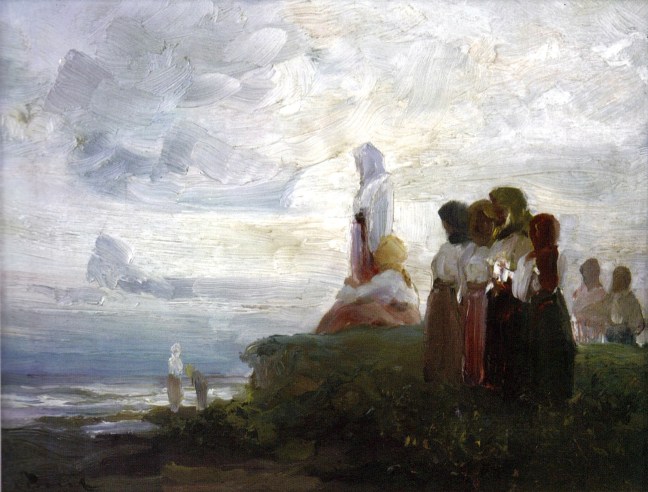
Love Actually

‘Sarbatoarea primaverii’ – Arthur Verona – Wikimedia

Love is the essence of everything, and our very nature. Because we don’t live separate and afar. We are not distant from each other. Nothing is. We have a natural intimacy with everything and everyone. This is not a theory, or a philosophical argument that we posit. This intimacy is our deepest reality, what we are, the property of our natural being, which we can feel, see, experience, but whose evidence has disappeared from our eyes. The reason is, we have preferred a theory to the reality, an illusion to the truth. Our life has stopped being natural. We have been faking it, living it according to beliefs, habits, conformity. But here, blatant in and as our very being, is a reality in which there is no time or place, no distance or separation, no otherness. And as we all know from experience, love is the abolition of time, of distance. Love is the end of separation, of otherness.

Love, which we may call beauty, for everything that we love is beautiful. Love, which we may call understanding, for to see love as the essence of life is the ultimate form of understanding. Love is to ‘stand in the midst of’. It is to stand with everything that is under, everything that is existing in our reality. It is to be connected, to be together with, to be of the same essence. So love is an expression of oneness, of our nature as the one and only reality there is. In the absence of separation — which is truth — we find love. In the absence of otherness — which is our reality — we find intimacy. We make love every time we are aware of our reality as only being. We manufacture love when time is discovered to be an idea, and separation a belief. To be in love is to realise our nature as being one with everything and everyone. It is to be unable to part with anything. It is humility at work. It is where division is only possible in a figment of our imagination. It is to be with what is, with no pulsion of escape or resistance. Love is both in the ache of separation and in the desire to be reunited. All seeking is done in the name of love.

To love is to stand in the midst of, to see no separation between an ‘I’ and a ‘he’ or a ‘she or a ‘it’. The more we stand as the quality of being aware, as that which knows all things, the more we have love as our daily companion. It is extraordinary that we can feel to be a body and a mind, when there is before these, in the subjective, the vast and unmissable expanse of that which is aware of them, which we have pushed away as a mere function of that body-mind. The body is something that we are aware of. We are not in the body. We are in the ‘aware of’. This being aware is our home, where we live, where we have our life. This is our placeless place. That which we cannot not be in. That which we cannot part from — our most intimate, unchanging identity. To be that knowingly, to live as that, is to love naturally and unconditionally. Every time we notice that there is a reality, a consciousness, a knowing presence before our body, thoughts, feelings, experience, world, then love appears to be the very material we and the world are made of. The first and last brick of our house. Our everything.

.

~~~

Text by Alain Joly

Painting by Arthur Verona (1868-1946)

~~~

.

Website:
Arthur Verona

Suggestion:
– Other ‘Reveries’ from the blog…

.
God’s Knowledge

‘The Blue Rigi Lake of Lucerne Sunrise’ – J. M. W.  Turner, 1842 – WikiArt

We know so many things. Everything is based on knowledge, and maybe that’s the way to live, as long as there is a body and a world. Knowledge is the score we need to play our part. But to know something, anything, seems presumptuous. It implies another kind of knowledge — that there is somebody here, a person at a distance, that knows and is a recipient of knowledge. Knowledge fixes us. It gives us a dubious identity — that I am a man or a woman, of a certain age, with certain qualities, and with a whole lot of knowledge, identities, beliefs. That I am unhappy, clever, stupid, happy. That I am a cook, or a carpenter. That there is a chair, a world. That I have skills and preferences. I even have the knowledge of my spiritual attainment.

But there is no knowing anything. To think we know something is a mistake. If we know something, then we haven’t looked well enough. We have stayed at the surface of our illusory world and existence. What we ought to know is the knowledge of our reality, of ourself. That’s the only knowing there is. That’s our world: Knowing. Being aware. All other knowledge is superfluous, is not real knowledge. For what would any such knowledge be, when we discover that there is no entity here with the capacity to possess that knowledge. Go only for the knowing of being, a knowledge which is owned by itself. Notice that you don’t know anything — that’s important to know. We have no knowledge other than the knowledge of our being. Apart from that, everything exists only as in a dream.

We may play the part of the one in the dream, and that’s a beautiful part. There may be a world here that is gorgeous, with many ‘things’ that are known. There may be relationships that have meanings. But this world of things borrows its beauty and making from the reality in which it exists for a time — knowing. And the meaning of relationship is found through its reality, which is love — shared being. Everything happy and true in our life is borrowed from our reality as awareness — the only knowledge there is. If we live or act while ignoring that one knowledge, the world and ourself will appear ridden with conflict and suffering. So notice that the ten thousand things of life — all our knowledge — are transparent, ephemeral, ethereal. What is here massive and solid is their reality as being — the supreme essence of everyone and everything. The truth we live in. Ourself. What is. Not somebody that knows.

There is no other real knowing than the knowing of our essence, of our true nature or identity. This knowledge of ourself is not something we can possess as a person. It is nothing more than pure, objectless, impersonal knowing, and this knowing is all there is, all we are. Everything, everyone, have died in it. That’s why we cannot know anything, for how could we know something without there being first a knower and things with their own reality. The only thing we in fact truly know is ourself, our essence. Our knowledge of anything has died inside pure knowing long ago. It is still available, but its reality is apparent. That’s why we can never be sure that there is a chair, or a world. That’s why every object passes, is not there, is only an appearance.

Even ourself cannot be known objectively. We are alone. Nobody knows us. We as a person are absent. We don’t have a reality as an entity, or a self of any kind. So we are known by God alone, who knows us by knowing Its own being. We are all in the knowledge of God. What follows after the sentence ‘we don’t know anything’ is ‘the only knowledge there is is God’s knowledge’. Or ‘know God, love god, and you will know what you ought to know’. It all boils down to ‘knowing, knowing knowing’. Paul said it all very clearly in the First Epistle to the Corinthians: “If anyone thinks that he knows anything, he doesn’t yet know as he ought to know. But anyone who loves God is known by him.” (8:2-3).

.

~~~

Text by Alain Joly

Painting by J. M. W. Turner (1775-1851)

~~~

.

Website:
J. M. W. Turner (Wikipedia)

Suggestion:
– Other ‘Reveries’ from the blog…

.

Hidden Desire

If you have any desire, any craving, make sure that you crave for yourself first. Make sure that you want yourself more than anything else. Check it. That before you go for something, you have first the will for yourself, for your sweet inner being, for that which sustains you, for that which is behind every one of your desires. Make sure that the one who desires is really you, not an impostor, not a fake self that mimics you but is not you. Make sure that you desire from that part of yourself that is real, that is here, not the will of a secondary thought, of an illusory, separate self, not a fake desire. Fake desires won’t work, won’t take you where you want, won’t give you what you seek. Go for a desire that comes from real you. Check that you know who desires your desire.

How do you know who desires your desire? Well first desire yourself, give at your sweet being a loving gaze, then see if your desire is still there. If it didn’t swiftly go, escape, disappear suddenly, didn’t have the guts of showing up, let alone showing off. If your desire doesn’t stand yourself, doesn’t survive the plain looking at your inner self, at your sense of knowing, of being aware, then your desire is not worth the name, doesn’t deserve to be fulfilled. Make that simple effort first. To watch your own being, to check your presence, melt for a second in it, with it, and then welcome any desire that comes. Sometimes desire can surprise you. Sometimes desire desires the most unexpected thing. Sometimes you find yourself desiring yourself more than anything else.

So please, before having the desire for something, desire yourself first. Stay there, in yourself, with yourself, have a sweet moment in the company of your being. See that you might be desiring it with all your heart, that no desire could ever compete with the desire for your self. See that could make a life of the desire for yourself. That you’d never want to leave yourself, even for a second. That what you want is to fully inhabit yourself — being yourself, which is being your sweet being, ravishing in its presence. Make sure that it becomes your primary desire. The most important one, which you want to fulfil, expose, indulge in. Indulge in yourself first. Don’t part from yourself, break up, and then indulge in the most silly, inefficacious, incompetent things. Don’t ever do that. Indulge after you have indulged all your might in yourself. Then see what you might further indulge in.

So always see yourself as the first object of your desire. This desire doesn’t always need to be expressed. You will notice that it is fulfilled by simply being. You have all your desires — expressed or in potential — fulfilled through the act of simply being. Being is like a magical formula, a universal recipe, the desire behind all desires. Being is the sweetest object of desire. Yourself is your bliss, where peace lives, where love is like your very essence. Your many desires for so many things have concealed yourself. So it’s only a matter of desiring the only thing worth being desired — yourself. Then you may have a thousand more desires, it doesn’t matter. They are not yours anymore. They have come from the hidden, unfathomable, inexpressible place of your inner self and being. Desire this place of no desire, of completeness. Respect it. Try to fulfill it. This is God’s hidden desire. After you have fulfilled God’s desire, be wild and determined with any other desire that may remain.

.

~~~

Text and photo by Alain Joly

~~~

.

Suggestion:
– Other ‘Reveries’ from the blog…

.
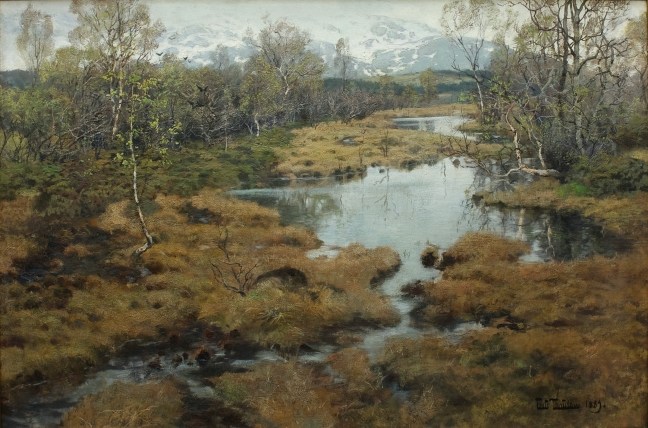
Our Human Condition

‘Winter Scene on the Ice’ – Jan van Goyen, 1641 – WikiArt

There is not a person in a thought, or in an assembly of thoughts. Not anymore than there is a person in a body or an emotion, or an activity of the body, a reaction after the emotion. These are but things that exist, but don’t make the complexity and radiance required in there being a person, an animal, or any kind of entity. This world is populated by objects, by appearances, by bodies, but not by persons or entities as such. There are no persons, nobody here that could claim to have its own, independent, separate reality. To think that there is, is an illusion, an invention, one of our many well-rehearsed thoughts.

But of course, beliefs have magic. If we believe to be a person, then we are one. If we believe that there are individuals, a world, untold suffering, then the source is obliging. It will create the reality of one such world, will give us the suffering we claim to have, will manufacture all our many conflicts, which we have come to be attached to, and to believe in. Everything is only a temporary, dreamlike appearance in and of reality, but not reality itself. The more you will believe to be a person, the more you will be one. The more consistency this person will acquire, the more suffering he or she will experience, and the more conflictual will be the world, for you have given them a reality they do not have — except for the reality of consciousness.

We have to keep knowing that we are aware, that we are awareness itself. Being a person is about knowing, not about a body, or a handful of thoughts. The body comes second to knowing. There is knowing first, and then a whole world unfolds, makes itself known. The reality of the world is in knowing, not in there being a world, not in there being a person. Knowing takes it all, wins the game. We’ve got to be aware of that. Then the world is shining. So is the person. They may not be truly here, in reality, but they shine with the transparency of knowing.

Every entity that exists, finds its reality within, from an inside experience. So to be a person is not to be a person, not in its reality. We are a person only from the vantage point of a thought, a belief, a representation, but not from inside, not from the depth of being. There, there is no person, no separation, no suffering, only the infinite body of knowing. After all, could a world with its own individual reality be harmonious or beautiful? Or is beauty or harmony conferred to the world by the grander reality of knowing? A world with its reality conferred by thoughts, beliefs, contains conflict, difficulties, suffering, for it is not recognised for what it is. We have confused the world with our misunderstanding, have rendered it an insecure place, and have made ourself an insecure person, constantly seeking its security in the insecurity of a world, which obviously is a vain enterprise.

So if there ever is to be a person, there is a person in infinity. If there ever is to be a world, there is a world in eternity. The world, our body, our thoughts, are all playgrounds for the infinite. Nothing more. If we do not know that, then we will be a suffering self, a person, living amongst the endless conflicts of the world. If we know we are infinity, then the world will oblige, and acquire the colours of the infinite. As for us, we will be playing being a person, or a thought, but with none of the sufferings or conflicts usually attached with their invented reality. We will remain infinity, eternity, in all occasions, no matter how much we live in time and place, and adopt for a while the limited vantage point of a body and a mind. Our own infinite reality will stay the only reality there is.

Now, imagine a world, a society of people where the only reality there is, is the reality of the infinite, of the eternal. What would this world be? What would our many personhoods be? Where could our suffering and conflicts stand in infinity? Where would our life turmoil thrive in eternity? The whole world — conflict, suffering, everything — stands within one single belief or misunderstanding. For the rest, eternity only is the one shaping the world. Infinity the one making a person — that is our human condition.

.

~~~

Text by Alain Joly

Painting by Jan Van Goyen (1596-1656)

~~~

.

Website:
Jan Van Goyen (Wikipedia)

Suggestion:
– Other ‘Reveries’ from the blog…

.