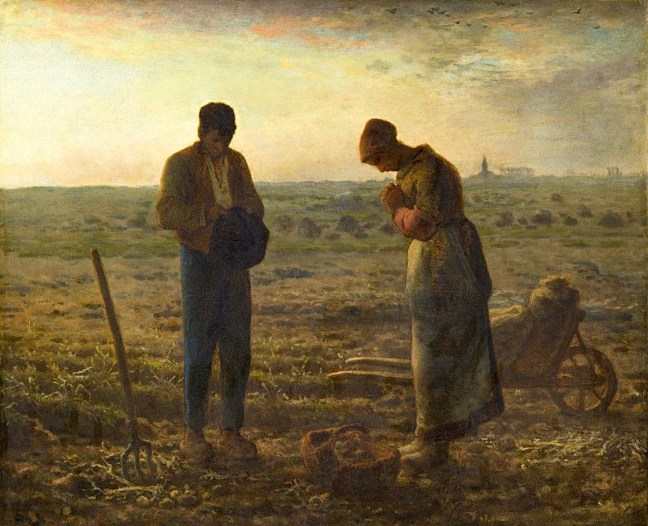
The Prayer of the Devotee

‘The Angelus’ – Jean-François Millet, 1857 – Wikimedia

Nowadays, we never think too much of the bells ringing from a distant church. Yet they were once set for a reason. They are the reminder of a practice of prayer called the ‘Angelus’. And it was precisely named so, after the moment when ‘The Angel of the Lord declared unto Mary, and she conceived of the Holy Spirit’: “Angelus Domini nuntiavit Mariæ”. So it is a message from a messenger of grace, lifting our spirit from the body, taking our experience at the level of what it truly is. It wasn’t just the recitation of a prayer. It was for our recalling. It was for being — for being held for a while in God’s bosom. It was for being reminded of our true nature, of our being the children of a deeper, forgotten presence which we are the incarnation of. It was an opportunity to remember. An invocation. A call from within.

This is a unique prayer, that some have named the ‘prayer of the devotee’. It was a prayer meant to be pronounced three times a day: in the morning, at noon and in the evening, accompanied by the ringing bells of the Angelus. A prayer inside which a few words strike with a special resonance. “And the Word was made flesh, and dwelt among us“. It was a testament to the sacrifice whereby God has made sure to leave in us a part of himself — his Son. A part of himself within ourself, which is more than our body and our qualifications, more than our mind and our many thoughts, beliefs, and identifications. It is that naked being or consciousness that is hidden in the maze of our many experiences, but is in fact our own, still, peaceful, never born identity.

So Mary has procreated while staying virgin, for the object of her nativity was herself, her true being which she has shown to the world to be the being of every other being. Jesus was a man, but Christ was that part of the man, and of us all, that didn’t need to be given a birth. It is the infinite, naked, ever-present being that is at the source of our sentiment of existing, of that very unique sense which is meant every time we say simply ‘I Am’, — I am, being, throbbing, living, never departing of that pure, godly, unqualified, indestructible essence, where infinity and eternity are like our most fitting attire. Nothing grandiose in these two words. They simply mean that I am not bound by time and place, by birth and death, by now and then, by here and there.

So three times a day, be it in the field as we were gleaning the wheat, or on the fishing boat in the middle of a river, we were called to stop and become a devotee for a timeless moment. Time and place were suspended, and our being recollected. It wasn’t anymore about harvesting the grain, or lifting the fish on the boat. It was for recognising in ourself the true nature of our being, and that special grace contained in being human — the child of a presence that abides in our very sense of being aware. For this apparently fleeting consciousness that is ourself is in fact the solid presence of God’s being, that is both sheltering and giving form to our body-mind-world. In this presence lives the peace that we are seeking everywhere, and that was placed here where it could never be missed, if only we are willing to listen to our inner call.

As very often in the religious world, there is the meaning intended, hidden, and the actual practice. The teaching, the message, and the poor understanding. The lifting grace, and the descent into belief and imagination. Here, the meaning intended, the teaching is: “Just be”. It is a prophetic, loving injunction for our sake, for our knowing, for our recognising. It is saying: notice that there is here and now, in and as yourself, a quality of being in which is contained life itself. It is saying: ‘God is with us’, which by the way is the meaning of one of the names given to Jesus, ‘Emmanuel’. So every time you hear the sound of a bell from a distant church, or the softer chime of your heart aching for peace, treat yourself with an Angelus, be like a devotee of your own being. Pause and go within, where you are forever being given a new birth, kneeling and offering your illusory identity in front of your one and true reality as being.

~~~

Text by Alain Joly

Painting by Jean-François Millet (1814-1875)

~~~

Website:
– Jean-François Millet (Wikipedia)

Suggestion:
Other ‘Ways of Being’ from the blog…

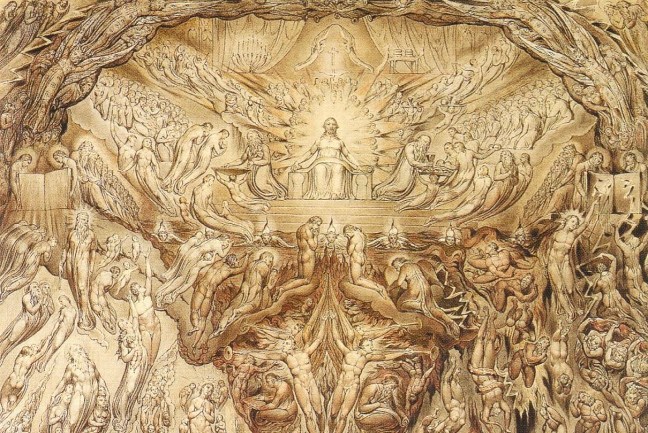
The Second Coming

‘Last Judgement’ (detail) – William Blake, 1808 – WikiArt

There has been a seed planted, a first coming. There has been for all appearances to exist, for the world of things to expand, the creative and pervading quality of a ground. This is where all beings and all things have tapped in for their own being. We have all sheltered it without our knowing it, for the ground of being is invisible to our eyes, not accessible to our senses. We have believed ourself to be a body and a mind, and have consequently been busy with the objective world, taking as a fact that our senses were reflecting back to us a true image of a dual universe. We have tried to conform to this idea, to this consensual representation of our reality, and this is the reason for our suffering and our innumerable conflicts. We have accepted our body-mind as an identity, and our life as the toiling for our security and happiness in a generally hostile, mindless, material world. We couldn’t be farther from the truth.

So there has been the promise of a Second Coming. The ‘returning of the Saviour at the end of time’, as some religions have stated. Well, maybe that formula bears some truth, if it wasn’t taken for what it is not. But there won’t be the first sign of a separate entity coming again in the world to free us. The Second Coming is taking place in our heart. This is where it lives and has its home, waiting for our realising, longing for our returning. This is the ground set for a meeting with ourself, with our reality. A truth unmoved, still, unqualified, that is abiding here in and as ourself, but has been forgotten, neglected, therefore left unnoticed. The remembering of it gives us the illusory impression of its coming again. But no. Its coming again is us coming out of our self-imposed dream. It is us seeing the world and everything in it as the many faces of God, which means the world exchanging its believed reality as matter for the luminous vibrancy of infinite consciousness.

So there is a Second Coming. It is only an apparent one for we have in fact never moved out of it. It is our infinite, eternal reality — in fact God’s very being — which we could never part from. This ‘coming’ is rather a revelation, an ‘epiphany’, as the Greek word for the coming again of Christ indicates. In Islam, this is called the ‘return’ (al-raj’ah), the ‘turning again’ towards ourself, our knowing of ourself — consciousness. It is a revolution, the ‘rolling back’ of a false idea, of a belief, to reveal, or return to our own reality as aware being. It is the coming into view of something that was here, but hidden by our looking in the wrong direction. It is our true nature or reality becoming perceptible again, a new light sprouting out of our lazy, habitual, and a thousand times rehearsed imagined identity as body and mind.

In fact, the Second Coming was simply called ‘Parousia’ in Greek, which literally means ‘being present’ — how could we have missed such level of clarity! So now the traditional, religious promise of the ‘returning of the Saviour at the end of time’ could be read in its new light of truth. It is our true nature as God’s being, or infinite consciousness, and its becoming perceptible again when all idea of time, sequence, saviour, hope or belief has left us. It is the ground of being, being present, and shining as our one and only peaceful reality, saving us from a lethal misunderstanding. The last judgment being nothing but the punishment given to the separate self, the fatal blow of its being non existent, and the rise of infinite consciousness as the only self there is, the reward of its quietly blissful nature.

~~~

Text by Alain Joly

Painting by William Blake (1757-1827)

~~~

Websites:
– Second Coming (Wikipedia)
– William Blake (Wikipedia)

Suggestion:
– Other ‘Reveries’ from the blog…

God’s Alliance

God is not a romantic. He wants the best for you, and will make sure that you have no peace until you know yourself exactly as you are, which is as He is. God is a tough mother. She will lead you to feel that you come from her very womb, and that you have within yourself the memory that you are as She is, which is infinite and eternal. God has no idea that you exist as a person. He knows none of your ideas or beliefs, none of your attachments or suffering. Your problems are of no interest to Her. If you want God to know you, make sure that you go to that part of yourself that is without qualifications, that is like your naked essence — what gives you the consciousness of everything. Make sure that you become just as Her being, and that you share of Her divine characteristics. Then God will know you as surely as He knows Himself. And you will know God as firmly as you know yourself. But don’t play the part of the poor little me. For you won’t see a single tear on the face of god, and will attract no compassion from Him. God knows you the moment you know God. That’s the beauty and magic of Her infinite presence.

Partake of the same ground of being that is God’s being, and you will come to love everyone in the way She loves you. Share the being of God Himself and you will bathe in the peace that God knows, and that is your own peace too. Know your being as being God’s being, and you will experience the joy that comes from the ease of simply being. The only way God can know you is through that part of yourself that is of the nature of His being. And the only way you can see God is by seeing yourself in the way He sees Himself. There is no knowing God through relationship. He is knowable through sameness only. Oneness is the common home that we all share. Everything and everyone partake of the same ground of being, and find their identity in God’s identity. This alliance of God with the ten thousand beings and things of existence is one of supreme intimacy. Once this intimacy with God has been established in your life, you will come to know God as you know yourself, and to know everything and everyone as God’s intimate being. Her interior as to say. His loving heart.

And God is a lover of the strictest reality. The idea that you have of yourself can never know God. And God can never know the belief that you have formed about yourself. They are mutually exclusive. If you want to be a person of your own, away from God, then God will retire and become absent from your life although still holding you in the most humble and loving way. The person that you believe yourself to be has no reality and cannot share of God’s reality. This is why you suffer, and know the plight of loneliness and separation. Give the idea of yourself up, and you will find yourself as having the self of God Himself. This is God’s special bond with you, to know you through His very being, which is your being too. This alliance with God suffers no approximation. Be of God’s humble nature, and She will share with you Her blissful being, offering Her infinite body as the world you live in and mix your being with. But be with your own limited, separate self, and God will know nothing of you, and you nothing of Him. You will be just a passing cloud with no reality, absent from even the most insignificant thought of God.

~~~

Text and photo by Alain Joly

~~~

Suggestion:
Other ‘Ways of Being’ from the blog…

The Word ‘God’

‘Italienische Landschaft’ – Pierre-Henri de Valenciennes – WikiArt

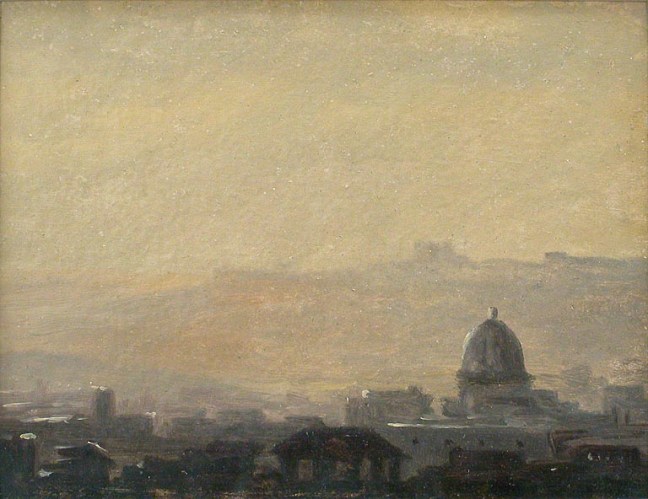
Long before any idea of a God, before any belief or possibility of a deity, of a divine command, God is already here, hiding within yourself. Or rather you yourself have just come hiding God. It means, don’t make God into an idea, a form, a projection born of your fears, of your eagerness for peace or relief. God is not ahead of you, or before you, or above you. God is not an entity, or anything that would not be your own.

God wouldn’t be God if it were an idea, a conceptual form far away from your self. For God is not something abstract, vague, distant. God is resplendent. God is shining. Not in a far away, unreachable place. God is brightly here, just as you are. You are, because of God. Because God is, you are. God is the very essence and quality of your being.

There is nothing above or beyond your being. It seems that there is, because you have limited your being by giving it a qualification. You have found it better to clothe your being with something. Then God goes hiding. Or you yourself are hiding your own divine self or essence, the possibility of your being only being. For there — in being — is the key to god.

In that being, God is. God is doing your being. That’s the extent of the presence of God in your life. In that, there is not even the possibility of a belief in God. In that, you feel God’s presence every time you feel your own presence, which makes God very present indeed in your life. In that, a belief in God would in fact trample God. It would make it an entity. A distant thing. A poor meaning. Not God at all.

Who do you think is ‘doing’ your being right here, right now? Think of that for a while. What is this being that I am? What is this I am that I am? Answer that in verity, through your actual experience, and God won’t be a secret to you anymore. God will cease being distant. You will be yourself made of the presence of God. No belief in God could ever match that.

But remember that once God’s being is recognised to be your being, then you won’t find room anymore to have your own personal being. Your own being will be lost to God. Now there is only God, which actually means there is no God at all. The idea of God is for when you have distanced yourself from God, when you don’t know yourself — that you are God’s being. In recognising yourself as God’s being, you will have lost both your being, and the idea of a God. It is a form of death.

So think twice before you say that you want to know God, or to know yourself. For this knowledge will leave you with being only. There won’t be a you. And there won’t be a God. There will be the purity of being, which is the everlasting life in death, which is to live as the One. You will lose your apparent doership, the control that you think you have, every objective identity that you believe makes you.

But in that loss is the finding of yourself, of who you are. In that loss is the end of your suffering, and the discovery of your nature as peace. This finding of your essence is the meaning behind the word ‘God’. In finding God, you will have rid of God, and of yourself. What is left is more than any word can tell. More than the word ‘God’ could ever convey. There would be no word at all. Except you. You would be the living word for ‘God’. 

.

~~~

Text by Alain Joly

Painting by Pierre-Henri de Valenciennes (1750-1819)

~~~

.

Website:
– Pierre-Henri de Valenciennes (Wikipedia)

Suggestion:
– Other ‘Reveries’ from the blog…

.

Harp of the Spirit

Fresco of Ephrem the Syrian, 14th AD (part) – Protaton Church,  Mt Athos – Wikimedia

.

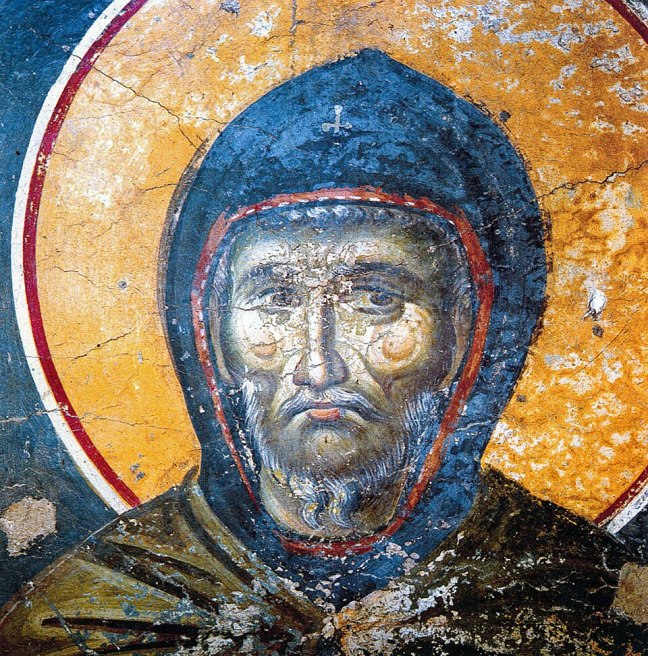
If you go for its gems, you will find the Christian tradition to be unbelievably rich of the highest wisdom. The work of Ephrem the Syrian is one such gem. He was a prominent Christian theologian and hymnographer born in 303 AD, expressing himself in the Classical Syriac language of early Christianity, in the eastern part of modern-day Turkey. But he was also known for his outstanding poetry, which he used as a vehicle for theologian purposes. Over four hundred of his hymns have come down to us, and many more got lost along the way, that have earned him the title of ‘Harp of the Holy Spirit’. It is said that his poetic descriptions of the Last Judgment influenced Dante Alighieri in some sections of the Divine Comedy. There is no doubt that he had a passion to put his long years of studying and reading into the fire of experience, as can be felt in this eloquent verse:

.
“On a certain day a pearl did I take up, my brethren;
I saw in it mysteries pertaining to the Kingdom;
Semblances and types of the Majesty;
It became a fountain, and I drank out of it mysteries of the Son
.”
~ The Pearl, Seven Hymns on the Faith (1:1)

.
Ephrem the Syrian is said to have been baptised as a young man, and to have been a deacon, with a more limited liturgical role than a priest, and a duty centred on service. He had a great knowledge of the Scriptures and was devoted to his mission as a teacher. He made theology accessible through his poetry, and is recognised as one of the first to introduce songs into the Church’s public worship. He was eager to transmit his passion and devotion in whatever way was possible to him.

.
“In its brightness I beheld the Bright One Who cannot be clouded,
And in its pureness a great mystery,
Even the Body of Our Lord which is well-refined:
In its undivideness I saw the Truth
Which is undivided.”
~ The Pearl, Seven Hymns on the Faith (1:1)

.
There is no doubt that he was an influential man, being honoured with titles like the ‘Sun of the Syrians’, or the ‘Column of the Church’. He lived a simple, ascetic life, embracing the ideals of poverty and celibacy. During the last decade of his life, he moved to Edessa, and stayed there in a small cave overlooking the city, devoting his time to his writings. In Hymns on Faith (VIII.9), he stressed that “the intellect was not intended to pry into hidden things”, emphasising the fact that our deepest identity as being cannot be understood conceptually, through the mind, but is a living, subjective reality. In his Hymns on Paradise, he described this with these exquisite words:

.

“Your nature is far too weak
to be able
to attain to its greatness,
and its beauties are much diminished
by being depicted in the pale colors
with which you are familiar.”
~ Hymn on Paradise, XI:7

[…]

Discover the hymns of ancient theologian Ephrem the Syrian… (READ MORE…)

.

A Universal Cure

‘Creation of the World XIII’ (part) – Mikalojus Konstantinas Ciurlionis, 1906 – WikiArt

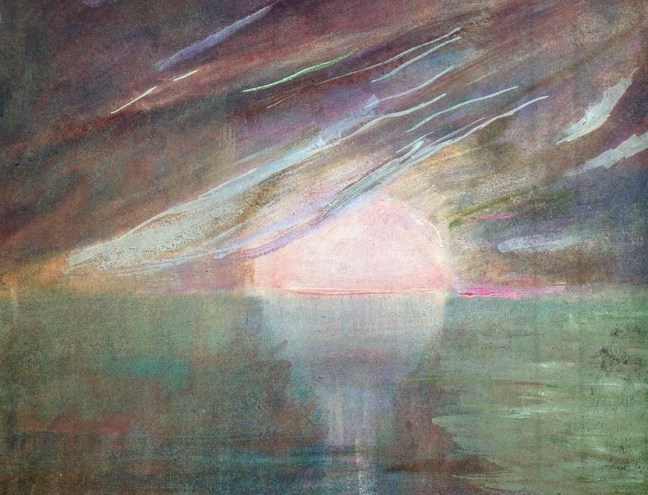
The part that we’re playing is not small. We are not living in a corner, limited by the skin of our bodies, and the world is not limited to the time and space in which it seems to unfold and have its conflicts and sufferings. The world has a foot in the infinite. In fact not just a foot, it is bathed in infinity, in eternity, and so are we, we who have been made small and suffering entities by our limiting beliefs and prejudices. We are ruling the world with our thoughts and then blame ourself for it. For the results are of course as limited as our thoughts can be. We have made the world the hostage of our limitations, and its hostility is in fact our own, that we have projected unto it. We believe and think we can only play small and limited, but in fact, we haven’t quite seen ourself as we are, and from this blindness comes the entirety of the world’s agony, and ours too.

Fortunately, ours and the world’s true essence comes spilling over in every possible way through the manifestation of beauty, and through the many expressions of love or peace. That’s what makes it so attractive in spite of all, and that’s where we should be way more curious than we are. Beauty, love, intelligence, peace, are not created by the random structure of a body and the passing thoughts in our mind. This is not where they are manufactured. They are born of infinity and wholeness. They are the expressions of the One, which we can never own. We are in fact rather owned by them, embraced by the infinity that is their reality. We must surrender to this god given identity. We don’t have to play small. Would we think of god playing small? So why would we of ourself, who are like the arm and willpower of God in God’s dream? So we don’t have to play small in this world. We ought to play our given, sacred part. We ought to be what we are and recognise ourself and the world as a whole, indivisible being. A being that is nothing but our own, that is experienced here and now every time we say ‘I Am’, and that we are fortunate enough to share in.

Act on the world from within. Mould it from there, from the source of yourself and of the world, from the ground of being that you feel as your own being, and that is the common ground of all beings and all things. This ground has the best ability. Religions haven’t called it Paradise or Eden for nothing. There is always a truth behind every misunderstood word. This ground of being is where you can play big, from within, from the interior of everything and everyone. You don’t have to create a new reality. It’s already there within and without, for the taking and for the looking. This reality is already here, already yours. There is love and harmony woven in the fabric of life, just here and now in and as our given experience. Our efforts to heal ourself and the world are veiling this reality, and so are our limited thoughts, which carry the false reality of there being persons and separation instead of the reality of one being and the peace contained in the infinite. Our own unlimited being is the ground where we can play big, for it is as large as God’s being if we are willing to notice its real, undefeatable nature. In fact, being is a universal cure, and it’s always at hand.

.

~~~

Text by Alain Joly

Painting by Mikalojus Konstantinas Ciurlionis (1875-1911)

~~~

.

Website:
– Mikalojus Konstantinas Ciurlionis (Wikipedia)

Suggestion:
Other ‘Ways of Being’ from the blog…

.
‘I Am with You Always’

‘The rest’ – Marc Chagall, 1968 – WikiArt

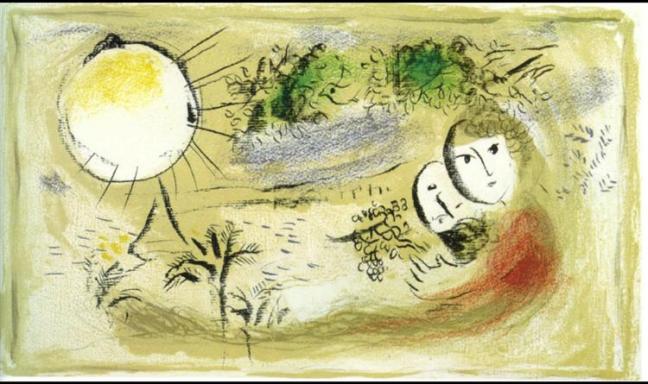
There is no ambiguity with God. This has been said in a thousand different ways, in every corner of every page of the Bible for example, that God is with us, that there is in us, as us, a presence hidden in plain sight, that won’t let go of us ever. That it is the very making of ourself, our sublime identity — what we live our life with and could never depart from. We couldn’t doubt it in the least, for with just the right kind of looking, and with no effort whatsoever, we could see it, feel it, sense it, that we are that, and not truly our body or mind, let alone our thoughts, our story, our problems, our suffering. “I am with you always, to the end of the age”, that’s from ‘Matthew 28:20’. So there is no worry to be had. We are not alone. That’s just an impression, an invention, that we are separate, insecure, fragile. In fact, we couldn’t be without it. In ‘Zephaniah 3:17’, they say “The Lord your God is in your midst”. That’s what they mean, that our mind finds its ground in this very presence, in this being of ours that is in fact borrowed from God’s being. In ‘1 Corinthians 3:16’, they are even more specific, clearer on that subject, “God’s Spirit dwells in you”. It couldn’t be plainer and clearer. Why don’t we listen?

And we profit from an inbuilt, intrinsic protection in our life. After all, haven’t we gone through illnesses and floods, through a thousand aches, and is not death itself called eternal rest? Haven’t we lived in the constant grip of desire and worry, hassled by a quiet, ever going despair? And yet, are we not beautiful now as we are, after having gone through all this? Are we not pristine beings, untouched by it all, made of this unsurpassable, never changing awareness of being? In ‘Isaiah 41:10’, God is reported to have said: “I will strengthen you, I will help you, I will uphold you with my righteous right hand.” And in ‘Zephaniah 3:17’, it is written that God is the “mighty one who will save”. They wouldn’t say that if they don’t mean it. But we won’t be saved in an hypothetical future, at the time of death. We are being saved now, kept virgin of every objective experience, if we are willing to look. Furthermore, there is an inner peace that has landed in and as our very being since time immemorial. This inner peace expresses itself as joy or love, which we have experienced even amongst our ignorance. Isn’t life worth living for these fleeting moments of joy? And isn’t love our most precious, cherished, sought after experience, that seems to be a miracle beyond understanding? In ‘Zephaniah 3:17’, they say, clothed in the most exquisite poetry: “He will rejoice over you with gladness; he will quiet you by his love; he will exult over you with loud singing.”

So, as is advised in ‘1 Chronicles 16:11’, “Seek the Lord and his strength; seek his presence continually!” Which means we ought to stay with that part of ourself that lies peacefully below the hustle and bustle of existence, before everything that can be pointed at and named, and that is therefore not truly ourself. But God is not happy with only being our being, with filling us with its own infinite being. This presence is also made of the gorgeous fabric of love. This is where love finds its reality, in the innocence of our being, in awareness. So if we love, this love is not our own. We have not manufactured it, let alone directed it. “We love because he first loved us”, it is said in ‘1 John 4:19’. This is what our being feels like, when it is kept pure, unsoiled by our attachment to experience. Love is what we feel when we have relinquished everything in ourself that is mistakingly taken to be us, but is not. In ‘1 John 4:19’, we are being reminded of this eternal truth, that “God is love, and whoever abides in love abides in God, and God abides in him.” And this love, this being of God, is not something that can be had. It lives and breathes only through our being it. The world of things, of objectivity, cannot apprehend it, “cannot receive, because it neither sees him nor knows him”, as is said in ‘John 14:17’. So we are it, not have it, not know it. As long as we believe to be an entity, a something, a someone, we have separated ourself from our reality as God or consciousness. Yet everything, everyone, is eternally made of this being, which is God’s being, and finds its identity and essence as that. After all, didn’t God make that very clear, when saying in ‘Jeremiah 23:24’, “Do I not fill heaven and earth?” To which God could have added: I am all beings and all things, their secret identity, their essence which is only spirit. As I have said and proved a zillion times: ‘I am with you always’.

.

~~~

Quotes taken from the Bible

Text by Alain Joly

Painting by Marc Chagall (1887-1985)

~~~

.

Website:
– Marc Chagall (Wikipedia)

Suggestion:
– Other ‘Shreds of Infinity’ from the blog…

.