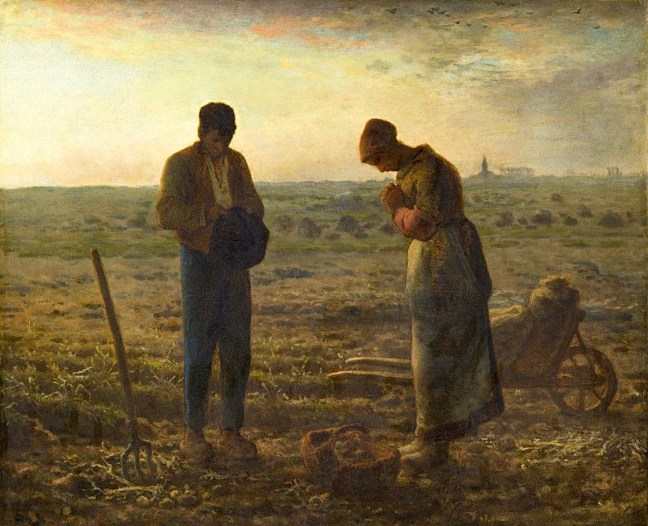
‘The Angelus’ – Jean-François Millet, 1857 – Wikimedia
Nowadays, we never think too much of the bells ringing from a distant church. Yet they were once set for a reason. They are the reminder of a practice of prayer called the ‘Angelus’. And it was precisely named so, after the moment when ‘The Angel of the Lord declared unto Mary, and she conceived of the Holy Spirit’: “Angelus Domini nuntiavit Mariæ”. So it is a message from a messenger of grace, lifting our spirit from the body, taking our experience at the level of what it truly is. It wasn’t just the recitation of a prayer. It was for our recalling. It was for being — for being held for a while in God’s bosom. It was for being reminded of our true nature, of our being the children of a deeper, forgotten presence which we are the incarnation of. It was an opportunity to remember. An invocation. A call from within.
This is a unique prayer, that some have named the ‘prayer of the devotee’. It was a prayer meant to be pronounced three times a day: in the morning, at noon and in the evening, accompanied by the ringing bells of the Angelus. A prayer inside which a few words strike with a special resonance. “And the Word was made flesh, and dwelt among us“. It was a testament to the sacrifice whereby God has made sure to leave in us a part of himself — his Son. A part of himself within ourself, which is more than our body and our qualifications, more than our mind and our many thoughts, beliefs, and identifications. It is that naked being or consciousness that is hidden in the maze of our many experiences, but is in fact our own, still, peaceful, never born identity.
So Mary has procreated while staying virgin, for the object of her nativity was herself, her true being which she has shown to the world to be the being of every other being. Jesus was a man, but Christ was that part of the man, and of us all, that didn’t need to be given a birth. It is the infinite, naked, ever-present being that is at the source of our sentiment of existing, of that very unique sense which is meant every time we say simply ‘I Am’, — I am, being, throbbing, living, never departing of that pure, godly, unqualified, indestructible essence, where infinity and eternity are like our most fitting attire. Nothing grandiose in these two words. They simply mean that I am not bound by time and place, by birth and death, by now and then, by here and there.
So three times a day, be it in the field as we were gleaning the wheat, or on the fishing boat in the middle of a river, we were called to stop and become a devotee for a timeless moment. Time and place were suspended, and our being recollected. It wasn’t anymore about harvesting the grain, or lifting the fish on the boat. It was for recognising in ourself the true nature of our being, and that special grace contained in being human — the child of a presence that abides in our very sense of being aware. For this apparently fleeting consciousness that is ourself is in fact the solid presence of God’s being, that is both sheltering and giving form to our body-mind-world. In this presence lives the peace that we are seeking everywhere, and that was placed here where it could never be missed, if only we are willing to listen to our inner call.
As very often in the religious world, there is the meaning intended, hidden, and the actual practice. The teaching, the message, and the poor understanding. The lifting grace, and the descent into belief and imagination. Here, the meaning intended, the teaching is: “Just be”. It is a prophetic, loving injunction for our sake, for our knowing, for our recognising. It is saying: notice that there is here and now, in and as yourself, a quality of being in which is contained life itself. It is saying: ‘God is with us’, which by the way is the meaning of one of the names given to Jesus, ‘Emmanuel’. So every time you hear the sound of a bell from a distant church, or the softer chime of your heart aching for peace, treat yourself with an Angelus, be like a devotee of your own being. Pause and go within, where you are forever being given a new birth, kneeling and offering your illusory identity in front of your one and true reality as being.
.
~~~
Text by Alain Joly
Painting by Jean-François Millet (1814-1875)
~~~
.
Website:
– Jean-François Millet (Wikipedia)
Suggestion:
Other ‘Ways of Being’ from the blog…
.