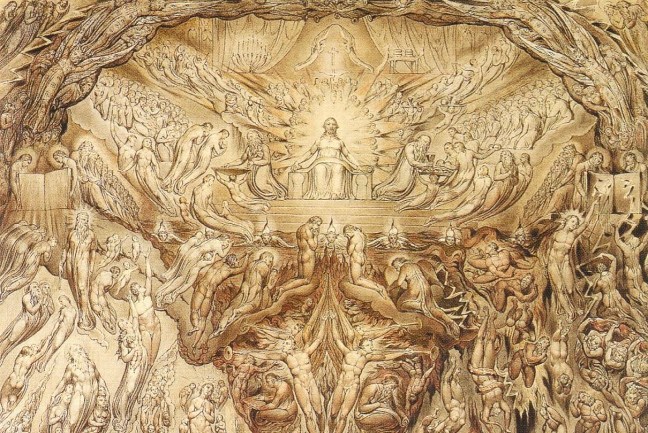
‘Last Judgement’ (detail) – William Blake, 1808 – WikiArt
There has been a seed planted, a first coming. There has been for all appearances to exist, for the world of things to expand, the creative and pervading quality of a ground. This is where all beings and all things have tapped in for their own being. We have all sheltered it without our knowing it, for the ground of being is invisible to our eyes, not accessible to our senses. We have believed ourself to be a body and a mind, and have consequently been busy with the objective world, taking as a fact that our senses were reflecting back to us a true image of a dual universe. We have tried to conform to this idea, to this consensual representation of our reality, and this is the reason for our suffering and our innumerable conflicts. We have accepted our body-mind as an identity, and our life as the toiling for our security and happiness in a generally hostile, mindless, material world. We couldn’t be farther from the truth.
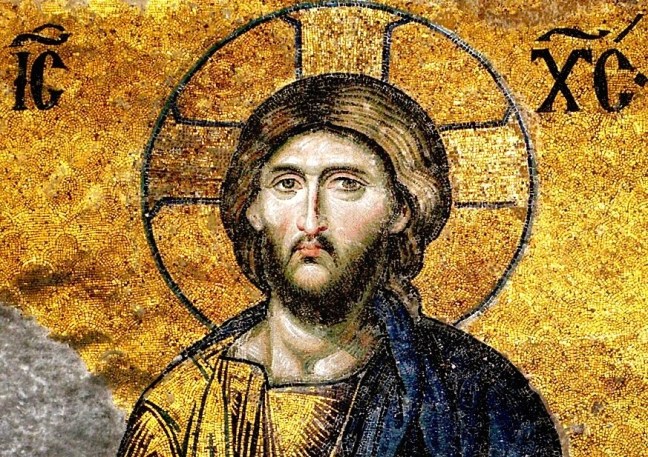
So there has been the promise of a Second Coming. The ‘returning of the Saviour at the end of time’, as some religions have stated. Well, maybe that formula bears some truth, if it wasn’t taken for what it is not. But there won’t be the first sign of a separate entity coming again in the world to free us. The Second Coming is taking place in our heart. This is where it lives and has its home, waiting for our realising, longing for our returning. This is the ground set for a meeting with ourself, with our reality. A truth unmoved, still, unqualified, that is abiding here in and as ourself, but has been forgotten, neglected, therefore left unnoticed. The remembering of it gives us the illusory impression of its coming again. But no. Its coming again is us coming out of our self-imposed dream. It is us seeing the world and everything in it as the many faces of God, which means the world exchanging its believed reality as matter for the luminous vibrancy of infinite consciousness.
So there is a Second Coming. It is only an apparent one for we have in fact never moved out of it. It is our infinite, eternal reality — in fact God’s very being — which we could never part from. This ‘coming’ is rather a revelation, an ‘epiphany’, as the Greek word for the coming again of Christ indicates. In Islam, this is called the ‘return’ (al-raj’ah), the ‘turning again’ towards ourself, our knowing of ourself — consciousness. It is a revolution, the ‘rolling back’ of a false idea, of a belief, to reveal, or return to our own reality as aware being. It is the coming into view of something that was here, but hidden by our looking in the wrong direction. It is our true nature or reality becoming perceptible again, a new light sprouting out of our lazy, habitual, and a thousand times rehearsed imagined identity as body and mind.
In fact, the Second Coming was simply called ‘Parousia’ in Greek, which literally means ‘being present’ — how could we have missed such level of clarity! So now the traditional, religious promise of the ‘returning of the Saviour at the end of time’ could be read in its new light of truth. It is our true nature as God’s being, or infinite consciousness, and its becoming perceptible again when all idea of time, sequence, saviour, hope or belief has left us. It is the ground of being, being present, and shining as our one and only peaceful reality, saving us from a lethal misunderstanding. The last judgment being nothing but the punishment given to the separate self, the fatal blow of its being non existent, and the rise of infinite consciousness as the only self there is, the reward of its quietly blissful nature.
.
~~~
Text by Alain Joly
Painting by William Blake (1757-1827)
~~~
.
Websites:
– Second Coming (Wikipedia)
– William Blake (Wikipedia)
Suggestion:
– Other ‘Reveries’ from the blog…
.