The Birth of Personhood

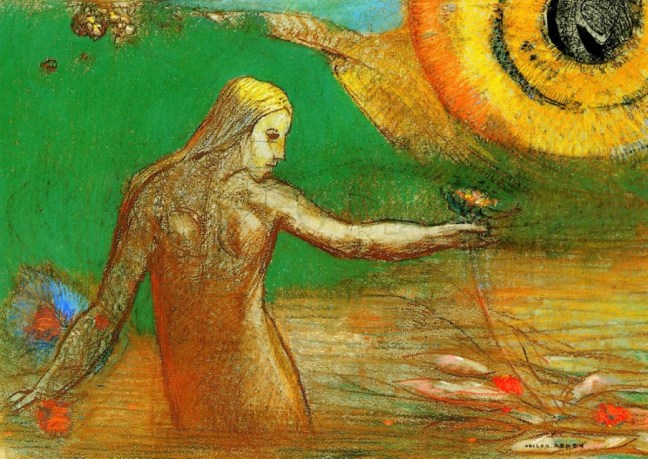
‘Flower of Blood’ – Odilon Redon, 1895 – WikiArt

It is consciousness — not body, not thoughts — that gives us the impression that we are a person with a continuity. There is absolutely no chance that a bundle of thoughts, feelings, and bodily sensations, could give us that impression. We borrow our personhood to consciousness, to the fact of being aware — to this light that creates us in the darkness that are otherwise thoughts, feelings, body. Our sense of continuity belongs to consciousness, to presence — that portion of ourself that is empty, unchanging, not objective, but full to the brim with itself. Our thoughts are but isolated events that are changing over the course of time, and so are our feelings and bodily sensations. The content of our mind is like a passing, unpredictable weather. So continuity in that area is absurd. Our essential self is to be found in and as being. What makes us is in that which is unmade. That impersonal part of ourself is what paradoxically gives us the chance of being a person. We are therefore nothing but empty, undivided being playing ‘being a person seemingly characterised by body and thoughts’. We have got it all upside down: Our person is not prior to consciousness. Consciousness is prior to our person, and the sine qua non of our existence or appearance.

Our thoughts are far away from each other, inconsistent, contradictory, confused, hesitant. They are not the voice of our self, are incapable of forming an identity of any kind. Our identity is to be found somewhere else, in something that we cannot get hold of, or limit, or name. The only thing that could link the different events of thoughts, feelings, sufferings, bodily sensations, and perceptions — all that for us constitute our self, a person with a name and form — is the presence of consciousness. We owe the impression that we are something solid, a real person, to emptiness, silence, stillness. So our person is actually non-existent, or rather has its existence in that which stands unseen between the happenings or events that we think make us. So our story, our thoughts, our body, become evanescent, losing their reality, disappearing within the experience of our massive sense of being — its coming to our attention. Being is seen to be the nature of ourself, which we had imagined in passing, isolated, impermanent, objective events and qualities. And believe me, that makes for a beautiful, gorgeous person — the one we have always wanted to be! A person is infinity being born.

The fact that there is a certain coherence in being a body-mind, and that we are able to live a life, is nothing but the expression of a play, a ‘lila’ as the Hindus are saying. We are nothing but a character in the hands of an actor. A body-mind is the little necessary to carry our wider identity to its term. In fact, all that we seemingly are — a person with an apparent life — is just the vehicle for a bigger quest. We are pretending a body-mind, so that we can realise our divine being. We are carrying infinity on our back, on the back of the finite, giving it the seeming, temporary life of an entity progressing in time and space. But this story, this appearance of a life, is but an excuse, something marginal that serves a wider purpose. We are meant to carry God on our shoulders for a while. At first unknowingly. Until we know God knowingly. Until God has acquired enough substance, and has sufficiently widened Its being in our life. Until God can in return carry us on Its own shoulders. And move us. And swallow us. Then, we find the security and courage to surrender ourself in God’s solid being and be like God Itself. We transfer our being in and as God’s being. And die there.

.

~~~

Text by Alain Joly

Painting by Odilon Redon (1840-1916)

~~~

.

Website:
Odilon Redon (Wikipedia)

Suggestion:
Other ‘Ways of Being’ from the blog…

.

God Unveiled

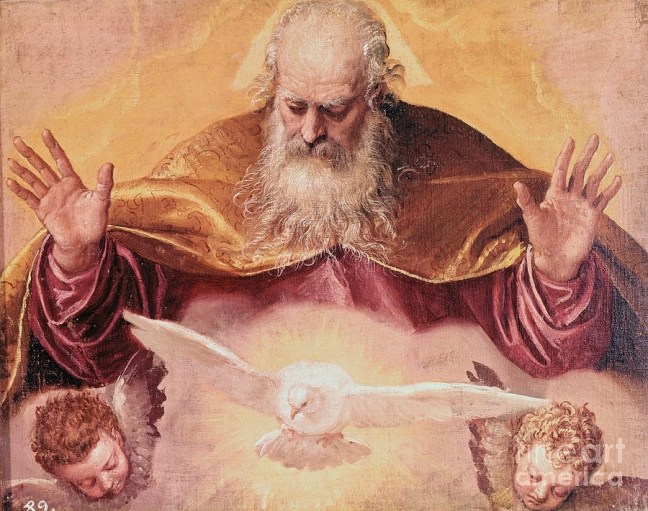
‘Illustrated Depiction of God with Holy Bettmann’ – Tintoretto, 16th AD – WikiArt

.
For many of us, god is nothing more
than the idea or belief we have inherited of such a being, an idea that is conditioned by religion as the lazy representation of an omniscient, omnipotent entity that is both our creator and protector — in the popular Christian imagery an old bearded figure who lives far and away from us, in a lofty, elevated place for a good view on its creation and creatures. The existence of such a god is almost only a matter of belief or faith, and the relationship we have with it one of reward and punishment, devotion, fear, prayer, praise, but rarely of understanding and exactitude. It seems that we better have god in a hazy place, feel more at ease with not knowing too much about the wisdom that may hide behind that term. So our ignorance is a calculated one, a refusal to rock the boat, and a patting of our carefully assembled opinions from which we derive our sacrosanct identity and security. But let’s tackle god here. Let’s undress the myth and have a thorough eye-contact with the divine. Let’s dare some experiential understanding. Let’s have god out of its hiding place.

Maybe god was never defined because it is the one thing in life that is indefinable. Everything objective that we can know, see, hear, touch, smell, taste — qualities and all — can be described with words and given a name. We have our life surrounded by objects. The objective has filled our experience to the brim, and we are being choked in it — with no breathing possible, and no space allotted to the unknown. God is one such unknown. But how could we describe something that we cannot know as an object? So to god we can only give a generic, provisional name. Because god cannot be pointed at and recognised as an object or entity. God is not an easy catch. The divine defies our understanding, and this defiance is at the core of our misinterpretation of god. So if you want to know god, you have to look for it in your life, and turn every stone and pebble that crowd your experience. So start by removing everything in existence that you can know, see, hear, touch, smell, taste — qualities and all — that have an objective quality and can be given a proper name. You know: everything that you can show to another fellow, and that he too can see, hear, know, understand, and comprehend, just like you. Take it all away, and then see what remains behind.

[…]

An explanation of the nature and reality of God’s being… (READ MORE…)

.

God’s Favourite Child

You are not alone, not just anybody left in one corner of the world, with no resources. You have been given a world that cannot go wrong, except in your own imagination. So you may relax now, and let yourself be. Just be. You can give it all away, all your worries, all your concerns about a future. Keep only this one reality close to yourself: you are. In that being is contained all that you need. Be only concerned with that, with presence. Feel it to be your nurturing essence, your progenitor. You are God’s favourite child. We all are. We worry and suffer until comes the day when we realise it. Know this filial nature as your only reality, your one solid insurance in life. God is as close to you as your sense of being is. It won’t leave you ever. It has been building a gorgeous house for you to live in. This house is the one you already are in. It is yourself, who you are of all eternity, although you may not have noticed yet. It has soft, silk drapes on the walls. For there is luxury in being yourself. And the only thing that brings you closer to putting an end to your suffering is the knowing of that — the knowing of being — with its inescapability and the soothing comfort contained in it.

There is a special sense of gratefulness that comes with simply being. Have you tried it? To simply be the one which you are. With no supplement needed. No artifice in the least. This very sense of being is God showing to yourself how he cares for you. How much you matter to her. You don’t need to add anything to that. Actually, you shouldn’t: that will make you drop from god’s sweet embrace. So be always under the warm influence of being. Feel that you are it, and that you are in this way as God’s being itself. You will never have to look for an identity outside yourself. For there is only one drama currently running in this world. It is that they made you think that God is far and away. An impossible task while it is in fact the nearest, most accessible thing there is in your life. One that needs only a little attention. The attention of being. The curling up in the warm blanket of your self. Just that. Simple and easy. The only thing you do not have to reach. God gave you the favour to only be. So stay acquainted with it. Do it justice. Return the favour. Be only being. That’s how God can recognise you as its favourite child.

.

~~~

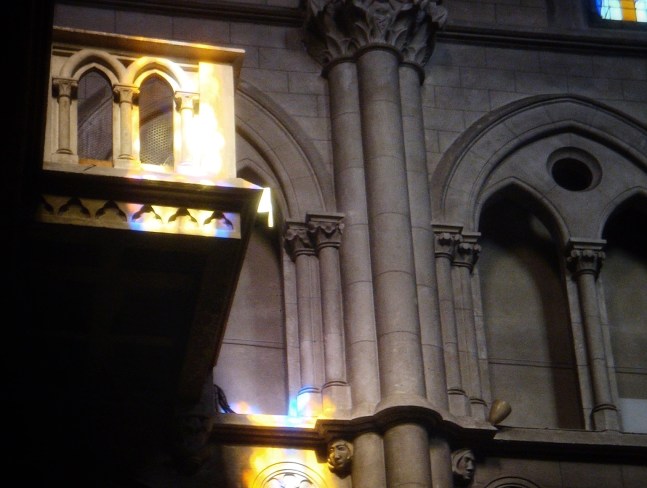
Text and photo by Alain Joly

~~~

.

Suggestion:
Other ‘Ways of Being’ from the blog…

.

Know Thyself

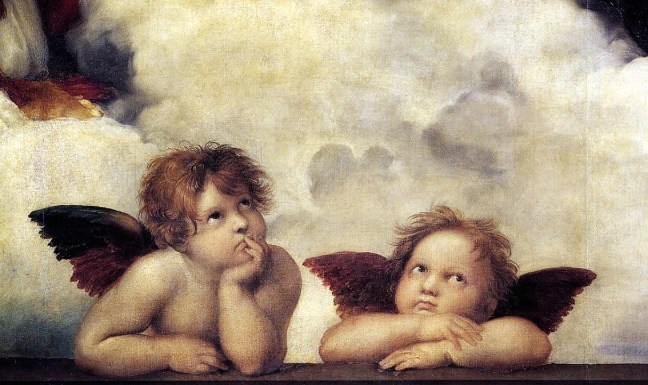
‘Putti, detail from The Sistine Madonna’ – Raphael, 1513 – WikiArt

.

γνῶθι σεαυτόν

.

Know thyself. Know who you are. That’s how simple it is. You may start from the far end, from a belief, a philosophy, an exotic term. You may call it religion, or spirituality, or non-duality — whichever name you want. You may go through the rugged path of belief, faith, practice, meditation, prayer, philosophy — all the names and concepts, the endless thinking about it, and the seeking that seems to never end. But now, when you stop and consider it all at last, you will come to the realisation that, deep down, it all comes down to that simple sentence. ‘Know thyself’. Not the knowing of your thoughts, ideas, opinions, feelings. Not your idiosyncrasies, or character, or outer shape, or preferences. None of that. To know oneself points directly to the knowing of your essence, of your innermost being, what you are made of at the core, when every other thing that can be pointed to has been discarded as superfluous. This is who you truly are. This maxim was once carved in golden letters on the front of the Temple of Apollo in Ancient Greece. That’s what this wisest of civilisations gave to the world as its supreme and most fundamental advice. ‘Know Thyself’.

So self-knowledge is the key. Of course, you may analyse it, take it apart, trace the endless chain of philosophers that gave their stand on this famous maxim, but I would not encourage you to do so. Sometimes, what’s really of crucial, definite importance resides at the simplest, closest address. The one you never truly considered for fault of being almost as nothing, a child’s play unworthy of your attention. Could it be that simple? That the meaning of the whole of life, the solution to our happiness, and the key to the whole riddle of existence could be found there, in the simple knowing of ourself? Let’s assume that it can and consider it seriously. Let’s embark on this shortest of journeys, the one going within, in the direction of our own self, where no distance is needed, no time necessary, and no special expertise required. This simple journey is the one of which the Ancient Greek poet and philosopher Ion of Chios wrote in the 5th century AD: “This ‘know yourself’ is a saying not so big, but such a task Zeus alone of the gods understands.”

[…]

A reverie that explores the path towards the knowing of our self… (READ MORE…)

.