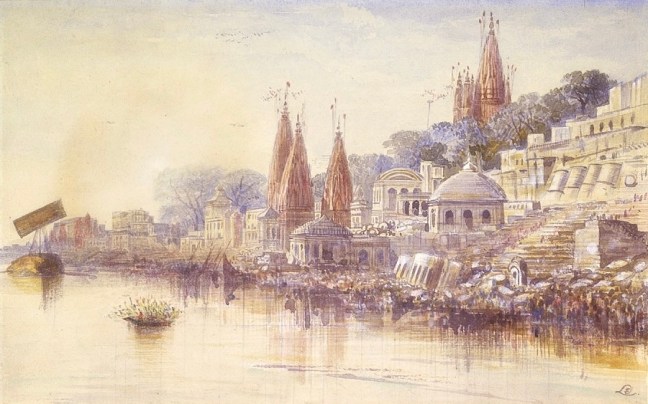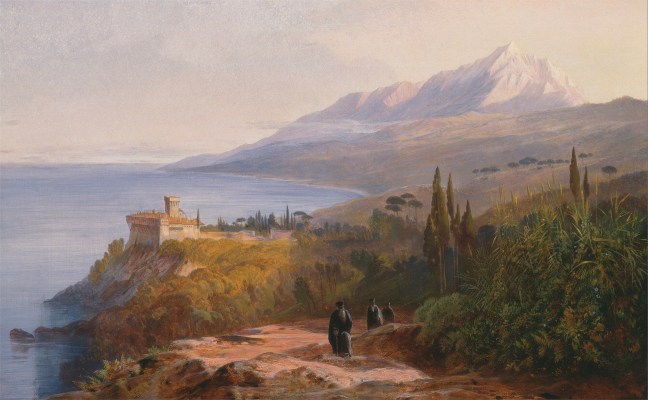
‘Mount Athos and the Monastery of Stavronikétes’ – Edward Lear, 1857 – Wikimedia
When the young Romanian Ioan Gutu arrived at Mount Athos to spend his life there as a monk, he was welcomed by his spiritual Father Elder Ilie with these few words: “Try to die here.” That’s what you do when you arrive at your true self, at your Mount Athos, you don’t form another thought about yourself, you stop looking for an identity, you don’t take refuge again in your mind, in your body. You leave all things, all identities, all beliefs behind. You stop reincarnating as a self separate from the world, for you have found that you were already fully, and wholly incarnated in being, in the selfless reality of your true nature.
In fact, the monastic life is only a metaphor for the truth of your living. You are required to spend your life and die there, because you cannot leave the reality of your own being. A monastery is a place where you reenact reality, where you know no separation, no ‘other’. You are alone, as the word ‘monk’ tells you in its etymology. It is where you know being to be the only place there is, no matter where you are, where you look. You lose your many pursuits and ambitions in being something, someone. You retire where you have never ceased to be, which is in yourself, in your nature, in the truth or reality of your infinite, undivided being. So this is the death that Ilie had in view for Ioan. “Try to die here”. Cease to be other than the One. Stay in your reality as it is, and spend your life there. Don’t leave who you are. Don’t go back to your life of separation, pursuits, hope, envy, comparison. This is prayer.
Wherever you are, try to die there. Don’t pursue your thoughts. Don’t go after anything. Don’t be enthralled by any object on the way. The way is what you are, where you are now, where you have already arrived. To die is to arrive where you are eternally, to stop believing in a destination. But this dying is a strange death. It is not the dying that you may have in mind, for there is no dying to your being. How would the One die? How would you die, if you have already ended all identification, every belief, thought, object, projection about yourself? What is left here that could die, when everything that you believed yourself to be, all your wrongdoings, have naturally, effortlessly ended? Could your essence, your deepest being die? Could that which is not a thing die? What is left here but the immortal, when everything mortal has been left behind?
Maybe there is another hidden twist in Ilie’s words. They could imply: ‘Try to die here if you can!’ You cannot. You cannot die in being, in presence. An appearance can die, but not that in which it appears. So, a monastery is where you can never die, never leave. It is where you leave behind all your many clothings of beliefs and identifications, all your wrongdoings — which is death. It is where you enter into the immortal and infinite nature of your true being — which is life. Everything else can die and follow its natural, mortal course except the One, of which the ‘everything’ is but a movement and a creation with a beginning and an end. So when you arrive at your Mount Athos, try to die here — in the One. When you enter, do your best to leave all your ‘mortals’ outside. Then find out that you can never die. John of the Cross said exactly the same thing upon ascending Mount Carmel:
“When thy mind dwells upon anything,
Thou art ceasing to cast thyself upon the All.”
~ John of the Cross (Ascent of Mount Carmel, I-13:12)
.
~~~
Text by Alain Joly
Title quote by Schema-Hieromonk Ilie Vulpe (1851–1928)
Quote by John of the Cross (1542-1591)
Painting by Edward Lear (1812-1888)
~~~
.
Websites:
– Mount Athos (Wikipedia)
– John of the Cross (Wikipedia)
– Edward Lear (Wikipedia)
Suggestion:
– Other ‘Reveries’ from the blog…
.