Boundary

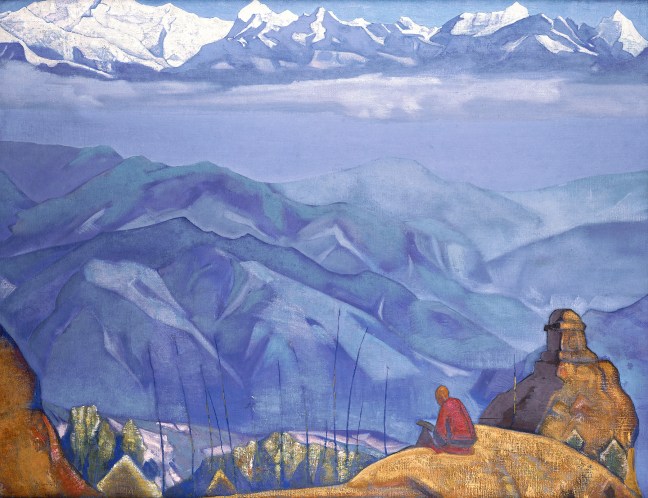
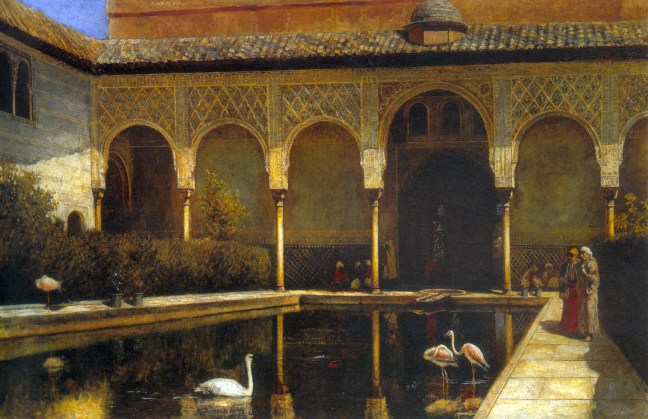
‘Book of Wisdom’ – Nicholas Roerich, 1924 – WikiArt

It is naive to imagine that there is a boundary or separation between consciousness and the world we are conscious of. It would be extraordinary to find that boundary, where our consciousness ends and where the outside world begins. We have an apparent and necessary boundary between body-mind and world, for our convenience, for practical purposes, and have left it there as an unquestionable fact. And everybody has complied, including scientists, that this separation must exist, that consciousness is a competence of the body, that it cannot be challenged, that it would be madness, beyond reason to do so. But there is an impossibility here. For this boundary can never be found at the deepest level, or even conceptualised. It is inexistant. Something like a pure invention. But this illusion of a separation was broken, seen through long ago, in the world of mind, of which our spiritual traditions are experts. Sages have seen long ago that there was here, between consciousness and the objective world, a seamless relationship, an undoubted oneness, no boundary, no separation, not even an unlikeness. It was all one with nothing besides it. The world is wholly contained in Mind, as Mind, and Mind or consciousness is all we are, all there is — our fundament.

So we have invented the reality of a world out of the reality of consciousness. After all, it is a beautiful find, a gorgeous dream, that we have a world, and that this world was shaped, sculpted by our five senses for as long as our senses have existed, and for as long as our bodies have been made the inevitable side effects of the appearance of a world. Everything — world, body, mind, senses — is an appearance in a more fundamental, non-objective reality. So nothing new, or other, or different was ever introduced in our reality. Reality is all there is. Consciousness is our playground, our only field or ground, and it is hosting everything in and as itself, including our apparent self. This is how we have a father and a son. A reality, and a temporary, individual, apparently located point of view on that reality. But between father and son, between reality and ourself, there is only one seamless consciousness. God has made sure that all things and beings find a habitation within him — or her. And then, ‘within’ was too taken away, for how would you have a within and a without when there is only the One?

So we have to meditate on the appearance of this world. On what is hiding behind it. On what it teaches us on our nature, on our reality, on our humanness. By the way, being human is by no means derogatory. In its most ancient Sanskrit root, the word for ‘human’ means: “The being whose essence is the capacity for self-remembrance of its divine nature.” So this knowledge of the reality of the world is a sacred knowledge. For with that knowledge firmly held, you can now enjoy personhood without the burden of separation, without the suffering that is its natural outcome. So we don’t have to be spiritual anymore. We have acquired our personhood, our humanness. Our nature has been realised, uncovered, in its primal, intended truth, and it is once and for all. Now we can enjoy a world for the first time. Now we can be lovers. Watchers. Listeners. Devoid of the superfluous. Free of our cumbersome, limiting beliefs. Recognising and accepting God’s will as our own. 

.

~~~

Text by Alain Joly

Painting by Nicholas Roerich (1874-1947)

~~~

.

Website:
Nicholas Roerich (Wikipedia)

Suggestion:
– Other ‘Reveries’ from the blog…

.

The Dream of a World

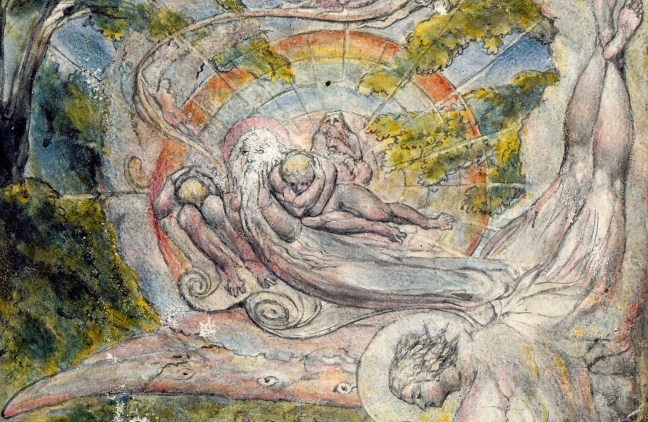
‘Milton`s Mysterious Dream’ (part) – William Blake, 1816-20 – WikiArt

There is a fraud in our life. An illusion that makes us feel that life is going to get better. That time or circumstance will bring us to a place of understanding, where our troubles will come to an end, where there will be betterment, improvement, change. To believe this will make us miss that we are already here and now in a place of no change, of no betterment, where nothing can improve or get better. This place is our very self, our sense of being that we have never been able to affect or modify, no matter how relentless our life has been, no matter our despair, our sorrow, our losses. Nothing we have gone through has touched it in any way. All our stories and sufferings have taken the shape of our thoughts and beliefs about them. But while we are desperately trying to give a form to our life, a solidity to our body, a reality to our problems, and a truth to our beliefs, right here and now, right where it all is seemingly taking place, hidden within experience, enveloping it all, is already a presence, a vastness, a reality that is embracing everything, and that is our only reality, our only place, our only possible self in this living experience.

For there is not a world there where we could be in. That would be a lovely idea, but the fact is: there is no possibility to prove the existence of such a world. We can only assert it, marvel at it through our senses, study it, analyse it, but of a solid proof there is none. The existence of a world is dependent on our perceiving it, and perceptions are contained in our knowing them. Without the knowing faculty, there cannot be a world. The whole glory and misery of the world, of the whole universe, is all gathered in that fathomless fraction of knowing, or awareness. Without that simple, ungraspable, dimensionless, ethereal element of knowing, no world could ever come into existence. So in fact, knowing is all there is, consciousness is the essence of every single appearance that comes to be seen, heard, touched, or experienced. The world is shaped, or its appearance created, through our being aware of it. So the whole of our living experience is but a dream in consciousness, a game that can be played and enjoyed at the level of our body-mind, but whose reality is only the awareness of it.

Now, where are we if we are not in a world? Where are we if the world is not even there? What is this something that we feel we are in, and exists, and is undoubtedly? What is a world, an experience, when we have passed through all illusions, all beliefs, all shaky appearances? What is left here that holds our experience, that is indomitable, indestructible, present without a shadow of doubt? This place is our self, what we are, our very essence, the reason behind our saying ‘I’. So we live in our self, not in a world. We see our limited existence pass and consume itself within that which is creating it, which is our own aware being, the knowing that we are and could never not be. And there, in ourself, in being, where the world takes its apparent form, is found what we have been looking for in every direction, in a non-existing world, in experience: a sense of relief, peace, beauty, love, and the understanding of our essence, the explanation of it all. An explanation that is not conceptual, but a living one, a subjective one, something made plain by being it. We and life then become self-explanatory. The fraud has been diluted. All imagination has died down. Now our living experience has acquired the rawness of truth. Something that is, unlike the world or our experience, beyond doubt and absolute.

.

~~~

Text by Alain Joly

Painting by William Blake (1757-1827)

~~~

.

Website:
William Blake (Wikipedia)

Suggestion:
– Other ‘Reveries’ from the blog…

.

A Safe Harbour

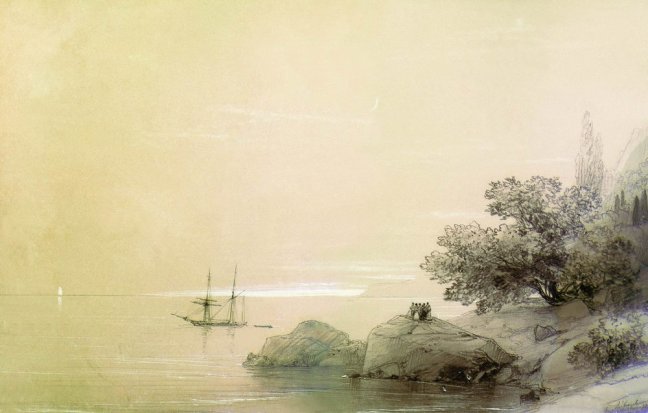
‘Sea against a rocky shore’ – Ivan Aivazovsky, 1851 – WikiArt

In our relative existence, we are always only a simple human being, a disciple of truth. We are seeking to merge the relative with the absolute, and to raise the finite where the infinite compels it to be. There is no being a super human, with a perfected soul. There is no being a specialist in the field of spirituality. The knower is a so shy and humble presence that it won’t show up when you are there. You will hide it with the boastful assertion of your own self. So if you want to espouse your true nature, you will have to feel yourself as almost nothing. You will have to stop reifying yourself, and make your person a servant of truth. There is a soothing freedom from pride and arrogance to be experienced in our human life.

The feeling of separation is what makes you assert yourself. To only and simply be is felt to be insufficient. You need to be or have something that makes you whole and happy, which you then seek through objects, qualities, qualifications, events, circumstances. To be somebody, to be important is the privilege of incompleteness. Being has no privilege, is not a superior position. it won’t make you anything. It won’t give you an advantage. You’d have to be miserable for that. You’d have to be limited. Your nature as peace doesn’t belong to you the person. When you have realised yourself as the one being that you truly are, then it won’t make you anything, it won’t give you a pedestal. Your knowing is in not knowing. In simply being.

There is a special, humble glory that lies in not being a self that feels separate. Peace is the perfume of your divine nature, that stands unaffected before the person that you happen to be. It is the nature that lends itself to the making of the world and to the selfing of its myriad of apparent entities. It is the secret power behind all appearances. Your nakedness is the key for its being seen and felt in your existence. You will then live from the stand of that knowing presence. Your self will cease feeling separate and superior. Your person will be depersonalised, will have infinity as its ‘I’ identity, and love as its guiding principle. But you won’t get any pride out of it, for your person is now devoid of its own, personal substance.

It is no accident that the life of many truth seekers is expressed through poverty and nakedness. In not possessing, in being undefended, as is the case for nuns, monks, hermits, anchorites. There is joy in not owning your own self, and your own identity. There is release in being at the service of the loving, silent being which you have discovered yourself to be. You have lost the prestige and identity contained in being a seeker. For there is no seeking in being. Being contains the gist of that which you want to obtain or achieve through your constant seeking — the juice of it. Being is the heart of life, and its reward. The Eden which you have placed far and away, as a cherished belief or possibility, is now found here, in the simple knowing of your being.

So there are no Shris, Maharshis, Bhagavans, Rinpoches, Maharaj-s, or Your Holiness, at the level of the person. There are even no sages. All these titles are only for ‘being’, for the reverence of truth, for the One. There is always only one Bhagavan. One Rimpoche. One sage. The peace contained in simply being is not another quality that is added to you as a person. A person, a body-mind, doesn’t have peace. Peace or understanding doesn’t belong to you. It is not for the person. It is all contained in that which lends you consciousness. It is in the presence that makes you, out of which you draw your personhood, and which allows you to love, live, and share. You are not an autonomous, self-contained person. You are infinity lending itself to a portion of finitude. How would an appearance be conscious, if it wasn’t for the presence which contains and creates this appearance? This peaceful, infinite presence is all there truly is. The One you have to bow to. Your teacher and your beloved. Your safe harbour in the storm of appearances.

.

~~~

Text by Alain Joly

Painting by Ivan Aivazovsky (1817-1900)

~~~

.

Website:
Ivan Aivazovsky (Wikipedia)

Suggestion:
– Other ‘Reveries’ from the blog…

.

The Birth of Personhood

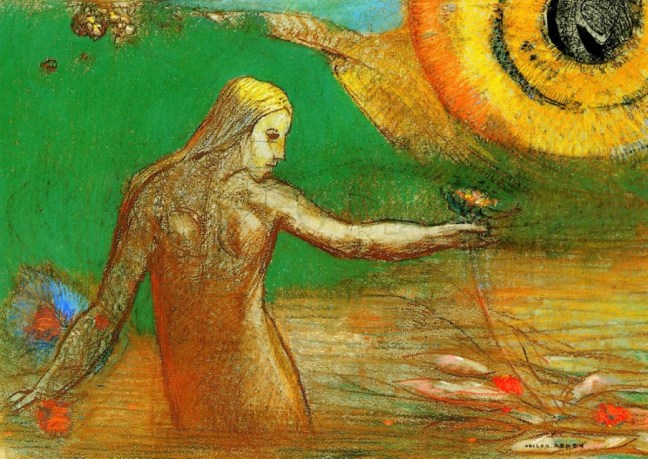
‘Flower of Blood’ – Odilon Redon, 1895 – WikiArt

It is consciousness — not body, not thoughts — that gives us the impression that we are a person with a continuity. There is absolutely no chance that a bundle of thoughts, feelings, and bodily sensations, could give us that impression. We borrow our personhood to consciousness, to the fact of being aware — to this light that creates us in the darkness that are otherwise thoughts, feelings, body. Our sense of continuity belongs to consciousness, to presence — that portion of ourself that is empty, unchanging, not objective, but full to the brim with itself. Our thoughts are but isolated events that are changing over the course of time, and so are our feelings and bodily sensations. The content of our mind is like a passing, unpredictable weather. So continuity in that area is absurd. Our essential self is to be found in and as being. What makes us is in that which is unmade. That impersonal part of ourself is what paradoxically gives us the chance of being a person. We are therefore nothing but empty, undivided being playing ‘being a person seemingly characterised by body and thoughts’. We have got it all upside down: Our person is not prior to consciousness. Consciousness is prior to our person, and the sine qua non of our existence or appearance.

Our thoughts are far away from each other, inconsistent, contradictory, confused, hesitant. They are not the voice of our self, are incapable of forming an identity of any kind. Our identity is to be found somewhere else, in something that we cannot get hold of, or limit, or name. The only thing that could link the different events of thoughts, feelings, sufferings, bodily sensations, and perceptions — all that for us constitute our self, a person with a name and form — is the presence of consciousness. We owe the impression that we are something solid, a real person, to emptiness, silence, stillness. So our person is actually non-existent, or rather has its existence in that which stands unseen between the happenings or events that we think make us. So our story, our thoughts, our body, become evanescent, losing their reality, disappearing within the experience of our massive sense of being — its coming to our attention. Being is seen to be the nature of ourself, which we had imagined in passing, isolated, impermanent, objective events and qualities. And believe me, that makes for a beautiful, gorgeous person — the one we have always wanted to be! A person is infinity being born.

The fact that there is a certain coherence in being a body-mind, and that we are able to live a life, is nothing but the expression of a play, a ‘lila’ as the Hindus are saying. We are nothing but a character in the hands of an actor. A body-mind is the little necessary to carry our wider identity to its term. In fact, all that we seemingly are — a person with an apparent life — is just the vehicle for a bigger quest. We are pretending a body-mind, so that we can realise our divine being. We are carrying infinity on our back, on the back of the finite, giving it the seeming, temporary life of an entity progressing in time and space. But this story, this appearance of a life, is but an excuse, something marginal that serves a wider purpose. We are meant to carry God on our shoulders for a while. At first unknowingly. Until we know God knowingly. Until God has acquired enough substance, and has sufficiently widened Its being in our life. Until God can in return carry us on Its own shoulders. And move us. And swallow us. Then, we find the security and courage to surrender ourself in God’s solid being and be like God Itself. We transfer our being in and as God’s being. And die there.

.

~~~

Text by Alain Joly

Painting by Odilon Redon (1840-1916)

~~~

.

Website:
Odilon Redon (Wikipedia)

Suggestion:
Other ‘Ways of Being’ from the blog…

.
Pathways

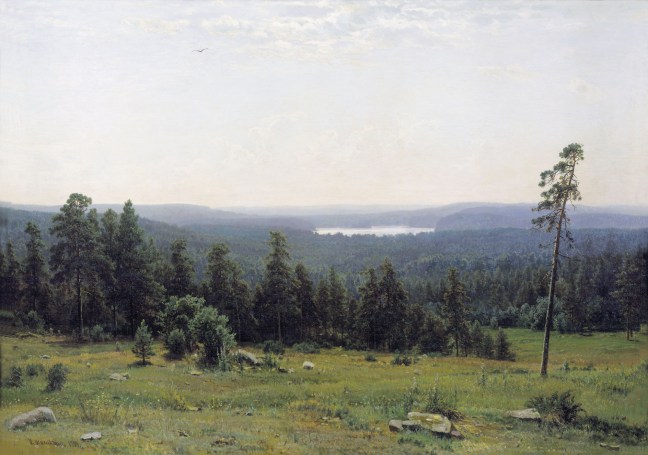
‘Court in the Alhambra’ – Edwin Lord Weeks, 1876 – WikiArt

The spiritual endeavour is really such good fun. You may happen to experience some suffering in your life and feel entangled — with thoughts rushing into your mind and problems seizing the entirety of yourself. The web of experience is overwhelming you and you can find no space to breathe within. You may then have to have a little conversation with yourself. You may have to disentangle yourself from your stubborn identification with thoughts and with the overcrowding objects born of the senses. That’s when you may present yourself with a simple question like: “What is this part in myself that is aware of my experience?” And so are you now taken amongst the scents of 8th century India, treading its immemorial dust with Shankara, debating with the great Vedantic master. He will show you how to move inwards right at the core of that aware presence in yourself. You will be taken with him to the core of this investigation, which is but the separation of the multiple objects of experience from the one aware, pervading presence of consciousness that is your true identity. That’s when Shankara leaves you with this one infaillible recipe:

.
I bow down to that all-knowing One
which is pure Consciousness, all-pervading, all,
residing in the hearts of all beings
and beyond all objects of knowledge.”
~ Shankara (Upadesasahasri, 1:1)

.
You may then find yourself sitting in your kitchen, cutting vegetables, with your thoughts suddenly wandering in the 17th century Paris, surrounded by the walls of a Carmelite monastery’s kitchen, chatting along with Brother Lawrence. He might tell you with his big generous smile: you know brother, “nothing is easier than to repeat often in the day these little internal adorations.” That’s when you understand that this investigation can be made into a joyful, often repeated practice, where you go and meet yourself within, have a little chat with this hidden presence, spontaneously, as you gaze into the eyes of a friend. Amongst the frantic sound of knives hitting the wooden board and the fumes of the next meal simmering on the stove, you meet Brother Lawrence’s glance offering you this last precious advice:

.
I renounced, for the love of Him,
everything that was not He;
and I began to live as if there was none
but He and I in the world.”
~ Brother Lawrence

[…]

Continue this journey into the investigation of your true nature… (READ MORE…)

.

God Unveiled

‘Illustrated Depiction of God with Holy Bettmann’ – Tintoretto, 16th AD – WikiArt

.
For many of us, god is nothing more
than the idea or belief we have inherited of such a being, an idea that is conditioned by religion as the lazy representation of an omniscient, omnipotent entity that is both our creator and protector — in the popular Christian imagery an old bearded figure who lives far and away from us, in a lofty, elevated place for a good view on its creation and creatures. The existence of such a god is almost only a matter of belief or faith, and the relationship we have with it one of reward and punishment, devotion, fear, prayer, praise, but rarely of understanding and exactitude. It seems that we better have god in a hazy place, feel more at ease with not knowing too much about the wisdom that may hide behind that term. So our ignorance is a calculated one, a refusal to rock the boat, and a patting of our carefully assembled opinions from which we derive our sacrosanct identity and security. But let’s tackle god here. Let’s undress the myth and have a thorough eye-contact with the divine. Let’s dare some experiential understanding. Let’s have god out of its hiding place.

Maybe god was never defined because it is the one thing in life that is indefinable. Everything objective that we can know, see, hear, touch, smell, taste — qualities and all — can be described with words and given a name. We have our life surrounded by objects. The objective has filled our experience to the brim, and we are being choked in it — with no breathing possible, and no space allotted to the unknown. God is one such unknown. But how could we describe something that we cannot know as an object? So to god we can only give a generic, provisional name. Because god cannot be pointed at and recognised as an object or entity. God is not an easy catch. The divine defies our understanding, and this defiance is at the core of our misinterpretation of god. So if you want to know god, you have to look for it in your life, and turn every stone and pebble that crowd your experience. So start by removing everything in existence that you can know, see, hear, touch, smell, taste — qualities and all — that have an objective quality and can be given a proper name. You know: everything that you can show to another fellow, and that he too can see, hear, know, understand, and comprehend, just like you. Take it all away, and then see what remains behind.

[…]

An explanation of the nature and reality of God’s being… (READ MORE…)

.

Finding Relationship

‘Hazy Relationship’ – Rinaldo Wurglitsch – Wikimedia

If you think you are having a relationship with another, you’re telling yourself a story. Literally. For this is what ‘relationship’ truly means: ‘to recount’, ’to relate’, ‘to refer’. More precisely, it means that something has been ‘brought back’, or ‘carried back’. So relationship is not an innocuous word. It expresses something fundamental, that for our relationships to be, we have to conjure up the past, or some kind of knowledge. We have to refer to something, to bring back some old memories, some kind of object or image. We have to bring the past into the now. And this is what we have done so far, to attach our relationships to some kind of reference to the past. We have learnt that we cannot be related to another outside the field of memory or images, without making concepts, without burying our relationships into the impasse of storytelling. But in fact, real relationship only takes place when we stop relating anything to another person or object. It is the moment when you are emptying yourself and the apparent other from the past or the future, which is from knowledge.

Relationship as we know it is a process that involves separation. It is an interplay between two entities that have been brought about, fabricated, their reality made into selves out of fear, habit, convenience, or ignorance. These objective, illusory selves are so brittle that they are incapable of making true connection. They are like empty shells with no real substance. The only possible connection between human beings is love. Just think about it for a moment. Why do we hug anybody? Is it because we acknowledge the powerlessness of words and rather mimic our deep connection through the use of body language and silence? How do you convey what cannot be conveyed? What can you do when words come short, other than fall into silence and cancel the space or division between you and another? This annihilation is the act of love itself. It is the acknowledgement of being or ‘isness’ as the only possible connection. It is the truth of ‘what is’ when all conceptualisation has come to an end, when memory has been brought to its knees.

True relationship is the flowering of consciousness. It is the coming to the foreground of the reality that stands behind all apparently existing things. It is the noticing of the reality that is here amongst beings and things — the ciment behind it all, the nature of everything, the deepest connection there is, before which all other connections pale into insignificance. The irony is that you can only have true relationship with another when you don’t make up a relationship, when you don’t bring in any idea or judgement, when you don’t invite fear or former hurts, or condescendence, or even respect for that matter. You must stay silent, empty of qualifications. You have to be who you truly are, to let the natural relationship of love come to the foreground and act itself out through you, and in spite of you. Let it carry you where you are, at the right place of your pure, innocent self where relationship is not anything you do but what you are as being. It is ‘what is there no matter what between beings’ — be they human or otherwise.

So be watchful of what you bring. For the qualities of the world will depend on the quality of your relationships. That’s how a world is being experienced — through relationships. So don’t start with yourself, with a self, any self, and relate from there, from this position of untruthfulness, of deceitfulness. You’d make an insane world. A world where we use, impose, abuse, misuse, mistreat. That’s how wars are launched, through biased relationships and crooked selves. See how fundamental relationship is, how it can make the world a place where hurt, anger, ignorance are being acted out. Or how it can make the world a place of peace, harmony and love.

.

~~~

Text by Alain Joly

Photo by Rinaldo Wurglitsch

~~~

.

Suggestion:
– Other ‘Reveries’ from the blog…

.