One Living Being

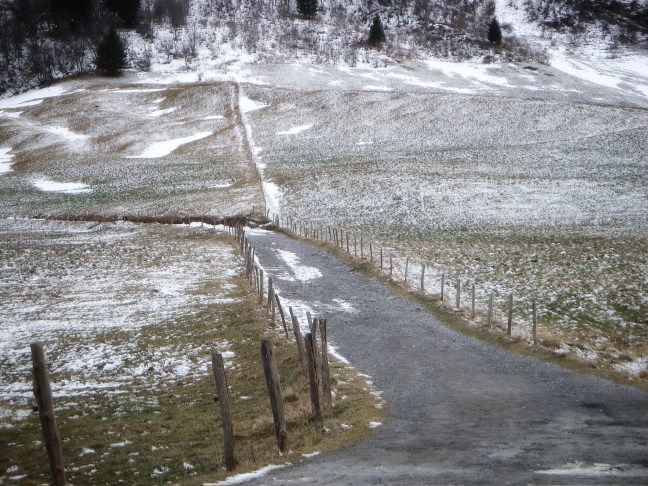
Truth is when the one who desires truth is not there. That one is a flaw. It is superimposed on the truth it is looking for, and veils it, makes it unreachable. It tramples it, literally. It makes it misty, obscure, mysterious. But truth is an obvious reality, if we don’t put it at a distance. If we don’t imagine it as something. Truth is not a thing, a concept. It is what we are — present, alive, real. Only we have to leave, recede, tiptoe. It’s all it takes, to not be boastful about it, to not think we don’t have it, to not assert the lie of our being someone. Being someone will push truth into the darkness, unseen therefore forgotten, hidden therefore to be sought. Our looking for it is the difficulty. Truth is to be approached with subtlety and utmost delicacy. Not that it is fragile, it is not. But it is sensitive to our feeling separate from it. It doesn’t like it. It shrinks at the thought of it, that we are looking for it, wanting it, being ambitious about it. Truth is not to be conquered, practised, refined. Truth is here fully dressed. It is our most fitting attire. The very being of our being. Massive. Obvious. If we let it open up, unfurl, spread its all-pervasive presence, and its creative, mind-blowing, self-evident, undeniable power and eminence.

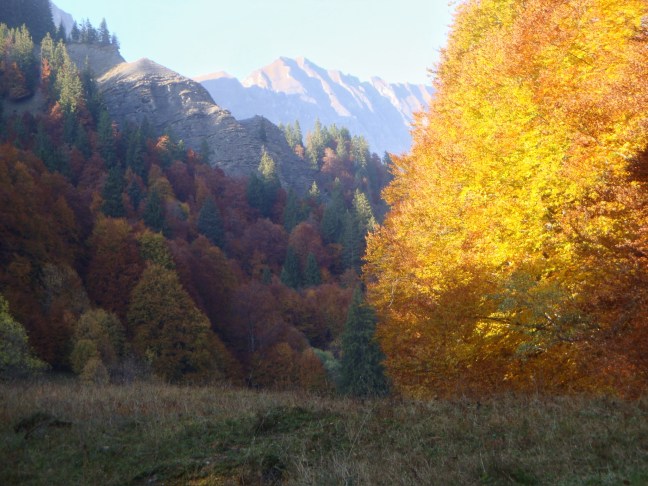
But if we think we’re not enough, well then we’re not enough. If we want to indulge in being a person, a poor me, then we fall from a great height. We suffer from being separated from our essence, our quintessence. We feel the burden of our constant, intrinsic, congenital seeking. It becomes our identity, to be a self seeking, to live in separation, to be fearful of this condition, and a believer of ideas. We live in our mind, struggle with our beliefs, conflict with experience. We are not what we should be, and we feel it, know it, dread it. And we are crippled by our impending death, which we cannot understand, fathom, and marvel at. So it really comes down to ending a belief, a simple belief, that cheated us. That our body, our thoughts, feelings, senses are substantial when they are but a dream. That our being finds its reality in our body and mind when our essential is not there. Our essential draws its reality from a presence that is infinite, eternal, unfathomable, loaded with love, peace, and a creative impetus. Nothing else than this presence is at play in our experience. We realise that we are just one living being, which cannot be divided, and has no other than itself. We realise that we are that, in spite of all evidence and impression. This self that we believe ourself to be is in fact secretly made of that, if the mist of its fallacious reality breaks apart and reveals its hidden nature. There is no separate, distinctive, solitary self. Only this shared, glorious one being. Then it falls into place that, for exemple, “I and my Father are one.” (John, 10:30) And that “In him we live, and move, and have our being.” (Acts, 17:28)

.

~~~

Text and photo by Alain Joly

~~~

.

Suggestion:
Other ‘Ways of Being’ from the blog…

.
On Desperation

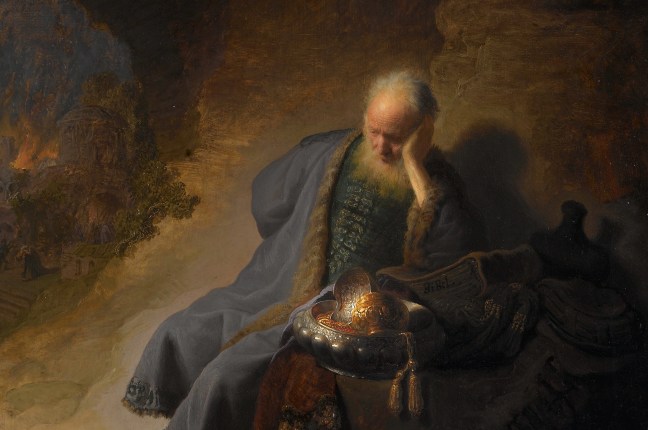
‘Jeremiah mourning over the Destruction of Jerusalem’ (part) – Rembrandt, 1630 – WikiArt

What needs to be seen and understood is that the story of humanity, the story of every life lived here under the sun, is the story of a desperation. We are fighting off the feeling that something is lacking. We want to reach or attain something, and this something that we are looking for is the same thing for everybody. Whatever form may take our life search, our drives, our dreams, our desires, our pleasures, they are all here to make us feel at peace, content, whole. They are here to free us from ourself, from our search, from our never-ending desperation. Outside, we may put on the appearance of control, normality, and responsibility, but inside we are burning, seeking, longing for that which we have never been able to put into words, explain, rationalise, or make sense of. But in fact, we are looking for something that we already possess in infinite quantity, although unknowingly. We are craving for the abundance that we already have, searching for a peace that is already given, begging for a joy that is throbbing unnoticed in the background of our everyday experience.

Our suffering or desperation is the symptom of this misunderstanding. We fail to notice that we have what we are looking for, that it is here in plain view, already achieved, already formed in and as our most intimate identity. Our self is made of that sweet fire of peace, contentment, and sufficiency. So the misery we are in is only apparent, imagined, made up by our thinking about it, and by our looking for peace unnecessarily, out there, in the wrong place, in experience. There is no amount of effort that will ever help us to attain something that is already attained. On the contrary, the disturbance involved in seeking what we have will cause us misery, in the form of a desperate, separate sense of self. We are too eager. We never sit still, always foraging our experience to harvest some scattered drops of peace or joy, when our very being is already overflowing with them.

The only necessity, or even possibility of being a self separate from experience is through managing the tension involved in seeking a peace that is already our most intimate nature. Our self is the story, the memory of this seeking. When peace is here, there is no self present, no tension that could make us a suffering entity. In fact, we seem to proceed by distraction. We are not looking, and then we complain that it is not there. All our efforts to obtain an enduring peace in our life are vain and doomed to failure for the simple reason that peace is not a thing that can be had. Peace is something that we have to realise is present here and now. It is our vey being, what we are made of, our unborn reality. So there is no real, substantial suffering here to be rid of. It is not that suffering is not experienced. It is that its only reality is only in and as our imagined self. It is but the friction that goes with believing to be a separate entity. Suffering is essentially made of our believed self, which is but our constant seeking to alleviate this apparent misery. The ending of the belief in being a self, which is also the ending of time, space, and separation, will make fully apparent our nature as peace and happiness, in which there can be no suffering, no self, no seeking, no desperation.

.

~~~

Text by Alain Joly

Painting by Rembrandt (1606-1669)

~~~

.

Website:
Rembrandt (Wikipedia)

Suggestion:
– Other ‘Reveries’ from the blog…

.

Spiritual Wine

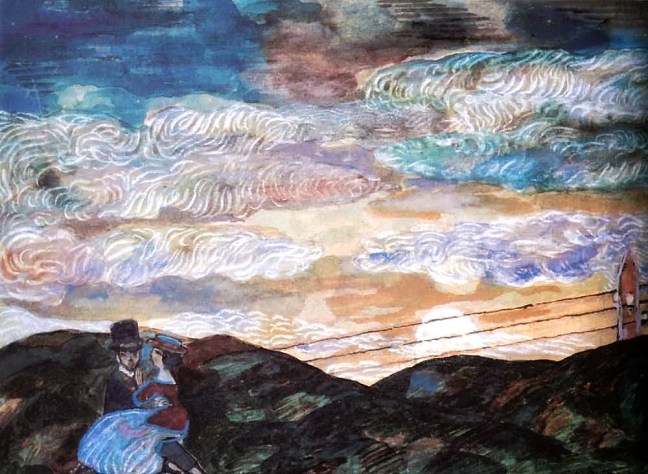
‘Lovers under the moon’ – Serge Sudeikin, 1910 – WikiArt

The word ‘spiritual’ is quite a nebulous one. It is used indiscriminately, carelessly, for a bewildering array of wildly different practices or beliefs. Krishnamurti didn’t like the word, which he found ‘ugly’, ‘romantic’, ‘unpleasant’, and used it cautiously. So maybe the time has come to clean the word, to give it some of its forgotten brilliance, and dig out its original meaning and raison d’être. I would start with the suggestion that the word ‘spiritual’ simply wants to point something at us: that the world, the whole of it, our experience, everything, is in fact made of ‘spirit’. Spirit is all there is, the only thing in presence. And believe me, this is a timely pointer, for most of us believe the world to be a hard reality, made of something solid, composed of a variety of different objects — our body-mind being considered one such object. So the word has the virtue of reminding us of our true nature, of the nature of everything as spirit, or consciousness.

But it is only a provisional word, one for our time of misunderstanding. There will come a time when the suggestion that experience is made of spirit will be a matter of fact, something integrated, not to be thought about anymore. The word will then become redundant, to be replaced by another word of a higher intensity and meaning. Or maybe there won’t be any need for a word to describe reality. Reality will have been understood, digested, lived as the fact of simply being. Spirituality will have become useless. There will be no need of spirituality, no need even of the word ‘happiness’, or ‘peace’. Once you are wholly, and only spirit, which is peace, which is happiness, what need is there to mention it? There will be no seeking either. After all, what you are, you are. Identity will have been achieved. No suffering around. Seeking obsolete. Out of date. To be disposed of. What will remain is a splendour, indescribable, filling the world of experience to the brim with its essence.

Also, spirit means ‘breath’. It is the breath of life, a thing invisible, transparent, quietly sitting in the background, and yet essential and life-giving. It is what is playing us, giving us an identity and a sweetness of living. For spirit is like the air we breathe. It is still, silent, empty, yet a breath that can blow our mind and make us like an inextinguishable fire. It is the breath of god that we have left unnoticed time after time, but whose presence is holding us in its firm embrace. It is a breath of devastating effects, laying us waste, destroying all traces of suffering and separation, blowing our self away, not by slaying it but by showing this self to be just the air within the divine breath of god. You had thought yourself a hard, solid, but fragile entity, and are now shown to be empty yet as indestructible as is a fire in the wind. That’s what being spiritual, or spirit-like, truly means.

Spirit also means character, and courage. It doesn’t pretend, and rejects a lukewarm understanding. It is uncompromising and free. It is not afraid, not conditioned by the hazards of life. It stays firm, alone, whole, undisturbed. Spirit is eternally high, but mingles with the lowly too, for it is humble by nature. And it has clarity as its best asset, for it is blessed with the purity contained in knowing without being itself a knower. This knowing is undivided, self-contained, total, applying to all and everything. This is what makes it holy, a spirit which cannot be taken apart, and which contains universes beyond universes. It has a religious quality, a sanctity that is beyond what humans have called sacred. The wholeness of spirit cannot be broken, dampened, violated, injured, or even changed. Its holiness lies in the fact that it is one without any division or addition.

And spirit is music too. It has a sound to it, and it is our duty to play it, or rather being played by it — the musician being god, or spirit itself. Our being is found to be the breath of god, the movement of consciousness singing our life on the reed of our apparent self. As that, we may become the vessel of a life whose notes have risen above the ten thousand things of existence, to be taken by various harmonies of silence, peace, love — all carried by a quiet but devastating breeze of inner joy, like a hum. We are like God’s music, and our experience is bathing inside it, and being made melody. This is what spirituality is, and what a life lived in and as spirit sounds like.

‘Tis the fire of Love that is in the reed, ‘tis the fervour of Love that is in the wine”, Rumi once wrote in the Masnavi. So spirit is a delightful beverage too. It is what gives us this gentle drunkenness which is the state of our self when it recognises itself to be but God’s being. In Spirit, we are intoxicated by the ‘Love that is in the wine’. For this nectar, we are willing to pay the price of surrender at the tavern.

.

~~~

Text by Alain Joly

Painting by Serge Sudeikin (1882-1946)

~~~

.

Website:
Serge Sudeikin (Wikipedia)

Suggestion:
– Other ‘Reveries’ from the blog…

.

The Face of the Infinite

For many things in life, we are exigent, demanding. We won’t let things be as they are. We are picky — we want more and better. We expect, hope, resist, desire, and are rarely satisfied. We are seekers of advantageous situations, and have a good idea of what they can be. Yet when it comes to ourself, to knowing who or what we are, we lose all inquisitiveness. We take ourself for granted. We may want to be more loving, less violent, have more of the good qualities, and less of the bad ones, but who is the ‘I’ that desires these things, we don’t want to know. Maybe we have an intuition that there is great danger in uncovering our true identity. After all, it was never talked about, a sort of family secret that society doesn’t want you to interfere with. Even religion is not clear about it, that encourages you to rather follow, pray, and submit yourself to God, but not to know who you are. At least not in a clearly stated way. You may know about anything you want, but please keep yourself out of it. In fact, ‘Know Thyself’ is the least encouraged commandment in this world of ours, and that alone should be enough to fuel our curiosity.

So who am I? What is my identity? What is this last part of my experience that is yet to pioneer and fully settle in? Which has remained untouched, virgin of our constant and fanatic rummaging? Which hasn’t yet been recognised for the simple reason that it is not a place we can know, let alone go to? It is so ourself that it cannot be seen, felt, experienced as something objective, or as an entity. This land of ourself has slipped out of our attention. We are blind to our eternal home. We have left behind us, untackled, unidentified, in the darkness of our wilful mind, the vibrant sky of our being. So what is my true identity? What is this unchanging substance that is the formless form of my being? In other words, what am I identical with, or the same as? ‘Same’, in its most ancient etymology, has the meaning of ‘one’. So we can rule out all the separate, isolated objects that we project ourself to be — that includes our body and our mind, and the many thoughts we’re thinking. Our identity is not in something which we identify with, but in the expression of oneness — the one being that is by definition free from all identification. This identity with the One has been achieved from time immemorial. We don’t need to come back to it, to rehearse it, or affirm it. Our identity has dissolved into the One, which is identified with no other than itself.

Where does unity or oneness live in my experience? In what portion of my conscious being can I feel an absence of otherness? Where do I find in myself no distinction, variation, or divergence, not even a breach that would differentiate me from reality? Where am I wholly and only being? What is it that I truly am, with no intervention of a past or a future? Where is this within that is also without? What is this ‘I’ that I could never ever cease to be? Who am I when all objectivity and multiplicity have died down? Where do I find an absence of ‘me’ in myself? Or rather, where do I find a sense of ‘me’, in me, that is not already the ‘me’ of everything and everyone? Where am I when every remnant of a seeking mind has left? Where do I find an individuality that is not universality? Where could I not find God’s presence in my experience? Where is this ‘where’, where I can never say where, what, when, how, why to what I am? And lastly, where have now all my questions dissolved? Only settle for a living, silent answer. Any other verbal or conceptual answer at this point would ruin it all. It would be like slamming the door in the face of the infinite.

.

~~~

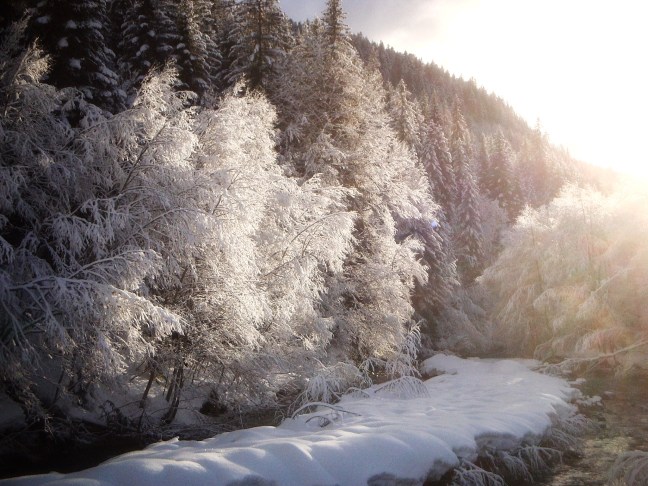
Text and photo by Alain Joly

~~~

.

Suggestion:
– Other ‘Reveries’ from the blog…

.

The End of Self-Improvement

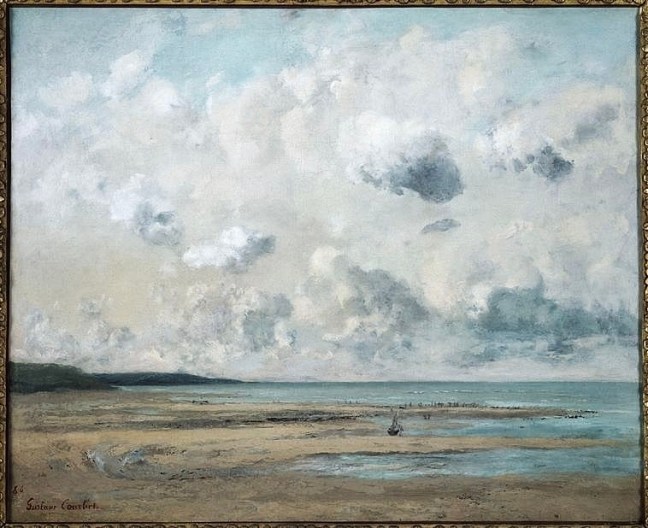
‘Shores of Normandy’ – Gustave Courbet, 1866 – WikiArt

.

To know that your Self has not changed,
this illustration itself is enough.”
~ Ramana Maharshi

.

There is no ameliorating emptiness, developing the unborn, aggrandising what is, and expecting the timeless to be anything more or different than what it is. Being leaves no room for improvement because it is not a thing, it is not a result, a something that has a cause. How do you improve the non-objective? How does the infinite progress? How do you make better a self that is absent as self — as something different or separate from experience? So self-improvement is a misunderstanding and a form of violence. It is an imposition, a belief that we squeeze to fit our idea of reality, an objection to the innate perfection of what is. It is mind-made, a product, a progeny of conditioning. It is designed for the continuation of our belief in being a self or entity that can be objectively defined. And remember this: every object, every ‘thing presented to the mind’ — as Latin word ‘objectum’ stands for — is in fact nothing but something thrown in the way of your knowing who you are. This is the meaning of Latin ‘obicere’ — ‘ob-‘: ‘in the way of’ and ‘jacere’: ‘to throw’. The self that you believe yourself to be, and that you strive to improve, is your hindrance. It is what makes you blind to your true nature.

To improve on a self is to make it continue, it is to give it credit, to give it the existence it never had. After all, we all want to feel real, to see that we can act, and have a power on our self. So we have the desire to consolidate and sculpt our being through rendering it an object that we can manipulate. We want to make a profit of our self, and see a return on our investment. In fact, to improve myself is nothing but a form of merchandising. It is a trade and a transaction. It is retail management, the ‘cutting off’ of our self with the aim of maximising profits. But don’t ever forget that if you are able to improve yourself, you can therefore also make it deteriorate, worsen, decline, decay. So what then?… is self-improvement decay, error, illusion? Is it ourself going astray, being mislaid? Are we really so sure that our being could ever decay? That awareness is a so fragile thing?

[…]

On how there is no improving our self and being… (READ MORE…)

.

The Story of It All

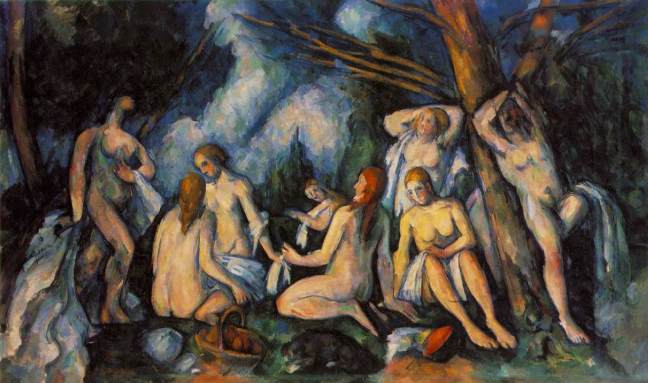
‘Large Bathers’ – Paul Cézanne, 1905 – WikiArt

There is a hidden presence everywhere we go, that hides within our experience. It is concealed within its own shining, and is the reason for our seeing and experiencing anything. It seems to be woven into our very being, to have married its being to our being. Would we want to separate ourself from it, that we wouldn’t know where to go. In fact, there is no way outside ourself. We have it all here as we are. Our life is unfolding within that which is ‘myself’. We are the garden of our self, of all our human endeavour, of our quest and of our finding, of our lack and of our glory. All that we live for, when reduced to its core target, is to be relieved from our chronic sense of not having enough. We feel there is a thing here to be found, without knowing what it is. So we become blind to ourself, and are consequently driven into the world, seeking there in the distance of time or place, what is already here in and as our very self. We are our own hidden remedy, our secret paradise. We have shrouded the infinite within ourself, and are erring within our own misconception.

In fact, we have been misled by our having a body, imagining us inside it rather than it inside us. We have belittled ourself, have lost faith, squeezing ourself into a thought that we have aggrandised to being an entity. We are a trick of the mind — nothing more — and have lived caught within our own creation, struggling inside our own mistake, wrestling with a world that we have stripped of its essence. We have divided our experience into separate objects, and have reduced ourself to being one such object. Now we are striving to unravel our own mistake, to defeat our foolish, unfortunate belief — hence our suffering and our struggling. Our life has been made into a scream for peace and justice, and the silence of simply being has retired within us, into the hiding place where we have pushed it. We have shied away from our truthful nature, and wandered off from simply being naked being. We have clothed our emptiness with the garment of a self delineated by thought and identification. We have limited the infinite to our convenience, and squeezed eternity into the burden of time.

But there is a dawn here just as we are. There is a light ready to overcome our night. For we never got lost far from our home, never took our stand away from our own being. So our journey is always only the shortest step from ourself to ourself. We have to return where we never left. We have to get acquainted with ourself, with who we truly are, and get accustomed to our being — much wider than we ever noticed. We have a sky at our disposal when we have dismissed the thousands fascinations and identifications with everything that is at a distance from ourself, and is the prey to our mind and our senses. There, curled within and prolonged without, treated so far with contempt, is our own indomitable self. There, trampled by a belief about ourself that we have imposed on everything, is a magnificence. There, is the being of our being, what we-the-seeker have sought everywhere except in its own place of living, which is ourself. We have missed it because it was the last thing investigated, the last stone lifted, for being too close and intimate. Who could have thought that the sought was the seeker?

Now we only have to be that ground of being alone, at the exception of all that is moving and changing in it, and that isn’t us, not truly us. We only have to sink beneath the moving sea of our multiple, insatiable experiences, and let ourself reach that part of ourself that cannot be known or possessed, and is yet our undeniable self and identity. Here we discover that our being is the being of everyone and everything, and that we are bound to this totality by love. Here every single thing in our experience is unraveling itself back to its essence, taking its right place within it — and that essence is found to be our essence. And god’s being too finds its right place and meaning in and as ourself — and we too have our place in god. And our so precious peace is now teeming as our own being, and justice is found right under every step we are taking. Now we have silence as our very best companion, and our seeking — which was our suffering — has been buried under it. Now we are right where we were supposed to be when the world became a world, and the son of god became a woman or a man. And now…

Now let me rest and live and walk the world as I am, alone and one, and all in I.


~~~

Text by Alain Joly

Painting by Paul Cezanne (1839-1906)

~~~

.

Website:
Paul Cezanne (Wikipedia)

Suggestion:
– Other ‘Reveries’ from the blog…

.

Entangled Life

There’s been a trend here for millennia. I would call it the trend of entanglement. Or maybe it is rather a habit, a belief, an erroneous view that we are bound, attached, entangled to our life, to its situations and circumstances. We are enmeshed in our thoughts, worries, conditionings, capacities, habits, patterns of living from which we get no release. Thankfully our sleep comes timely everyday to deliver us from the demon of entanglement. Yet we have to bow to the evidence that our perpetual seeking is nothing but our repeated attempts at freeing ourself from the prison of entanglement. We have tied ourself to its relentless effects, and are suffering consequently. We have failed to see that our entanglement is born out of our belief in being separated from the life we are in. We most of the time feel alone, detached, broken up, disconnected from our surroundings which as a result challenge us, and against which we have to fight, or from which we must repeatedly flee into further separation. That’s the life we live in for the most part. That’s what we have. An entangled life.

Now, the reason we feel so overcome and ruled by our circumstances — and often defeated by them — is that we take our many entanglements for a reality. Through our being a person, we have made everything that is ‘other’ a possible threat or cure, and live therefore in constant insecurity — hence our compulsive seeking or avoiding. But we haven’t gone far enough, to find out that there is a supreme, sacred entanglement, which ties us to our self in an irrevocable way. This entanglement with our being is devoid of all previous entanglements. It ties us in an embrace so total that our person feels merged with the being it is made of, and discovers itself to be not there, or rather to be only one, undivided being with no need or possibility to be tied to anything but itself. That’s how the feeling of being entangled is vanquished: by a more radical, ultimate, terminal form of entanglement. An entanglement with no entanglement in it, for it has disentangled itself from all objectivity or otherness, and be made into a subjectivity so absolute that it has only itself as a possible other — which means no otherness at all. This absence of otherness is the surfacing of a life that we discover to be devoid of inner suffering or conflict. It is a life of freedom, untied, disentangled, and therefore spacious, peaceful, and bound only to its essence, which is love.

.

~~~

Text and photo by Alain Joly

~~~

.

Suggestion:
Other ‘Ways of Being’ from the blog…

.