Spiritual Wine

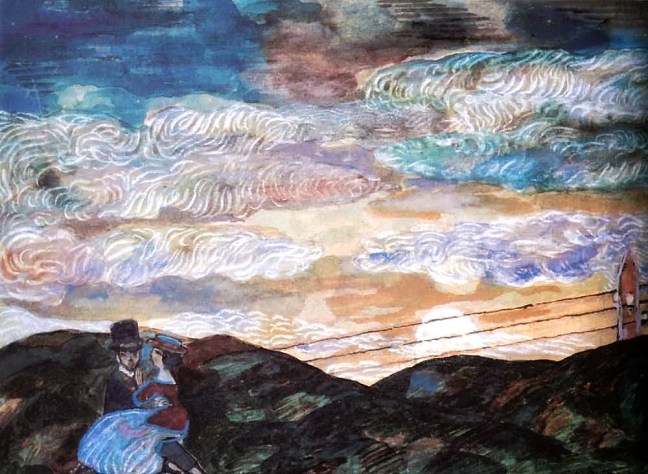
‘Lovers under the moon’ – Serge Sudeikin, 1910 – WikiArt

The word ‘spiritual’ is quite a nebulous one. It is used indiscriminately, carelessly, for a bewildering array of wildly different practices or beliefs. Krishnamurti didn’t like the word, which he found ‘ugly’, ‘romantic’, ‘unpleasant’, and used it cautiously. So maybe the time has come to clean the word, to give it some of its forgotten brilliance, and dig out its original meaning and raison d’être. I would start with the suggestion that the word ‘spiritual’ simply wants to point something at us: that the world, the whole of it, our experience, everything, is in fact made of ‘spirit’. Spirit is all there is, the only thing in presence. And believe me, this is a timely pointer, for most of us believe the world to be a hard reality, made of something solid, composed of a variety of different objects — our body-mind being considered one such object. So the word has the virtue of reminding us of our true nature, of the nature of everything as spirit, or consciousness.

But it is only a provisional word, one for our time of misunderstanding. There will come a time when the suggestion that experience is made of spirit will be a matter of fact, something integrated, not to be thought about anymore. The word will then become redundant, to be replaced by another word of a higher intensity and meaning. Or maybe there won’t be any need for a word to describe reality. Reality will have been understood, digested, lived as the fact of simply being. Spirituality will have become useless. There will be no need of spirituality, no need even of the word ‘happiness’, or ‘peace’. Once you are wholly, and only spirit, which is peace, which is happiness, what need is there to mention it? There will be no seeking either. After all, what you are, you are. Identity will have been achieved. No suffering around. Seeking obsolete. Out of date. To be disposed of. What will remain is a splendour, indescribable, filling the world of experience to the brim with its essence.

Also, spirit means ‘breath’. It is the breath of life, a thing invisible, transparent, quietly sitting in the background, and yet essential and life-giving. It is what is playing us, giving us an identity and a sweetness of living. For spirit is like the air we breathe. It is still, silent, empty, yet a breath that can blow our mind and make us like an inextinguishable fire. It is the breath of god that we have left unnoticed time after time, but whose presence is holding us in its firm embrace. It is a breath of devastating effects, laying us waste, destroying all traces of suffering and separation, blowing our self away, not by slaying it but by showing this self to be just the air within the divine breath of god. You had thought yourself a hard, solid, but fragile entity, and are now shown to be empty yet as indestructible as is a fire in the wind. That’s what being spiritual, or spirit-like, truly means.

Spirit also means character, and courage. It doesn’t pretend, and rejects a lukewarm understanding. It is uncompromising and free. It is not afraid, not conditioned by the hazards of life. It stays firm, alone, whole, undisturbed. Spirit is eternally high, but mingles with the lowly too, for it is humble by nature. And it has clarity as its best asset, for it is blessed with the purity contained in knowing without being itself a knower. This knowing is undivided, self-contained, total, applying to all and everything. This is what makes it holy, a spirit which cannot be taken apart, and which contains universes beyond universes. It has a religious quality, a sanctity that is beyond what humans have called sacred. The wholeness of spirit cannot be broken, dampened, violated, injured, or even changed. Its holiness lies in the fact that it is one without any division or addition.

And spirit is music too. It has a sound to it, and it is our duty to play it, or rather being played by it — the musician being god, or spirit itself. Our being is found to be the breath of god, the movement of consciousness singing our life on the reed of our apparent self. As that, we may become the vessel of a life whose notes have risen above the ten thousand things of existence, to be taken by various harmonies of silence, peace, love — all carried by a quiet but devastating breeze of inner joy, like a hum. We are like God’s music, and our experience is bathing inside it, and being made melody. This is what spirituality is, and what a life lived in and as spirit sounds like.

‘Tis the fire of Love that is in the reed, ‘tis the fervour of Love that is in the wine”, Rumi once wrote in the Masnavi. So spirit is a delightful beverage too. It is what gives us this gentle drunkenness which is the state of our self when it recognises itself to be but God’s being. In Spirit, we are intoxicated by the ‘Love that is in the wine’. For this nectar, we are willing to pay the price of surrender at the tavern.

.

~~~

Text by Alain Joly

Painting by Serge Sudeikin (1882-1946)

~~~

.

Website:
Serge Sudeikin (Wikipedia)

Suggestion:
– Other ‘Reveries’ from the blog…

.
Pathways

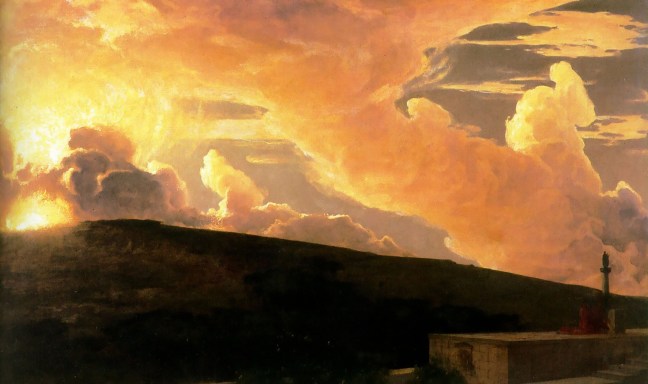
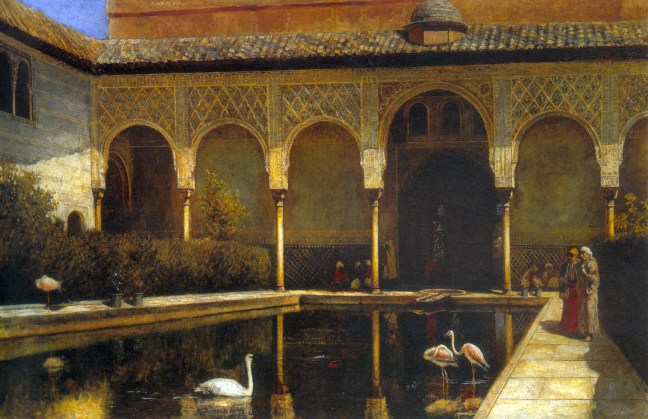
‘Court in the Alhambra’ – Edwin Lord Weeks, 1876 – WikiArt

The spiritual endeavour is really such good fun. You may happen to experience some suffering in your life and feel entangled — with thoughts rushing into your mind and problems seizing the entirety of yourself. The web of experience is overwhelming you and you can find no space to breathe within. You may then have to have a little conversation with yourself. You may have to disentangle yourself from your stubborn identification with thoughts and with the overcrowding objects born of the senses. That’s when you may present yourself with a simple question like: “What is this part in myself that is aware of my experience?” And so are you now taken amongst the scents of 8th century India, treading its immemorial dust with Shankara, debating with the great Vedantic master. He will show you how to move inwards right at the core of that aware presence in yourself. You will be taken with him to the core of this investigation, which is but the separation of the multiple objects of experience from the one aware, pervading presence of consciousness that is your true identity. That’s when Shankara leaves you with this one infaillible recipe:

.
I bow down to that all-knowing One
which is pure Consciousness, all-pervading, all,
residing in the hearts of all beings
and beyond all objects of knowledge.”
~ Shankara (Upadesasahasri, 1:1)

.
You may then find yourself sitting in your kitchen, cutting vegetables, with your thoughts suddenly wandering in the 17th century Paris, surrounded by the walls of a Carmelite monastery’s kitchen, chatting along with Brother Lawrence. He might tell you with his big generous smile: you know brother, “nothing is easier than to repeat often in the day these little internal adorations.” That’s when you understand that this investigation can be made into a joyful, often repeated practice, where you go and meet yourself within, have a little chat with this hidden presence, spontaneously, as you gaze into the eyes of a friend. Amongst the frantic sound of knives hitting the wooden board and the fumes of the next meal simmering on the stove, you meet Brother Lawrence’s glance offering you this last precious advice:

.
I renounced, for the love of Him,
everything that was not He;
and I began to live as if there was none
but He and I in the world.”
~ Brother Lawrence

[…]

Continue this journey into the investigation of your true nature… (READ MORE…)

.

The Highest Language

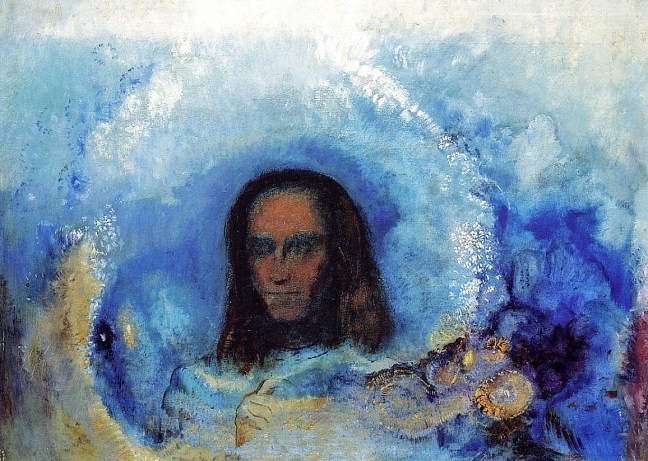
‘Silence’ – Odilon Redon, 1911 – WikiArt

In our language, the word ‘silence’ is defined as the complete absence of sound, or the abstinence of speech. Yet silence has fascinated us beyond these elementary descriptions to evoke the unknown and the mysterious. Something in silence speaks to us, and is a presence beyond its apparent nature as absence. Spiritual teachers from all traditions have abundantly used the word for its richness of meaning and its powerful evocative dimension. So pregnant and profound is this experience of silence that the word has often been likened to awareness or the nature of god’s silent being. Among others, Ramana Maharshi has often pointed silence as being the ultimate teacher in these matters, and Krishnamurti has described it in supremely effective and graceful words just below. This page is dedicated to their many expressions of silence:

~~~

The experience of silence alone is the real and perfect knowledge.”
~ Ramana Maharshi (‘Be as You Are’)

~

Keep silence, that you may hear Him speaking
Words unutterable by tongue in speech
Keep silence, that you may hear from that Sun
Things inexpressible in books and discourses.
Keep silence, that the Spirit may speak to you
.”
~ Rumi (‘Masnavi i Ma’navi’)

~

Accept what comes from silence.
Make the best you can of it.
Of the little words that come
out of the silence, like prayers
prayed back to the one who prays,
make a poem that does not disturb
the silence from which it came
.”
~ Wendell Berry

[…]

Read these many quotes on silence by various teachers… (READ MORE…)

.

The Angel of Death

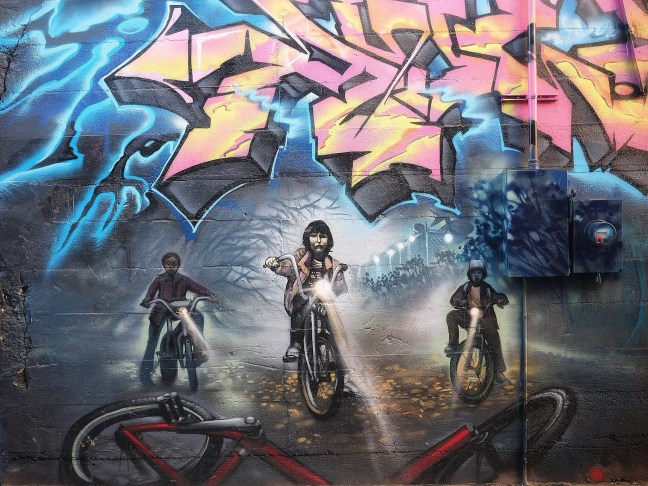
‘Stranger Things Graffiti’ – Paul Sableman (Jher Seno & the Arty Deeds) – Wikimedia

.

A myth is a mask of God, a metaphor
for what lies behind the visible world.”
~ Joseph Campbell (‘The Power of Myth’)

.

There is an astounding profundity in popular culture. It is just for us to see when it pops up, when it arises above the sea of confusion that our life is for the most part. What is designed to be just light entertainment, what appears to have no depth or consistence other than being an easy escape out of ourself, can hide the brightest of gems if we can elevate ourself to its hidden meaning. I stumbled across one such meaningful gem recently.

Running Up That Hill’ is a song created by pop singer Kate Bush in the eighties. It recently got a second life and triumph by appearing in one scene of the famous sci-fi thriller series ‘Stranger Things’. In this particular show, there is a hideous monster that roams in an imaginary city, and feeds on the minds of teens deeply affected and traumatised by their past, luring them into its parallel and ultimately illusory reality. In that particular scene, the girl is trapped in some dark chamber of her mind. The ugly beast keeps her prisoner there — a cave like place where she is about to be engulfed in the monster’s hideous mind. She manages to escape the grip and run towards an opening in the distance where is her true self and salvation. Pieces of rocks are falling all around her to stop her course, but she keeps running one-pointedly ahead while hearing Kate Bush’s song ‘Running Up That Hill’. The reason for her escape is to be found with her friends playing this song she deeply loves, and creating in her that powerful call and incentive.

Why does a particular blend of a scene and a song suddenly hit a target, move people beyond what could be possibly expected? Just one glance in the comments of that particular scene on YouTube makes it clear: “Best scene of the series”, “This scene made me want to live”, “Cathartic”, “A metaphor for what’s battling your mind”. Why does anything hit us and move us to feel in ourself a feeling of being alive? Tears may come, a feeling of thankfulness, maybe even some sense of profound happiness. What is tilting in our minds in these ineffable moments is the recalling of our life’s most essential meaning and purpose, and the remembering of a place in ourself that we have neglected. This place is the forgotten but obvious target for all our thirsty mind-arrows. It is the open space of our deepest being that we keep missing at every moment of our lives, precisely because of its total intimacy and openness. How do we manage to miss it? Because we focus on the periphery of objective experience. We are enclosed in a dark chamber of our own making that lures us into itself, and makes us fragile, hopeful dreamers with fearful minds, forever caught in the prospect of impending death.

[…]

See how popular culture is infused with non-dual reminiscences… (READ MORE…)

.

Humanity’s Healers

‘Clytie’ – Frederic Leighton, 1890 – WikiArt

.

The moment I realise I am humanity,
that is the greatest action
.”
~ J. Krishnamurti

.

Why has humanity left this whole field of knowing oneself — all the spiritual endeavour, the extraordinary adventure that it is — outside the conventional and widely accepted way of living? It is a difficult thing to understand, since the door to it is so wide open and evident. Of course, religions are there, and have taken an all too consuming place in the past, but yet to no real avail. For an immense majority of people, religious faith didn’t go very deep, and didn’t put much of a light on the everyday suffering of humanity other than being a widespread system of morals and rituals destined to give some rules to society, and to instil fear, consolation or respect. So why has this understanding been confined to only a few, scattered individuals? Why has it not yet become the one accepted and necessary endeavour of our lives?

[…]

An essay exploring the place of humanity in our being… (READ MORE…)

.

The Little Monsters

Here is a reminder inspired from the words of Rupert Spira. It is necessary and terribly efficient to look into these matters for ourselves. This is why I like to share here the parts of a spiritual teaching that sounds like ‘something to do’, something to experiment and verify for ourselves:

Just experience the raw sensation, for example of fear, without thought, without the labelling. Instead of covering it up, turn around and face it. Let the feeling come totally to you. Face it, keep living with it, keep opening yourself to it so fully, until there is not the slightest resistance to it. Ask yourself: Can I live with this feeling for ever? You have to be able to answer ‘yes’ to that question. Then see what remains of it. Be very careful not to turn this into a practice that you undertake in order to get rid of unpleasant feelings. Make it just a loving contemplation to discover the truth of your being, the dissolution of this feeling being a side-effect, a by-product…’

~~~

Further exploring on the subject:

Observation is like a flame which is attention, 
and with that capacity of observation, 
the wound, the feeling of hurt, the hate, 
all that, is burnt away, gone
.”
~ J. Krishnamurti 

~

Fall in love with this secret humanity. Know that darkness is NOT darkness, only scared fragments longing to come into the light, beings who want love, and attention, and breath, and inclusion in the larger picture of Self. […] Illuminate. Radiate. Make it safe for the little monsters to come out of hiding. Let them know they are beautiful. And worthy. And not monsters at all.”
~ Jeff Foster

~

In simple openness which is welcoming you will come to accept and get to know your negative feelings, desires and fears. Once welcomed in non-directed attention these feelings will burn themselves up, leaving only silence.”
~ Jean Klein (‘I Am’)

~

You never remain with any feeling, pure and simple, but always surround it with the paraphernalia of words. The word distorts it; thought, whirling round it, throws it into shadow, overpower it with mountainous fears and longings. You never remain with a feeling, and with nothing else: with hate, or with that strange feeling of beauty.” […] Try to remain with a feeling, and see what happens. You will find it amazingly difficult. Your mind will not leave the feeling alone; it comes rushing in with its remembrances, its associations, its do’s and don’ts, its everlasting chatter. […] Can you look without the movement of the mind? Can you live with the feeling behind the word, without the feeling that the word builds up? If you can, then you will discover an extraordinary thing, a movement beyond the measure of time, a spring that knows no summer.” 
~ J. Krishnamurti (Commentaries on Living, Series III – Chapter 37 – ‘Aloneness Beyond Loneliness’)

~

The dark thought, the shame, the malice,
meet them at the door laughing, and invite them in.
Be grateful for whoever comes, because each 
has been sent as a guide from the beyond
.”
~ Rumi

.

B4B1EF62-8C55-4D3A-A93C-CEF684A607CC

.

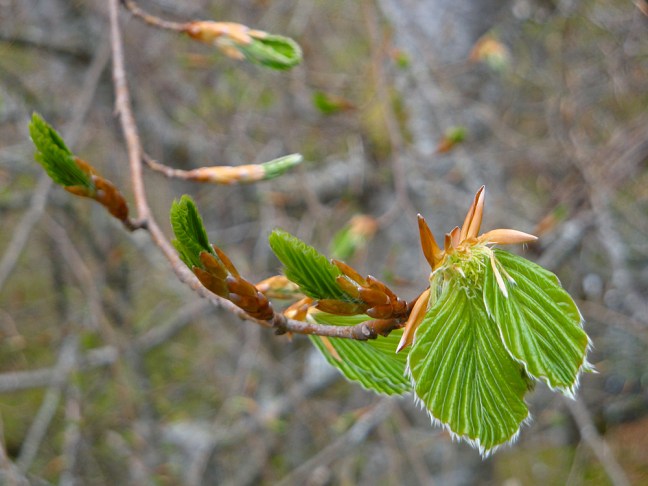
The photo is by Alain Joly

Bibliography:
– ‘Presence’, Vol. I & II – by Rupert Spira (Non-Duality Press)
– ‘Commentaries on Living, I, II & III’ – by J. Krishnamurti – (Quest Books,U.S.)
– ‘The Way of Rest: Finding the Courage to Hold Everything in Love’ – by Jeff Foster – (Sounds True)
– ‘I Am’ – by Jean Klein – (Non-Duality Press)
– ‘The Essential Rumi’ – Translated by Coleman Barks – (HarperOne)

Websites:
Rupert Spira
J. Krishnamurti
Jean Klein (Wikipedia)
Jeff Foster
Rumi (Wikipedia)

Suggestions:
Fleeing to God (other pointers from the blog)
A Day at Brockwood Park (Homage to J. Krishnamurti)
Rumi (Homage to Rumi)
A Secret Love Affair with Life (text by Jeff Foster)

.

The Tail of the Tiger

Here is a reminder from Robert Adams. It is necessary and terribly efficient to look into these matters for ourselves. This is why I like to share here the parts of a spiritual teaching that sounds like ‘something to do’, something to experiment and verify for ourselves:

You’ve got to realize you are greater than you think, and you’ve got the same power within you as everybody else does. It may appear to be asleep, but as you work on yourself, work on yourself, work on yourself, you will awaken it, and one day it will become stronger than you are and take you over completely and you’ll be free. But you’ve got to keep on working on yourself, and stop putting yourself down. That’s the worst thing you can do is to put yourself down. That’s blasphemy because you’re putting God down. Think of yourself as a higher person, love yourself, worship yourself, bow to yourself. You are greater than you think.”

~~~

Further exploring on the subject:

Increase and widen your desires till nothing but reality can fulfil them. It is not desire that is wrong, but its narrowness and smallness. Desire is devotion. By all means be devoted to the real, the infinite, the eternal heart of being. Transform desire into love. All you want is to be happy. All your desires, whatever they may be, are expressions of your longing for happiness. Basically, you wish yourself well.”
~ Nisargadatta Maharaj

~

Hold on to the tail of the tiger, don’t let it go, because you will see if you hold on, you will enter into quite, totally a different dimension. But if you let go, you know it is like coming back to living in the beastly life of struggle and conflict and battle with each other.”
~ J. Krishnamurti

~

I think the best way to live in this world, the most important thing, is to explore and to recognise who we essentially are. And having recognised who we essentially are, or as we are engaged in this exploration, to think and feel in a way that is consistent with our understanding of ourself. And to act in a way that is consistent with those thoughts and feelings. In other words, our knowledge of ourself, our understanding of ourself, is the most important aspect of life, because everything we do, everything we think, all the relationships we engage in, we think and feel and act and relate on behalf of ourself. And therefore, everything depends on our understanding of ourself.”
~ Rupert Spira

~

O soul, seek the Beloved, O friend, seek the Friend,
O watchman, be wakeful: it behoves not a watchman to sleep
.”
~ Rumi

~

You always have two choices. One choice is the familiar one: to sacrifice this mysterious awakeness for something else. The second choice is not to sacrifice this that’s awake and present, whatever you happen to be. You can choose not to sacrifice this for the next promise of a better moment, a better event, or a better experience. This is your choice — to be true to what’s true or not. And this is the Fire of Truth. This that is awake now, as you, in you, reveals the utter irrelevance of every other argument, whatever that may be. This that is awake to itself renders everything that is not true irrelevant. This silence burns the grasping for anything else and frees the life that you are, to live itself without negotiation. Feel the immediate visceral invitation of this that is awake, to put down everything else. The invitation asks you to cease bargaining with life, with the moment, yourself, your teacher, your friend, your mate. Just stop. This fire is unseen and unknown, and yet it burns everything other than itself.”
~ Adyashanti

..

B4B1EF62-8C55-4D3A-A93C-CEF684A607CC

.

The picture is by Susann Mielke / Pixabay

Bibliography:
– ‘Silence of the Heart’ – by Robert Adams – (Infinity Institute)
– ‘Being Aware of Being Aware’, – by Rupert Spira – (Sahaja Publications)
– ‘I Am That‘ – by Sri Nisargadatta Maharaj – (Non-Duality Press)
– ‘Krishnamurti’s Notebook’ – by J. Krishnamurti – (Krishnamurti Publications of America, US)
– ‘The Essential Rumi’ – Translated by Coleman Barks – (HarperOne)
– ‘Falling into Grace: Insights on the End of Suffering’ – by Adyashanti – (Sounds True Inc)

Websites:
Robert Adams (Wikipedia)
Rupert Spira
Nisargadatta Maharaj (Wikipedia)
J. Krishnamurti 
– Rumi (Wikipedia)
Adyashanti

Suggestion:
Fleeing to God (other pointers from the blog)
A Day at Brockwood Park (Homage to J. Krishnamurti)
Rumi (Homage to Rumi)
Khetwadi Lane (Homage to Nisargadatta Maharaj)

.