A Study of Mind

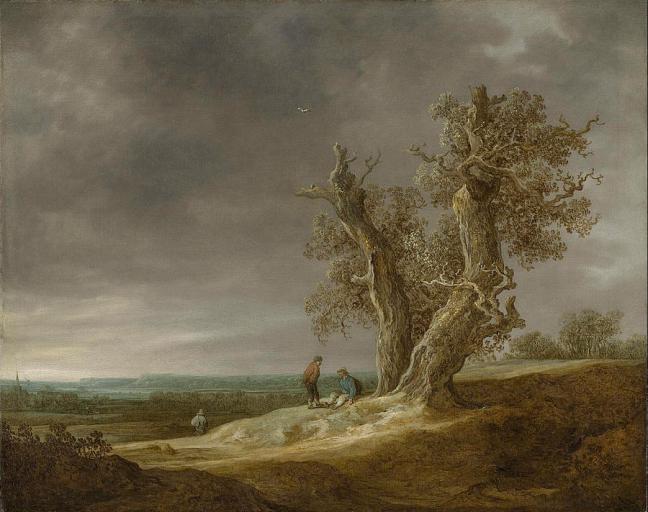
‘Landscape with Two Oaks’ – Jan van Goyen, 1641 – WikiArt

Notice that your mind is inapt at staying still. Stillness is not its thing. It has always something to think about. It is always on the road, roaming, judging, comparing, evaluating. Mind you, it is its nature to do so, if you let it. The mind is a restless thing. But its restlessness has a virtue. It pushes you beyond it. It encourages you to go deeper, where stillness is your nature. Where there is quiet. Something abiding. A stability.

Go not to the mind, but to the presence that supports it. Be like the gentle arms that hold it. Notice that your mind is not alone. It needs a space for its functioning. Sink in the mind’s left vacant space. Go in the interstices, between your many thoughts, inside your overwhelming feelings. Attain to the very substance your mind is made of. Be like its gorgeous essence. Not the mind itself, but the depth of being within it.

The mind deals only with the superficies. It is changing its mind at the slightest disturbance. With the latest flip of an opinion. Don’t follow its many thoughts. They will convince you that you are a self separate from experience. They will tell you that you are lonely. They will make you a suffering entity, though there is none. Go to the bottom of your being. Where the mind is only an appearance. See that you don’t disappear. You can’t.

The mind is ever changing, not you. It has an idea in mind. Forever keeping an agenda, being interested in outcomes, seeking experiences — only happy ones. You have happiness enmeshed within your own being, as the nature of your own gorgeous self. You don’t need to manufacture one, to provoke it with circumstances. Go so deep within the mind that you cease to be involved with its productions. This is called peace.

Stay with your imperturbable essence. It will show you that you are married to the world. The mind believes in the many, in division, in separation. But it is its own invention that it passes on to you as the only reality. Reality is where the mind is only a puppet. Reality is when you are one. It is beyond even your sense perceptions. They have colluded with the mind in making you believe in separation. Reality is aware presence. The mind is not.

Now be careful. For the mind has appropriated the ‘I’. It too says ‘I Am’. But the mind is not ‘I’. It is not your real self. The mind is pretending to be you. It does it all the time. So often that you have come to believe a bundle of thoughts and feelings to be ‘I’. But ‘I’ goes deeper. It doesn’t live in such a shallow land. ‘I’ belongs to the ground, to your innermost being, to that part of yourself that is unmovable. Where there is no past or future. No other, beyond, or away.

So if you happen to meet the mind one day, and be entangled in its mesh, or if you have adopted it as your everyday identity, don’t stay there. Move away. Be bold. See that all that comes here with a beginning and an end, with a limitation, has very little to do with you. See that as you deepen in and as being, your mind will slow down, and acquire a strange transparency. Your thoughts and feelings may even appear to be clothed in the infinite.

Your mind now seems to be no mind at all, and is in no capacity to bring separation. It stops being a brigand, and becomes a precious ally. Thoughts may be used wisely, and feelings are seen as a reflection of love and its indispensable joy. Essence acquires a new meaning, as it pervades the world and every experience that comes your way. Your body is experienced as made of Mind, and Mind as your new body. Spirit is where you live. It is without end.

~~~

Text by Alain Joly

Painting by Jan Van Goyen (1596-1656)

~~~

Website:
– Jan Van Goyen (Wikipedia)

Suggestion:
– Other ‘Reveries’ from the blog…

Awareness is All

‘Conscious Capability’ – George Harvey (1806-1876) – WikiArt

.

The very fact of being aware of what is is truth.”
~ J. Krishnamurti

.

If you observe yourself carefully, awareness can be felt as a truly overwhelming presence. It is actually all there is, and that can be easily proved. Let’s take an experience like our current experience, since no other than this one present, living experience, has ever existed and will ever do. We cannot divide experience, make it into bits and pieces to be compared or analysed. Experience is not limited to its content. You cannot separate content from its recipient. That’s the first clue for our investigation: Experience is undivided, unbroken awareness.

But let’s not be too quick on this, and jump to an easy conclusion. Let’s look thoroughly at our experience. What are the things that occupy us? What is actually filling this presence of ours? Let’s take our thoughts for example. There seems to be a steady arrival of them in our mind. All kinds of thoughts. The organised ones and the messy ones. The scared, confused, barely audible ones, and the vindicative ones. The happy ones and the weeping ones. Some that are useful in the course of a day, and others utterly useless and gratuitous, that are here solely to soothe our broken sense of self, or escape from a dreadful, imagined reality. Let’s face it: most of our thoughts are actually mad thoughts owned by a barely identifiable owner.

[…]

Explore how the nature of our experience is made of awareness… (READ MORE…)

.

The Coronation

I want to be all alone with you.
Who cares of these hundreds
relentless thoughts. I’ll let them
be and live their own thinking-life.
I’m not concerned with them.
They’re none of my business.
Have a good journey folks!
I’ll just stay here alone
with my silent friend.

I want to be all alone with you.
I have nothing to do with these
endless stories and beliefs.
All these far-fetched ideas
that keep giving birth to
that constant flow of suffering.
Waves after waves of feelings.
Don’t involve me. I want to be
in unaccompanied solitude.

I want to be all alone with you.
I won’t busy myself with these
ten thousand things. Not this time.
They have helped me well, with
pleasures and necessities.
To fight my fears off and
seek a hidden peace.
But god they’re clumsy! So
please, leave me alone for now.

I want to be all alone with you.
And when I’ll feel your presence
in me, so as to be just only you,
then I’ll return to all and everything;
To the feelings and the spicy;
To the world and its troubled affairs.
I shall welcome the weird and the inept,
and the thinking rendered innocuous.
I’ll make them my loyal attendants
And I’ll crown them with glory.

.

~~~

Text and photo by Alain Joly

~~~

.

Suggestion:
Voices from Silence (other poems from the blog)

.

The Rightful King

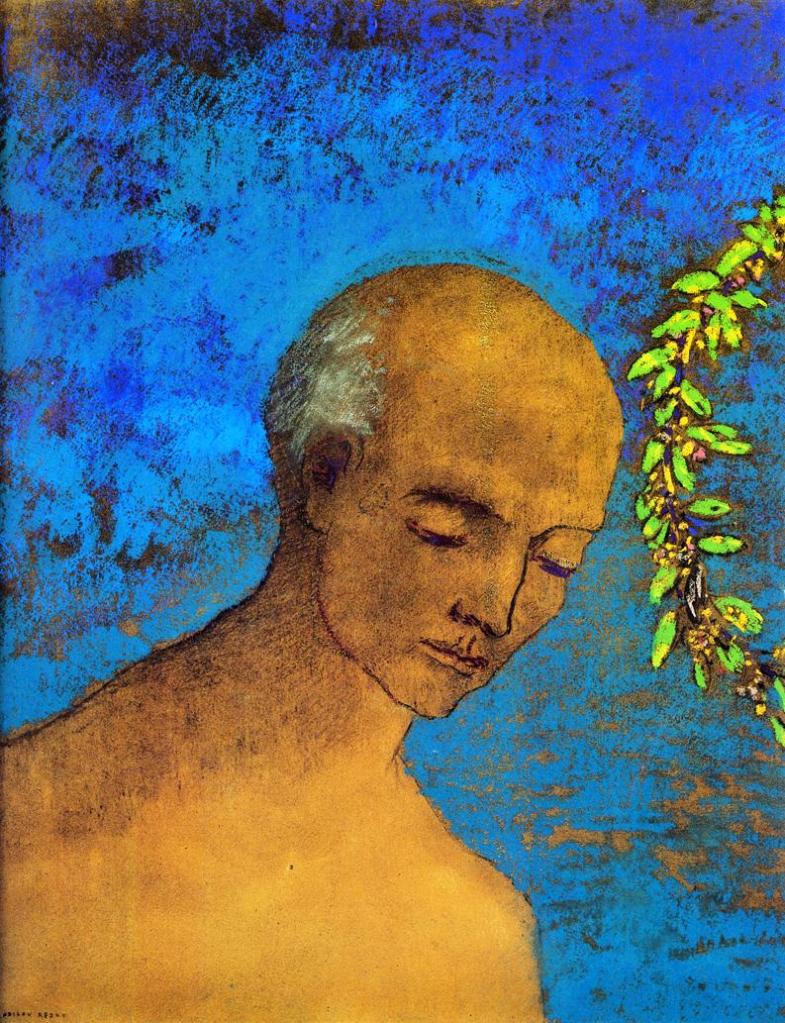
‘The Crown’ – Odilon Redon, 1910 – WikiArt

.

A thought never comes alone. It appears with a container attached to it. But unfortunately, in our most habitual way to relate to experience, this container is felt to be the negligible part. And the same applies to feelings. Every appearance in the mind comes wrapped up with something that supports it. But that support is unseen, ignored, and the fleeting appearance is too often upgraded as being mind itself. Yet I think that the opposite is truer. That thought is the negligible, feeling is the dispensable. Not that they should be neglected. Far from it. For they are pointers. They are blooming flowers brought to our attention for a mission. They are flagging a message to our conscience. One that says, we — thoughts and feelings — are the negligible. We are not mind, but only temporary appearances in the mind. The mind is what matters. The container matters the most. That which we have taken to be secondary, unimportant, negligible — and that we have as a result pushed in the background — is our innermost reality. It is what needs to be raised in and as the foreground. This is the one and only entity there is, far before — and above — any fluttering thoughts or feelings which, to the mind that supports them, are no more than waves on the surface of an ocean. The container — this vast, indomitable expanse — wants to be explored, visited, admired. Cease taking a few thoughts and feelings to be you. They are not you. They only express the parts of you that are blind, unconscious, indolent. By emphasising them, we neglect all that is around them, behind them, beyond them. All that is supporting them, allowing them to be. Every objective appearance is secondary to that unmatchable presence, to whom even the body is a negligible. How could a few unruly servants think that they are the King, that they run the kingdom in place of the rightful King? But be careful here. Don’t neglect any of these unruly servants. Only remind them of their right place and rank. Invite them at your table. Make them see and understand where lies their interest. By thinking they are themselves little kings and queens, they miss an opportunity to surrender to the one who gives them food and lodging. Consciousness is our rightful King. Only give Him allegiance and contemplate His loving and all encompassing nature. He will make you to His likeness, and will send you back to life with a crown on your head. So be yourself the very subject of this majestic presence. Let Her crown you with Her very crown. And you’re not Her only subject, for everything in the kingdom of experience is Hers. Every house, every being, every tree, every expansive sea, every reflection of the sun on every crested wave, are Her subjects. And every subject subjects only one thing: Herself. So let yourself be the ultimate subject. The one that never bows to any object. Many objective appearances will mistakenly think to be subjects, but never will be, never can be. For this is a kingdom of one subject only. Nobody is meant to take the lead, except that which is the rightful King. 

.

~~~

Text by Alain Joly

Painting by Odilon Redon (1840-1916)

~~~

.

Website:
Odilon Redon (Wikipedia) 

.

The Little Monsters

Here is a reminder inspired from the words of Rupert Spira. It is necessary and terribly efficient to look into these matters for ourselves. This is why I like to share here the parts of a spiritual teaching that sounds like ‘something to do’, something to experiment and verify for ourselves:

Just experience the raw sensation, for example of fear, without thought, without the labelling. Instead of covering it up, turn around and face it. Let the feeling come totally to you. Face it, keep living with it, keep opening yourself to it so fully, until there is not the slightest resistance to it. Ask yourself: Can I live with this feeling for ever? You have to be able to answer ‘yes’ to that question. Then see what remains of it. Be very careful not to turn this into a practice that you undertake in order to get rid of unpleasant feelings. Make it just a loving contemplation to discover the truth of your being, the dissolution of this feeling being a side-effect, a by-product…’

~~~

Further exploring on the subject:

Observation is like a flame which is attention, 
and with that capacity of observation, 
the wound, the feeling of hurt, the hate, 
all that, is burnt away, gone
.”
~ J. Krishnamurti 

~

Fall in love with this secret humanity. Know that darkness is NOT darkness, only scared fragments longing to come into the light, beings who want love, and attention, and breath, and inclusion in the larger picture of Self. […] Illuminate. Radiate. Make it safe for the little monsters to come out of hiding. Let them know they are beautiful. And worthy. And not monsters at all.”
~ Jeff Foster

~

In simple openness which is welcoming you will come to accept and get to know your negative feelings, desires and fears. Once welcomed in non-directed attention these feelings will burn themselves up, leaving only silence.”
~ Jean Klein (‘I Am’)

~

You never remain with any feeling, pure and simple, but always surround it with the paraphernalia of words. The word distorts it; thought, whirling round it, throws it into shadow, overpower it with mountainous fears and longings. You never remain with a feeling, and with nothing else: with hate, or with that strange feeling of beauty.” […] Try to remain with a feeling, and see what happens. You will find it amazingly difficult. Your mind will not leave the feeling alone; it comes rushing in with its remembrances, its associations, its do’s and don’ts, its everlasting chatter. […] Can you look without the movement of the mind? Can you live with the feeling behind the word, without the feeling that the word builds up? If you can, then you will discover an extraordinary thing, a movement beyond the measure of time, a spring that knows no summer.” 
~ J. Krishnamurti (Commentaries on Living, Series III – Chapter 37 – ‘Aloneness Beyond Loneliness’)

~

The dark thought, the shame, the malice,
meet them at the door laughing, and invite them in.
Be grateful for whoever comes, because each 
has been sent as a guide from the beyond
.”
~ Rumi

.

B4B1EF62-8C55-4D3A-A93C-CEF684A607CC

.

The photo is by Alain Joly

Bibliography:
– ‘Presence’, Vol. I & II – by Rupert Spira (Non-Duality Press)
– ‘Commentaries on Living, I, II & III’ – by J. Krishnamurti – (Quest Books,U.S.)
– ‘The Way of Rest: Finding the Courage to Hold Everything in Love’ – by Jeff Foster – (Sounds True)
– ‘I Am’ – by Jean Klein – (Non-Duality Press)
– ‘The Essential Rumi’ – Translated by Coleman Barks – (HarperOne)

Websites:
Rupert Spira
J. Krishnamurti
Jean Klein (Wikipedia)
Jeff Foster
Rumi (Wikipedia)

Suggestions:
Fleeing to God (other pointers from the blog)
A Day at Brockwood Park (Homage to J. Krishnamurti)
Rumi (Homage to Rumi)
A Secret Love Affair with Life (text by Jeff Foster)

.

Tantra, the Song of Life

My world will light its hundred different lamps with thy flame 
and place them before the altar of thy temple.
No, I will never shut the doors of my senses. 
The delights of sight and hearing and touch will bear thy delight
.” 
~ Rabindranath Tagore (Gitanjali)


For anyone interested in uncovering the true nature of his or her being, some pathways exist to travel – motionlessly – from being identified to an imaginary sense of self to being established in the real, forgotten, and only self there is: consciousness. These pathways correspond to the different components of our living experience, namely thinking, feeling, and sensing. I have, in previous texts, endeavoured to explore the path of understanding, or Jñāna, that is derived from the exercice of thinking, and the path of love, or Bhakti, born out of feeling. The last pathway to explore is the one that comes through our senses, which is everything we see, hear, touch, taste or smell, everything that is seemingly outside of ourselves and that we have named by the generic term of the ‘world’. This path is best described in India through what is called ‘Tantra’, which after the two other pathways, is one that is all encompassing, that invites the world in, or in Atmananda Krishna Menon’s words brings “the universal under the individual.”

The idea behind tantra is that the world, the totality of our experience, need not be pushed away, or dreaded as an obstacle, but is also a doorway as is the exercice of thought in jñāna, or feeling and devotion in bhakti. The whole world is a possibility because although it is often experienced as an objective reality, it is also the expression or creation of a subjective presence and can therefore be used to trace back and uncover the reality of our own being. We must define what we mean by the world. In any given time or place, we experience a totality. A group of forms and experiences is presented to us and these form the totality of what exists in any given moment. What is this totality and what is it made of? What is this play of forms? Does it have a separate existence? These questions are at the core of the tantric path. If the world, the body, the feelings – our whole experience – are not what we have but what we are, then it opens up a whole new set of possibilities in understanding and accessing our true nature. “Every object is the footprint of God.” says Rupert Spira. …

An exploration into the nature of the tantric path… (READ MORE…)


Bhakti, the Song of Love

Don’t forget love;
it will bring all the madness you need 
to unfurl yourself across the universe
.”
~ Meera Bai (1498-1546)


I intend here to continue exploring the three different pathways towards realising our true nature. I have some time ago given my attention to Jñāna, which in the Indian tradition is the name given to the means of attaining truth through the investigative qualities of the mind, which are mostly thinking and the power of discrimination. The two other paths towards realisation are the tantric path, which involves the senses, and the path of love, which involves feeling, and is the subject of this essay.

The path of knowledge requires a certain steadiness, orderliness, being thorough, constant. But even somebody set on this logical path of knowledge will be exposed to ineffable, timeless moments of pure love. Some people are best suited to a more loving, encompassing pathway, that would allow them to be just as they are, with all their confusion and overwhelming feelings. I can be the me that I am, as long as I am too this loving, embracing presence to which I can offer myself. In love there is no theory, no guidelines to follow. And it is not a surprise to find this expression of truth as one of the means to the realisation of our true self. This pathway of love has been called ‘Bhakti’ in the tradition of India. All the Indian faith, at least in its more popular expression, is of a devotional nature, and has elevated this simple love for god or truth to the rank of art. That seemed to me a good starting point to embark on this path of devotion, which the Śivānanda Laharī (verse 61) describes as: “The way needle seeks magnet, the way creeper seeks tree, the way river unites with ocean and the way the mind seeks the lotus feet of Śiva.”

An exploration into Bhakti, the path of love and devotion (READ MORE…)