Pathways

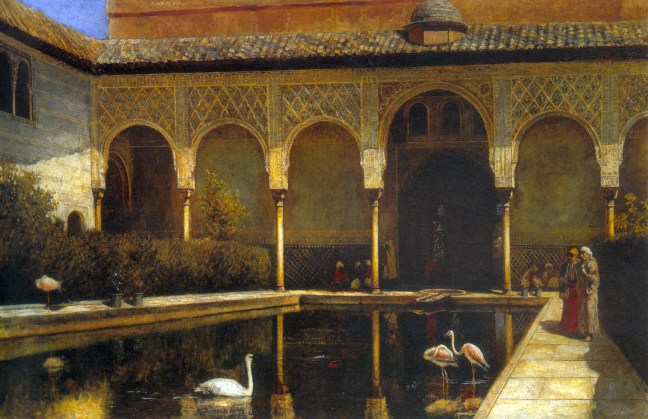
‘Court in the Alhambra’ – Edwin Lord Weeks, 1876 – WikiArt

The spiritual endeavour is really such good fun. You may happen to experience some suffering in your life and feel entangled — with thoughts rushing into your mind and problems seizing the entirety of yourself. The web of experience is overwhelming you and you can find no space to breathe within. You may then have to have a little conversation with yourself. You may have to disentangle yourself from your stubborn identification with thoughts and with the overcrowding objects born of the senses. That’s when you may present yourself with a simple question like: “What is this part in myself that is aware of my experience?” And so are you now taken amongst the scents of 8th century India, treading its immemorial dust with Shankara, debating with the great Vedantic master. He will show you how to move inwards right at the core of that aware presence in yourself. You will be taken with him to the core of this investigation, which is but the separation of the multiple objects of experience from the one aware, pervading presence of consciousness that is your true identity. That’s when Shankara leaves you with this one infaillible recipe:

.
I bow down to that all-knowing One
which is pure Consciousness, all-pervading, all,
residing in the hearts of all beings
and beyond all objects of knowledge.”
~ Shankara (Upadesasahasri, 1:1)

.
You may then find yourself sitting in your kitchen, cutting vegetables, with your thoughts suddenly wandering in the 17th century Paris, surrounded by the walls of a Carmelite monastery’s kitchen, chatting along with Brother Lawrence. He might tell you with his big generous smile: you know brother, “nothing is easier than to repeat often in the day these little internal adorations.” That’s when you understand that this investigation can be made into a joyful, often repeated practice, where you go and meet yourself within, have a little chat with this hidden presence, spontaneously, as you gaze into the eyes of a friend. Amongst the frantic sound of knives hitting the wooden board and the fumes of the next meal simmering on the stove, you meet Brother Lawrence’s glance offering you this last precious advice:

.
I renounced, for the love of Him,
everything that was not He;
and I began to live as if there was none
but He and I in the world.”
~ Brother Lawrence

[…]

Continue this journey into the investigation of your true nature… (READ MORE…)

.

The Glorious Reality

Do nothing that may be unworthy of the
glorious reality within your heart and you
shall be happy and remain happy.”

~ Nisargadatta Maharaj

.

~

Quote by Nisargadatta Maharaj (1897-1981)

Photo by Alain Joly

~

.

Bibliography:
– ‘I Am That’ – by Sri Nisargadatta Maharaj – (Chetana Pvt.Ltd)

Website:
Nisargadatta Maharaj (Wikipedia)

Suggestions:
Beauty in Essence (other pointers from the blog)
Khetwadi Lane (Homage to Nisargadatta Maharaj)

.

The Highest Language

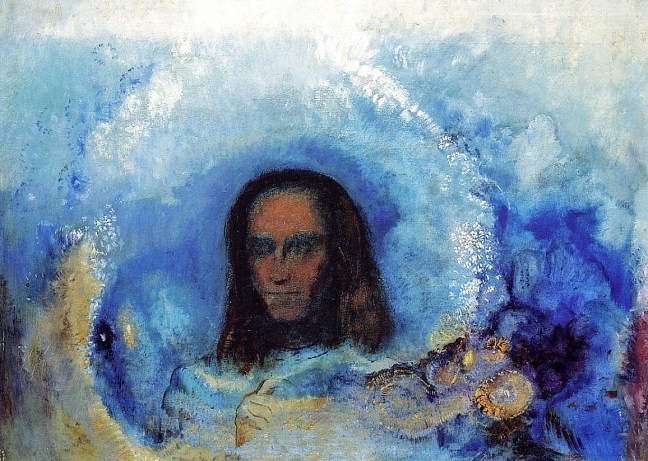
‘Silence’ – Odilon Redon, 1911 – WikiArt

In our language, the word ‘silence’ is defined as the complete absence of sound, or the abstinence of speech. Yet silence has fascinated us beyond these elementary descriptions to evoke the unknown and the mysterious. Something in silence speaks to us, and is a presence beyond its apparent nature as absence. Spiritual teachers from all traditions have abundantly used the word for its richness of meaning and its powerful evocative dimension. So pregnant and profound is this experience of silence that the word has often been likened to awareness or the nature of god’s silent being. Among others, Ramana Maharshi has often pointed silence as being the ultimate teacher in these matters, and Krishnamurti has described it in supremely effective and graceful words just below. This page is dedicated to their many expressions of silence:

~~~

The experience of silence alone is the real and perfect knowledge.”
~ Ramana Maharshi (‘Be as You Are’)

~

Keep silence, that you may hear Him speaking
Words unutterable by tongue in speech
Keep silence, that you may hear from that Sun
Things inexpressible in books and discourses.
Keep silence, that the Spirit may speak to you
.”
~ Rumi (‘Masnavi i Ma’navi’)

~

Accept what comes from silence.
Make the best you can of it.
Of the little words that come
out of the silence, like prayers
prayed back to the one who prays,
make a poem that does not disturb
the silence from which it came
.”
~ Wendell Berry

[…]

Read these many quotes on silence by various teachers… (READ MORE…)

.

An Invitation from Silence

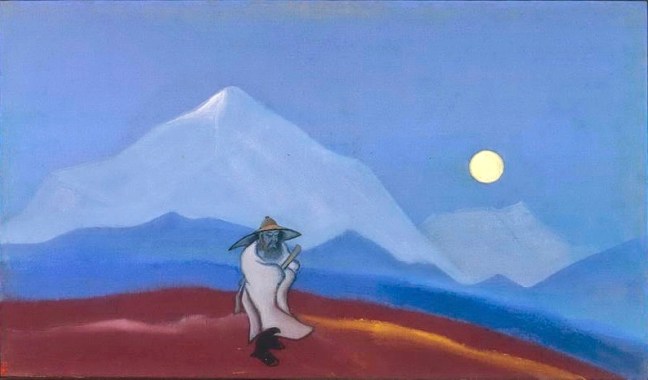
‘The Philosopher. Silence’ – Nicholas Roerich, 1940 – WikiArt

.

Of the unknowable only silence talks.”
~ Nisargadatta Maharaj

.

Silence is always called upon us. Once we have stopped engaging with our endless thoughts, once we have released the rage of our permanent search towards happiness, once the dance of our daily relentless activities has died down, then silence is here always present. Silence is here to re-collect us into itself. It is a never failing embrace, always available, always ready to mother us, always pregnant in and behind every one of our failures or pains, of our battles with ourself and with the world.

In a way, silence could be said to be the mother of a symphony of sounds. Silence is a sound enhancer, and by extension, a revealer of objectivity. But notice that we stop hearing anything when the space of silence is filled with an overcrowding of sounds. Any sound is then only participating in the general cacophony. This is the same with awareness. If our mind — this presence that we are — is filled to the brim with objective experiences, so as to seem to become itself a big object, it then becomes impossible for this mind to find any space within itself to experience objects as objects, and to notice that in which these are appearing. The space of awareness goes unnoticed with the pregnancy of objects, just as silence goes unnoticed with the cover of sounds.

[…]

A text that shows how silence is revealed as our very own being… (READ MORE…)

.

The Names of God

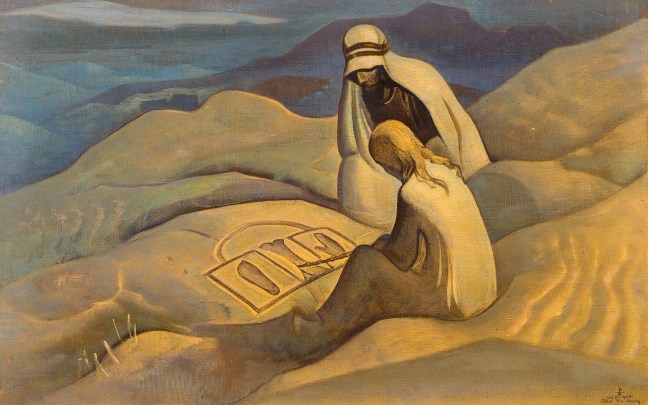
‘Signs of Christ’ – Nicholas Roerich, 1924 – WikiArt

.

The knowing of ‘I am’
is the apparition of God’s being
in our human experience.
It is the being of all beings,
the self of all selves
.”
~ Rupert Spira

.

יהוה               الله               ईश्वर

ब्रह्म               رحمن

אֱלֹהִים

.

There is something that is very hard to understand about God. A survey of the names that have been given to god makes it unequivocally clear, but we keep missing the target: ‘Being’, ‘Mighty Being’, ‘I Am’, and so many others, refer to the fundamental equation of god with ‘being’, with our very everyday experience of plain, simple, pure being. And yet, we keep projecting the presence of god in an hypothetical outside, another ‘being’ that our very ‘being’. So it seems that a study of the different names of god will help focusing on the fundamental nature of god’s being, this mighty Being whose being rests unseen, unnoticed in our own being.

Etymologically, the word ‘god’ (Proto-Germanic ‘gudan’) finds its root meaning in the ancient ritual of sacrifice, as in ‘libation’, or ‘to pour’, or in the Sanskrit ‘hutá’, meaning ‘having been sacrificed’. So god is ‘the one to whom sacrifices are made’, which extends to the sense of calling, invoking. To whom or what do I give the primary attention in myself? Do I indulge in, or fall to any objective appearance as thoughts, sensations, perceptions? Or do I sacrifice these appearances and find rest in the stillness of the one that is aware of these, which is pure being? To whom does my pouring, my libation go?

[…]

See how the many names of god relate to the sense of ‘being’… (READ MORE…)

.

Taking the Bow

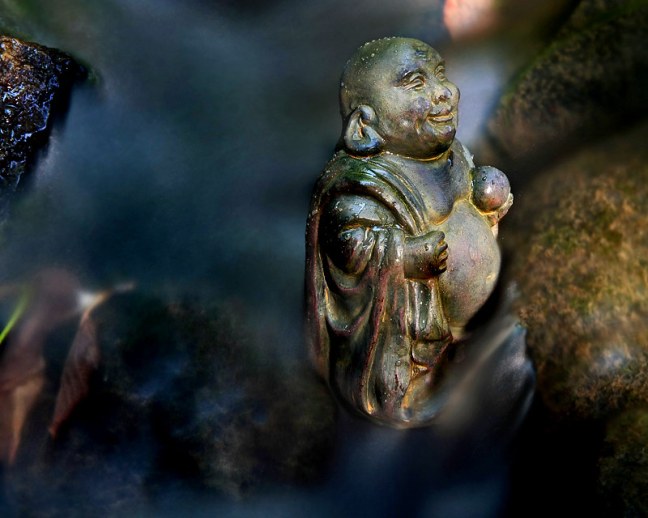
‘Bathing Buddha’ – Photo by ViaMoi on Foter.com

Here is a reminder inspired from the words of Rupert Spira. It is necessary and terribly efficient to look into these matters for ourselves. This is why I like to share here the parts of a spiritual teaching that sounds like ‘something to do’, something to experiment and verify for ourselves:

See that your experience is made of thoughts, feelings, sensations, and perceptions. Where is the ‘I’ that is orchestrating all of those? Where is this ‘I’ in the system? Take any thought that appears in you. Did you choose that thought? See if there was any entity, a chooser that decided to have that particular thought. Go slowly and observe carefully. See that there is no chooser in between each thought. The notion of a chooser is simply itself a thought appearing along many other thoughts. It’s only a thought that says ‘I was there in between each thought choosing it’. It’s the clown that wasn’t actually present but claims responsibility afterwards, and takes the bow. There is a choosing thought, but there is no chooser…’

~~~

Further exploring on the subject:

There is no entity present who could either have or not have free will. Experience is too intimate and immediate to admit of one who may stand back and orchestrate it like a conductor, willing, choosing, deciding, and so on. There is no time present for such a one to exist in. The idea of free will is an inevitable side effect of the belief in a separate entity. If we believe there is a separate entity, we will by definition, whether we know it or not, believe there is free will. If, as this apparent entity, we then believe there is no free will, then that is simply a belief that we superimpose onto our much deeper conviction that we are a separate doer, chooser, decider, and so on. Once the separate entity is seen clearly to be non-existent, the idea of free will dissolves. All that is left is the freedom of consciousness.”
~ Rupert Spira (’Interview with Paula Marvelly: Contemplating the Nature of Experience’)

~

Who is the entity that exercises will to do this or that? Please follow this carefully. If the observer is the observed what need is there for decision at all? … When there is any form of decision, depending on choice, it indicates a mind that is confused. A mind that sees very clearly has no choice, there is only action. And this lack of clarity comes into being when there is this division between the observer and the observed.”
~ J. Krishnamurti (‘Beyond Violence’ – Part IV, Chapter 1 – Brockwood Park, 3rd Public Talk)

~

When the mind returns to the heart, when the separate self is divested of its separateness and stands revealed as the only self of pure awareness, then it becomes clear that there was never a separate self to begin with. And therefore the question as to whether that separate self has choice or not is mute.” 
~ Rupert Spira

~

Freedom, I say, does not mean getting to do whatever one wishes. Nor does freedom have anything to do with so-called ‘free will’, which is a fantasy. Freedom arises with the understanding that in each moment what is, is, and cannot be different, including whatever ’myself’ sees, feels, thinks, or does. In the light of that understanding, while acceding outwardly to social conventions which require playing the role of chooser and decider, inwardly — within one’s private understanding — one may come clean and admit that the ‘myself’ who chooses is a fiction, a story I have learned to tell myself. In that admission one may find freedom — not the freedom to ‘choose’, but the freedom to be.”
~ Robert Saltzman (‘The Ten Thousand Things’)

~

In Hinduism the very idea of free will is non-existent, so there is no word for it. Will is commitment, fixation, bondage. … You must be free first. To be free in the world you must be free of the world. Otherwise your past decides for you and your future. Between what had happened and what must happen you are caught. Call it destiny or karma, but never — freedom. First return to your true being and then act from the heart of love.” 
~ Nisargadatta Maharaj (‘I Am That’)

~

Doing happens, and then you appropriate the doer-ship, but there is no doer-ship. Things happen. When you breathe, you don’t need to think that you’re a breather. When your heart beats, you don’t need to think that you’re a beater. When you’re digesting, you don’t need to think that you’re a digester. These things happen by themselves. The same way, thinking happens by itself; there is no thinker, there is only thinking. The thinker is a thought of other thoughts. So, there’s nothing to do actually means that there is no appropriation in life. Thus, you must give yourself to the fact that life is happening through you, but there is no need to pretend to be the doer. It’s not that there is nothing to do, it’s just that things happen by themselves.”
~ Eric Baret (‘There is No Doer’ in Science & Nonduality)

.

B4B1EF62-8C55-4D3A-A93C-CEF684A607CC

.

Bibliography:
– ‘Being Aware of Being Aware’, – by Rupert Spira – (Sahaja Publications)
– ‘I Am That‘ – by Sri Nisargadatta Maharaj – (Non-Duality Press)
– ‘The Ten Thousand Things’ – by Robert Saltzman – (Non-Duality Press)
– ‘Krishnamurti’s Notebook’ – by J. Krishnamurti – (Krishnamurti Publications of America, US)
– ‘Let the Moon Be Free: Conversations on Kashmiri Tantra’ – by Eric Baret (translation by Jeanric Meller) – (CreateSpace Independent Publishing Platform)

Websites:
Rupert Spira
J. Krishnamurti
Robert Saltzman
Nisargadatta Maharaj (Wikipedia)

Suggestions:
Fleeing to God (other pointers from the blog)
A Day at Brockwood Park (Homage to J. Krishnamurti)
Khetwadi Lane (Homage to Nisargadatta Maharaj)

.

The Waiting Room

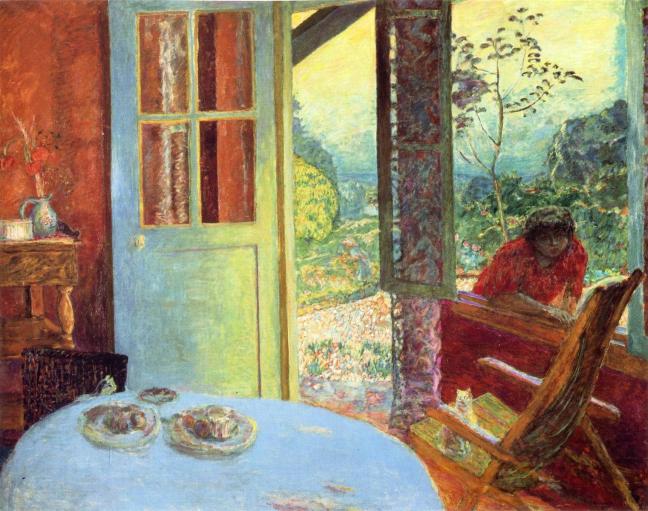
‘The Dining Room in the Country’ – Pierre Bonnard, 1913 – WikiArt

There is a subtle waiting lingering inside us. Do you feel it? I do. Let’s have a look at it. It’s an expectation, a yearning, a feeling that says that the now, what is happening for me right now, is not quite enough. In whatever way I may look at it, that’s very clear. This is definitely not enough. Period. And off I go, keeping on living as if one day, maybe, if I’m lucky enough, if all the good stars align at last, that might descend upon me. I might get it, that feeling that I’m now complete. Cooked. Finished. Over with it. But that’s really just a fancy idea. Wishful thinking. In the meantime, did I ever look at it carefully? This subtle feeling, this buzz underlying each and every second of my existence, that something is missing? I concede that there are exceptions, fleeting moments when I suddenly find myself whole, silenced, at peace. But this is not satisfactory. So there is comfort in waiting, in not quite engaging. Staying put. Waiting on the platform of life for the next train of thought. The next occurrence. What is this waiting made of? Is it a real feeling? Or maybe just a ghost-feeling? What is here that I don’t see? Why am I waiting? […]

Continue exploring this subtle waiting lingering within… (READ MORE…)