Anatomy of a Desire

You must not desire the truth. You must let the truth desire you. For truth has the greatest desire, the most efficient one, to which yours is but a pale copy. It is the desire to be itself alone, unaccompanied, unsoiled. In the fulfilment of that desire, truth will swallow you, will undress you and render you transparent, nonexistent, naked. You’d be inspired to let go, to give in, to trust that desire which is so greater than yours. For your desires are small, inadequate, vile, selfish. They won’t get you where you truly want to be. They will miss the mark. Every time.

So don’t desire truth. Don’t make it like something you can possess. Truth is in fact already possessing you, the only one in command. So undress your being of the superfluous. The superfluous is all the beliefs attached to yourself, that makes you a self that feels separate, an entity in a body, delineated by its thoughts and feelings, that looks up to experience, and betrays its profound suffering through its constant desire for fulfilment.

Notice that your desire has no true owner. The one that desires is not really there. It is but an idea, a desperate attempt to feel that you are complete. But you won’t feel complete by means of desiring, for desire is already the sign of your incompleteness. The problem with being a desirer is that it places you ahead of your natural identity as being. It is a position of ignorance with a plan and a hope. The desirer is a made-up entity whose unacknowledged goal is to consolidate itself. So don’t make truth like a projected goal to be achieved. The desired object of enlightenment, or realisation, was never intended. It was in fact all for the desirer, to strengthen your false identity as a self, to adorn the temple of separation, to attach yourself to another idea. Liberation is not in desiring to be liberated.

[…]

Continue this exploration of desire in matters of truth… (READ MORE…)

.

The Possibility We Are In

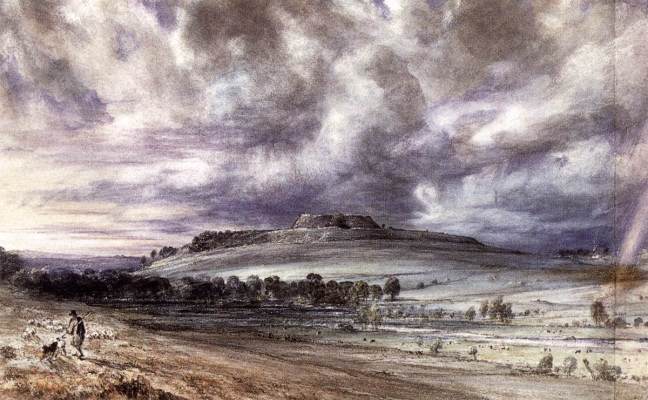
‘Old Sarum’ – John Constable, 1834 – WikiArt

Whatever there is is God’s presence felt. And whatever we may feel of God’s presence, is what there is here and now, including what exists and appears. It is all here for our recollecting, all here that we can be and be god like. Every experience that we may have, every sorrow and every joy, every fear or trust, every ugly or beautiful appearance, is felt and seen because of our being first. To watch anything is to be watched in return by a presence watching. We can make ourself disappear in it, and be without a self, without the self we have always known and colluded with. And we can share of that impersonal, infinite being that is not ours, but that we can be and embrace as our own. So ‘I am’ is the secret door opener within us, that will give us the world we are in. We will have an aggrandised property, or a world made of the very size of ourself, infinite, manageable, and towards which our being may shine a benevolent beam of light and peace. That I feel is a possibility.

The world will have its secret identity disclosed to us. And we too will have our secret identity revealed. Both being made one, and ourself being of it. Others will cease being others. They will join us as that shared one being. There won’t be any jealousy or comparison, but a rejoicing in and as that oneness felt. Our fate and destiny will be contained inside us, within our own being. There won’t be a time to hope for, or a place to fail in, or a self to mess up. There won’t be a fear of tomorrow, or a regret of yesterday, for both will have merged in and as the being that we are. Time and place will have come to be only convenience. And our very being will have come to be the time and place we are in. That too is a possibility.

The knowing of our own being will have come to be our only experience. The many will have shrunk into the one, and the infinite will have subdued our senses, and made itself seen, heard, touched, and contained within our experience. Happiness will cease being a temporary achievement, and will become the flavour of our shared being with people and things. We will have joy woven into every single corner of our life. That’s the possibility we have at hand.

Movement will be seen as the manifold expression of stillness, and silence recognised as the only component of our living symphony. Turmoil will be felt as this last bit of ourself that we have yet to embrace — not something to be afraid of, but an opportunity that we welcome. We have to see this as a possibility.

So this life is the garden of Eden we once extricated ourself from, but have in fact never left otherwise than in our imagination. And love is not an occasional encounter, but the very air we take our breath from. I’m just throwing the possibility in the air.

Now we recognise after all, that the being of God is what we are — the possibility we are in, without there being a God or a ‘we’.

.

~~~

Text by Alain Joly

Painting by John Constable (1776-1837)

~~~

.

Website:
John Constable (Wikipedia)

Suggestion:
Other ‘Ways of Being’ from the blog…

.

The Birth of Personhood

‘Flower of Blood’ – Odilon Redon, 1895 – WikiArt

It is consciousness — not body, not thoughts — that gives us the impression that we are a person with a continuity. There is absolutely no chance that a bundle of thoughts, feelings, and bodily sensations, could give us that impression. We borrow our personhood to consciousness, to the fact of being aware — to this light that creates us in the darkness that are otherwise thoughts, feelings, body. Our sense of continuity belongs to consciousness, to presence — that portion of ourself that is empty, unchanging, not objective, but full to the brim with itself. Our thoughts are but isolated events that are changing over the course of time, and so are our feelings and bodily sensations. The content of our mind is like a passing, unpredictable weather. So continuity in that area is absurd. Our essential self is to be found in and as being. What makes us is in that which is unmade. That impersonal part of ourself is what paradoxically gives us the chance of being a person. We are therefore nothing but empty, undivided being playing ‘being a person seemingly characterised by body and thoughts’. We have got it all upside down: Our person is not prior to consciousness. Consciousness is prior to our person, and the sine qua non of our existence or appearance.

Our thoughts are far away from each other, inconsistent, contradictory, confused, hesitant. They are not the voice of our self, are incapable of forming an identity of any kind. Our identity is to be found somewhere else, in something that we cannot get hold of, or limit, or name. The only thing that could link the different events of thoughts, feelings, sufferings, bodily sensations, and perceptions — all that for us constitute our self, a person with a name and form — is the presence of consciousness. We owe the impression that we are something solid, a real person, to emptiness, silence, stillness. So our person is actually non-existent, or rather has its existence in that which stands unseen between the happenings or events that we think make us. So our story, our thoughts, our body, become evanescent, losing their reality, disappearing within the experience of our massive sense of being — its coming to our attention. Being is seen to be the nature of ourself, which we had imagined in passing, isolated, impermanent, objective events and qualities. And believe me, that makes for a beautiful, gorgeous person — the one we have always wanted to be! A person is infinity being born.

The fact that there is a certain coherence in being a body-mind, and that we are able to live a life, is nothing but the expression of a play, a ‘lila’ as the Hindus are saying. We are nothing but a character in the hands of an actor. A body-mind is the little necessary to carry our wider identity to its term. In fact, all that we seemingly are — a person with an apparent life — is just the vehicle for a bigger quest. We are pretending a body-mind, so that we can realise our divine being. We are carrying infinity on our back, on the back of the finite, giving it the seeming, temporary life of an entity progressing in time and space. But this story, this appearance of a life, is but an excuse, something marginal that serves a wider purpose. We are meant to carry God on our shoulders for a while. At first unknowingly. Until we know God knowingly. Until God has acquired enough substance, and has sufficiently widened Its being in our life. Until God can in return carry us on Its own shoulders. And move us. And swallow us. Then, we find the security and courage to surrender ourself in God’s solid being and be like God Itself. We transfer our being in and as God’s being. And die there.

.

~~~

Text by Alain Joly

Painting by Odilon Redon (1840-1916)

~~~

.

Website:
Odilon Redon (Wikipedia)

Suggestion:
Other ‘Ways of Being’ from the blog…

.

The Face of the Infinite

For many things in life, we are exigent, demanding. We won’t let things be as they are. We are picky — we want more and better. We expect, hope, resist, desire, and are rarely satisfied. We are seekers of advantageous situations, and have a good idea of what they can be. Yet when it comes to ourself, to knowing who or what we are, we lose all inquisitiveness. We take ourself for granted. We may want to be more loving, less violent, have more of the good qualities, and less of the bad ones, but who is the ‘I’ that desires these things, we don’t want to know. Maybe we have an intuition that there is great danger in uncovering our true identity. After all, it was never talked about, a sort of family secret that society doesn’t want you to interfere with. Even religion is not clear about it, that encourages you to rather follow, pray, and submit yourself to God, but not to know who you are. At least not in a clearly stated way. You may know about anything you want, but please keep yourself out of it. In fact, ‘Know Thyself’ is the least encouraged commandment in this world of ours, and that alone should be enough to fuel our curiosity.

So who am I? What is my identity? What is this last part of my experience that is yet to pioneer and fully settle in? Which has remained untouched, virgin of our constant and fanatic rummaging? Which hasn’t yet been recognised for the simple reason that it is not a place we can know, let alone go to? It is so ourself that it cannot be seen, felt, experienced as something objective, or as an entity. This land of ourself has slipped out of our attention. We are blind to our eternal home. We have left behind us, untackled, unidentified, in the darkness of our wilful mind, the vibrant sky of our being. So what is my true identity? What is this unchanging substance that is the formless form of my being? In other words, what am I identical with, or the same as? ‘Same’, in its most ancient etymology, has the meaning of ‘one’. So we can rule out all the separate, isolated objects that we project ourself to be — that includes our body and our mind, and the many thoughts we’re thinking. Our identity is not in something which we identify with, but in the expression of oneness — the one being that is by definition free from all identification. This identity with the One has been achieved from time immemorial. We don’t need to come back to it, to rehearse it, or affirm it. Our identity has dissolved into the One, which is identified with no other than itself.

Where does unity or oneness live in my experience? In what portion of my conscious being can I feel an absence of otherness? Where do I find in myself no distinction, variation, or divergence, not even a breach that would differentiate me from reality? Where am I wholly and only being? What is it that I truly am, with no intervention of a past or a future? Where is this within that is also without? What is this ‘I’ that I could never ever cease to be? Who am I when all objectivity and multiplicity have died down? Where do I find an absence of ‘me’ in myself? Or rather, where do I find a sense of ‘me’, in me, that is not already the ‘me’ of everything and everyone? Where am I when every remnant of a seeking mind has left? Where do I find an individuality that is not universality? Where could I not find God’s presence in my experience? Where is this ‘where’, where I can never say where, what, when, how, why to what I am? And lastly, where have now all my questions dissolved? Only settle for a living, silent answer. Any other verbal or conceptual answer at this point would ruin it all. It would be like slamming the door in the face of the infinite.

.

~~~

Text and photo by Alain Joly

~~~

.

Suggestion:
– Other ‘Reveries’ from the blog…

.
The Distant Country

‘The return of the prodigal son’ – by Elena Murariu, 2018 – Wikimedia

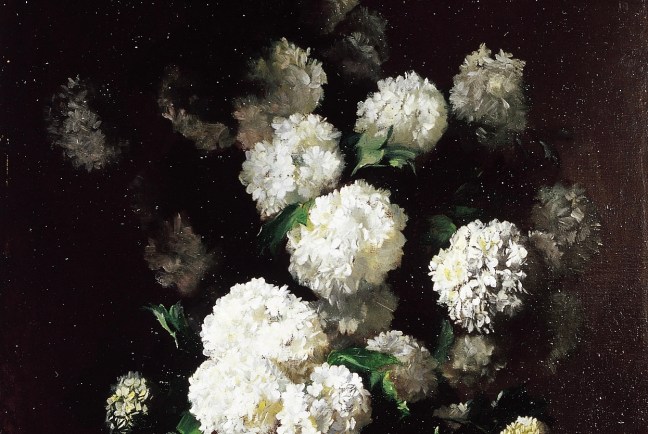
How ironic this life is, isn’t it? How incongruous to have imagined that this is the real deal: being a person locked in and bound to the limits of a body. How astonishing to have this certainty to be a self that feels separate and needs to be fulfilled. To think we have to fight our way through the world, and suffer with such consistency. To have been persuaded that seeking is our way of life, without which we are doomed to poverty and stagnation. Yet the illusion of our being in a world is so convincing that we had to buy its many effects and constraints, and be subjected to its perils. So we have gone far away, thinking that we could live remote from our true home and identity, that we could roam the world on our own, and snob our essence. So we have landed into what we are not. We have lived the adventures of a person, gone through challenges and despair, carried ourself through time and space, and lived attached to worries and hopes, to the aches of regrets and loneliness, and the brief consolation contained in the occasional relief from our wrestling with the physicality of the world. So we have paid the price of such a lonesome, faraway trip. As Augustine of Hippo once said: “Distant country signifies forgetfulness of God“. We have left our father behind, despised his presence, judged his love as unworthy. Unhappiness is intrinsic in having mistaken an illusion for the reality, just as it is natural to be in the shadow when we hide from the sun. But maybe there is a return from our erroneous view. Maybe the time has come to stop being tied to a false idea, and to return from our adventures into deceitfulness.

Now see that this faraway trip is but the following of a belief. It is our being led into an illusion, a fantasy — shared by all — that the life in and as this body-mind is all the reality there is, and that the way we live and believe is our truthful condition, to which we have to submit ourself. We have swallowed that suffering is the condition of life, and the way to alleviate it resides in either circumstances, good luck, or smart choices. But in fact, suffering is but the consequence of our departure from our true, forgotten nature. It is the natural outcome of our prodigality, of our obsessive desire to possess and be more than what we already are, of our seeking happiness inside the development of our adventures into ego-land. But as far as we may have erred into agony and chance, there is chiselled in our very nature, a return into the open arms of our simple, inescapable being. This quiet resting as our innermost being is the home from which we should never depart, no matter how enticing is the call for an adventure in the distant land of separation. There is a father or mother here, a being eternal, always waiting for the return of their prodigal son or daughter. And it is in the nature of this return to be a welcoming one, for the simple reason that you are yourself the embrace contained in being only being. So your return to the father was never a return from any kind of reality, but the noticing that we had in fact never left its loving embrace, and that all that was needed is our letting go, our bowing to the grace contained in simply being.

.

~~~

Text by Alain Joly

Painting by Elena Murariu (born 1963)

~~~

.

Website:
Elena Murariu (Your Portal to the Art of Icon)

Suggestion:
– Other ‘Reveries’ from the blog…

.
The Frailty of Naming

‘Still life with Apples’ – Paul Cezanne, 1890 – WikiArt

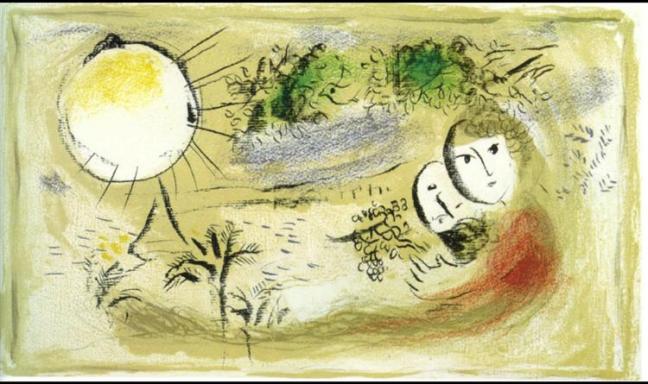
We really have made a muddle of it all, by believing that all things nameable are so in reason of their being there. It has made what is truly here — formless, absolute, undeniable being — seemingly absent in reason of its not being perceivable and nameable. Our true and essential being is unnameable because it has no objective quality. To name it is to spiritualise it, to give it a form, and finally destroy it. It is to set ourself as a being outside of it, which we are able to name, or describe. So if you have named yourself, know that you are therefore not there. You are still a shadow, a belief, a repetition, a form incompatible with the formless. And if you have qualified yourself as this or that, know that these limits, expressions, or colours you have imposed on yourself are illusions, the clothing of your reality, but not reality itself, not your nature, not the truth of your essential being, not the nameless, not that which is here and now, beyond any shadow of doubt. The named is for absence, and the nameless for presence. For how could you name presence, how could you give a qualification to something which is so here that it could never be there, so now that it could never be then, therefore never made into an object there and then, at a distance from yourself, in capacity to be named.

What is truly here, when it is recognised, ceases to be named. It is the nameless, the unnameable. The names we give to consciousness, to god, to that which is aware and constitutes us for the most part, are only provisional names, given when we are still part of the things that are named, still a person, an entity, a self. But this entity is not truly here. If we can name ourself, it is in reason of our being made into something objective through endless names and qualifications. So make yourself nameless, approach yourself so fully, investigate it so thoroughly, that you cannot name it anymore. Un-name yourself, strip it from objectivity or qualification until you are recognised as being only being. Then notice that you cease to be nameable. You are too close to yourself for that. Then the only way to name that reality of yourself is to not give it a name but to say simply ’I Am’. ‘I Am’ is the only name we can give to God’s being, and its supreme subjectivity indicates that its reality can only be felt as your own reality or being. It is the intensity of its subjective nature that prevents it from being given a name.

[…]

A reflection on what can be named and what cannot… (READ MORE…)

.

Pathways

‘Court in the Alhambra’ – Edwin Lord Weeks, 1876 – WikiArt

The spiritual endeavour is really such good fun. You may happen to experience some suffering in your life and feel entangled — with thoughts rushing into your mind and problems seizing the entirety of yourself. The web of experience is overwhelming you and you can find no space to breathe within. You may then have to have a little conversation with yourself. You may have to disentangle yourself from your stubborn identification with thoughts and with the overcrowding objects born of the senses. That’s when you may present yourself with a simple question like: “What is this part in myself that is aware of my experience?” And so are you now taken amongst the scents of 8th century India, treading its immemorial dust with Shankara, debating with the great Vedantic master. He will show you how to move inwards right at the core of that aware presence in yourself. You will be taken with him to the core of this investigation, which is but the separation of the multiple objects of experience from the one aware, pervading presence of consciousness that is your true identity. That’s when Shankara leaves you with this one infaillible recipe:

.
I bow down to that all-knowing One
which is pure Consciousness, all-pervading, all,
residing in the hearts of all beings
and beyond all objects of knowledge.”
~ Shankara (Upadesasahasri, 1:1)

.
You may then find yourself sitting in your kitchen, cutting vegetables, with your thoughts suddenly wandering in the 17th century Paris, surrounded by the walls of a Carmelite monastery’s kitchen, chatting along with Brother Lawrence. He might tell you with his big generous smile: you know brother, “nothing is easier than to repeat often in the day these little internal adorations.” That’s when you understand that this investigation can be made into a joyful, often repeated practice, where you go and meet yourself within, have a little chat with this hidden presence, spontaneously, as you gaze into the eyes of a friend. Amongst the frantic sound of knives hitting the wooden board and the fumes of the next meal simmering on the stove, you meet Brother Lawrence’s glance offering you this last precious advice:

.
I renounced, for the love of Him,
everything that was not He;
and I began to live as if there was none
but He and I in the world.”
~ Brother Lawrence

[…]

Continue this journey into the investigation of your true nature… (READ MORE…)

.