The Dream of a World

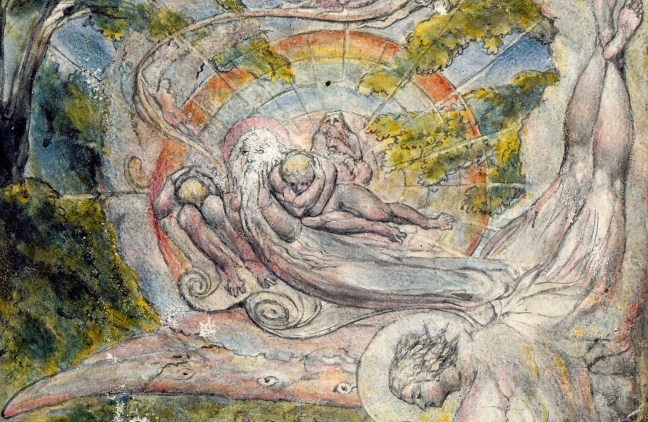
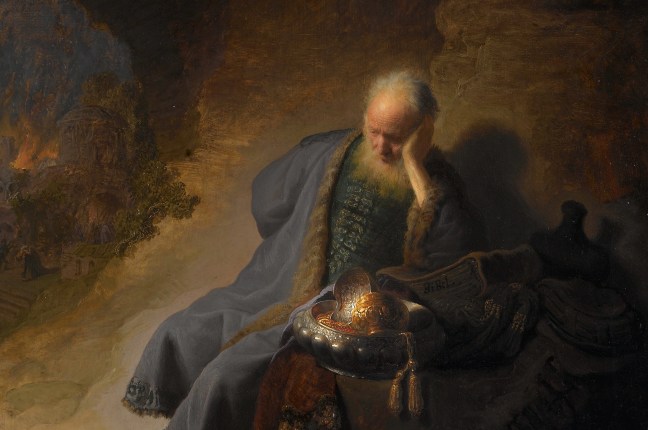
‘Milton`s Mysterious Dream’ (part) – William Blake, 1816-20 – WikiArt

There is a fraud in our life. An illusion that makes us feel that life is going to get better. That time or circumstance will bring us to a place of understanding, where our troubles will come to an end, where there will be betterment, improvement, change. To believe this will make us miss that we are already here and now in a place of no change, of no betterment, where nothing can improve or get better. This place is our very self, our sense of being that we have never been able to affect or modify, no matter how relentless our life has been, no matter our despair, our sorrow, our losses. Nothing we have gone through has touched it in any way. All our stories and sufferings have taken the shape of our thoughts and beliefs about them. But while we are desperately trying to give a form to our life, a solidity to our body, a reality to our problems, and a truth to our beliefs, right here and now, right where it all is seemingly taking place, hidden within experience, enveloping it all, is already a presence, a vastness, a reality that is embracing everything, and that is our only reality, our only place, our only possible self in this living experience.

For there is not a world there where we could be in. That would be a lovely idea, but the fact is: there is no possibility to prove the existence of such a world. We can only assert it, marvel at it through our senses, study it, analyse it, but of a solid proof there is none. The existence of a world is dependent on our perceiving it, and perceptions are contained in our knowing them. Without the knowing faculty, there cannot be a world. The whole glory and misery of the world, of the whole universe, is all gathered in that fathomless fraction of knowing, or awareness. Without that simple, ungraspable, dimensionless, ethereal element of knowing, no world could ever come into existence. So in fact, knowing is all there is, consciousness is the essence of every single appearance that comes to be seen, heard, touched, or experienced. The world is shaped, or its appearance created, through our being aware of it. So the whole of our living experience is but a dream in consciousness, a game that can be played and enjoyed at the level of our body-mind, but whose reality is only the awareness of it.

Now, where are we if we are not in a world? Where are we if the world is not even there? What is this something that we feel we are in, and exists, and is undoubtedly? What is a world, an experience, when we have passed through all illusions, all beliefs, all shaky appearances? What is left here that holds our experience, that is indomitable, indestructible, present without a shadow of doubt? This place is our self, what we are, our very essence, the reason behind our saying ‘I’. So we live in our self, not in a world. We see our limited existence pass and consume itself within that which is creating it, which is our own aware being, the knowing that we are and could never not be. And there, in ourself, in being, where the world takes its apparent form, is found what we have been looking for in every direction, in a non-existing world, in experience: a sense of relief, peace, beauty, love, and the understanding of our essence, the explanation of it all. An explanation that is not conceptual, but a living one, a subjective one, something made plain by being it. We and life then become self-explanatory. The fraud has been diluted. All imagination has died down. Now our living experience has acquired the rawness of truth. Something that is, unlike the world or our experience, beyond doubt and absolute.

.

~~~

Text by Alain Joly

Painting by William Blake (1757-1827)

~~~

.

Website:
William Blake (Wikipedia)

Suggestion:
– Other ‘Reveries’ from the blog…

.
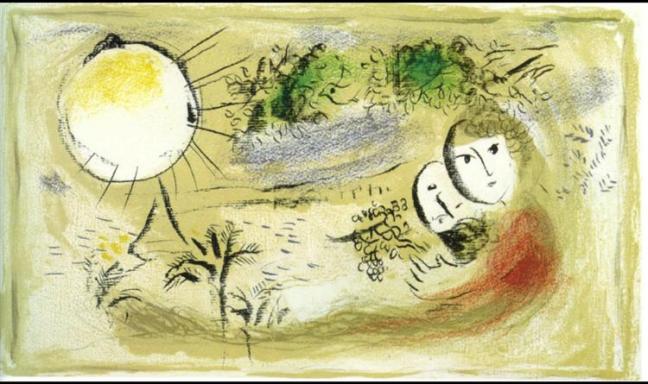
The Fantasy of a Self

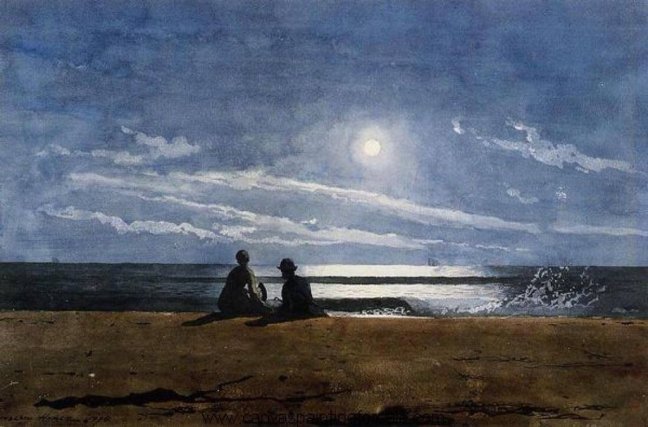
‘Moonlight’ – Winslow Homer, 1874 – WikiArt

We only ever land where we are. There is no escape from where we are. Where we are, is all there is. I mean this deepest place of ourself, from which we have never been separated, is the very thing which we have been looking for in a thousand distant places, in endless situations, in hopes and expectations, in projections, attachments, identifications. Our mind has been thirsting for this place of peace for as long as we can remember, and it has been escaping us with perfect consistency. For there is a rule attached to this place: we can’t find it outside of ourself. And the reason is: there is no place outside of ourself. Ourself — what we are here and now — contains all that we could long for. It is the home which we have left through our contant looking for it in the wrong direction. Our seeking is way too aggressive for its tender being. Our peaceful home lies in the nest that our being is, and this nest of being is where all existence finds its birth and takes its journey.

The problem with accessing our being — our peaceful home — is that we have introduced a self. We have posited a self that is separate from the peace it is looking for. And if peace is situated at a distance from ourself, therefore where we are is the place where peace is not. We have superimposed a self on our peaceful being, and in doing so have invited suffering, which is but the seeking for our lost peace or happiness. It all comes from the connivance of a few thoughts, feelings and sensations, which have set themselves up as a self. It is all part of a scheme on their part, and a gross one if you ask me. For how could something that is coming and going have a self? Something as flittering as a thought, or a sensation, could never produce a self. The self that we think we are, and that we feel is at a distance from experience, is fabricated. It is a product that we have elaborated to feel secure. But we cannot find security in a self. Security is rather the absence of a self, and the merging of ourself with experience, which is felt as oneness.

This self, without our noticing, has created untold damages, it has made life into a havoc. It has invented a within and a without, a here and there, a now and then, when there is in fact only a seamless experience. All these distinctions are of course necessary for our functioning in a world, but they are not the reality. And to ignore their reality is to transform them from a few peaceful, useful devices into brigands that have made experience either something to be feared and avoided, or desired and pursued. In other words, being a self has made experience into a dependence, a battlefield for our own imaginary benefit. But in fact, there is in reality only a now that is ever present and eternal, and a here that has no boundary, no limit, and is infinite. And there is a within that we will cease seing within, for after all thoughts and images are filtering experience to the point of making it their own creation. Thoughts are not just within. They are scattered all over the field of experience, colouring everything we see or hear. And the without will cease being without. For where could without be if not in our intimate experience. So the trees, the houses, and the dog we meet in the street are part of our very own being, for there is only one being out of which they could make an appearance. Where would another being than our being be? To posit another being than our being, or a without without, or a within within, or a there, or a then, is to be absent to our true being or nature, and to live in a world scattered about and fragmented, where reigns every bit of suffering and conflict. But to live as the One renders without within, within without, there here, then now, and our being just only one being. The rest is but a fantasy which we can either buy and suffer from, or borrow and play with.

.

~~~

Text by Alain Joly

Painting by Winslow Homer (1836-1910)

~~~

.

Website:
Winslow Homer (Wikipedia)

Suggestion:
Other ‘Ways of Being’ from the blog…

.

Apocalypse

‘Traditional bhavachakra wall mural’ – By Wonderlane (Sakya Monastery of Seattle) – Wikimedia

There is a beautiful and meaningful contrast in Buddhism. It is to be found in the approach to impermanence (‘anicca’), which can be a very effective pathway to our true nature. It says: everything that passes away is not it, is not you. Notice everything in and around you, and see that it won’t be always here. The house where you live will be destroyed, and no objects you possess will stay forever, including your body, and the billions of other bodies, including the trees, the seas, the mountains, the air you breathe. Eventually, they will all go. Your thoughts, emotions, qualities, character, mind, that you think characterise you, well… The planets will wither too, the suns will die down, and space even may one day be swallowed back where it once was seemingly born.

Scan your experience and try to find something that doesn’t pass away. But go far enough. For then will come, like a new dawn, the revelation that there is something here that never passes away. There is a permanence, a nature, that is your very being, which will never not be, and which swallows in its own profound nature all things discovered to be devoid of their own independent natures. So in the end, nothing really passes away, for all the separate objects of your experience do not possess their own individual, separate nature, which could be considered impermanent. Impermanence is when you think you are a body. But in fact, permanence is all there is, and it is lived and seen as the one being that we truly are.

With this understanding, you will come to realise that your suffering also cannot stand the revelation of your completeness. What you called ‘suffering’ can only exist in the belief that all objects have their own separate existence. Believing yourself to be one such separate object, you find yourself to be incomplete, not enough, therefore seeking in objects your happiness or completeness, which you could of course never find. You started with a wrong view in mind, which made everything down the line unsatisfactory, and biased. That’s why the Buddhist term for suffering ´dukkha’ has the meaning of an ‘unstable stand’, or more poetically, the ‘badly fitting axle-hole of a cart or chariot’ giving ‘a very bumpy ride’. So what then? Suffering never actually existed? Was it all in our mind? Created by a simple belief, an ill-fitting understanding, a shaky representation, that rendered our world unstable, untrue?

In Buddhism, the positive is never named. What is is never mentioned. That’s why it is said that our existence bears the three qualities of ‘impermanence’, ‘suffering’, and ‘no-self’. You will never find a self in something that it always in movement, always changing. No self in things, no self in a thought, no self in a body, no self in you — this is how far it goes. There is no self inside your body-mind. There cannot be. This is logic. No phenomenon could ever hosts a self. There is ‘no self-existent essence’, as suggests the Buddhist term ‘anattā’. Essence cannot just exist. It would make it appear or disappear. The essence of all things, including your own self, is infinite, not limited, not bound to any phenomenon. So ‘no-self’ in Buddhism is only a strategy for you to realise that the only self in presence is the nature or being of all things and selves, which we are, but cannot comprehend or even name. This is what the wisdom of Buddhism has put in practice in such an eloquent and radical way. Not even a name are you given for your own being. The nameless, you can only be.

So the ‘three marks of existence’ of Buddhism are nothing but the story of an apocalypse. ‘Impermanence’, ‘suffering’, and ‘no-self’, may give you a rather apocalyptic vision of your existence. But this is only if you have forgotten that the word ‘apocalypse’ means in fact ‘revelation’. The apocalyptic picture of our existence in this world is used as a wake-up call to push us into the revelation of our true nature as being. It is all about strategy. Do not take religious teachings to be the real thing. They are but teachings that point to a deeper, unnameable truth — the turning around of an apocalypse into the revelation of our true being.

.

~~~

Text by Alain Joly

Photo of ‘bhavachakra’ mural by Wonderlane

~~~

.

Website:
Three Marks of Existence (Wikipedia)

Suggestion:
– Other ‘Reveries’ from the blog…

.
Our Only Landscape

‘An Autumn Landscape with a view of Het Steen’ – Peter Paul Rubens – WikiArt

We are always wandering about, always attracted by a thousand things. Falling for every passing experience. Looking for the fleeting promise it might carry. The reason is: we are so vulnerable to happiness. We want it above all else, at all cost. We know we deserve it, that it is our due, that it is natural, in the order of things, to be happy, rested, at peace. So our mind is never still. Seeking to obtain it. Longing to have it given. Working for it relentlessly. Sometime pretending to be happy if necessary. If it is what it takes. After all, this is the game we are being asked to play. This is our fate, that we have accepted as the norm, and to which we have complied and have been a slave. We would do anything to feel alive, contented, our heart full, our mind at peace, secure, on top of things. And we feel depressed when being turned down. Lost and disheartened at every bout of despair or suffering.

But maybe it is all an unfortunate misunderstanding. Maybe we have taken a wrong turn, and were embarked in our own forgetfulness, distracted by the general consensus. Maybe there is no need to wander about. Maybe experience is of no need to us for happiness. Maybe happiness is not found in experience, not in the least. Maybe working for it creates a distance, a gap, throwing it far and away, like something never reached, never quite here. Maybe hoping for it makes us a self, an illusory entity that needs to obtain peace through the satisfaction given by objects, events, favourable circumstances, which makes us dependent and fearful. What an irony it would be, if it were just this, just this misunderstanding, and that happiness was in fact right here, already spread in and as our sense of being, offered to us with a ruban — a gift eternal for our simply being here and now. How clumsy on our part, to have looked away from ourself for that which is not only in ourself, but our very own self itself. How foolish it all was.

So, this is how it is! We are already fixed in our being, which is peace, which is joy, and have been so all along. We have missed that: that this was our belonging, our identity, to be at peace, firm, stable, fastened, secure in our simply being. And that this simply being was enough, the completion we were after, what we thought was to be earned at the very end of a deceitful string of efforts. Adding to simply being is where we made the mistake, where the wrong turn was taken. We had to stay where we were, and simply notice where we actually were, and what we in fact truly were. Being was not a little thing, undeserving of attention. Being was the completion, everything: you, happiness, peace, experience, the world, all gathered in and as the simple experience of only being. That’s how you lose all wandering, all attraction to things, exchanging them for the one only attraction worth falling for, which is yourself. You have to fall for yourself, for your being. You have to let being embrace you, and swallow you. Then, you won’t have to be anything, won’t have to look for something or someone other than yourself. For you are the fact of being, and this in itself is all the landscape you will ever need and find yourself in.

.

~~~

Text by Alain Joly

Painting by Peter Paul Rubens (1577-1640)

~~~

.

Website:
Peter Paul Rubens (Wikipedia)

Suggestion:
Other ‘Ways of Being’ from the blog…

.

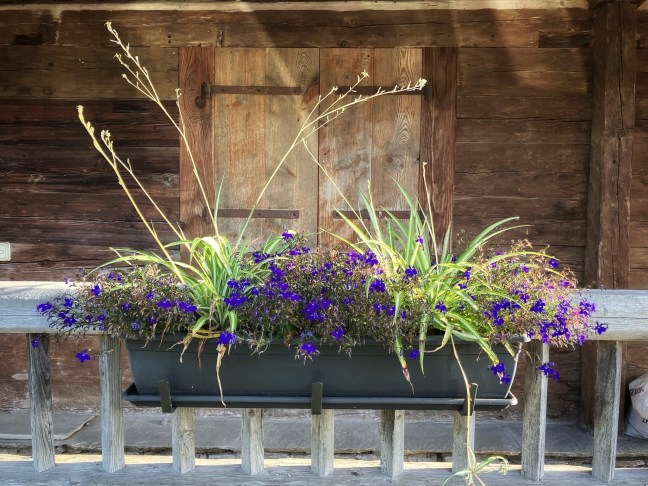
Where is True Home

Where can we find what is ‘our own’ in our experience? What is fitting? Where do we draw a sense of belonging from? Most of the time, we do not feel that we fit in, that we have a place. We feel insecure, so we secure an identity in a thousand things. We borrow from an object our appeasement. We make objects our own, we inhabit our thoughts, we adorn ourself with qualities, and we take shelter in a body. That’s what we do to fit in, and find security: we lose ourself in an ‘other’. We beg for anything that we could call our own, for fear of staying alone, and be left a nobody. We make up a self, and then call it ‘our own’. And that place of our own we find — and have defined — in a thousand shaky, unreliable places and things. But it is a bad try. In fact, we have burgled our own home of belongings that are not ours.

How are we going to find a home, if we keep rummaging through experience for every object that fits our needs? We ought to be disinterested for a while. We need to be disowned, dispossessed of every property or belonging that we have so far acquired, clung to, and in definitive stolen. For this is where true ownership is found, in not belonging. This is how a decent property is secured, by having no place to be. We ought to live free from all the accumulations that we have gathered and identified with. For our true home is not placed on the crest of experience, is not built on the sand of insecurity, and is not limited by the fence of limitation. It is not for a self, or a place, to produce the quality of enduring peace. Peace is already here, wholly achieved, in the home that our being truly is.

Live so that you don’t have to steal in your own house. You have it all. Your property extends to infinity and the world is the garment of your whole being. So in being, wherever you are is your home, and whatever you need is found here, in you, as you, with all the peace and security that pertain to a true home. You fit in when there is no space between yourself and what you long for. Being no space, you won’t have an urge to seek outside of yourself your identity and your happiness. Home is the recognition that you are already home. To be is to be home. There is no achieving it, let alone work for it. Be exactly where you are, in and as your own being — the place which you could never not be in. And if you find that a sense of indomitable peace is accompanying you there, then be in no doubt that this is home — what is your own, where you fit in, where you belong. Truly.

.

~~~

Text and photo by Alain Joly

~~~

.

Suggestion:
– Other ‘Reveries’ from the blog…

.
The Intimacy of Experience

‘First Leaves, near Nantes’ – Camille Corot, 1855 – WikiArt

.
I will tell you where to be
. Be where every experience feels an equally good experience. Don’t be attached to judgment and comparison. These are the mind’s favorite tools and activities. The mind tricks you to believe that experience is an uneven ground. That according to the content of your experience, you will be gifted with either happiness or suffering, peace or conflict, harmony or disorder. So the experience you are having becomes extraordinarily important. We become dependent on what happens to us, and come to dread it. So we retire into the secure place of our habitual self, with its cortège of worry, control, expectation, and manipulation.

There is a place in us where you don’t find experience to be such a determining factor. Where you will not let experience determine you, fix you, limit you. You won’t be shaped by its content. You won’t be made into something, someone, with qualities and flaws, to be judged, evaluated, compared with — the likeness of experience — in fact, just another object. The mind is a manufacturer of objects, entities, persons, fixing the insubstantial nature of your being into a self to be moulded and made either happy or miserable. To be made happy by an experience is to be cheated on by it: we are being manipulated, and made to believe an illusion. To let experience make us miserable is sheer deceitfulness, it is us being easily dazzled by the treachery and artifice of objects.

[…]

Continue this exploration of the nature of experience… (READ MORE…)

.

’katholikos’

‘The Life of St. Ignatius Loyola. Plate 4.‘ – Carlos Saenz de Tejada – WikiArt

You’ve got to respect the whole. That’s how you live the good life, in having reverence for the totality of your experience. Not just for the superfluous, all that is being the foam of life, that exists and appears, that you can see, hear, touch. You will never make a totality from the world of objects, from thoughts and perceptions. These are but occasional appearances, superficies. They are above you as it were, dancing upon you, at the periphery of who you are, but are not the reality covering your experience — its most profound constituent. You’ve got to go beyond the mundane and the obvious. For we keep leaving something out of experience. We don’t take the whole thing. We are choosy, only care for objects, don’t integrate our ‘within’ — where the reality of our being is. Notice that there is a world here, that is encompassing our world — a presence pervading our reality, taking everything in.

Actually, this is what the word ‘catholic’ is about. In Greek, ‘katholikos’ means: ‘pertaining to the whole’. We have to pay due respect to the whole, to the totality. We must look back at what we truly are, and find there the expression of the whole. I am not sure that Ignatius of Antioch had this in mind, when he first coined the term ‘catholic’ in the early 2nd century AD. He probably meant that the new belief, the new credence, was to be the universal truth, meant for everyone, adopted by all. But there was no need for adoption — the baby was already in the womb. There were no beliefs to be had, no hopes to project and entertain, no happiness to seek outside of our common day experience as being. He didn’t see that in this very word was the answer to all religions, to every quest for the divine peace; that what we were looking for was already here, close, so close to our very experience; and that there was no need to form a belief about it, or a new credence.

To accord with the whole is to be reconciled with our true nature — the reality of our being. It is to be ‘of one mind’, which is what reconciliation means, and to be brought together under the vault of one reality. This is achieved by turning towards the One, which is our true and only constituent. Universality wasn’t meant to be achieved in multiplicity. Universality is the quality of oneness noticed. The totality is in every place you happen to be. There is no totality of which you wouldn’t be the vessel. For the whole is not a geography, not a place to be in. It is the embrace of being. There is a totality in and as the being which you are now, here. You are not inside a totality. The totality is inside you. But mind you, this most venerated Christian Patriarch Ignatius of Antioch did say something of the highest order, when he brought up the word. He said that “wherever Jesus Christ is, there is the Catholic Church.” Yes. Yes indeed. Wherever we as our deepest being are, whenever we as our most profound nature-consciousness are, there is the expression of the whole, of oneness — the totality which is the very nature of the Lord’s House, and which is our nature and our house too.

.

~~~

Text by Alain Joly

Quote by Ignatius of Antioch (died c. 108/140)

Painting by Carlos Saenz de Tejada (1897-1958)

~~~

.

Websites:
Ignatius of Antioch (Wikipedia)
Carlos Saenz de Tejada (Wikipedia)

Suggestion:
Other ‘Ways of Being’ from the blog…

.