One Living Being

Truth is when the one who desires truth is not there. That one is a flaw. It is superimposed on the truth it is looking for, and veils it, makes it unreachable. It tramples it, literally. It makes it misty, obscure, mysterious. But truth is an obvious reality, if we don’t put it at a distance. If we don’t imagine it as something. Truth is not a thing, a concept. It is what we are — present, alive, real. Only we have to leave, recede, tiptoe. It’s all it takes, to not be boastful about it, to not think we don’t have it, to not assert the lie of our being someone. Being someone will push truth into the darkness, unseen therefore forgotten, hidden therefore to be sought. Our looking for it is the difficulty. Truth is to be approached with subtlety and utmost delicacy. Not that it is fragile, it is not. But it is sensitive to our feeling separate from it. It doesn’t like it. It shrinks at the thought of it, that we are looking for it, wanting it, being ambitious about it. Truth is not to be conquered, practised, refined. Truth is here fully dressed. It is our most fitting attire. The very being of our being. Massive. Obvious. If we let it open up, unfurl, spread its all-pervasive presence, and its creative, mind-blowing, self-evident, undeniable power and eminence.

But if we think we’re not enough, well then we’re not enough. If we want to indulge in being a person, a poor me, then we fall from a great height. We suffer from being separated from our essence, our quintessence. We feel the burden of our constant, intrinsic, congenital seeking. It becomes our identity, to be a self seeking, to live in separation, to be fearful of this condition, and a believer of ideas. We live in our mind, struggle with our beliefs, conflict with experience. We are not what we should be, and we feel it, know it, dread it. And we are crippled by our impending death, which we cannot understand, fathom, and marvel at. So it really comes down to ending a belief, a simple belief, that cheated us. That our body, our thoughts, feelings, senses are substantial when they are but a dream. That our being finds its reality in our body and mind when our essential is not there. Our essential draws its reality from a presence that is infinite, eternal, unfathomable, loaded with love, peace, and a creative impetus. Nothing else than this presence is at play in our experience. We realise that we are just one living being, which cannot be divided, and has no other than itself. We realise that we are that, in spite of all evidence and impression. This self that we believe ourself to be is in fact secretly made of that, if the mist of its fallacious reality breaks apart and reveals its hidden nature. There is no separate, distinctive, solitary self. Only this shared, glorious one being. Then it falls into place that, for exemple, “I and my Father are one.” (John, 10:30) And that “In him we live, and move, and have our being.” (Acts, 17:28)

.

~~~

Text and photo by Alain Joly

~~~

.

Suggestion:
Other ‘Ways of Being’ from the blog…

.

Daily Calling

It is easy to look, easier than we think. Yes we have seen temples and churches by the thousands, endless acts of devotions, and pilgrims whose faith seems indestructible. Yes we have marvelled at yogis whose ability and constancy is a subject of awe, at monks whose dedication and celibacy seem unattainable. It may have dawned on us that this path is too rigorous, that spirituality in only for the chosen few, for the dedicated ones, whose lives are set on a perfect course for it. So we have renounced to go there, finding excuses — that we don’t have what it takes, that God has for us no calling, that I wouldn’t have half of the rigour that a serious spiritual path requires. So we have stayed where we are, repairing here and there a few cumbersome habits, loving our loved ones, sharing our usual skills with the world, battling with our thoughts, dealing with our sorrows. We didn’t dare, didn’t quite believe that the spiritual endeavour was our path, or the path of the majority of us. We stayed put. We gave up without even the beginning of an understanding.

But spirituality is not what we think. It is not a path of renunciation or remoteness. It is not about belief, opinion, or even conviction. It is about reality. It is about looking what there truly is, here and now. What our experience is made of. What there is behind the gloss of experience. That’s how we are spiritual, by looking for that part of ourself that is not a thought, not a sensation or a feeling, not the body that we have come to be identified with. That’s how we are religious, by finding this deeper identity of ourself that is wholly and naturally related to others and to everything. By recognising that ungraspable, unfathomable, deeper being that is our eternal home, which we have lost sight of in the tempestuous world of our many experiences, a world that has so far attracted the totality of our attention without our objecting. We have simply missed, maybe indulgently, that spirituality is about knowing who we are, no more than that. Spirituality is not about practice or achievement, for its only aim lies in recognising what is eternally here as the very fabric of our self. It is not about age, for age will never affect what we are in the depth of our being. It is not about health, for there is a place in ourself that is forever stamped with wholeness, which is another name for perfect health.

So we don’t need to go to churches or temples, for where we are is our church if we know how to make it so, and inhabit it, not with our worries and projections, but with who we are as our deepest being. And remember that the world makes for a marvellous temple, when we connect to it with our deeper self, and bathe it with the peace of our own being. We will be in touch with our spiritual being every time we experience love in our life. That’s why people have pets, so that they can stay in touch with their heart. That’s why we so dearly seek the intimacy of relationship in our life, so we can lose the distance that our minds have imposed on us. That’s why we love fulfilling our desires, for we know that we find there, in this fulfilling, a taste of our own loving, untouched, unconditioned being.

So there is a mass or a puja going on in every corner of every experience that we may have. There are hallelujahs that can rise any time, anywhere, anyhow, if we are willing to pause and look at what our present experience is made of. And know that we will never be asked to believe, or corrupt any part of our gorgeous being, for we have a duty to be faithful to our self as it is. The only practice or prayer we will ever have to perform is to recognise and be aware of the nature of our being. This true and only identity or nature is lying just behind every temporary appearances and objects that can be formed, named, and pointed to in experience. Know that the formless is our most intimate companion, for it doesn’t live in time or place or objects, but in and as the very ground that is our one and only identity and being. This connection to that deepest, most intimate being in our everyday life, is in itself the most religious endeavour there is, where spirit is discovered to be the only thing in presence, and the home where we find our joy, and our undefeatable reality.

.

~~~

Text and photo by Alain Joly

~~~

.

Suggestion:
– Other ‘Reveries’ from the blog…

.
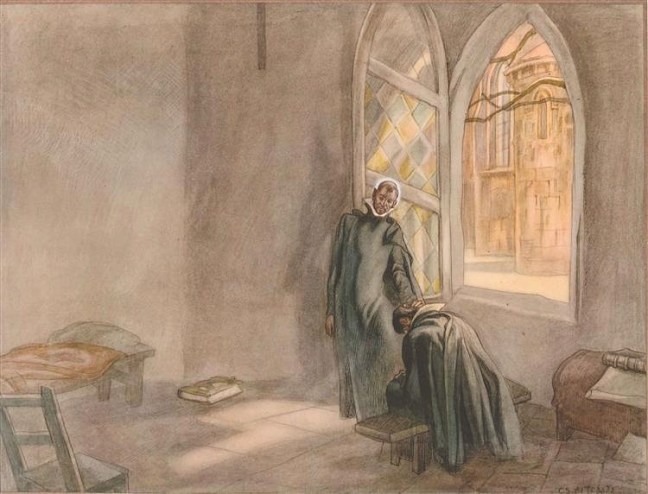
’katholikos’

‘The Life of St. Ignatius Loyola. Plate 4.‘ – Carlos Saenz de Tejada – WikiArt

You’ve got to respect the whole. That’s how you live the good life, in having reverence for the totality of your experience. Not just for the superfluous, all that is being the foam of life, that exists and appears, that you can see, hear, touch. You will never make a totality from the world of objects, from thoughts and perceptions. These are but occasional appearances, superficies. They are above you as it were, dancing upon you, at the periphery of who you are, but are not the reality covering your experience — its most profound constituent. You’ve got to go beyond the mundane and the obvious. For we keep leaving something out of experience. We don’t take the whole thing. We are choosy, only care for objects, don’t integrate our ‘within’ — where the reality of our being is. Notice that there is a world here, that is encompassing our world — a presence pervading our reality, taking everything in.

Actually, this is what the word ‘catholic’ is about. In Greek, ‘katholikos’ means: ‘pertaining to the whole’. We have to pay due respect to the whole, to the totality. We must look back at what we truly are, and find there the expression of the whole. I am not sure that Ignatius of Antioch had this in mind, when he first coined the term ‘catholic’ in the early 2nd century AD. He probably meant that the new belief, the new credence, was to be the universal truth, meant for everyone, adopted by all. But there was no need for adoption — the baby was already in the womb. There were no beliefs to be had, no hopes to project and entertain, no happiness to seek outside of our common day experience as being. He didn’t see that in this very word was the answer to all religions, to every quest for the divine peace; that what we were looking for was already here, close, so close to our very experience; and that there was no need to form a belief about it, or a new credence.

To accord with the whole is to be reconciled with our true nature — the reality of our being. It is to be ‘of one mind’, which is what reconciliation means, and to be brought together under the vault of one reality. This is achieved by turning towards the One, which is our true and only constituent. Universality wasn’t meant to be achieved in multiplicity. Universality is the quality of oneness noticed. The totality is in every place you happen to be. There is no totality of which you wouldn’t be the vessel. For the whole is not a geography, not a place to be in. It is the embrace of being. There is a totality in and as the being which you are now, here. You are not inside a totality. The totality is inside you. But mind you, this most venerated Christian Patriarch Ignatius of Antioch did say something of the highest order, when he brought up the word. He said that “wherever Jesus Christ is, there is the Catholic Church.” Yes. Yes indeed. Wherever we as our deepest being are, whenever we as our most profound nature-consciousness are, there is the expression of the whole, of oneness — the totality which is the very nature of the Lord’s House, and which is our nature and our house too.

.

~~~

Text by Alain Joly

Quote by Ignatius of Antioch (died c. 108/140)

Painting by Carlos Saenz de Tejada (1897-1958)

~~~

.

Websites:
Ignatius of Antioch (Wikipedia)
Carlos Saenz de Tejada (Wikipedia)

Suggestion:
Other ‘Ways of Being’ from the blog…

.

On Courage

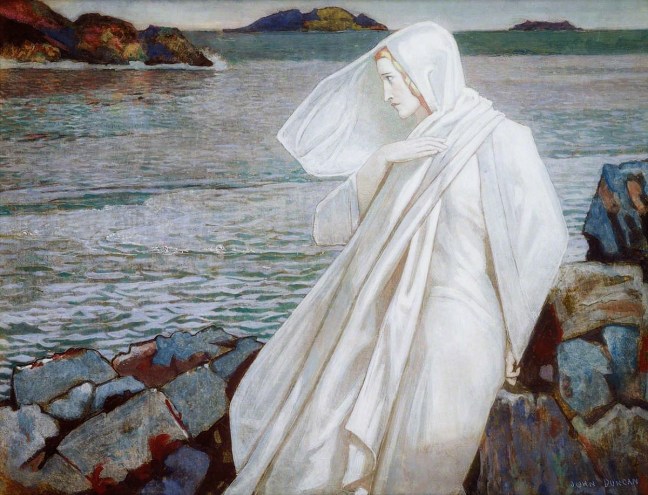
‘The Turn of the Tide’ – John Duncan – WikiArt

Not to suffer is not as desirable as we like to proclaim. We have mixed feelings towards our agonies and traumas. In fact, we have come to like the beastly thing. Suffering has given us many of the things we cherish in our life. Suffering has given us the hopes that we love to entertain, the pleasures we have developed as a routine of escape, and all the little addictions we enjoy in secret. It has shaped our drives and the nature of our beloved possessions. And our best friendships may have developed as a result of this beating pang in our heart. So this is not easy to let suffering go. A lot will go with it that is like the backbone of our beloved self. Being at peace and happy comes with a price.

There is some identity in our suffering, where is hidden a private treasure that we’d rather keep and nurture. If we are honest, we have to confess that our wounds have made us what we are, have formed the self that we believe we are, the personality that we have come to befriend. We haven’t fought our suffering with constancy, and have come to collude with it, socialise, associate, fraternise. We have indulged in every bit of it. We have surprised ourself having feelings for our pain, entertaining a secret love affair with everything that bites us. So to end suffering requires clarity and courage. For we won’t abandon a dream so easily, or put an end to a pleasure without balking. We need to be convinced. Our road to true happiness is paved with reluctance. We have a natural and well-rehearsed resistance to bliss.

[…]

Reflecting on how courage is found at the heart of ourself… (READ MORE…)

.

The Religious Life

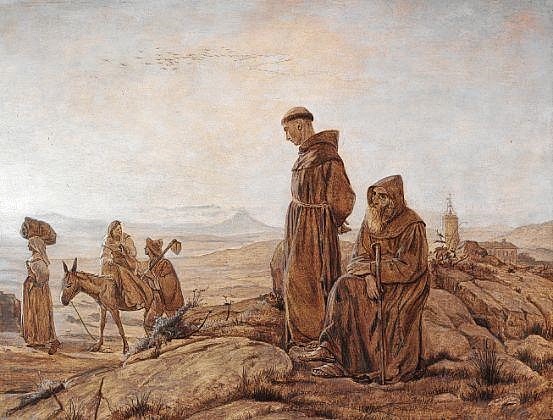
Two monks’ – Carl Bloch, 1861 – WikiArt

Spirituality is an exaggeration. We need to exaggerate our commitment to truth, and be ‘spiritual’ for a time. We need to take on this role. Being is to be favoured at the expense of experience. This is the way to re-establish a lost truth, to re-assert what we truly are against what we have conditioned ourself to be, by force of habit. It takes a lot to fight an addiction, to forget a well-rehearsed habit, to extricate ourself from our deeply imbedded identifications with our body and mind. What’s running in our head has a persuasive power, and perceptions have a way to project everything perceived as being out there, into what we commonly conceptualise as a world separate from ourself. So spirituality is a sort of rehab. We go to the church or the temple only because of our failure in making a cathedral of our experience. We attend the mass in reason of our not being grateful for the given bread of our life. And we meditate for lack of noticing that the meditator is a superimposition on our simple experience of being. We’re overdoing it, but it’s for the good cause. We need a magnifying glass to notice what is hidden in the cacophony of experience.

But spirituality is not a way of life. it is a temporary overemphasis, a dramatisation. We were never meant to be spiritual, or a believer in a religion. Religion is a teaching, a suggestion to realign ourself with truth rather than with an acquired belief. It is the temporary treatment for our suffering. It is the gentle scolding of a parent when we have made a mistake. It is benevolence — an encouragement towards a happier living. It is a bond and a reverence towards the simple reality of our being. So spirituality is an effort towards effortlessness. It is an attempt to recognise the given in ourself, amongst all the things that we have acquired and wrongly identified with. We have to dig out our true nature as pure, undivided, peaceful being, and have to be for a while a zealot for this, an ultra, a devotee of being, and to leave experience alone, to restrict our commitment with the world of things. It is a descent into spirit, before spirit pervades the totality of experience.

So all the paraphernalia of religion, all the words and practices of spirituality, and the endless commenting on the commenting, are only a means to acquire what we already have and already are, although unknowingly. Practice is to just be, and be happy. Prayer is to live a life that has meaning and clarity. Meditation is to have a vision of what we are, and with that vision, to love and share our deepest nature with others and with the world. It is to restore reality, in order to give ourself back to it. Because we cannot understand, feel, love, and just be, we have elaborated rituals, prayers, teachings. Spirituality is not the truth, only the means to access it, as devotion to a deity is but the path towards true, unconditional love. So we might want to push our practice. We might have to snob experience for a while, to leave it in the marge, in order to concentrate on our being only being. And we might want to stay there, in being — a yogi of presence. We don’t want to be an occasional visitor. We long to be a resident, to have being as our eternal companion. To feel that we are that naturally, and effortlessly. We want to drop all affectation. Effort is only a temporary device, to defeat a bias acquired over life times, and instilled by a whole society. We want to be free of ourself, and to quit being a believer, or a practitioner.

Then life becomes a temple, whether we are in the busy heart of a city, or in a monastery, whether we live the active life of a working hero, or the silent one of a dedicated monk. There will be a day when our life will take place in the clarity of being. When our daily activities will receive the flow of a constant radiance of meaning and beauty. When love will be the very canvas of all our relationships. When our duties and chores will be clothed with a flavour of sacredness. On that day, this tragic and magnificent exaggeration that spirituality is, will be replaced by a life that is discovered to be unaffected, spontaneous, uninhibited, relaxed, and genuine. Maybe this truly is the religious life.

.

~~~

Text by Alain Joly

Painting by Carl Bloch (1834-1890)

~~~

.

Website:
Carl Bloch (Wikipedia)

Suggestion:
– Other ‘Reveries’ from the blog…

.
The Distant Country

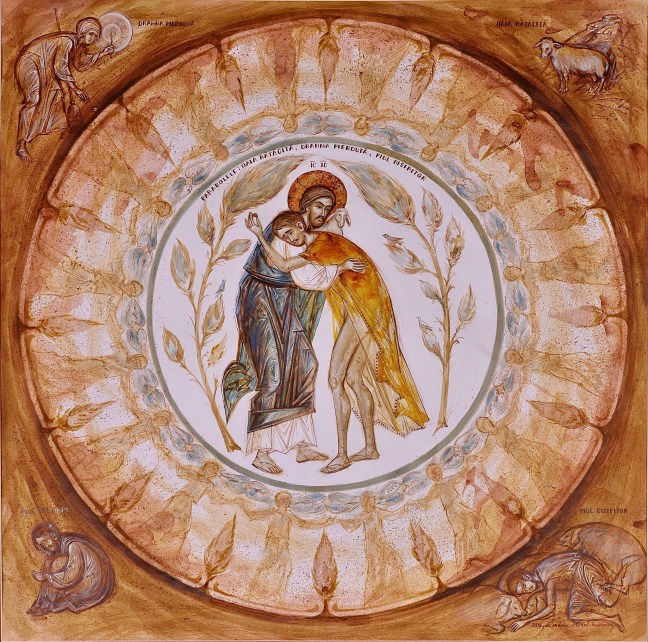
‘The return of the prodigal son’ – by Elena Murariu, 2018 – Wikimedia

How ironic this life is, isn’t it? How incongruous to have imagined that this is the real deal: being a person locked in and bound to the limits of a body. How astonishing to have this certainty to be a self that feels separate and needs to be fulfilled. To think we have to fight our way through the world, and suffer with such consistency. To have been persuaded that seeking is our way of life, without which we are doomed to poverty and stagnation. Yet the illusion of our being in a world is so convincing that we had to buy its many effects and constraints, and be subjected to its perils. So we have gone far away, thinking that we could live remote from our true home and identity, that we could roam the world on our own, and snob our essence. So we have landed into what we are not. We have lived the adventures of a person, gone through challenges and despair, carried ourself through time and space, and lived attached to worries and hopes, to the aches of regrets and loneliness, and the brief consolation contained in the occasional relief from our wrestling with the physicality of the world. So we have paid the price of such a lonesome, faraway trip. As Augustine of Hippo once said: “Distant country signifies forgetfulness of God“. We have left our father behind, despised his presence, judged his love as unworthy. Unhappiness is intrinsic in having mistaken an illusion for the reality, just as it is natural to be in the shadow when we hide from the sun. But maybe there is a return from our erroneous view. Maybe the time has come to stop being tied to a false idea, and to return from our adventures into deceitfulness.

Now see that this faraway trip is but the following of a belief. It is our being led into an illusion, a fantasy — shared by all — that the life in and as this body-mind is all the reality there is, and that the way we live and believe is our truthful condition, to which we have to submit ourself. We have swallowed that suffering is the condition of life, and the way to alleviate it resides in either circumstances, good luck, or smart choices. But in fact, suffering is but the consequence of our departure from our true, forgotten nature. It is the natural outcome of our prodigality, of our obsessive desire to possess and be more than what we already are, of our seeking happiness inside the development of our adventures into ego-land. But as far as we may have erred into agony and chance, there is chiselled in our very nature, a return into the open arms of our simple, inescapable being. This quiet resting as our innermost being is the home from which we should never depart, no matter how enticing is the call for an adventure in the distant land of separation. There is a father or mother here, a being eternal, always waiting for the return of their prodigal son or daughter. And it is in the nature of this return to be a welcoming one, for the simple reason that you are yourself the embrace contained in being only being. So your return to the father was never a return from any kind of reality, but the noticing that we had in fact never left its loving embrace, and that all that was needed is our letting go, our bowing to the grace contained in simply being.

.

~~~

Text by Alain Joly

Painting by Elena Murariu (born 1963)

~~~

.

Website:
Elena Murariu (Your Portal to the Art of Icon)

Suggestion:
– Other ‘Reveries’ from the blog…

.
The Greatest Trick

In fact, the understanding of our true nature is the simplest thing on earth. We have to, repeatedly, not be doing anything. The problem is: we cannot help but doing something, hoping something, trying something, anything, to get us where we think we should be. Where we are is never enough; never somewhere we should go to. What we are is not satisfying; we have to attain something that is better, no matter what. Even being, we think that we have to be being it — as if we were not already being. In all analysis, there is in fact such a thing as ‘nothing to do’ in spirituality, but only at the point when we are already not doing anything. If we are doing something, well, then we are doing something. This doing is an expression of our belief in not being ‘there’ yet, in our incompleteness, in our striving to get somewhere, to be someone. Then we have de facto missed all possibility of realisation: for we are already established in doing, in efforting. At this point, it is too late to not be doing anything. We need to revise our judgement.

We have been overtrained in doing. Maybe this doing is in fact what we have become — the essence of our self as a seemingly separate entity. We are born the moment we have the impulse of doing something, of being a doer, a knower. This is our original mistake, what we should never have been doing. We think we have to be somebody; to be nobody is a curse, a shame, an emptiness that we have to fill at all cost, even at the cost of losing ourself. So there is comfort in being a self, a somebody, in achieving something, in doing anything at all. The fact that we should be suffering for it, and be limited by it, well that’s the nature of existence, are we told. We are willing to pay that price for doing something, for being somebody. So let me do. Let me be. That’s how to feel ‘I am’ for now. That’s the story which was handed down to us. That’s how we have been regimented by society. And we have by now rehearsed it long enough, to perfection. We think that we’re not doing it when the doing has already been achieved. We are in fact implementing doing all the time while believing we are not doing it. This is the greatest trick that was ever performed on us.

[…]

A playful reflection into the question of the doer… (READ MORE…)

.