Offerings of Praise

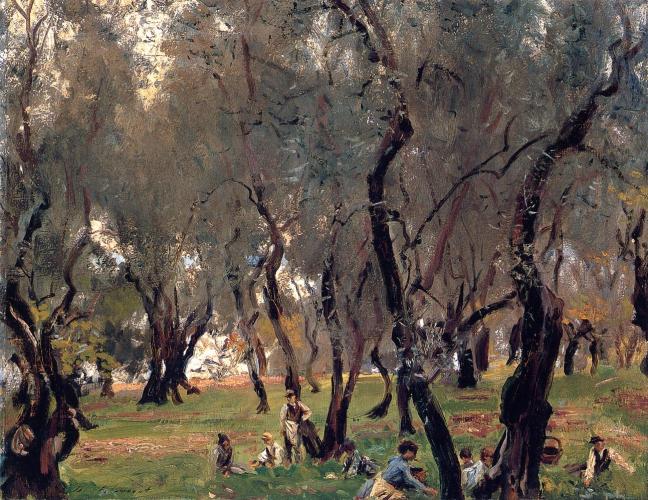
‘The Olive Grove’ – John Singer Sargent, 1908 – WikiArt

I don’t know if you have ever been in a gathering of truth seekers. Men and women willing to learn the truth of their being. Rendered humble enough to go through this discipleship. Battling to overcome their suffering. Journeying through the opening of their heart. Relinquishing their endless identities. Embracing infinity and friendship. If you haven’t, then I’ll leave this blessed and prominent ancient Christian theologian Ephrem the Syrian speak for it. Describe it in its own poetical terms. Tell you what it is like. Literally. And if you have, well then you have.
.

Who has ever beheld gatherings of people
whose sustenance is the giving of praise?
Their raiment is light,
their countenance full of radiance;
as they ruminate
on the abundance of His gift
there burst forth from their mouths
springs of wisdom;
tranquility reigns over their thought,
truth over their knowledge,
reverence over their enquiry,
and love over their offering of praise
.”

~ Ephrem the Syrian (Hymns on Paradise, IX:28)

.

~~~

Quote by Ephrem the Syrian (c.306-373)

Painting by John Singer Sargent (1856-1925)

Additional text by Alain Joly

~~~

.

Bibliography:
– ‘Hymns On Paradise’ – St. Ephrem the Syrian (trans. Sebastian Brock) – (St Vladimir’s Seminary Press)

Websites:
Ephrem the Syrian (Wikipedia)
John Singer Sargent (Wikipedia)

Suggestion:
Beauty in Essence (other pointers from the blog)

.

The Nectar and the Mouse

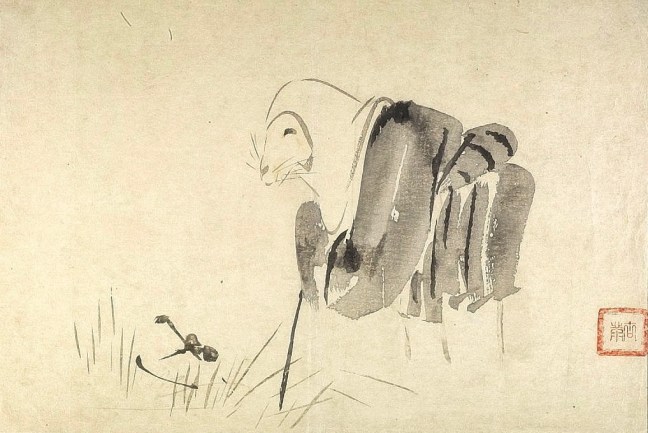
‘A Mouse as a Monk’ – Shibata Zeshin – WikiArt

We ought to love our being. That’s what animals do. The ones “that cut the airy way”, and feel “an immense world of delight”, as the poet William Blake wrote. The ones that sit on the window sill, in a pool of light, with eyes clinched in full appreciation of it all. The ones in the meadows, chewing and ruminating away their abundance of presence. Animals have being as their intrinsic companion. They live there, in being, as being, that’s how they have their life in such perfect order. That’s how they are alert, awake, aware, and know patience, diligence, scrutiny, care. They draw their intelligence from their sweet, sublime being, and their fierceness too — their courage, their laws, and their absolute well-being. We humans haven’t been doing so well. We have deviated. We have taken it all so personally. Maybe there is some lesson here to learn. A little wisdom from our friends.

Should we be in any need of a little guru here, I think I dug up the best of all. I didn’t find Its Highness amongst the large and the spectacular, but in the teeming world of our cereal fields, hopping around in the vegetation, feeding on seeds and on nectars. The harvest mouse is a four grams precipitation of the highest wisdom, wrapped in a brown and reddish fur coat, and equipped with a highly prehensile tail for the climb to heavenly heights. This mouse performs a unique sadhana. At the ripest of time, it climbs the stem of a chosen flower, and cuddles itself up in the cup of its petals to have a feast of the most delicious pollen. It stays there, inebriated by the scent and taste of it all. And it so happens that it sweetly falls asleep there. That’s it. This is Its Highness’ special sermon for you. This practice will act on you as a metaphor of the most sacred spiritual endeavour, of the highest understanding. It is saying, or rather showing, that you have to fall asleep to your self, or to sleep your regular self off. To so cuddle in your being as to realise yourself as being only being. To so impregnate yourself with the perfume of being as to be made of its very fragrance. And to so crawl into its blossom and bliss as to be yourself consumed by them both, and revealed as the flower of being itself, as the blooming of happiness.

Its Highness, if it could talk, would say something like this: You have to so totally and one pointedly devote yourself to your being as to feel to be made of it, with devotion fading and appearing as only a residual part of your sense of being a separate self, a somebody other than pure, essential being. You have to love being only being, so that love is no more a bridge between yourself and being, but the very nature of being — of who you are. You will feel the world and experience to be the very scented petals of being. And the stem of your bodily existence will draw its unabated strength and pliability from the rich soil of your selfless self — from its inseparable essence. You will feel yourself to be like a furious, furry ball of being. And experience will appear to you as a sweet, loving cuddle with your own nature. And your life will be made into nothing but a swift disappearance into God’s eternal embrace. That’s how you happy-sleep and wake up to your own nectar of beingness. When you harvest it all. As a mouse simply does.

.

~~~

Text by Alain Joly

Painting by Shibata Zeshin (1807-1891)

~~~

.

Websites:
Shibata Zeshin (Wikipedia)
William Blake (Wikipedia)

Suggestion:
– Other posts from ‘Eternity with a Smile’ in the blog…

.

The Heart Sutra

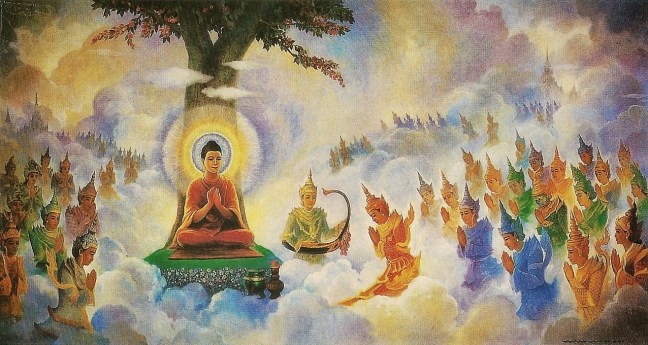
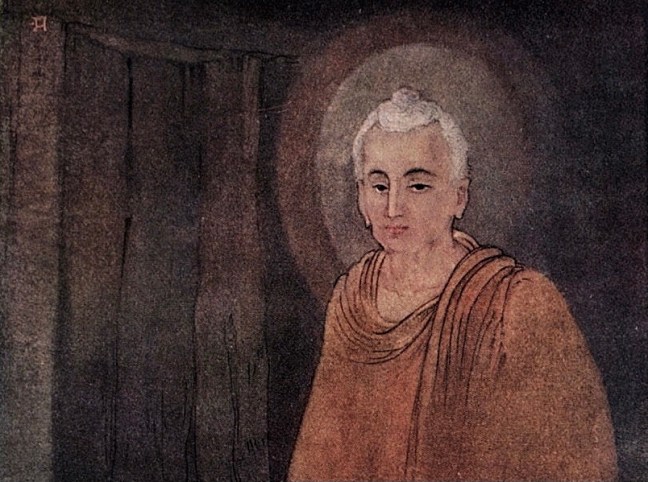
‘Buddha preaching Abhidhamma in Tavatimsa’ – Wikimedia Commons

.

प्रज्ञापारमिताहृदय

心經

བཅོམ་ལྡན་འདས་མ་ཤེས་རབ་ཀྱི་ཕ་རོལ་ཏུ་ཕྱིན་པའི་སྙིང་པོ

.

There is a text that came from the dawn of ages, whose author is unknown, but which has been widely accepted, practised, and chanted in Mahāyāna Buddhism as a condensed exposé of the teaching of Buddha. Although known and praised as the ‘Heart Sutra’, its original Sanskrit name translates as ‘The Heart of the Perfection of Wisdom’. If the Sutra’s main teaching asserts that all phenomena is ‘Śūnyatā’, a term widely translated as emptiness, its wide implications extend to many other aspects in the understanding of our true nature. Originally translated in Chinese by a 9th century Buddhist monk called Prajñā, the text exists in a shorter and longer version. I am sharing here the standard long version that provides an elegant and story-like context to the main teaching. I have also chosen to give to the many Sanskrit terms their original meaning or context. Following the Sutra is a short text that I wrote, some words that the text has evoked in me. I hope that this presentation will give justice to the profundity of this text, and that you will enjoy the reading.

~

Form is emptiness, emptiness is form.”
~ The Heart Sutra

[…]

Discover this milestone of Buddhist literature: the ‘Heart Sutra’… (READ MORE…)

.

The Great Replacement

You can always add to experience. You can always have more thoughts. Or different ones. More refined ones. Changes can always occur and always will. You can always fall down to the lowest of the lowest, and judge yourself undeserving. And that is more thoughts about yourself. You can always imagine anything. This is endless, all this activity. It will never stop. It will never reveal any truth worth of the name. It will keep going, headlessly, aimlessly, meaninglessly, like an illusion feeding on itself in order to give itself a seeming reality. Go anywhere in your objective experience, be it your feelings, your sensations, your perceptions, your body, the world out there, none of these will bring an inch of the happiness you are desperately running after. This enterprise is doomed to bankruptcy. It will leave you broke, feeble, mortal, prone to regular fits of unhappiness. It will leave you with not a penny of certainty, not a pebble of solidity, and a very little share of that life-giving energy which you are naturally entitled to. So what are we going to do now? We cannot stop thinking, feeling, perceiving, doing. We need a new comer in the picture. A special adviser. A rock of solidity in our changing sea of uncertainty. Who is going to win the game? When we have turned round and around the table for a new name, a new shareholder, another hope, another fake answer, another bout of shaking certainty, then maybe, it might dawn on us that:

The prodigal son is already at home. Everything we need is present within and without, here and there, now and then, enveloping our vey experience with its all pervading knowing. This something cannot be named, cannot be emptied of itself, and will not make the slightest effort for you. It was here all along, ignored, unnoticed, yet having the dimension of a sky, the solidity of a rock, and the certainty of something that was here before the coming of universes beyond universes. It is like discovering in yourself the wisest of gurus present at hand, in all circumstances. It is your eternal refuge waiting for you to come in. But beware now, for that unfailing refuge, that wisest of gurus, that beloved amongst the beloveds, is you. It is you, you understand? Not something to be reached. Not something far and away. You have nowhere to go, nothing to be, no time to wait for, except being your own unfailing, wise, beloved self. You are it all. Here. Now. Whatever. Whenever. Wherever. Release that old, worn out Chief Operating Officer of yours, and replace it with being. Look around now and relax. Being is all there is.

.

~~~

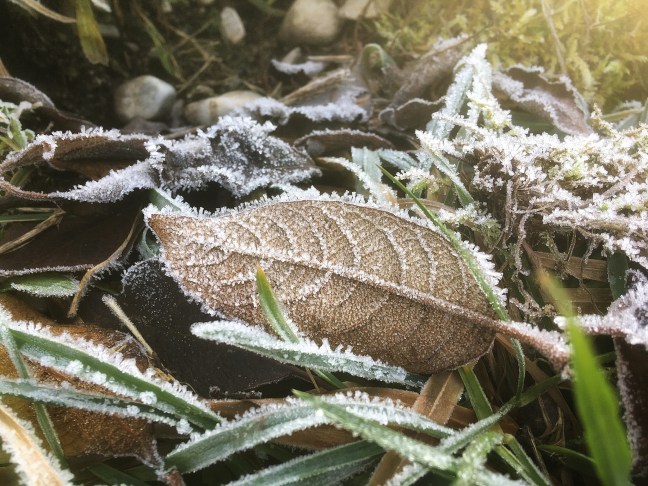
Text and photo by Alain Joly

~~~

.

Other ‘Ways of Being’ from the blog…

.

The Wisdom of Humility

‘Buddha as mendicant’ (Part) – Abanindranath Tagore, 1914 – Wikimedia

.

To look into and understand the meaning and implications of being truly humble, of that state of humility which we often hear about — but rarely fully understand — is a precious thing. The word ‘humble’ finds its roots in the Latin ‘humilis’ which means ‘lowly’, literally ‘on the ground’ (from ‘humus’ meaning ‘earth’). Its etymology covers both the more active aspect contained in being ‘humiliated’, or being ‘humbled’, and the one that refers to the state, or quality, of being ‘selfless’. The first one gives the primary importance to the self that we are, to this separate entity that we believe to be, and which needs to be rendered humbler, smaller, lower. But why would we want to do that? Why, if it wasn’t for our deep intuition that this self is illusory, false, and is ultimately preventing our true identity of peace and happiness to be recognised and realised? 

This inherent peace contained in just ‘being’ refers to the second aspect of the word. Being humble is being without self, without the belief of being separate from objective experience. We are not this restless entity that wants to achieve, to aggrandise itself, and needs to be rendered low. We are rather this pure being whose very nature is complete, and already, unconditionally humble. Otherwise, why would Shiva or Buddha be portrayed as a mendicant? Therefore, the solution to our chronic state of suffering and conflict does not lie in having more, or less, or better ‘self’, but in realising, and living from, this deep and already achieved peace that we are. This realisation, and the action that is born of it, is what true humility is about. This simple phrase from the Bible made it crystal clear long ago: “When pride comes, then comes disgrace, but with humility comes wisdom.” (Proverbs 11:2)

I am sharing here a few quotes that will further explore this deep and essential question:

~~~

In a space of humility,
no conflict is possible
.”
~ Éric Baret (‘Let the Moon be Free’)

~

Humility contains in itself the answer to all the great problems of the life of the soul. It is the only key to faith with which the spiritual life begins: for faith and humility are inseparable. […] If we were incapable of humility we would be incapable of joy, because humility alone can destroy the self-centeredness that makes joy impossible.”
~ Thomas Merton (‘Seeds of Contemplation’)

[…]

Discover many more quotes on this question of humility… (READ MORE…)

.