Boundary

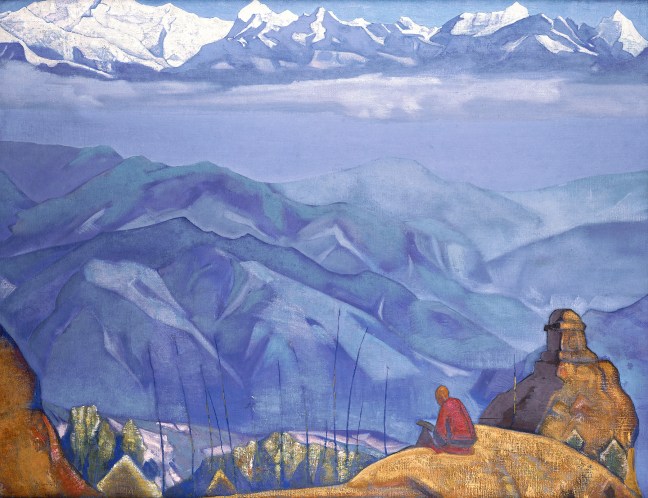
‘Book of Wisdom’ – Nicholas Roerich, 1924 – WikiArt

It is naive to imagine that there is a boundary or separation between consciousness and the world we are conscious of. It would be extraordinary to find that boundary, where our consciousness ends and where the outside world begins. We have an apparent and necessary boundary between body-mind and world, for our convenience, for practical purposes, and have left it there as an unquestionable fact. And everybody has complied, including scientists, that this separation must exist, that consciousness is a competence of the body, that it cannot be challenged, that it would be madness, beyond reason to do so. But there is an impossibility here. For this boundary can never be found at the deepest level, or even conceptualised. It is inexistant. Something like a pure invention. But this illusion of a separation was broken, seen through long ago, in the world of mind, of which our spiritual traditions are experts. Sages have seen long ago that there was here, between consciousness and the objective world, a seamless relationship, an undoubted oneness, no boundary, no separation, not even an unlikeness. It was all one with nothing besides it. The world is wholly contained in Mind, as Mind, and Mind or consciousness is all we are, all there is — our fundament.

So we have invented the reality of a world out of the reality of consciousness. After all, it is a beautiful find, a gorgeous dream, that we have a world, and that this world was shaped, sculpted by our five senses for as long as our senses have existed, and for as long as our bodies have been made the inevitable side effects of the appearance of a world. Everything — world, body, mind, senses — is an appearance in a more fundamental, non-objective reality. So nothing new, or other, or different was ever introduced in our reality. Reality is all there is. Consciousness is our playground, our only field or ground, and it is hosting everything in and as itself, including our apparent self. This is how we have a father and a son. A reality, and a temporary, individual, apparently located point of view on that reality. But between father and son, between reality and ourself, there is only one seamless consciousness. God has made sure that all things and beings find a habitation within him — or her. And then, ‘within’ was too taken away, for how would you have a within and a without when there is only the One?

So we have to meditate on the appearance of this world. On what is hiding behind it. On what it teaches us on our nature, on our reality, on our humanness. By the way, being human is by no means derogatory. In its most ancient Sanskrit root, the word for ‘human’ means: “The being whose essence is the capacity for self-remembrance of its divine nature.” So this knowledge of the reality of the world is a sacred knowledge. For with that knowledge firmly held, you can now enjoy personhood without the burden of separation, without the suffering that is its natural outcome. So we don’t have to be spiritual anymore. We have acquired our personhood, our humanness. Our nature has been realised, uncovered, in its primal, intended truth, and it is once and for all. Now we can enjoy a world for the first time. Now we can be lovers. Watchers. Listeners. Devoid of the superfluous. Free of our cumbersome, limiting beliefs. Recognising and accepting God’s will as our own. 

.

~~~

Text by Alain Joly

Painting by Nicholas Roerich (1874-1947)

~~~

.

Website:
Nicholas Roerich (Wikipedia)

Suggestion:
– Other ‘Reveries’ from the blog…

.

One Living Being

Truth is when the one who desires truth is not there. That one is a flaw. It is superimposed on the truth it is looking for, and veils it, makes it unreachable. It tramples it, literally. It makes it misty, obscure, mysterious. But truth is an obvious reality, if we don’t put it at a distance. If we don’t imagine it as something. Truth is not a thing, a concept. It is what we are — present, alive, real. Only we have to leave, recede, tiptoe. It’s all it takes, to not be boastful about it, to not think we don’t have it, to not assert the lie of our being someone. Being someone will push truth into the darkness, unseen therefore forgotten, hidden therefore to be sought. Our looking for it is the difficulty. Truth is to be approached with subtlety and utmost delicacy. Not that it is fragile, it is not. But it is sensitive to our feeling separate from it. It doesn’t like it. It shrinks at the thought of it, that we are looking for it, wanting it, being ambitious about it. Truth is not to be conquered, practised, refined. Truth is here fully dressed. It is our most fitting attire. The very being of our being. Massive. Obvious. If we let it open up, unfurl, spread its all-pervasive presence, and its creative, mind-blowing, self-evident, undeniable power and eminence.

But if we think we’re not enough, well then we’re not enough. If we want to indulge in being a person, a poor me, then we fall from a great height. We suffer from being separated from our essence, our quintessence. We feel the burden of our constant, intrinsic, congenital seeking. It becomes our identity, to be a self seeking, to live in separation, to be fearful of this condition, and a believer of ideas. We live in our mind, struggle with our beliefs, conflict with experience. We are not what we should be, and we feel it, know it, dread it. And we are crippled by our impending death, which we cannot understand, fathom, and marvel at. So it really comes down to ending a belief, a simple belief, that cheated us. That our body, our thoughts, feelings, senses are substantial when they are but a dream. That our being finds its reality in our body and mind when our essential is not there. Our essential draws its reality from a presence that is infinite, eternal, unfathomable, loaded with love, peace, and a creative impetus. Nothing else than this presence is at play in our experience. We realise that we are just one living being, which cannot be divided, and has no other than itself. We realise that we are that, in spite of all evidence and impression. This self that we believe ourself to be is in fact secretly made of that, if the mist of its fallacious reality breaks apart and reveals its hidden nature. There is no separate, distinctive, solitary self. Only this shared, glorious one being. Then it falls into place that, for exemple, “I and my Father are one.” (John, 10:30) And that “In him we live, and move, and have our being.” (Acts, 17:28)

.

~~~

Text and photo by Alain Joly

~~~

.

Suggestion:
Other ‘Ways of Being’ from the blog…

.
Daily Calling

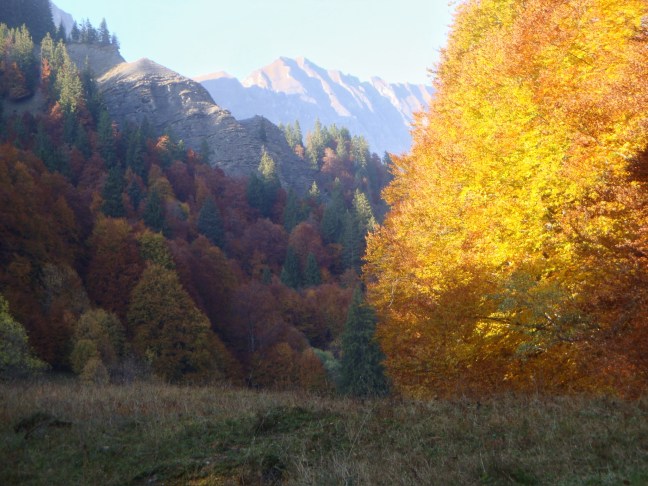
It is easy to look, easier than we think. Yes we have seen temples and churches by the thousands, endless acts of devotions, and pilgrims whose faith seems indestructible. Yes we have marvelled at yogis whose ability and constancy is a subject of awe, at monks whose dedication and celibacy seem unattainable. It may have dawned on us that this path is too rigorous, that spirituality in only for the chosen few, for the dedicated ones, whose lives are set on a perfect course for it. So we have renounced to go there, finding excuses — that we don’t have what it takes, that God has for us no calling, that I wouldn’t have half of the rigour that a serious spiritual path requires. So we have stayed where we are, repairing here and there a few cumbersome habits, loving our loved ones, sharing our usual skills with the world, battling with our thoughts, dealing with our sorrows. We didn’t dare, didn’t quite believe that the spiritual endeavour was our path, or the path of the majority of us. We stayed put. We gave up without even the beginning of an understanding.

But spirituality is not what we think. It is not a path of renunciation or remoteness. It is not about belief, opinion, or even conviction. It is about reality. It is about looking what there truly is, here and now. What our experience is made of. What there is behind the gloss of experience. That’s how we are spiritual, by looking for that part of ourself that is not a thought, not a sensation or a feeling, not the body that we have come to be identified with. That’s how we are religious, by finding this deeper identity of ourself that is wholly and naturally related to others and to everything. By recognising that ungraspable, unfathomable, deeper being that is our eternal home, which we have lost sight of in the tempestuous world of our many experiences, a world that has so far attracted the totality of our attention without our objecting. We have simply missed, maybe indulgently, that spirituality is about knowing who we are, no more than that. Spirituality is not about practice or achievement, for its only aim lies in recognising what is eternally here as the very fabric of our self. It is not about age, for age will never affect what we are in the depth of our being. It is not about health, for there is a place in ourself that is forever stamped with wholeness, which is another name for perfect health.

So we don’t need to go to churches or temples, for where we are is our church if we know how to make it so, and inhabit it, not with our worries and projections, but with who we are as our deepest being. And remember that the world makes for a marvellous temple, when we connect to it with our deeper self, and bathe it with the peace of our own being. We will be in touch with our spiritual being every time we experience love in our life. That’s why people have pets, so that they can stay in touch with their heart. That’s why we so dearly seek the intimacy of relationship in our life, so we can lose the distance that our minds have imposed on us. That’s why we love fulfilling our desires, for we know that we find there, in this fulfilling, a taste of our own loving, untouched, unconditioned being.

So there is a mass or a puja going on in every corner of every experience that we may have. There are hallelujahs that can rise any time, anywhere, anyhow, if we are willing to pause and look at what our present experience is made of. And know that we will never be asked to believe, or corrupt any part of our gorgeous being, for we have a duty to be faithful to our self as it is. The only practice or prayer we will ever have to perform is to recognise and be aware of the nature of our being. This true and only identity or nature is lying just behind every temporary appearances and objects that can be formed, named, and pointed to in experience. Know that the formless is our most intimate companion, for it doesn’t live in time or place or objects, but in and as the very ground that is our one and only identity and being. This connection to that deepest, most intimate being in our everyday life, is in itself the most religious endeavour there is, where spirit is discovered to be the only thing in presence, and the home where we find our joy, and our undefeatable reality.

.

~~~

Text and photo by Alain Joly

~~~

.

Suggestion:
– Other ‘Reveries’ from the blog…

.

On Desperation

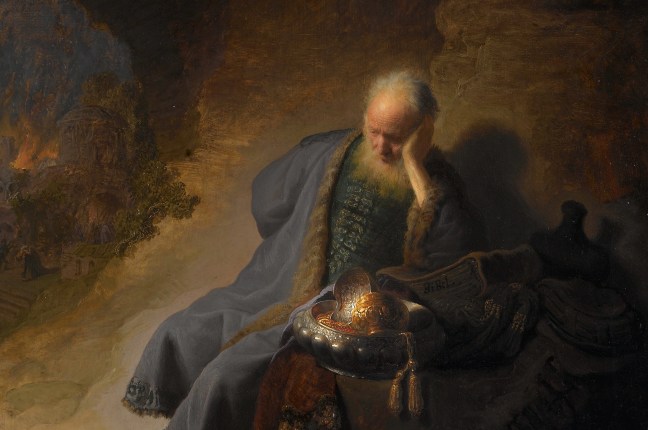
‘Jeremiah mourning over the Destruction of Jerusalem’ (part) – Rembrandt, 1630 – WikiArt

What needs to be seen and understood is that the story of humanity, the story of every life lived here under the sun, is the story of a desperation. We are fighting off the feeling that something is lacking. We want to reach or attain something, and this something that we are looking for is the same thing for everybody. Whatever form may take our life search, our drives, our dreams, our desires, our pleasures, they are all here to make us feel at peace, content, whole. They are here to free us from ourself, from our search, from our never-ending desperation. Outside, we may put on the appearance of control, normality, and responsibility, but inside we are burning, seeking, longing for that which we have never been able to put into words, explain, rationalise, or make sense of. But in fact, we are looking for something that we already possess in infinite quantity, although unknowingly. We are craving for the abundance that we already have, searching for a peace that is already given, begging for a joy that is throbbing unnoticed in the background of our everyday experience.

Our suffering or desperation is the symptom of this misunderstanding. We fail to notice that we have what we are looking for, that it is here in plain view, already achieved, already formed in and as our most intimate identity. Our self is made of that sweet fire of peace, contentment, and sufficiency. So the misery we are in is only apparent, imagined, made up by our thinking about it, and by our looking for peace unnecessarily, out there, in the wrong place, in experience. There is no amount of effort that will ever help us to attain something that is already attained. On the contrary, the disturbance involved in seeking what we have will cause us misery, in the form of a desperate, separate sense of self. We are too eager. We never sit still, always foraging our experience to harvest some scattered drops of peace or joy, when our very being is already overflowing with them.

The only necessity, or even possibility of being a self separate from experience is through managing the tension involved in seeking a peace that is already our most intimate nature. Our self is the story, the memory of this seeking. When peace is here, there is no self present, no tension that could make us a suffering entity. In fact, we seem to proceed by distraction. We are not looking, and then we complain that it is not there. All our efforts to obtain an enduring peace in our life are vain and doomed to failure for the simple reason that peace is not a thing that can be had. Peace is something that we have to realise is present here and now. It is our vey being, what we are made of, our unborn reality. So there is no real, substantial suffering here to be rid of. It is not that suffering is not experienced. It is that its only reality is only in and as our imagined self. It is but the friction that goes with believing to be a separate entity. Suffering is essentially made of our believed self, which is but our constant seeking to alleviate this apparent misery. The ending of the belief in being a self, which is also the ending of time, space, and separation, will make fully apparent our nature as peace and happiness, in which there can be no suffering, no self, no seeking, no desperation.

.

~~~

Text by Alain Joly

Painting by Rembrandt (1606-1669)

~~~

.

Website:
Rembrandt (Wikipedia)

Suggestion:
– Other ‘Reveries’ from the blog…

.

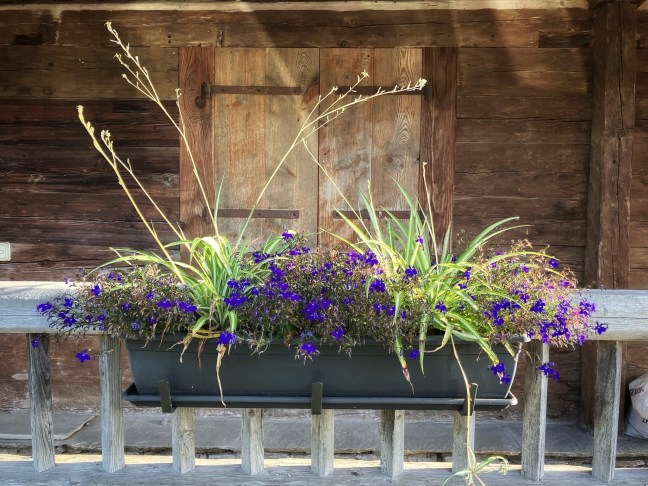
Holy Ground

We have no being of our own. We have built our existence as a person, as a body, as a bouquet of perceiving faculties, on a ground that is not our ground. We are borrowers, incomplete entities, which is the reason for our restlessness, for our many lacks, and for our sense of insufficiency. Wholeness and plenitude are attributes of the ground or essence. This essence is hidden because we are overlooking it. We, on our choice, have displaced our attention to what we mistakenly take to be ourself: our thoughts, feelings, sensations and perceptions — all that makes a narrative, that gives us an appearance, a consistency, an existence. But one such existence is a fraud. It is not what we essentially are. We have displaced our self, our identity, from the ground to the landscape, from the essence to the superfluous appearances that owe their existence to that universal, infinite being or ground.

But an appearance can never make us. A thought doesn’t make an identity. An idea, an image, a body, are not what we are in essence. But they all have a common ground, hence our confusion in our perceived identity. This common ground is our deepest sense of being, the consciousness that is found at the root of ourself. If only we were aware that what is seeing, thinking, perceiving in us, is actually the ground, not ourself; that what is experiencing, what is aware in our everyday life, is in fact this supreme, infinite ground, then we would acquire a very different idea or perception about ourself, another responsibility, another awe, another reverence for our reality. Our reality would be discovered to be the ground of all beings, called ‘god’ in the spiritual literature. God is not a word for a thing or a person, but for a living experience, a taste, the feeling of being that has its reality here and now. It is not distant, not dependent on a belief. It is a hard reality, accessible in all experience. It is our true nature, what we are, and what we know we are, without a shadow of doubt.

God is not a guess, a maybe, a question. God is a certainty, an evidence, and the answer to our suffering. It is our very conscious sense of being, the very thing which in us makes for the feeling ‘I’, for what I am in truth and in depth. It is our one and only reality. If we do live from that essential ‘I’, then we live from inside the holiest of temples. We cease living and acting from a private, separate sense of an individual self. Behind the veil of our mist, of our everyday fascination for mind, body, appearance, existence, is a presence that is revealed when we let go of ourself. It bears in its DNA the savour of holiness, and of a quiet, unbreakable happiness. Holiness is not an attribute of things, places or people for which we may have reverence. Sacredness doesn’t belong to the landscape, or the object. It is rather the natural expression of our true self, of ‘I’. It is in abiding in our true nature or essence that we feel a deep reverence for everyone and everything. What is sacred is our intimate, infinite being, and this being draws its holiness from its one pristine, untarnished, infinite nature. Wholeness makes for holiness. Holiness belongs to the ground, and the ground has it in its nature to shower benevolence to all hosted appearances. This is how we have, shining in our experience, the qualities of peace, love, beauty. They are all offsprings of the holy ground, which is ourself.

.

~~~

Text and photo by Alain Joly

~~~

.

Suggestion:
Other ‘Ways of Being’ from the blog…

.
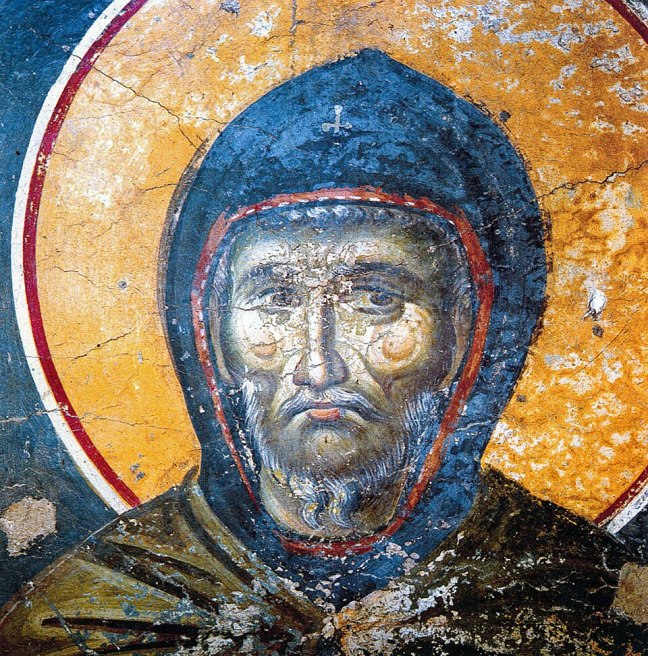
Unaccompanied Awareness

‘Woman in the Park’ – Ion Theodorescu-Sion, 1919 – WikiArt

Nothing is more beautiful than to be aware choicelessly, effortlessly, without involving a self, a thought that wants to do awareness, to control it, to achieve it. After all, awareness is by virtue of its being, and cannot be rendered more aware than it already is. So awareness blooms when it is left untouched, virgin of a self, free of an ambition or desire to be aware. Awareness is the kind that enjoys being alone, unaccompanied. It doesn’t like to be mimicked or carried by a somebody that feels superior, in charge of being aware. And yet this is what we are doing all the time, being like a commander, a figure of authority. No wander awareness is leaving the show, retreating in the background, he that has no desire, no ambition other than being, she that feels whole and sufficient, in no need of an other to possess her. You’ve got to let go of wanting to be awareness, for that desire is made of scattered little pieces of ego gathering together in a desperate attempt to keep some control on the situation. There is no desire involved in being aware, for the simple reason that awareness has no desire other than to simply be and shine. Awareness is here now beaming in and as our experience. Noticing is all we can do about it.

But noticing already implies awareness. Don’t think that you are the one who is going to notice awareness. The noticing is awareness itself recognising its own presence, acknowledging it, giving it the freedom to just be. So there is only awareness — no one here that is aware, or even noticing to be aware. That would imply that awareness needs a clutch, a somebody to be aware. This somebody is fictitious, fortuitous, disposable, redundant, not required. Awareness relies on itself only. It is bound together with itself. That’s why it can be depended upon with confidence. If you are awareness, well then you are awareness. Let yourself be taken in the embrace of it, without a second look for yourself. See that there is here and now only the activity of awareness, and renounce to your own, which is no renouncing at all, since there is here no such a thing as a self that is separate from awareness. Just see that you are not there, not at all. There are thoughts, sensations, perceptions, but of a self you won’t find any trace. If you do let go of the idea of a self, then you will come to see that what is left here is awareness alone, which is the only thing there is and that is in capacity of selfing.

So awareness is outrageously simple, since it is the only thing experienced, whether we know it or not. What is complicated is what is entangled, intertwined with awareness, that which has set itself up as an other, may that be a single thought… that’s enough. A single thought is enough to render yourself blind to awareness. Since awareness, or this quality of pure knowing, is all there is, then in a strange and fascinating way, it can be easily displaced or darkened. It needs only the slightest interference, the remotest identification, the minutest belief to be something — a self that has awareness — to send it into the hiding. Thoughts and perceptions have become experts in mimicking a self, stealing the space of awareness for their own purpose, and deceiving ourself into being an entity, a self. There is no self here separate from experience. There is but a plunge into your own being, a sea of awareness without an end or a limit, a free fall which no self could ever cope with, or grasp, or comprehend. This empty being with no objective quality is yourself, all there is to yourself, and its tissue is made of pure awareness. Experience then is realised to be only an appearance devoid of its own individual reality. It is made of that presence which is our essence, whose nature is awareness with nothing beside it.

.

~~~

Text by Alain Joly

Painting by Ion Theodorescu-Sion (1882-1939)

~~~

.

Website:
Ion Theodorescu-Sion (Wikipedia)

Suggestion:
Other ‘Ways of Being’ from the blog…

.
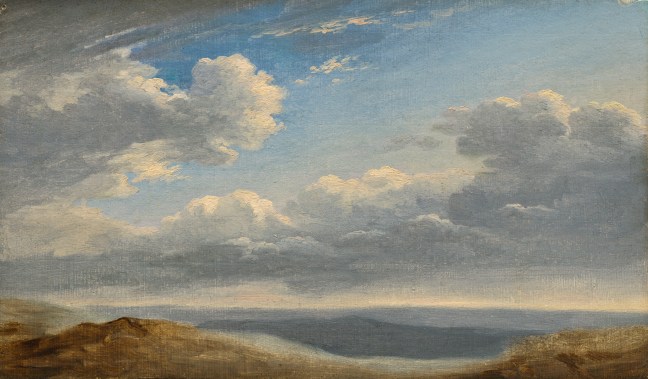
On God’s Existence

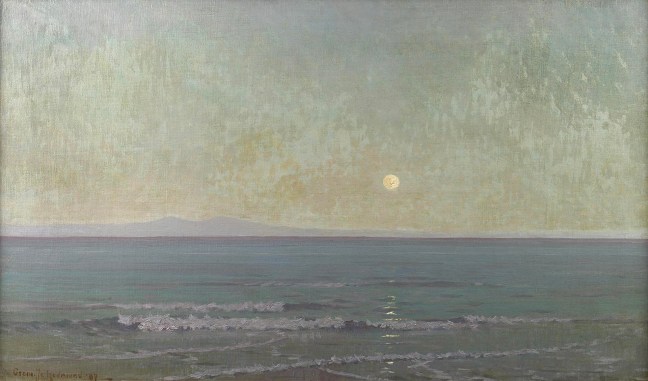
‘Calm on the Mediterranean Sea’ – Ivan Aivazovsky, 1892 – WikiArt

There is no god. God is an invention that we have placed far away, out there, as an object for our prayers and hopes. As an entity to whom we can address our suffering. God was given that role so that we are not alone. We have divided ourself up into a self here and another greater self there, between which reside our secret longings and our beliefs. We have made god into a handy projection, for our convenience. A soothing presence who will be there for us after death, whom we can trust and rely on, whom we can give ourself to, and find protection in. We feel good in that undoubted certainty of a god.

But there is no god outside of ourself, no distant god, either in place or time. Of this we can be sure. Because wherever we may travel, however far we may go, we find only ourself. We are bound to our own being which we feel in a ‘here’, and in a ‘now’. So we fail in going somewhere that is outside ourself. It’s an impossible task. We cannot go there. Not in a million years. So god cannot be found outside of ourself. Nothing can. Everywhere is here. And every time is now. The only place for god to be is in our own being. There is no other place to be — even for god. There is no way around it. But we have first to understand our own being, our own nature. There, in ourself, is the resolution of the conundrum of god.

So what is this place of ourself, to which we are bound? What is it made of? If we leave our body aside, and our many thoughts and sensations, if we leave the world out of the picture, what is left of ourself that we can say is here, is now? What is this consciousness that we have lived with for as long as we can remember, and for which we seem to have but little interest ? This thing which has held our peace, our happiness, our perceived sense of beauty, even if only experienced rarely or fleetingly? This consciousness that is holding us, that is giving us our very existence, holding our suffering and our conflicts? Should we not feel grateful to have been held with such consistency? To have been held with our feelings, whether happy or sorrowful? To have been lent a body, whether healthy or sick, and a mind, though both may be just a passing dream?

This thing which is here undoubtedly, showing that peace is possible, that beauty is real, that happiness is within reach, is this not our most profound self? Is it not our very being? What we are here? What we are now? And this god which cannot be anywhere outside of ourself, could this god not be this, this very presence of ourself? Our very being? Our very consciousness? Which we are by nature every day of our life? That which can be felt in every bit of our heart and soul? That can give an explanation for ‘there is no god’? That can give a reality to ‘there is god’? That can show that, in fact, not only there is god, but there is only god? That everything, all that we are and experience, is god? That the god which we had thought at a distance, is nothing but the loving presence and reality of ourself and of everything? That life is nothing but the living, pulsating being of god, which we are only and wholly? And which we share with every other apparent being, and every possible appearance? And that this, is the one thing that ever was, and will ever be? And that this, is not inside ourself, for of ourself it is seen that there is not? And that this, is not outside either, for there is no being outside something inexistant? And that now, at the end of our journey, and all things considered, is realised that god is not even god? Because for a god to be, there would have to be separate things and selves to give it a form, and to call it god. There would still have to be a trace of suffering. There would still have to be separation. So there’s got to be no god. God is only for the poor fellows. But for who we are, there is no god. Only being being, at the most. Beyond that, nothing much can be said, lest we should invent some other god.

.

~~~

Text by Alain Joly

Painting by Ivan Aivazovsky (1817-1900)

~~~

.

Website:
Ivan Aivazovsky (Wikipedia)

Suggestion:
– Other ‘Reveries’ from the blog…

.