Demons and Angels

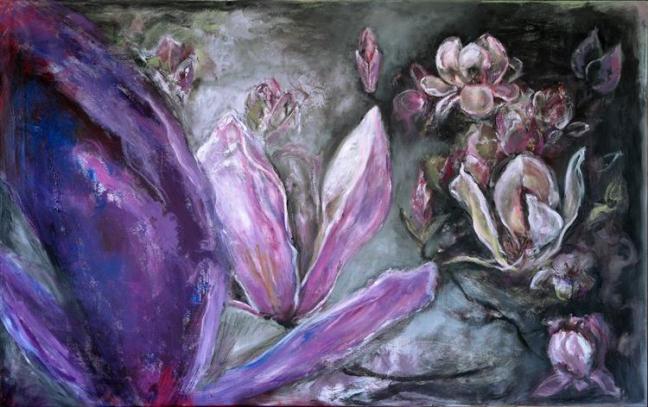
‘Magnolias’ – Carmen Delaco, 2022 – WikiArt

We are only ever made of thoughts. Sometime, thoughts come elaborate, with clearly defined words, perfect punctuation, following their due purpose. And sometime not. Sometime, they come as lightnings, striking us with a belief, an old stale repetitive assumption. Sometime, they linger unsaid, not pronounced, sneaking in but making untold damages. Sometime they don’t even need to be expressed. They have taken us over, have made a puppet of our life, tearing it apart in every mindless direction. All these thoughts are like little devils, unseen demons, unnoticed burglars stealing our identity. We have been brought to our knees, at the mercy of every one of their injunctions. We have been made just a collection of them, and nothing but an assumption. An idea of ourself. A self literally made up by the constant assault of thoughts, and by our believing them — belief being yet another thought.

Look in every direction you may. Notice here the coming of a hope, of a longing that takes form, but is yet just a thought. And when a worry comes, that this longing may never be fulfilled, it is just another thought that comes dancing with it. Attend to your expectations, to how you now imagine a future event. See how this evocation of the future comes as just another thought in your mind, for there is only ever thinking about the future. The future doesn’t exist, is always only imagined by a random thought. A regret, a desire, a fear, any bout of suffering or satisfaction, any feeling, comes wrapped in and as a thought. Thoughts are everywhere in our world. Even our body, our action, our world, are coloured and shaped by a thought or an image that condition their being perceived. A habit is a thought that took root and grew confident, unchecked, and many of our conditionings were once thoughts that have formed to become the established norm. As long as there is a thought somewhere in the system, that comes to define us, to give us a stand, an identity, that identifies with the body, that separates from the world, that gives a fleeting joy, or a tenacious pain, then we are not alone. We are not independent. We are not being our own identity. We have given it all up to thoughts, and have lost our being in them.

So go behind it all. Go before everything that appears for a while and recedes. Go before every worry, every hope, every mindless desire, behind every dull satisfaction that lingers lazily, every fear that strikes and leaves its trail inside you. Go to the place in you before every thought. Visit that portion of yourself where thoughts are of no consequence, where they are made trivial, ridiculous in their powerlessness. Go where distance is not, for thought as time has created the gap between yourself and your true nature, a gap where hides every shades of conflict and suffering in yourself — which are again thoughts. And go where you discover yourself to be unbreakable, unsoilable, eternal, for death too is another of your endless thoughts, maybe the most perverse one, but one that doesn’t stand being seriously investigated. Notice that thought is always some kind of thing, and that there is one place in yourself that a thing, that a thought, will never touch, or affect, or change: it is that portion of emptiness in yourself, which is only full of itself, and is therefore inaccessible to a thought — any thought. That placeless place is your peaceful being, your identity, who you truly are. To stand as that will freeze dead all the many thoughts whose only function was to give you support or approval, identity or escape, or contentment. These are burglar- or demon-thoughts, that come to lie to you, and try to impose their views on everything and on yourself. But a thought that is starting its journey from that virgin place of being is but a devotee and an angel, respecting your true identity and carrying in its wings the offering of your being, which is love. It is but a servant of the higher intelligence of truth. In general, demons are many, and angels are but a few.

.

~~~

Text by Alain Joly

Painting by Carmen Delaco (born 1976)

~~~

.

Website:
Carmen Delaco (WikiArt)

Suggestion:
– Other ‘Reveries’ from the blog…

.
Apocalypse

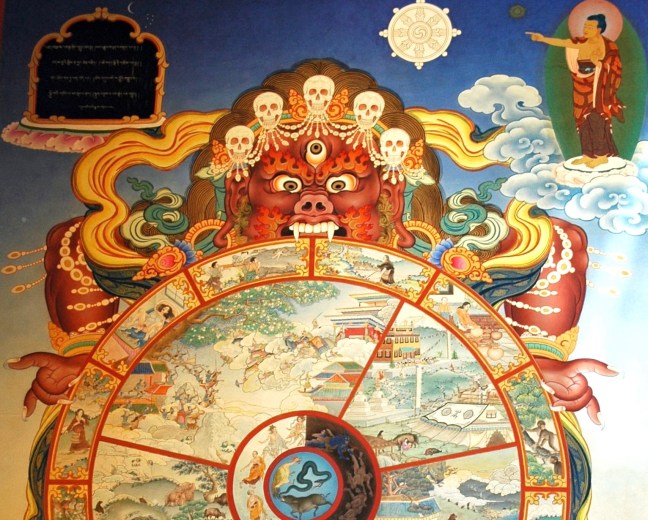
‘Traditional bhavachakra wall mural’ – By Wonderlane (Sakya Monastery of Seattle) – Wikimedia

There is a beautiful and meaningful contrast in Buddhism. It is to be found in the approach to impermanence (‘anicca’), which can be a very effective pathway to our true nature. It says: everything that passes away is not it, is not you. Notice everything in and around you, and see that it won’t be always here. The house where you live will be destroyed, and no objects you possess will stay forever, including your body, and the billions of other bodies, including the trees, the seas, the mountains, the air you breathe. Eventually, they will all go. Your thoughts, emotions, qualities, character, mind, that you think characterise you, well… The planets will wither too, the suns will die down, and space even may one day be swallowed back where it once was seemingly born.

Scan your experience and try to find something that doesn’t pass away. But go far enough. For then will come, like a new dawn, the revelation that there is something here that never passes away. There is a permanence, a nature, that is your very being, which will never not be, and which swallows in its own profound nature all things discovered to be devoid of their own independent natures. So in the end, nothing really passes away, for all the separate objects of your experience do not possess their own individual, separate nature, which could be considered impermanent. Impermanence is when you think you are a body. But in fact, permanence is all there is, and it is lived and seen as the one being that we truly are.

With this understanding, you will come to realise that your suffering also cannot stand the revelation of your completeness. What you called ‘suffering’ can only exist in the belief that all objects have their own separate existence. Believing yourself to be one such separate object, you find yourself to be incomplete, not enough, therefore seeking in objects your happiness or completeness, which you could of course never find. You started with a wrong view in mind, which made everything down the line unsatisfactory, and biased. That’s why the Buddhist term for suffering ´dukkha’ has the meaning of an ‘unstable stand’, or more poetically, the ‘badly fitting axle-hole of a cart or chariot’ giving ‘a very bumpy ride’. So what then? Suffering never actually existed? Was it all in our mind? Created by a simple belief, an ill-fitting understanding, a shaky representation, that rendered our world unstable, untrue?

In Buddhism, the positive is never named. What is is never mentioned. That’s why it is said that our existence bears the three qualities of ‘impermanence’, ‘suffering’, and ‘no-self’. You will never find a self in something that it always in movement, always changing. No self in things, no self in a thought, no self in a body, no self in you — this is how far it goes. There is no self inside your body-mind. There cannot be. This is logic. No phenomenon could ever hosts a self. There is ‘no self-existent essence’, as suggests the Buddhist term ‘anattā’. Essence cannot just exist. It would make it appear or disappear. The essence of all things, including your own self, is infinite, not limited, not bound to any phenomenon. So ‘no-self’ in Buddhism is only a strategy for you to realise that the only self in presence is the nature or being of all things and selves, which we are, but cannot comprehend or even name. This is what the wisdom of Buddhism has put in practice in such an eloquent and radical way. Not even a name are you given for your own being. The nameless, you can only be.

So the ‘three marks of existence’ of Buddhism are nothing but the story of an apocalypse. ‘Impermanence’, ‘suffering’, and ‘no-self’, may give you a rather apocalyptic vision of your existence. But this is only if you have forgotten that the word ‘apocalypse’ means in fact ‘revelation’. The apocalyptic picture of our existence in this world is used as a wake-up call to push us into the revelation of our true nature as being. It is all about strategy. Do not take religious teachings to be the real thing. They are but teachings that point to a deeper, unnameable truth — the turning around of an apocalypse into the revelation of our true being.

.

~~~

Text by Alain Joly

Photo of ‘bhavachakra’ mural by Wonderlane

~~~

.

Website:
Three Marks of Existence (Wikipedia)

Suggestion:
– Other ‘Reveries’ from the blog…

.

Our Only Landscape

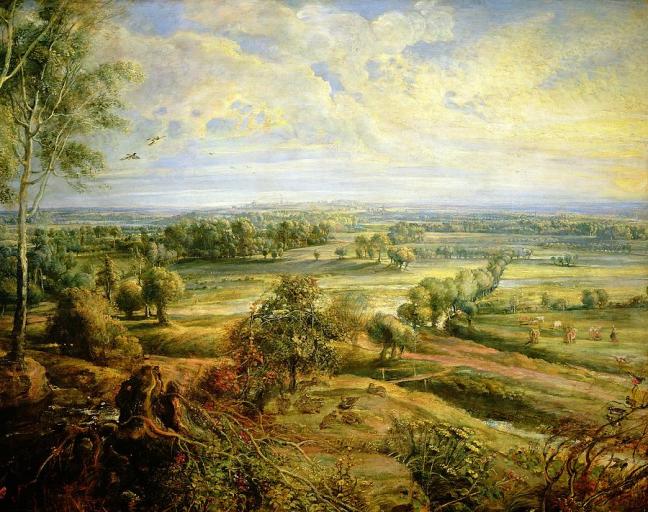
‘An Autumn Landscape with a view of Het Steen’ – Peter Paul Rubens – WikiArt

We are always wandering about, always attracted by a thousand things. Falling for every passing experience. Looking for the fleeting promise it might carry. The reason is: we are so vulnerable to happiness. We want it above all else, at all cost. We know we deserve it, that it is our due, that it is natural, in the order of things, to be happy, rested, at peace. So our mind is never still. Seeking to obtain it. Longing to have it given. Working for it relentlessly. Sometime pretending to be happy if necessary. If it is what it takes. After all, this is the game we are being asked to play. This is our fate, that we have accepted as the norm, and to which we have complied and have been a slave. We would do anything to feel alive, contented, our heart full, our mind at peace, secure, on top of things. And we feel depressed when being turned down. Lost and disheartened at every bout of despair or suffering.

But maybe it is all an unfortunate misunderstanding. Maybe we have taken a wrong turn, and were embarked in our own forgetfulness, distracted by the general consensus. Maybe there is no need to wander about. Maybe experience is of no need to us for happiness. Maybe happiness is not found in experience, not in the least. Maybe working for it creates a distance, a gap, throwing it far and away, like something never reached, never quite here. Maybe hoping for it makes us a self, an illusory entity that needs to obtain peace through the satisfaction given by objects, events, favourable circumstances, which makes us dependent and fearful. What an irony it would be, if it were just this, just this misunderstanding, and that happiness was in fact right here, already spread in and as our sense of being, offered to us with a ruban — a gift eternal for our simply being here and now. How clumsy on our part, to have looked away from ourself for that which is not only in ourself, but our very own self itself. How foolish it all was.

So, this is how it is! We are already fixed in our being, which is peace, which is joy, and have been so all along. We have missed that: that this was our belonging, our identity, to be at peace, firm, stable, fastened, secure in our simply being. And that this simply being was enough, the completion we were after, what we thought was to be earned at the very end of a deceitful string of efforts. Adding to simply being is where we made the mistake, where the wrong turn was taken. We had to stay where we were, and simply notice where we actually were, and what we in fact truly were. Being was not a little thing, undeserving of attention. Being was the completion, everything: you, happiness, peace, experience, the world, all gathered in and as the simple experience of only being. That’s how you lose all wandering, all attraction to things, exchanging them for the one only attraction worth falling for, which is yourself. You have to fall for yourself, for your being. You have to let being embrace you, and swallow you. Then, you won’t have to be anything, won’t have to look for something or someone other than yourself. For you are the fact of being, and this in itself is all the landscape you will ever need and find yourself in.

.

~~~

Text by Alain Joly

Painting by Peter Paul Rubens (1577-1640)

~~~

.

Website:
Peter Paul Rubens (Wikipedia)

Suggestion:
Other ‘Ways of Being’ from the blog…

.

The Intimacy of Experience

‘First Leaves, near Nantes’ – Camille Corot, 1855 – WikiArt

.
I will tell you where to be
. Be where every experience feels an equally good experience. Don’t be attached to judgment and comparison. These are the mind’s favorite tools and activities. The mind tricks you to believe that experience is an uneven ground. That according to the content of your experience, you will be gifted with either happiness or suffering, peace or conflict, harmony or disorder. So the experience you are having becomes extraordinarily important. We become dependent on what happens to us, and come to dread it. So we retire into the secure place of our habitual self, with its cortège of worry, control, expectation, and manipulation.

There is a place in us where you don’t find experience to be such a determining factor. Where you will not let experience determine you, fix you, limit you. You won’t be shaped by its content. You won’t be made into something, someone, with qualities and flaws, to be judged, evaluated, compared with — the likeness of experience — in fact, just another object. The mind is a manufacturer of objects, entities, persons, fixing the insubstantial nature of your being into a self to be moulded and made either happy or miserable. To be made happy by an experience is to be cheated on by it: we are being manipulated, and made to believe an illusion. To let experience make us miserable is sheer deceitfulness, it is us being easily dazzled by the treachery and artifice of objects.

[…]

Continue this exploration of the nature of experience… (READ MORE…)

.

An Abundance of Spirit

‘Chateau Noir’ – Paul Cezanne, 1904 – WikiArt

We always go too far, too quick. We jump to the objective display of reality, and in doing so leave our reality behind. It is a strange phenomenon, this forgetting, this negligence, this hurry. In fact, we pass ourself by, and rush towards what we think matters the most, what we believe to be real. This is how we have made this life difficult, an impossible thing to comprehend, and a hardship: in this forgetting, in this passing by. Our suffering is the product of a simple, single act of absent-mindedness. We have put ourself into oblivion by having made the facile postulation that reality is in the objective, in what we can see, hear, touch with our senses. And then have clung to it, to the point of losing our mind inside it, and losing ourself with it. What an absurd thing to have done.

We ought to be slow and still, if we are to meet our nature. We need to be attentive, if we are to notice our being. Not the one-pointed kind of attention, that we are already so well-acquainted with, but the sluggish one. The lazy one, that doesn’t want to go out and stumble into the world. That doesn’t feel like wrestling with thoughts. That cannot be bothered with the threat or seduction contained in the last surge of a sensation or a feeling. I can assure you that there is already a lot to see, hear, feel, on our way to the vast, far-ranging world that our senses provide. So let us not have time or space on our schedule. Let us forget the agenda that our person has and wants to fulfil. Let us not form any concept, idea, or projection, and delve into what is here before every appearance.

We may see, in slowing down, that there is here a presence that stands still, transparent, and aware. We may hear the sound of a silence that stays unaffected by the clamour of existence. We may feel the world to be but the thousand colours of our sumptuous being. We may notice the pregnancy of spirit in what is seen, heard, felt, and realise this pregnancy to be our very own nature felt, heard, seen. This abundance of spirit in our life is but the disappearance of the entity that sees, hears, feels the world, and the surging of the One as our own and only reality or world. Then we won’t pass truth by anymore. Our own nature will be unmistakable, unmissable. It will meet us in the face at the first surge of an object seen, heard, felt. We won’t miss it because it is all there is. Because there is here the absence of a self living in separation, and the absence of a world as world. This absence is our presence, our nature, our self, our world, and there ends our suffering.

.

~~~

Text by Alain Joly

Painting by Paul Cézanne (1839-1906)

~~~

.

Website:
Paul Cézanne (Wikipedia)

Suggestion:
Other ‘Ways of Being’ from the blog…

.

Spiritual Wine

‘Lovers under the moon’ – Serge Sudeikin, 1910 – WikiArt

The word ‘spiritual’ is quite a nebulous one. It is used indiscriminately, carelessly, for a bewildering array of wildly different practices or beliefs. Krishnamurti didn’t like the word, which he found ‘ugly’, ‘romantic’, ‘unpleasant’, and used it cautiously. So maybe the time has come to clean the word, to give it some of its forgotten brilliance, and dig out its original meaning and raison d’être. I would start with the suggestion that the word ‘spiritual’ simply wants to point something at us: that the world, the whole of it, our experience, everything, is in fact made of ‘spirit’. Spirit is all there is, the only thing in presence. And believe me, this is a timely pointer, for most of us believe the world to be a hard reality, made of something solid, composed of a variety of different objects — our body-mind being considered one such object. So the word has the virtue of reminding us of our true nature, of the nature of everything as spirit, or consciousness.

But it is only a provisional word, one for our time of misunderstanding. There will come a time when the suggestion that experience is made of spirit will be a matter of fact, something integrated, not to be thought about anymore. The word will then become redundant, to be replaced by another word of a higher intensity and meaning. Or maybe there won’t be any need for a word to describe reality. Reality will have been understood, digested, lived as the fact of simply being. Spirituality will have become useless. There will be no need of spirituality, no need even of the word ‘happiness’, or ‘peace’. Once you are wholly, and only spirit, which is peace, which is happiness, what need is there to mention it? There will be no seeking either. After all, what you are, you are. Identity will have been achieved. No suffering around. Seeking obsolete. Out of date. To be disposed of. What will remain is a splendour, indescribable, filling the world of experience to the brim with its essence.

Also, spirit means ‘breath’. It is the breath of life, a thing invisible, transparent, quietly sitting in the background, and yet essential and life-giving. It is what is playing us, giving us an identity and a sweetness of living. For spirit is like the air we breathe. It is still, silent, empty, yet a breath that can blow our mind and make us like an inextinguishable fire. It is the breath of god that we have left unnoticed time after time, but whose presence is holding us in its firm embrace. It is a breath of devastating effects, laying us waste, destroying all traces of suffering and separation, blowing our self away, not by slaying it but by showing this self to be just the air within the divine breath of god. You had thought yourself a hard, solid, but fragile entity, and are now shown to be empty yet as indestructible as is a fire in the wind. That’s what being spiritual, or spirit-like, truly means.

Spirit also means character, and courage. It doesn’t pretend, and rejects a lukewarm understanding. It is uncompromising and free. It is not afraid, not conditioned by the hazards of life. It stays firm, alone, whole, undisturbed. Spirit is eternally high, but mingles with the lowly too, for it is humble by nature. And it has clarity as its best asset, for it is blessed with the purity contained in knowing without being itself a knower. This knowing is undivided, self-contained, total, applying to all and everything. This is what makes it holy, a spirit which cannot be taken apart, and which contains universes beyond universes. It has a religious quality, a sanctity that is beyond what humans have called sacred. The wholeness of spirit cannot be broken, dampened, violated, injured, or even changed. Its holiness lies in the fact that it is one without any division or addition.

And spirit is music too. It has a sound to it, and it is our duty to play it, or rather being played by it — the musician being god, or spirit itself. Our being is found to be the breath of god, the movement of consciousness singing our life on the reed of our apparent self. As that, we may become the vessel of a life whose notes have risen above the ten thousand things of existence, to be taken by various harmonies of silence, peace, love — all carried by a quiet but devastating breeze of inner joy, like a hum. We are like God’s music, and our experience is bathing inside it, and being made melody. This is what spirituality is, and what a life lived in and as spirit sounds like.

‘Tis the fire of Love that is in the reed, ‘tis the fervour of Love that is in the wine”, Rumi once wrote in the Masnavi. So spirit is a delightful beverage too. It is what gives us this gentle drunkenness which is the state of our self when it recognises itself to be but God’s being. In Spirit, we are intoxicated by the ‘Love that is in the wine’. For this nectar, we are willing to pay the price of surrender at the tavern.

.

~~~

Text by Alain Joly

Painting by Serge Sudeikin (1882-1946)

~~~

.

Website:
Serge Sudeikin (Wikipedia)

Suggestion:
– Other ‘Reveries’ from the blog…

.
On Courage

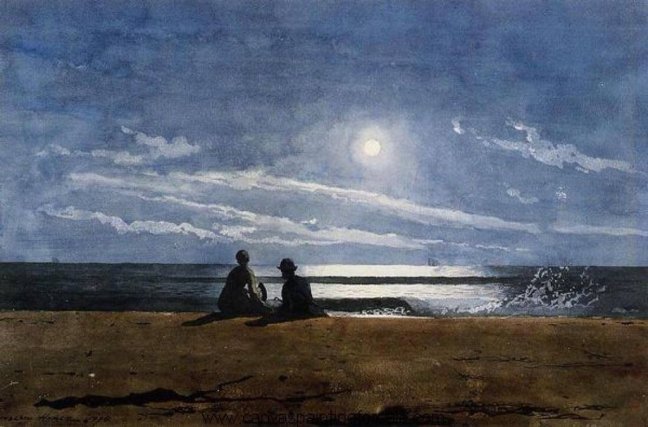
‘The Turn of the Tide’ – John Duncan – WikiArt

Not to suffer is not as desirable as we like to proclaim. We have mixed feelings towards our agonies and traumas. In fact, we have come to like the beastly thing. Suffering has given us many of the things we cherish in our life. Suffering has given us the hopes that we love to entertain, the pleasures we have developed as a routine of escape, and all the little addictions we enjoy in secret. It has shaped our drives and the nature of our beloved possessions. And our best friendships may have developed as a result of this beating pang in our heart. So this is not easy to let suffering go. A lot will go with it that is like the backbone of our beloved self. Being at peace and happy comes with a price.

There is some identity in our suffering, where is hidden a private treasure that we’d rather keep and nurture. If we are honest, we have to confess that our wounds have made us what we are, have formed the self that we believe we are, the personality that we have come to befriend. We haven’t fought our suffering with constancy, and have come to collude with it, socialise, associate, fraternise. We have indulged in every bit of it. We have surprised ourself having feelings for our pain, entertaining a secret love affair with everything that bites us. So to end suffering requires clarity and courage. For we won’t abandon a dream so easily, or put an end to a pleasure without balking. We need to be convinced. Our road to true happiness is paved with reluctance. We have a natural and well-rehearsed resistance to bliss.

[…]

Reflecting on how courage is found at the heart of ourself… (READ MORE…)

.