The Fantasy of a Self

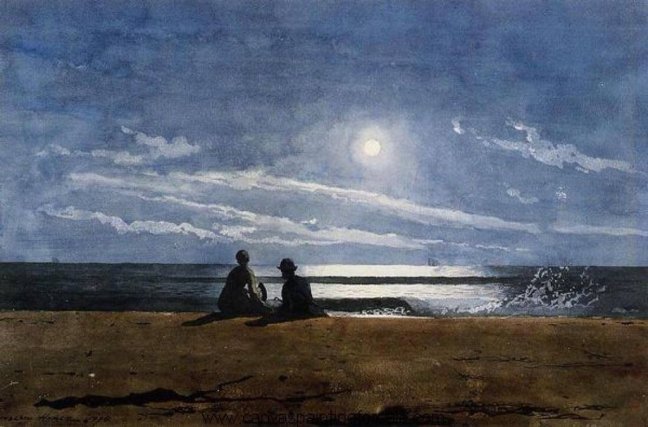
‘Moonlight’ – Winslow Homer, 1874 – WikiArt

We only ever land where we are. There is no escape from where we are. Where we are, is all there is. I mean this deepest place of ourself, from which we have never been separated, is the very thing which we have been looking for in a thousand distant places, in endless situations, in hopes and expectations, in projections, attachments, identifications. Our mind has been thirsting for this place of peace for as long as we can remember, and it has been escaping us with perfect consistency. For there is a rule attached to this place: we can’t find it outside of ourself. And the reason is: there is no place outside of ourself. Ourself — what we are here and now — contains all that we could long for. It is the home which we have left through our contant looking for it in the wrong direction. Our seeking is way too aggressive for its tender being. Our peaceful home lies in the nest that our being is, and this nest of being is where all existence finds its birth and takes its journey.

The problem with accessing our being — our peaceful home — is that we have introduced a self. We have posited a self that is separate from the peace it is looking for. And if peace is situated at a distance from ourself, therefore where we are is the place where peace is not. We have superimposed a self on our peaceful being, and in doing so have invited suffering, which is but the seeking for our lost peace or happiness. It all comes from the connivance of a few thoughts, feelings and sensations, which have set themselves up as a self. It is all part of a scheme on their part, and a gross one if you ask me. For how could something that is coming and going have a self? Something as flittering as a thought, or a sensation, could never produce a self. The self that we think we are, and that we feel is at a distance from experience, is fabricated. It is a product that we have elaborated to feel secure. But we cannot find security in a self. Security is rather the absence of a self, and the merging of ourself with experience, which is felt as oneness.

This self, without our noticing, has created untold damages, it has made life into a havoc. It has invented a within and a without, a here and there, a now and then, when there is in fact only a seamless experience. All these distinctions are of course necessary for our functioning in a world, but they are not the reality. And to ignore their reality is to transform them from a few peaceful, useful devices into brigands that have made experience either something to be feared and avoided, or desired and pursued. In other words, being a self has made experience into a dependence, a battlefield for our own imaginary benefit. But in fact, there is in reality only a now that is ever present and eternal, and a here that has no boundary, no limit, and is infinite. And there is a within that we will cease seing within, for after all thoughts and images are filtering experience to the point of making it their own creation. Thoughts are not just within. They are scattered all over the field of experience, colouring everything we see or hear. And the without will cease being without. For where could without be if not in our intimate experience. So the trees, the houses, and the dog we meet in the street are part of our very own being, for there is only one being out of which they could make an appearance. Where would another being than our being be? To posit another being than our being, or a without without, or a within within, or a there, or a then, is to be absent to our true being or nature, and to live in a world scattered about and fragmented, where reigns every bit of suffering and conflict. But to live as the One renders without within, within without, there here, then now, and our being just only one being. The rest is but a fantasy which we can either buy and suffer from, or borrow and play with.

.

~~~

Text by Alain Joly

Painting by Winslow Homer (1836-1910)

~~~

.

Website:
Winslow Homer (Wikipedia)

Suggestion:
Other ‘Ways of Being’ from the blog…

.

Our Only Landscape

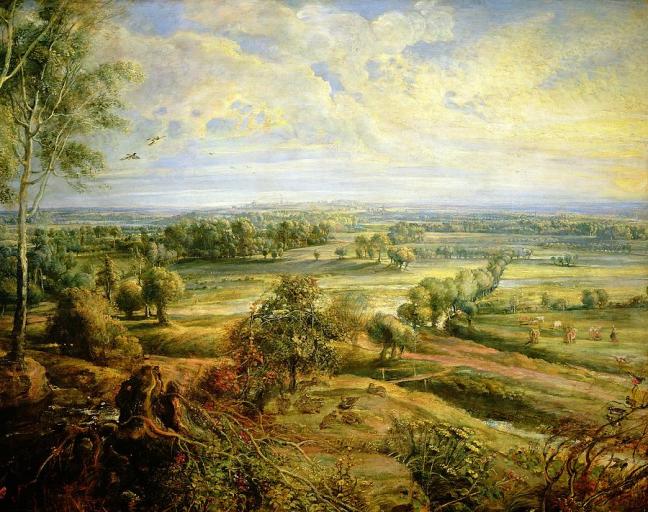
‘An Autumn Landscape with a view of Het Steen’ – Peter Paul Rubens – WikiArt

We are always wandering about, always attracted by a thousand things. Falling for every passing experience. Looking for the fleeting promise it might carry. The reason is: we are so vulnerable to happiness. We want it above all else, at all cost. We know we deserve it, that it is our due, that it is natural, in the order of things, to be happy, rested, at peace. So our mind is never still. Seeking to obtain it. Longing to have it given. Working for it relentlessly. Sometime pretending to be happy if necessary. If it is what it takes. After all, this is the game we are being asked to play. This is our fate, that we have accepted as the norm, and to which we have complied and have been a slave. We would do anything to feel alive, contented, our heart full, our mind at peace, secure, on top of things. And we feel depressed when being turned down. Lost and disheartened at every bout of despair or suffering.

But maybe it is all an unfortunate misunderstanding. Maybe we have taken a wrong turn, and were embarked in our own forgetfulness, distracted by the general consensus. Maybe there is no need to wander about. Maybe experience is of no need to us for happiness. Maybe happiness is not found in experience, not in the least. Maybe working for it creates a distance, a gap, throwing it far and away, like something never reached, never quite here. Maybe hoping for it makes us a self, an illusory entity that needs to obtain peace through the satisfaction given by objects, events, favourable circumstances, which makes us dependent and fearful. What an irony it would be, if it were just this, just this misunderstanding, and that happiness was in fact right here, already spread in and as our sense of being, offered to us with a ruban — a gift eternal for our simply being here and now. How clumsy on our part, to have looked away from ourself for that which is not only in ourself, but our very own self itself. How foolish it all was.

So, this is how it is! We are already fixed in our being, which is peace, which is joy, and have been so all along. We have missed that: that this was our belonging, our identity, to be at peace, firm, stable, fastened, secure in our simply being. And that this simply being was enough, the completion we were after, what we thought was to be earned at the very end of a deceitful string of efforts. Adding to simply being is where we made the mistake, where the wrong turn was taken. We had to stay where we were, and simply notice where we actually were, and what we in fact truly were. Being was not a little thing, undeserving of attention. Being was the completion, everything: you, happiness, peace, experience, the world, all gathered in and as the simple experience of only being. That’s how you lose all wandering, all attraction to things, exchanging them for the one only attraction worth falling for, which is yourself. You have to fall for yourself, for your being. You have to let being embrace you, and swallow you. Then, you won’t have to be anything, won’t have to look for something or someone other than yourself. For you are the fact of being, and this in itself is all the landscape you will ever need and find yourself in.

.

~~~

Text by Alain Joly

Painting by Peter Paul Rubens (1577-1640)

~~~

.

Website:
Peter Paul Rubens (Wikipedia)

Suggestion:
Other ‘Ways of Being’ from the blog…

.
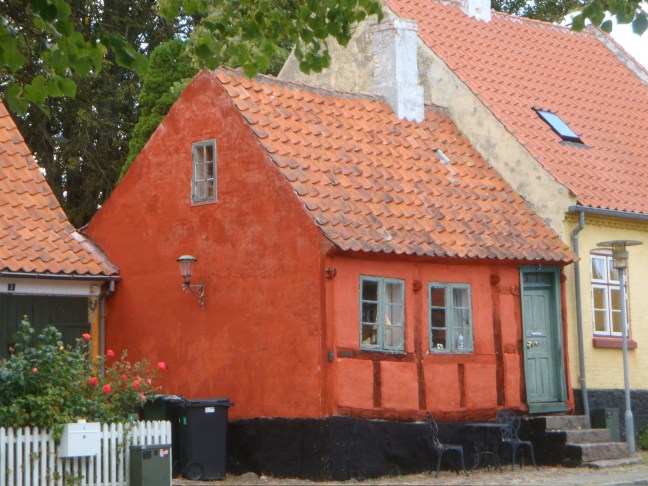
Where is True Home

Where can we find what is ‘our own’ in our experience? What is fitting? Where do we draw a sense of belonging from? Most of the time, we do not feel that we fit in, that we have a place. We feel insecure, so we secure an identity in a thousand things. We borrow from an object our appeasement. We make objects our own, we inhabit our thoughts, we adorn ourself with qualities, and we take shelter in a body. That’s what we do to fit in, and find security: we lose ourself in an ‘other’. We beg for anything that we could call our own, for fear of staying alone, and be left a nobody. We make up a self, and then call it ‘our own’. And that place of our own we find — and have defined — in a thousand shaky, unreliable places and things. But it is a bad try. In fact, we have burgled our own home of belongings that are not ours.

How are we going to find a home, if we keep rummaging through experience for every object that fits our needs? We ought to be disinterested for a while. We need to be disowned, dispossessed of every property or belonging that we have so far acquired, clung to, and in definitive stolen. For this is where true ownership is found, in not belonging. This is how a decent property is secured, by having no place to be. We ought to live free from all the accumulations that we have gathered and identified with. For our true home is not placed on the crest of experience, is not built on the sand of insecurity, and is not limited by the fence of limitation. It is not for a self, or a place, to produce the quality of enduring peace. Peace is already here, wholly achieved, in the home that our being truly is.

Live so that you don’t have to steal in your own house. You have it all. Your property extends to infinity and the world is the garment of your whole being. So in being, wherever you are is your home, and whatever you need is found here, in you, as you, with all the peace and security that pertain to a true home. You fit in when there is no space between yourself and what you long for. Being no space, you won’t have an urge to seek outside of yourself your identity and your happiness. Home is the recognition that you are already home. To be is to be home. There is no achieving it, let alone work for it. Be exactly where you are, in and as your own being — the place which you could never not be in. And if you find that a sense of indomitable peace is accompanying you there, then be in no doubt that this is home — what is your own, where you fit in, where you belong. Truly.

.

~~~

Text and photo by Alain Joly

~~~

.

Suggestion:
– Other ‘Reveries’ from the blog…

.

The Intimacy of Experience

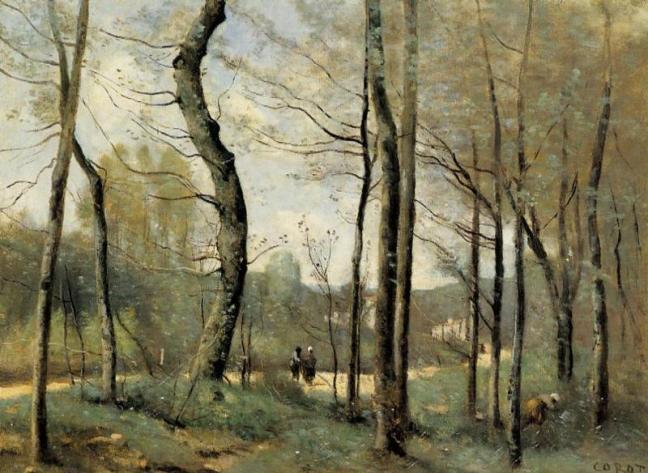
‘First Leaves, near Nantes’ – Camille Corot, 1855 – WikiArt

.
I will tell you where to be
. Be where every experience feels an equally good experience. Don’t be attached to judgment and comparison. These are the mind’s favorite tools and activities. The mind tricks you to believe that experience is an uneven ground. That according to the content of your experience, you will be gifted with either happiness or suffering, peace or conflict, harmony or disorder. So the experience you are having becomes extraordinarily important. We become dependent on what happens to us, and come to dread it. So we retire into the secure place of our habitual self, with its cortège of worry, control, expectation, and manipulation.

There is a place in us where you don’t find experience to be such a determining factor. Where you will not let experience determine you, fix you, limit you. You won’t be shaped by its content. You won’t be made into something, someone, with qualities and flaws, to be judged, evaluated, compared with — the likeness of experience — in fact, just another object. The mind is a manufacturer of objects, entities, persons, fixing the insubstantial nature of your being into a self to be moulded and made either happy or miserable. To be made happy by an experience is to be cheated on by it: we are being manipulated, and made to believe an illusion. To let experience make us miserable is sheer deceitfulness, it is us being easily dazzled by the treachery and artifice of objects.

[…]

Continue this exploration of the nature of experience… (READ MORE…)

.

’katholikos’

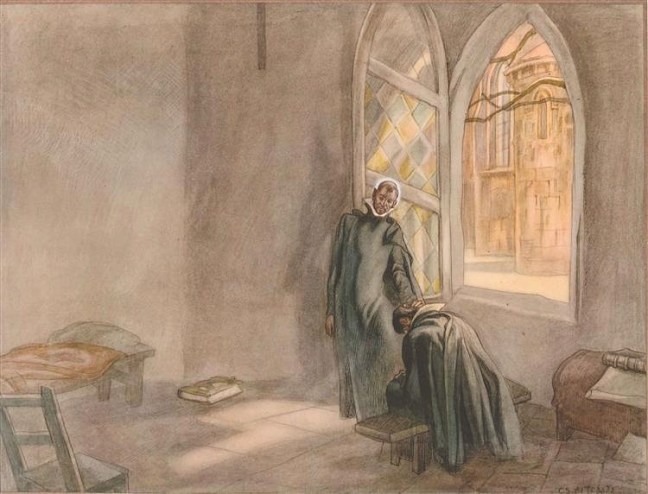
‘The Life of St. Ignatius Loyola. Plate 4.‘ – Carlos Saenz de Tejada – WikiArt

You’ve got to respect the whole. That’s how you live the good life, in having reverence for the totality of your experience. Not just for the superfluous, all that is being the foam of life, that exists and appears, that you can see, hear, touch. You will never make a totality from the world of objects, from thoughts and perceptions. These are but occasional appearances, superficies. They are above you as it were, dancing upon you, at the periphery of who you are, but are not the reality covering your experience — its most profound constituent. You’ve got to go beyond the mundane and the obvious. For we keep leaving something out of experience. We don’t take the whole thing. We are choosy, only care for objects, don’t integrate our ‘within’ — where the reality of our being is. Notice that there is a world here, that is encompassing our world — a presence pervading our reality, taking everything in.

Actually, this is what the word ‘catholic’ is about. In Greek, ‘katholikos’ means: ‘pertaining to the whole’. We have to pay due respect to the whole, to the totality. We must look back at what we truly are, and find there the expression of the whole. I am not sure that Ignatius of Antioch had this in mind, when he first coined the term ‘catholic’ in the early 2nd century AD. He probably meant that the new belief, the new credence, was to be the universal truth, meant for everyone, adopted by all. But there was no need for adoption — the baby was already in the womb. There were no beliefs to be had, no hopes to project and entertain, no happiness to seek outside of our common day experience as being. He didn’t see that in this very word was the answer to all religions, to every quest for the divine peace; that what we were looking for was already here, close, so close to our very experience; and that there was no need to form a belief about it, or a new credence.

To accord with the whole is to be reconciled with our true nature — the reality of our being. It is to be ‘of one mind’, which is what reconciliation means, and to be brought together under the vault of one reality. This is achieved by turning towards the One, which is our true and only constituent. Universality wasn’t meant to be achieved in multiplicity. Universality is the quality of oneness noticed. The totality is in every place you happen to be. There is no totality of which you wouldn’t be the vessel. For the whole is not a geography, not a place to be in. It is the embrace of being. There is a totality in and as the being which you are now, here. You are not inside a totality. The totality is inside you. But mind you, this most venerated Christian Patriarch Ignatius of Antioch did say something of the highest order, when he brought up the word. He said that “wherever Jesus Christ is, there is the Catholic Church.” Yes. Yes indeed. Wherever we as our deepest being are, whenever we as our most profound nature-consciousness are, there is the expression of the whole, of oneness — the totality which is the very nature of the Lord’s House, and which is our nature and our house too.

.

~~~

Text by Alain Joly

Quote by Ignatius of Antioch (died c. 108/140)

Painting by Carlos Saenz de Tejada (1897-1958)

~~~

.

Websites:
Ignatius of Antioch (Wikipedia)
Carlos Saenz de Tejada (Wikipedia)

Suggestion:
Other ‘Ways of Being’ from the blog…

.
Spiritual Wine

‘Lovers under the moon’ – Serge Sudeikin, 1910 – WikiArt

The word ‘spiritual’ is quite a nebulous one. It is used indiscriminately, carelessly, for a bewildering array of wildly different practices or beliefs. Krishnamurti didn’t like the word, which he found ‘ugly’, ‘romantic’, ‘unpleasant’, and used it cautiously. So maybe the time has come to clean the word, to give it some of its forgotten brilliance, and dig out its original meaning and raison d’être. I would start with the suggestion that the word ‘spiritual’ simply wants to point something at us: that the world, the whole of it, our experience, everything, is in fact made of ‘spirit’. Spirit is all there is, the only thing in presence. And believe me, this is a timely pointer, for most of us believe the world to be a hard reality, made of something solid, composed of a variety of different objects — our body-mind being considered one such object. So the word has the virtue of reminding us of our true nature, of the nature of everything as spirit, or consciousness.

But it is only a provisional word, one for our time of misunderstanding. There will come a time when the suggestion that experience is made of spirit will be a matter of fact, something integrated, not to be thought about anymore. The word will then become redundant, to be replaced by another word of a higher intensity and meaning. Or maybe there won’t be any need for a word to describe reality. Reality will have been understood, digested, lived as the fact of simply being. Spirituality will have become useless. There will be no need of spirituality, no need even of the word ‘happiness’, or ‘peace’. Once you are wholly, and only spirit, which is peace, which is happiness, what need is there to mention it? There will be no seeking either. After all, what you are, you are. Identity will have been achieved. No suffering around. Seeking obsolete. Out of date. To be disposed of. What will remain is a splendour, indescribable, filling the world of experience to the brim with its essence.

Also, spirit means ‘breath’. It is the breath of life, a thing invisible, transparent, quietly sitting in the background, and yet essential and life-giving. It is what is playing us, giving us an identity and a sweetness of living. For spirit is like the air we breathe. It is still, silent, empty, yet a breath that can blow our mind and make us like an inextinguishable fire. It is the breath of god that we have left unnoticed time after time, but whose presence is holding us in its firm embrace. It is a breath of devastating effects, laying us waste, destroying all traces of suffering and separation, blowing our self away, not by slaying it but by showing this self to be just the air within the divine breath of god. You had thought yourself a hard, solid, but fragile entity, and are now shown to be empty yet as indestructible as is a fire in the wind. That’s what being spiritual, or spirit-like, truly means.

Spirit also means character, and courage. It doesn’t pretend, and rejects a lukewarm understanding. It is uncompromising and free. It is not afraid, not conditioned by the hazards of life. It stays firm, alone, whole, undisturbed. Spirit is eternally high, but mingles with the lowly too, for it is humble by nature. And it has clarity as its best asset, for it is blessed with the purity contained in knowing without being itself a knower. This knowing is undivided, self-contained, total, applying to all and everything. This is what makes it holy, a spirit which cannot be taken apart, and which contains universes beyond universes. It has a religious quality, a sanctity that is beyond what humans have called sacred. The wholeness of spirit cannot be broken, dampened, violated, injured, or even changed. Its holiness lies in the fact that it is one without any division or addition.

And spirit is music too. It has a sound to it, and it is our duty to play it, or rather being played by it — the musician being god, or spirit itself. Our being is found to be the breath of god, the movement of consciousness singing our life on the reed of our apparent self. As that, we may become the vessel of a life whose notes have risen above the ten thousand things of existence, to be taken by various harmonies of silence, peace, love — all carried by a quiet but devastating breeze of inner joy, like a hum. We are like God’s music, and our experience is bathing inside it, and being made melody. This is what spirituality is, and what a life lived in and as spirit sounds like.

‘Tis the fire of Love that is in the reed, ‘tis the fervour of Love that is in the wine”, Rumi once wrote in the Masnavi. So spirit is a delightful beverage too. It is what gives us this gentle drunkenness which is the state of our self when it recognises itself to be but God’s being. In Spirit, we are intoxicated by the ‘Love that is in the wine’. For this nectar, we are willing to pay the price of surrender at the tavern.

.

~~~

Text by Alain Joly

Painting by Serge Sudeikin (1882-1946)

~~~

.

Website:
Serge Sudeikin (Wikipedia)

Suggestion:
– Other ‘Reveries’ from the blog…

.

The Possibility We Are In

‘Old Sarum’ – John Constable, 1834 – WikiArt

Whatever there is is God’s presence felt. And whatever we may feel of God’s presence, is what there is here and now, including what exists and appears. It is all here for our recollecting, all here that we can be and be god like. Every experience that we may have, every sorrow and every joy, every fear or trust, every ugly or beautiful appearance, is felt and seen because of our being first. To watch anything is to be watched in return by a presence watching. We can make ourself disappear in it, and be without a self, without the self we have always known and colluded with. And we can share of that impersonal, infinite being that is not ours, but that we can be and embrace as our own. So ‘I am’ is the secret door opener within us, that will give us the world we are in. We will have an aggrandised property, or a world made of the very size of ourself, infinite, manageable, and towards which our being may shine a benevolent beam of light and peace. That I feel is a possibility.

The world will have its secret identity disclosed to us. And we too will have our secret identity revealed. Both being made one, and ourself being of it. Others will cease being others. They will join us as that shared one being. There won’t be any jealousy or comparison, but a rejoicing in and as that oneness felt. Our fate and destiny will be contained inside us, within our own being. There won’t be a time to hope for, or a place to fail in, or a self to mess up. There won’t be a fear of tomorrow, or a regret of yesterday, for both will have merged in and as the being that we are. Time and place will have come to be only convenience. And our very being will have come to be the time and place we are in. That too is a possibility.

The knowing of our own being will have come to be our only experience. The many will have shrunk into the one, and the infinite will have subdued our senses, and made itself seen, heard, touched, and contained within our experience. Happiness will cease being a temporary achievement, and will become the flavour of our shared being with people and things. We will have joy woven into every single corner of our life. That’s the possibility we have at hand.

Movement will be seen as the manifold expression of stillness, and silence recognised as the only component of our living symphony. Turmoil will be felt as this last bit of ourself that we have yet to embrace — not something to be afraid of, but an opportunity that we welcome. We have to see this as a possibility.

So this life is the garden of Eden we once extricated ourself from, but have in fact never left otherwise than in our imagination. And love is not an occasional encounter, but the very air we take our breath from. I’m just throwing the possibility in the air.

Now we recognise after all, that the being of God is what we are — the possibility we are in, without there being a God or a ‘we’.

.

~~~

Text by Alain Joly

Painting by John Constable (1776-1837)

~~~

.

Website:
John Constable (Wikipedia)

Suggestion:
Other ‘Ways of Being’ from the blog…

.