Our Only Landscape

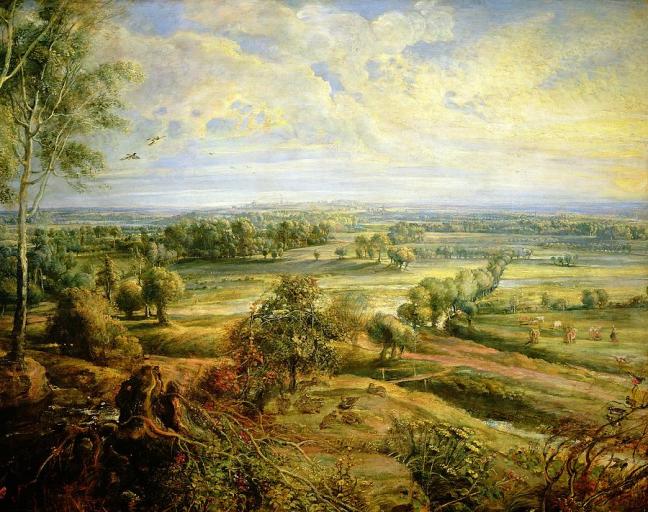
‘An Autumn Landscape with a view of Het Steen’ – Peter Paul Rubens – WikiArt

We are always wandering about, always attracted by a thousand things. Falling for every passing experience. Looking for the fleeting promise it might carry. The reason is: we are so vulnerable to happiness. We want it above all else, at all cost. We know we deserve it, that it is our due, that it is natural, in the order of things, to be happy, rested, at peace. So our mind is never still. Seeking to obtain it. Longing to have it given. Working for it relentlessly. Sometime pretending to be happy if necessary. If it is what it takes. After all, this is the game we are being asked to play. This is our fate, that we have accepted as the norm, and to which we have complied and have been a slave. We would do anything to feel alive, contented, our heart full, our mind at peace, secure, on top of things. And we feel depressed when being turned down. Lost and disheartened at every bout of despair or suffering.

But maybe it is all an unfortunate misunderstanding. Maybe we have taken a wrong turn, and were embarked in our own forgetfulness, distracted by the general consensus. Maybe there is no need to wander about. Maybe experience is of no need to us for happiness. Maybe happiness is not found in experience, not in the least. Maybe working for it creates a distance, a gap, throwing it far and away, like something never reached, never quite here. Maybe hoping for it makes us a self, an illusory entity that needs to obtain peace through the satisfaction given by objects, events, favourable circumstances, which makes us dependent and fearful. What an irony it would be, if it were just this, just this misunderstanding, and that happiness was in fact right here, already spread in and as our sense of being, offered to us with a ruban — a gift eternal for our simply being here and now. How clumsy on our part, to have looked away from ourself for that which is not only in ourself, but our very own self itself. How foolish it all was.

So, this is how it is! We are already fixed in our being, which is peace, which is joy, and have been so all along. We have missed that: that this was our belonging, our identity, to be at peace, firm, stable, fastened, secure in our simply being. And that this simply being was enough, the completion we were after, what we thought was to be earned at the very end of a deceitful string of efforts. Adding to simply being is where we made the mistake, where the wrong turn was taken. We had to stay where we were, and simply notice where we actually were, and what we in fact truly were. Being was not a little thing, undeserving of attention. Being was the completion, everything: you, happiness, peace, experience, the world, all gathered in and as the simple experience of only being. That’s how you lose all wandering, all attraction to things, exchanging them for the one only attraction worth falling for, which is yourself. You have to fall for yourself, for your being. You have to let being embrace you, and swallow you. Then, you won’t have to be anything, won’t have to look for something or someone other than yourself. For you are the fact of being, and this in itself is all the landscape you will ever need and find yourself in.

.

~~~

Text by Alain Joly

Painting by Peter Paul Rubens (1577-1640)

~~~

.

Website:
Peter Paul Rubens (Wikipedia)

Suggestion:
Other ‘Ways of Being’ from the blog…

.
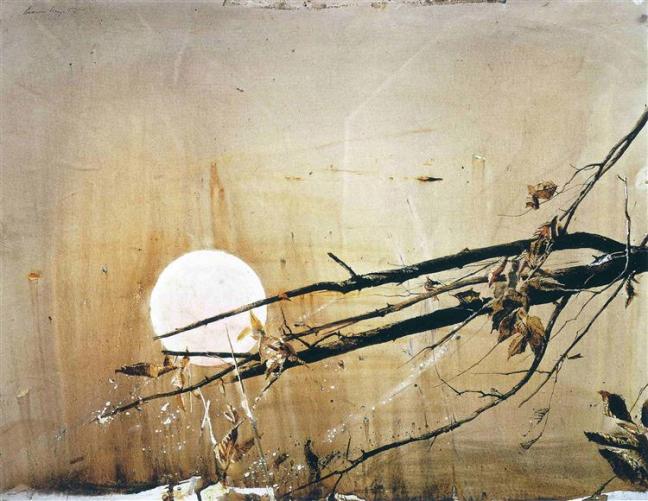
Overflowing Questions

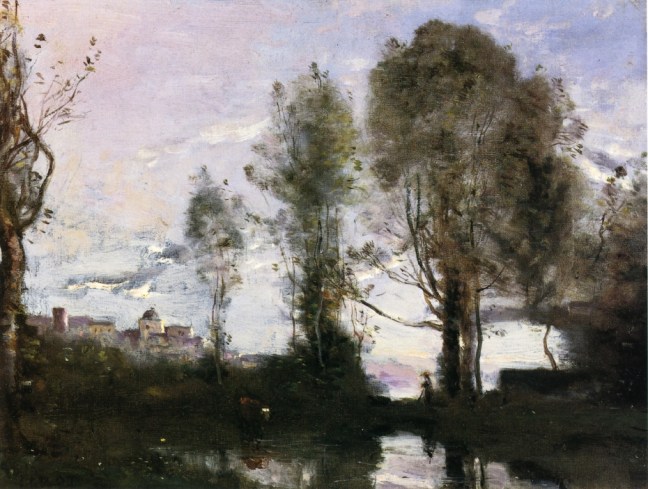
‘Edge of a Lake (Souvenir of Italy)’ – Camille Corot, c.1855-60 – WikiArt

Wouldn’t you like to have a knowledge which cannot be surpassed, which amounts to everything? That has in its core the truth of living, the philosopher’s stone from which everything springs, and to which all appearances owe their existence to? Actually, don’t you already long for it, and have done so for as long as you can remember? Is it not what you secretly hope for in your life? To have this knowledge, this direct access to the peace of your being? To have it here at hand, like a secret bond which you can find under and within every difficult situation, every outrage, every burst of suffering? And wouldn’t you love to harvest what this intimate knowledge contains? Its most reliable sense of joy, of contentment, and see yourself plentiful, complete, enough, in an absence of need? Wouldn’t that be great? To uncover it, and let it find its natural place in you, and as you, easily, without your doing very much about it? Wouldn’t that be great? Would anything be more valuable to you? Would that not be worth a life? Any life?

And what if you were told that you are not this bunch of objects which you have believed yourself to be — these endless qualifications, and the myriad of thoughts and feelings to which you have tied yourself with? Wouldn’t that give you freedom, a sense of release? To be unattached, not bound to your body-mind, at least not in a fundamental way? Wouldn’t that be healing, to be not the body but what holds it in its embrace? Wouldn’t that be soothing, to be not the mind but that which lends it the space to wander about? What is to you more elating and convincing than finding yourself naturally, effortlessly, in a place of health and vigour? The body’s ailments? The mind’s silly wanderings? Well, what if they were not really yours? Wouldn’t you like to find out, what would be their fate when left alone? What could be their trajectory when you rest peaceful in your own healthy, infinite body of awareness? Wouldn’t that be great to make this discovery? To have the final answer behind all that has been troubling you for so long?

And what if you were to uncover some even bigger findings? That behind your long, busy, eventful, suffering life, there has been a stillness, a silence which couldn’t be stirred or broken? And that nothing truly ever happened in your life? That it has been just a passing dream? What would be the implications of that ? And what if you were to find out that the world is just only clothed by the awareness of it? That it is not there in the way you had imagined so far? And that behind it all was also dawning the certainty, the knowing of your immortal, undefeatable nature? Wouldn’t that be wonderful? To see, feel, touch the truth of it with your hands, that death is a myth? That it is not there? Not in the least? Wouldn’t that be extraordinary? That things do die but not you? That body does become ashes but not you — not that which you truly are? That mind withers away but not you — not your primal being which you have to concede is eternal, is infinite? Wouldn’t that take your breath away? Wouldn’t that blow your mind?

.

~~~

Text by Alain Joly

Painting by Camille Corot (1796-1875)

~~~

.

Website:
Jean-Baptiste-Camille Corot (Wikipedia)

Suggestion:
– Other ‘Reveries’ from the blog…

.

The Intimacy of Experience

‘First Leaves, near Nantes’ – Camille Corot, 1855 – WikiArt

.
I will tell you where to be
. Be where every experience feels an equally good experience. Don’t be attached to judgment and comparison. These are the mind’s favorite tools and activities. The mind tricks you to believe that experience is an uneven ground. That according to the content of your experience, you will be gifted with either happiness or suffering, peace or conflict, harmony or disorder. So the experience you are having becomes extraordinarily important. We become dependent on what happens to us, and come to dread it. So we retire into the secure place of our habitual self, with its cortège of worry, control, expectation, and manipulation.

There is a place in us where you don’t find experience to be such a determining factor. Where you will not let experience determine you, fix you, limit you. You won’t be shaped by its content. You won’t be made into something, someone, with qualities and flaws, to be judged, evaluated, compared with — the likeness of experience — in fact, just another object. The mind is a manufacturer of objects, entities, persons, fixing the insubstantial nature of your being into a self to be moulded and made either happy or miserable. To be made happy by an experience is to be cheated on by it: we are being manipulated, and made to believe an illusion. To let experience make us miserable is sheer deceitfulness, it is us being easily dazzled by the treachery and artifice of objects.

[…]

Continue this exploration of the nature of experience… (READ MORE…)

.

An Abundance of Spirit

‘Chateau Noir’ – Paul Cezanne, 1904 – WikiArt

We always go too far, too quick. We jump to the objective display of reality, and in doing so leave our reality behind. It is a strange phenomenon, this forgetting, this negligence, this hurry. In fact, we pass ourself by, and rush towards what we think matters the most, what we believe to be real. This is how we have made this life difficult, an impossible thing to comprehend, and a hardship: in this forgetting, in this passing by. Our suffering is the product of a simple, single act of absent-mindedness. We have put ourself into oblivion by having made the facile postulation that reality is in the objective, in what we can see, hear, touch with our senses. And then have clung to it, to the point of losing our mind inside it, and losing ourself with it. What an absurd thing to have done.

We ought to be slow and still, if we are to meet our nature. We need to be attentive, if we are to notice our being. Not the one-pointed kind of attention, that we are already so well-acquainted with, but the sluggish one. The lazy one, that doesn’t want to go out and stumble into the world. That doesn’t feel like wrestling with thoughts. That cannot be bothered with the threat or seduction contained in the last surge of a sensation or a feeling. I can assure you that there is already a lot to see, hear, feel, on our way to the vast, far-ranging world that our senses provide. So let us not have time or space on our schedule. Let us forget the agenda that our person has and wants to fulfil. Let us not form any concept, idea, or projection, and delve into what is here before every appearance.

We may see, in slowing down, that there is here a presence that stands still, transparent, and aware. We may hear the sound of a silence that stays unaffected by the clamour of existence. We may feel the world to be but the thousand colours of our sumptuous being. We may notice the pregnancy of spirit in what is seen, heard, felt, and realise this pregnancy to be our very own nature felt, heard, seen. This abundance of spirit in our life is but the disappearance of the entity that sees, hears, feels the world, and the surging of the One as our own and only reality or world. Then we won’t pass truth by anymore. Our own nature will be unmistakable, unmissable. It will meet us in the face at the first surge of an object seen, heard, felt. We won’t miss it because it is all there is. Because there is here the absence of a self living in separation, and the absence of a world as world. This absence is our presence, our nature, our self, our world, and there ends our suffering.

.

~~~

Text by Alain Joly

Painting by Paul Cézanne (1839-1906)

~~~

.

Website:
Paul Cézanne (Wikipedia)

Suggestion:
Other ‘Ways of Being’ from the blog…

.
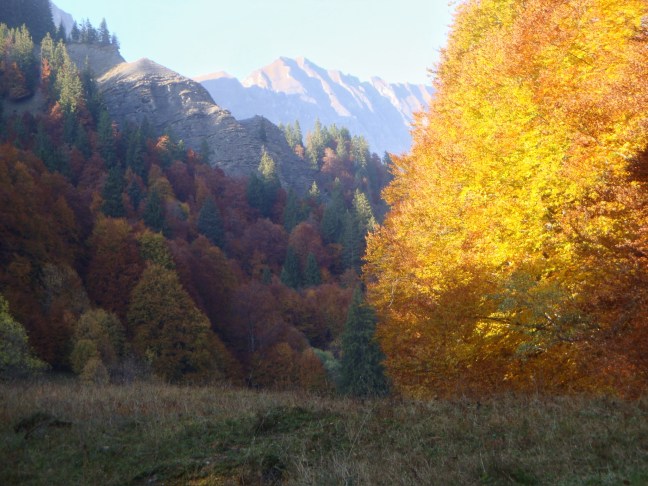
The Birth of Personhood

‘Flower of Blood’ – Odilon Redon, 1895 – WikiArt

It is consciousness — not body, not thoughts — that gives us the impression that we are a person with a continuity. There is absolutely no chance that a bundle of thoughts, feelings, and bodily sensations, could give us that impression. We borrow our personhood to consciousness, to the fact of being aware — to this light that creates us in the darkness that are otherwise thoughts, feelings, body. Our sense of continuity belongs to consciousness, to presence — that portion of ourself that is empty, unchanging, not objective, but full to the brim with itself. Our thoughts are but isolated events that are changing over the course of time, and so are our feelings and bodily sensations. The content of our mind is like a passing, unpredictable weather. So continuity in that area is absurd. Our essential self is to be found in and as being. What makes us is in that which is unmade. That impersonal part of ourself is what paradoxically gives us the chance of being a person. We are therefore nothing but empty, undivided being playing ‘being a person seemingly characterised by body and thoughts’. We have got it all upside down: Our person is not prior to consciousness. Consciousness is prior to our person, and the sine qua non of our existence or appearance.

Our thoughts are far away from each other, inconsistent, contradictory, confused, hesitant. They are not the voice of our self, are incapable of forming an identity of any kind. Our identity is to be found somewhere else, in something that we cannot get hold of, or limit, or name. The only thing that could link the different events of thoughts, feelings, sufferings, bodily sensations, and perceptions — all that for us constitute our self, a person with a name and form — is the presence of consciousness. We owe the impression that we are something solid, a real person, to emptiness, silence, stillness. So our person is actually non-existent, or rather has its existence in that which stands unseen between the happenings or events that we think make us. So our story, our thoughts, our body, become evanescent, losing their reality, disappearing within the experience of our massive sense of being — its coming to our attention. Being is seen to be the nature of ourself, which we had imagined in passing, isolated, impermanent, objective events and qualities. And believe me, that makes for a beautiful, gorgeous person — the one we have always wanted to be! A person is infinity being born.

The fact that there is a certain coherence in being a body-mind, and that we are able to live a life, is nothing but the expression of a play, a ‘lila’ as the Hindus are saying. We are nothing but a character in the hands of an actor. A body-mind is the little necessary to carry our wider identity to its term. In fact, all that we seemingly are — a person with an apparent life — is just the vehicle for a bigger quest. We are pretending a body-mind, so that we can realise our divine being. We are carrying infinity on our back, on the back of the finite, giving it the seeming, temporary life of an entity progressing in time and space. But this story, this appearance of a life, is but an excuse, something marginal that serves a wider purpose. We are meant to carry God on our shoulders for a while. At first unknowingly. Until we know God knowingly. Until God has acquired enough substance, and has sufficiently widened Its being in our life. Until God can in return carry us on Its own shoulders. And move us. And swallow us. Then, we find the security and courage to surrender ourself in God’s solid being and be like God Itself. We transfer our being in and as God’s being. And die there.

.

~~~

Text by Alain Joly

Painting by Odilon Redon (1840-1916)

~~~

.

Website:
Odilon Redon (Wikipedia)

Suggestion:
Other ‘Ways of Being’ from the blog…

.
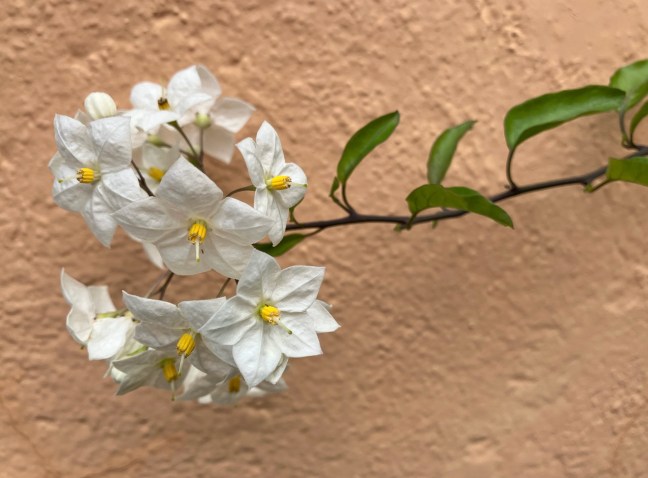
On Courage

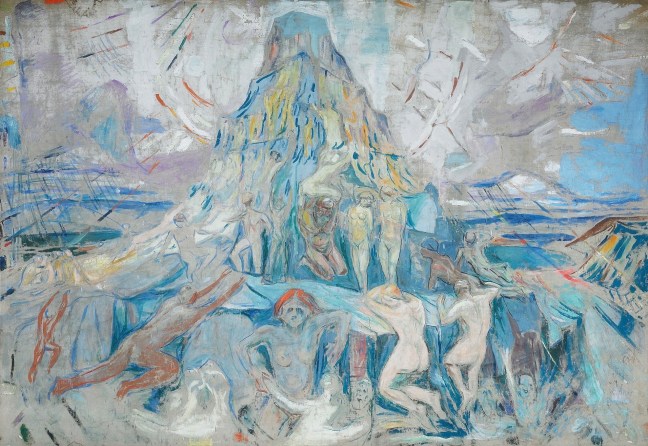
‘The Turn of the Tide’ – John Duncan – WikiArt

Not to suffer is not as desirable as we like to proclaim. We have mixed feelings towards our agonies and traumas. In fact, we have come to like the beastly thing. Suffering has given us many of the things we cherish in our life. Suffering has given us the hopes that we love to entertain, the pleasures we have developed as a routine of escape, and all the little addictions we enjoy in secret. It has shaped our drives and the nature of our beloved possessions. And our best friendships may have developed as a result of this beating pang in our heart. So this is not easy to let suffering go. A lot will go with it that is like the backbone of our beloved self. Being at peace and happy comes with a price.

There is some identity in our suffering, where is hidden a private treasure that we’d rather keep and nurture. If we are honest, we have to confess that our wounds have made us what we are, have formed the self that we believe we are, the personality that we have come to befriend. We haven’t fought our suffering with constancy, and have come to collude with it, socialise, associate, fraternise. We have indulged in every bit of it. We have surprised ourself having feelings for our pain, entertaining a secret love affair with everything that bites us. So to end suffering requires clarity and courage. For we won’t abandon a dream so easily, or put an end to a pleasure without balking. We need to be convinced. Our road to true happiness is paved with reluctance. We have a natural and well-rehearsed resistance to bliss.

[…]

Reflecting on how courage is found at the heart of ourself… (READ MORE…)

.

Remembrance

‘Remember’ – Nicholas Roerich, 1924 – WikiArt

All the things that stand out in us, and that we finally believe to be us — our story — are the rugged parts of our existence. They are what we fear or project. What we separate from and refuse to embrace. What we identify with and refuse to let go. What we have used for our identity, to shape our person, and draw some pride and contentment, or some shame and resentment. All the same. We are the children of circumstances and failures, of successes and apparent choices. Of sufferings. So we have shaped ourself with and from what we are not — from what we can remember and hook on. From events and ideas. From what can give us a form and a semblance of reality. But with all these, we are left only with what doesn’t truly satisfy us, doesn’t quench our thirst, doesn’t make us a rock but only a fragile, elusive entity. There is more to us than story and existence. There is what we cannot remember and make a story of. What we cannot fit into the shape of a person. What we have left unnoticed in the interstices of our life.

Why is it, do you think, that we often have difficulty remembering the happiest parts of our lives, which tend to disappear into thin air? Why cannot we seize happiness? Why is it that we seem to disappear in it and with it? That the best part of what we are, is the part less remembered and graspable? We tend to emphasise the foreground, the highlights, what exists, appears, and disappears. We have little consideration for what stands behind, unnoticed — the still, silent, benevolent matrix of it all. The unfathomable that we are, with its indomitable nature. That which lends a ground to all forms and appearances, including time and space. That which is not an object in our experience. Which is not an idea or a representation. Which is alive and can only be felt in and as the depth of our being. Which has the solidity of a rock that can never be moved. Which will never be a person, never have accidents, never be shamed or shaped by circumstances or events. This most profound nature of our being holds for us the peace and happiness which we are seeking in the foreground. We borrow the happiest parts of our existence to our own nature, while thinking it lies in chances and accidents.

If this nature of ourself is not felt, we will live with fear and lack. So this is our worthiest remembrance. This is where we have to be. To live as that field of being is to remember our nature as the rock-like essence of all beings, things and events. Then, this sublime identity that we have found ourself to be will matter more than any life achievement or result. It will be like the air we breathe. It is ourself seen in the conscious light of our being. In this, happiness is prevailing because it is the very colour of being. In fact, happiness is devouring our old self, which is why and how we as a separate entity disappear every time we feel at peace and content. Peace becomes our very identity — the eternal, ever-present nature of our being. Life then puts on the clothes of clarity and well-being, and our self deserts the ruggedness of the eventful life of time and place. What we ‘remember’, according to the etymology, is what we ‘call to mind’. So we ought to be cautious of what we remember or forget. That will condition our being happy or miserable.

.

~~~

Text by Alain Joly

Painting by Nicholas Roerich (1874-1947)

~~~

.

Website:
Nicholas Roerich (Wikipedia)

Suggestion:
Other ‘Ways of Being’ from the blog…

.