A Living Thing

The emphasis that Krishnamurti places here on space and silence is very important in my view. Space and silence are what connects us to everything, and gives us a sense of intimacy. To not be confined in the borders of our mind, but be aware that we live in a place of expansion and no borders. To not be limited by what thought tells us, but to touch that deep silence that is our reality deep down, and where everything takes place and has its birth and death. Unless we make space and silence our home, we won’t know what being alive truly means. Mind is not just function. It is the whole thing. It is life itself…

.
“If your mind has space,
then in that space there is silence —
and from that silence everything else comes,
for then you can listen,
you can pay attention without resistance.

That is why it is very important
to have space in the mind.
If the mind is not overcrowded,
not ceaselessly occupied,
then it can listen to that dog barking,
to the sound of a train crossing the distant bridge,
and also be fully aware of what is being said by a person talking here.
Then the mind is a living thing, it is not dead.

~ J. Krishnamurti (‘Think on These Things’, ch.18)

.

~~~

Quote by J. Krishnamurti (1895-1986)

Photo and introductory text by Alain Joly

~~~

.

Bibliography :
– ‘Think on these Things’ – by J. Krishnamurti – (HarperOne)

Website:
Jiddu Krishnamurti (Wikipedia)

Suggestions:
Beauty in Essence (other pointers from the blog)
A Day at Brockwood Park (Homage to J. Krishnamurti)

.

‘Who Am I?’

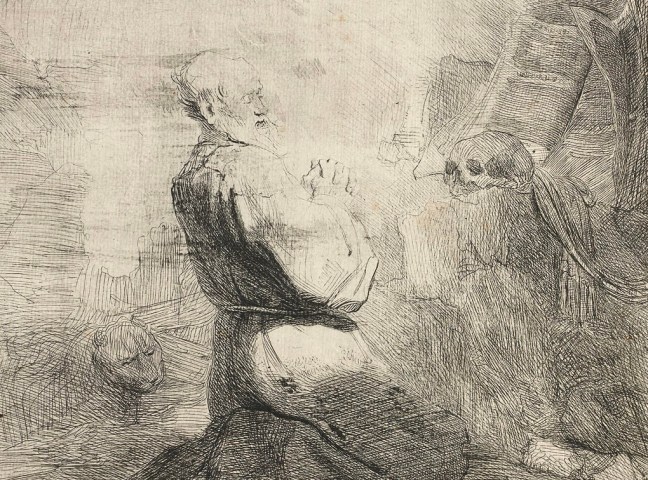
‘St. Jerome kneeling’ (detail) – Rembrandt, 1630 – WikiArt

The question of who I am is a big question. It is not being asked very often though. At least not in the way it should. We do as if. As if we all knew who we are. As if it wasn’t worth asking. As if it was a waste of time to do so. When we do ask about who we are, it is to fill ourself with objects, qualities, identities. We are gathering informations about our body, our emotions, skills, idiosyncrasies, tendencies, but not about ourself. We live as if on a racing track, never actually stopping the course of our acquired, rehearsed, believed identities. We never watch, inquire as if for the first time, as if we didn’t know. We are bragging. We don’t want to be humble, and learn about something that appears to be so simple, and goes — so we believe — without saying. But the truth is: it scares us. We are afraid to know. We have picked up, from the beginning of times, that this question is a question of immense implications. It is a deadly question. One that changes you, finishes you, shakes your very ground.

It is a question for a sacred remembering, to just notice what we already are, what is already here, but that we have been too distracted to see. It is a question to prevent us from going out all the time, from escaping ourself, to help us return to where we have always been — in the home of our inner being. It is a question for which we have to let go of our bodily refuge. A question for which we have to lose the self that has been our anchor so far. It is a question for the mind, although its answer is to be found outside every consideration of mind, thought, image, memory. It is a free fall that pushes us to look beyond our limitations, and gives us the gift of our limitlessness. It is a question with no end, not because there is no answer to it, but because the answer is a living answer, whose reality can never come to an end. It is an impossible question, for even before we have the occasion to utter it, we find it already answered through the act of our simply being.

The living answer to the question ‘Who am I?’, is ‘I Am’, which contains its own undefeatable, eternal, inescapable reality. ‘I Am’ is before the question ‘Who am I?’. ‘I Am’ is the living answer which swallows every single question on our identity. It takes us into itself, and shows our identity to be only being, a being so pure that nothing can be added to it. It is the only sacred knowledge there is, which all the words and rites of every religion have sought to deliver as the name ‘God’. A knowledge that they have failed to pass on with accuracy for going too far, and postulate outside of ourself the reality that is in fact our very own self, hiding in plain sight in and as our own aware being. So ‘Who am I?’ is a prayer that is clearing the path, recalling God in ourself in the form of ‘I Am’.

It is a question that opens the door for the peace that we have been looking for in every possible direction, except in the direction of our innermost self alone. It is a question that we ask with expectation and inquiry, and answer with the peace and joy that we find already here, beyond any expectation or understanding. It is an implicit question that we cannot help asking in the secrecy of our mind, but that we fail to form explicitly, expecting the answer to be outside our own being. It is an absolute question, that needs no other answer than going to the very aware being that initiated it, because of  its longing to be freed from everything that seems to limit it and veil it. It is our returning to what we have never ceased to be, but are failing to see for reason of looking in a thousand directions outside ourself. ‘Who am I?’ is a question that takes you to ‘I Am’, which is the only accurate description there is of our true identity. 

.

~~~

Text by Alain Joly

Painting by Rembrandt (1606-1669)

~~~

.

Website:
Rembrandt (Wikipedia)

Suggestion:
Other ‘Ways of Being’ from the blog…

.

A Virtue of Old

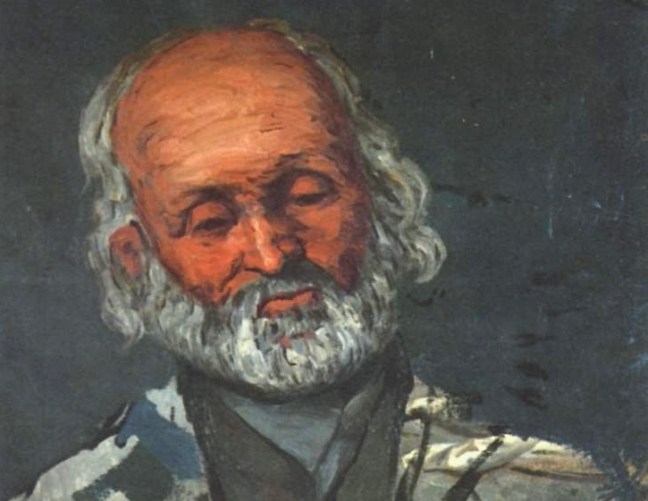
‘Portrait of an old man’ – Paul Cézanne, 1868 – WikiArt

Od age and ailments have an astonishing virtue. They teach us that our body and our mind have a weak reality, that they soften, do not last, crumble. They are like everything else. Their reality is passing, illusory, and ours is not what we have taken it to be. For we notice that as our body weakens, falls apart, we do not with it. We stay as strong as ever. We shine as something else. Not a body. Not a mind. Not an apparent self. But spirit. Our spirit strengthens. Our presence widens — if we care to look at all, to be aware, to not attach ourself to a dying object, to a withering skill. If we stay as our solid being, as that which we haven’t been attentive to so far, for reason of an irrational and obstinate fascination for our body-mind-experience, and our puny self.

So when these, that didn’t have a true reality, go; when these, that didn’t stand the mark of eternity, wither; then our fascination shifts for that which cannot go, wither, or crumble. For what stays massively behind. This reality of ourself hits us in the face — what we are, what we were even when we weren’t looking, weren’t interested, had our life within the limitations of our body-mind. Then it comes soothing us, telling us of our nature, of our grandeur. Then, what falls apart is not just our body or our skills, but also our beliefs about our mistaken reality. Our error as to what our nature is. Now we have a conversation with the infinite, and a rising love affair with the eternal. Now we have a compassion for what we believed ourself to be — body, mind, self, skill, experience — and that now have the humility to show their frail existence. Now we stop minding so much about them, and we find the peace that it is to do so.

So where do we choose to go when we cannot go anywhere, when places become fewer, when time stops being a promise, when circumstances lessen? Where is this place that our body cannot take us to, and that comprehends all that we as a body were chasing relentlessly? What is it that our thoughts cannot give us, and that we now find is here behind and before every thought, every belief, hope, or fantasy? There is a sumptuous gift behind every body or mind that loses grip on the objective world. There is a treasure in the quiet home of our self, when we are asked to stop seeking our happy self in a thousand places, practices, or experiences.

There comes a time when we cannot chase our preferences anymore. When we have to leave behind our dearest experiences. When we have no more time to become, attain, grasp that which we want to grasp, attain, become. But there is offered a time for letting go, for a sweet abandon, for uncovering that which in us can never wither, weaken, age, crumble, suffer any kind of ailment. There is a place which holds the whole world in its loving heart, and this place of love is ourself when we have renounced to find it within time, place, or circumstance. There is a virtue in not expecting from body, mind, world, experience, what they can never give us. There is a virtue in resting where we are, where we swallow body, mind, world in an instant, and are free in spite of circumstances.

.

~~~

Text by Alain Joly

Painting by Paul Cézanne (1839-1906)

~~~

.

Website:
Paul Cézanne (Wikipedia)

Suggestion:
Other ‘Ways of Being’ from the blog…

.

Our Sole Horizon

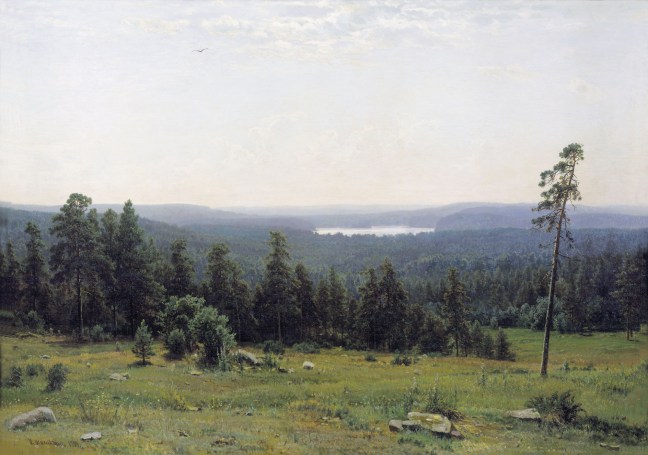
‘The Forest Distant Views’ – Ivan Shishkin, 1884 – WikiArt

The key in spiritual matters, is that we have to keep it very simple. We must not blow it out of proportion, exaggerate it, make a conundrum out of it. It is just a matter of looking, of breaking a little, stubborn habit. Nothing extraordinary. We keep looking away from our own being. We act as if we knew all about who we are, as if it were understood, that we are our body, that we are these thoughts that keep coming, which we judge, influence, direct according to what other thoughts say. We live in a little corner of ourself, feeling like a little king in our kingdom. We are so used to our own ways, to our concepts and explanations, to our beliefs and repetitive actions, that we have taken for granted to be just a person in a world. That’s what we were taught. That’s what we were conditioned to think. In fact, we are only followers. We play small. We are protecting our own establishment.

But we know more than that. In fact, we are all experts at being, without our realising. We are masters of freedom. We know that with just a little looking, a little asking, we could rock our lifeboat. We could make our life sensational, attractive, happy, tranquil. We have that hint in ourself, otherwise we wouldn’t be seeking, or working for happiness, improvement, progress, with such undeterred faith. We know that in spite of everything, the world has magic, and our life keeps inside it secrets of glory. That’s how we can face unspeakable suffering, trauma, violence, and the looming threat of death. Because we have in ourself the warmth and security of being, which we try to reenact in every possible and unreasonable ways, in our pleasures and our hopes, in our beliefs and our addictions.

The problem is that we have put a belief in front of what is. We have invented a self where there is only the wide expanse of being. Our whole identity is in being. We have no space to be anything else than being. Our whole life is being. Our body doesn’t even come close to being what we are, and neither does our mind. Being as consciousness takes it all, the whole of what we are, and of what everything is. Every appearance finds its essence in it, and lives in the gorgeous space it provides. We have all our senses embedded in being, and the world finds its reality in the reality of being. Consciousness has it all. It is all we will ever find. All that ever is. It may hide from our gaze, that being is our only landscape, our sole horizon, but it shows blatantly in every corner of experience, if we are willing to look.

In fact, it is so much here, so reachable, so knowable, that we are blind to it, unable to know it. That’s because we have attached ourself to another pseudo reality inside our own reality of being. We have chosen the lie of being somebody over the truth of being only being. We have chosen to be something, a body, a thought, an idea, a self, and have as a result lost, forgotten, limited the infinity of being, that is pervading our life to the point of being the only thing in presence. The truth is that we can never be something other than being. It’s a nice try to believe it, but it won’t happen, to be a suffering self, a limited body, and a mind with its own separate agenda. Everything that we think we are, we are not. We have to distance ourself from every qualification, from every belief, from every identity. We have to be naked of every addition to being in order to see our naked being, and to be in its gorgeous grip.

.

~~~

Text by Alain Joly

Painting by Ivan Shishkin (1832-1898)

~~~

..

Website:
Ivan Shishkin (Wikipedia)

Suggestion:
Other ‘Ways of Being’ from the blog…

.

Salvation

‘Storm by a Lake’ – Pierre-Henri de Valenciennes, 1780 – WikiArt

Many religions have spoken of salvation, but the idea of being ‘saved’ is not fancied by most people. We don’t like it. People have their self-esteem. They want to feel that they can be responsible for themselves, that they have the resources to overcome whatever needs to be overcome in their life. They don’t want to rely on a god, or an external agency, or even a power. They don’t like to be put down, don’t fancy being a poor thing in need of being saved.

The good news is that there is no such external power or entity. We have it all in and as ourself, as our own being. Nothing exists or stands beyond or aside our being. This simple being that we are, which we are made of, which we draw our very existence from, is the only thing that has a reality. We won’t find a reality at a distance of our own being. The idea that there is a reality other than our own reality as being is only a belief. We won’t find a power beyond our own power, that could come to save us. This world of ourself was perfectly designed. It was made whole and one, so that we hold within ourself our own resource, our salvation, everything needed to live a gorgeous, peaceful, meaningful life.

So the idea of a salvation took us on the wrong track. It had us waiting, hoping, praying, expecting, while at the same time abhorring the idea of needing help. It gave us the idea or impression that we were an entity, a person with its own personal, separate being. It manipulated us to think that we were our story, and that we needed to be fixed, aggrandised, improved, saved. For after all, let’s be honest, we do need to be rescued from a peril. We do need to be delivered from the danger of suffering, of separation, loneliness, conflict. We do need to save ourself from our belief, idea, concept that we are squeezed in our body-mind, and limited by it.

With such an idea in mind, we have but the semblance of a life, but not life itself. We have been simulating having a life, pretending to know who we are, and then acting as if everything is as it should, as if suffering couldn’t be avoided, as if it were intrinsic to living. We have in fact ourself created the idea of a salvation, of a person at a loss, needing help. But the truth is, there is really no such a thing as salvation. Salvation is implied, or contained in being. Salvation means ending a belief. It means not taking ourself to be what we are not. It is the returning to our natural state of simply being.

This conceptualisation of our being into being a self, an entity, a separate being, is the road towards separation, isolation, suffering, conflict, and therefore salvation. It is our wrongdoing, our ‘sin’. But the sinner is an entity that we have created. We have made a sufferer, a sinner where there was only the peace of being. Through this creation of an illusory self, we have invited separation, duality, and have divided being into a self separate from other selves and things. We have given the world a reality independent of our own, and have made the glory of being into a self that has retired into the limits of the body-mind.

Our salvation is in the sin itself, in its ending. It is in being, before the birth of the idea that being requires being something, or someone. Before our identification with our body and mind, which has made suffering and conflict our daily companions. So salvation is always only an acknowledgment, a noticing. It is the knowing of our being as it is, and not as we have made it, through belief and habit. This is how we are doomed, in being a self separate from everything. And this is how we are saved, in being only being. This understanding does save for it tells to a mortal that he is immortal, and it assures a suffering self that she is blessed with a peaceful being. A sin is an unfortunate addition to plainly being. It is a simple exaggeration. We have created, invented a sinner where there was nothing but our gorgeous, infinite being.

But this is something that can be reversed. Salvation is natural, already here, achieved, contained in and as our own being. Salvation is being. The one in need of being saved is not there, has no reality other than in our mind. The idea of salvation or deliverance itself must go. It had found its use and meaning when we were but the thought of being someone. When this idea of being someone goes, when the qualification withers, being stays behind, resplendent, in no need of being saved whatsoever.

All this, the whole spiritual enchilada, is only a convenient story for the poor me. Deliverance is achieved in being. The sinner is an illusory superimposition on being, which is intrinsically already free. We have limited being, have made it an impotent thing. So there is ultimately no sinner, and no salvation. This is why we say that God is forgiving, because there is always at hand the realisation that there is in ourself, in being, no room or possibility for an entity separate from experience, and therefore for a sinner. In this discovery of our being whole, and One, is the birth of a love and a peace that is beyond understanding, beyond any making. In fact, we have been saved and safe all along. 

.

~~~

Text by Alain Joly

Painting by Pierre-Henri de Valenciennes (1750-1819)

~~~

.

Website:
Pierre-Henri de Valenciennes (Wikipedia)

Suggestion:
– Other ‘Reveries’ from the blog…

.

Boundary

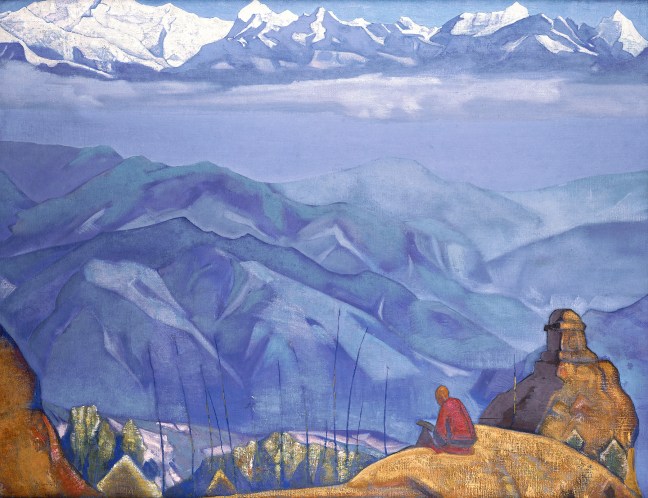
‘Book of Wisdom’ – Nicholas Roerich, 1924 – WikiArt

It is naive to imagine that there is a boundary or separation between consciousness and the world we are conscious of. It would be extraordinary to find that boundary, where our consciousness ends and where the outside world begins. We have an apparent and necessary boundary between body-mind and world, for our convenience, for practical purposes, and have left it there as an unquestionable fact. And everybody has complied, including scientists, that this separation must exist, that consciousness is a competence of the body, that it cannot be challenged, that it would be madness, beyond reason to do so. But there is an impossibility here. For this boundary can never be found at the deepest level, or even conceptualised. It is inexistant. Something like a pure invention. But this illusion of a separation was broken, seen through long ago, in the world of mind, of which our spiritual traditions are experts. Sages have seen long ago that there was here, between consciousness and the objective world, a seamless relationship, an undoubted oneness, no boundary, no separation, not even an unlikeness. It was all one with nothing besides it. The world is wholly contained in Mind, as Mind, and Mind or consciousness is all we are, all there is — our fundament.

So we have invented the reality of a world out of the reality of consciousness. After all, it is a beautiful find, a gorgeous dream, that we have a world, and that this world was shaped, sculpted by our five senses for as long as our senses have existed, and for as long as our bodies have been made the inevitable side effects of the appearance of a world. Everything — world, body, mind, senses — is an appearance in a more fundamental, non-objective reality. So nothing new, or other, or different was ever introduced in our reality. Reality is all there is. Consciousness is our playground, our only field or ground, and it is hosting everything in and as itself, including our apparent self. This is how we have a father and a son. A reality, and a temporary, individual, apparently located point of view on that reality. But between father and son, between reality and ourself, there is only one seamless consciousness. God has made sure that all things and beings find a habitation within him — or her. And then, ‘within’ was too taken away, for how would you have a within and a without when there is only the One?

So we have to meditate on the appearance of this world. On what is hiding behind it. On what it teaches us on our nature, on our reality, on our humanness. By the way, being human is by no means derogatory. In its most ancient Sanskrit root, the word for ‘human’ means: “The being whose essence is the capacity for self-remembrance of its divine nature.” So this knowledge of the reality of the world is a sacred knowledge. For with that knowledge firmly held, you can now enjoy personhood without the burden of separation, without the suffering that is its natural outcome. So we don’t have to be spiritual anymore. We have acquired our personhood, our humanness. Our nature has been realised, uncovered, in its primal, intended truth, and it is once and for all. Now we can enjoy a world for the first time. Now we can be lovers. Watchers. Listeners. Devoid of the superfluous. Free of our cumbersome, limiting beliefs. Recognising and accepting God’s will as our own. 

.

~~~

Text by Alain Joly

Painting by Nicholas Roerich (1874-1947)

~~~

.

Website:
Nicholas Roerich (Wikipedia)

Suggestion:
– Other ‘Reveries’ from the blog…

.
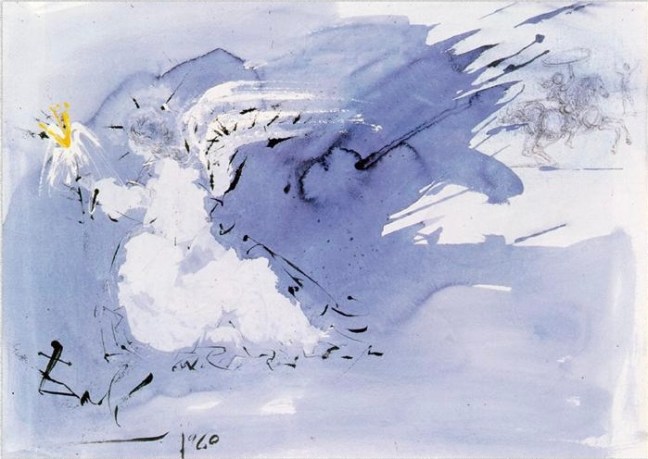
Lightness On End

Angel of Light’ – Salvador Dali, 1960 – WikiArt

I can be me forever
There is no limit to being myself
I don’t have a home in a body
In the limitations contained
In a mind.

I don’t want to refer to anything
In order to describe myself, I can describe
My body, my thoughts or my actions
My hopes and my desires
But not myself.

Myself is for the infinite
I am not to be squeezed by words
Not to be qualified or situated
I won’t appear in the world
Of appearances.

Rather all things find a home
In my infinite embrace
So I am a universal home
I am a shelter for everything
That is finite.

I am not to be divided, I cannot be
disunited, driven apart, isolated,
Alienated — my fate is to be whole
My destiny is to have peace
As my horizon.

I cannot be suffering
For suffering knows boundaries
Is born of the finite; I know only
An expanse without end — definition
Of happiness.

How could one-you-I
Bear the infinite
Or find it has a weight
The infinite is for being,
It is for lightness on end. 

.

~~~

Text by Alain Joly

Painting by Salvador Dalí (1904-1989)

~~~

.

Website:
Salvador Dalí (Wikipedia)

Suggestion:
Voices from Silence (other poems from the blog)

.