Pathways

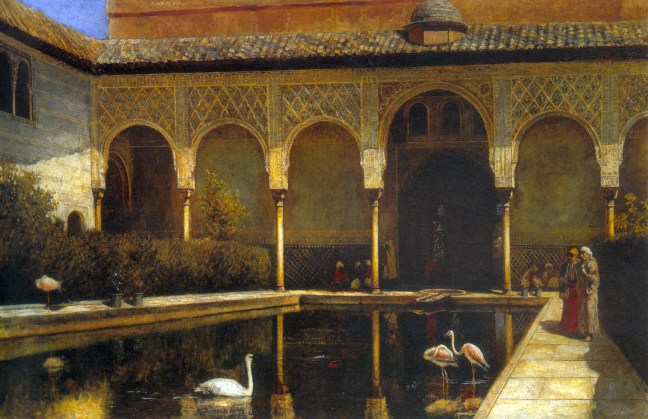
‘Court in the Alhambra’ – Edwin Lord Weeks, 1876 – WikiArt

The spiritual endeavour is really such good fun. You may happen to experience some suffering in your life and feel entangled — with thoughts rushing into your mind and problems seizing the entirety of yourself. The web of experience is overwhelming you and you can find no space to breathe within. You may then have to have a little conversation with yourself. You may have to disentangle yourself from your stubborn identification with thoughts and with the overcrowding objects born of the senses. That’s when you may present yourself with a simple question like: “What is this part in myself that is aware of my experience?” And so are you now taken amongst the scents of 8th century India, treading its immemorial dust with Shankara, debating with the great Vedantic master. He will show you how to move inwards right at the core of that aware presence in yourself. You will be taken with him to the core of this investigation, which is but the separation of the multiple objects of experience from the one aware, pervading presence of consciousness that is your true identity. That’s when Shankara leaves you with this one infaillible recipe:

.
I bow down to that all-knowing One
which is pure Consciousness, all-pervading, all,
residing in the hearts of all beings
and beyond all objects of knowledge.”
~ Shankara (Upadesasahasri, 1:1)

.
You may then find yourself sitting in your kitchen, cutting vegetables, with your thoughts suddenly wandering in the 17th century Paris, surrounded by the walls of a Carmelite monastery’s kitchen, chatting along with Brother Lawrence. He might tell you with his big generous smile: you know brother, “nothing is easier than to repeat often in the day these little internal adorations.” That’s when you understand that this investigation can be made into a joyful, often repeated practice, where you go and meet yourself within, have a little chat with this hidden presence, spontaneously, as you gaze into the eyes of a friend. Amongst the frantic sound of knives hitting the wooden board and the fumes of the next meal simmering on the stove, you meet Brother Lawrence’s glance offering you this last precious advice:

.
I renounced, for the love of Him,
everything that was not He;
and I began to live as if there was none
but He and I in the world.”
~ Brother Lawrence

[…]

Continue this journey into the investigation of your true nature… (READ MORE…)

.
Excessive Imagination

We have it all already, independently of any spiritual consideration. All that we ever wanted to acquire or achieve, which we have been aiming to possess without ever truly succeeding, the core object of all our desires before objects multiply and confuse us in their multiplicity — that precious thing: that plenitude — well… we have it. It is there, just as we are, in this experience that we have, in our present feeling and sensation, breathing in our senses, singing as our identity, a kit already assembled, a world designed for us to live in, live for, and live by. Religions have sent us warnings for millennia, but the message was unclear, diffused by authoritative hierarchies to frighten, separate, and control. Yet some got it all through the religious maze, dissecting even the most obscure teaching to its crystalline, original clarity, as Meister Eckhart has done. For he knew — the great master — that our being is a sky knitted of awareness. He knew that this emptiness is all there is, and that our thoughts, feelings, preceptions, the ‘creatures’ as they were called in his words, are all secondary appearances, that draw their multiple existence from the one single identity of our self as pure, unlimited, shared being.

But we have yet to see it. That our present being is the final deal. That what we experience right now contains it all, and is the expression of the silent being that we are in our utmost reality. So there is really no experience other than the experience of this deepest reality of ourself. There is no other than yourself. It is all about what I am, or that I am — all about that which is felt now, before the rise of experience, before the ‘creatures’. That is the landscape that all spiritualities have ploughed for millennia. What you are being now is it, the whole mystery of it. So don’t even try to be it, let alone become it — that would ruin it all. The work is done. You only have to notice yourself in the maze of objective experience. You only have to develop a passion for yourself. To be inquisitive of your being. You don’t have to go through the paraphernalia of spirituality, if you are not inclined to. Just watch your being intensely. Make it the biggest interest of your life. As Krishnamurti once said: “You have only to watch, see, listen; it is all there open and clear.” Don’t tell yourself endless stories about a so-called spiritual path, about advancement — the pride of it all. Jump directly inside the experience of your being. “Take a swift step into yourself” was Krishnamurti’s advice. And swift it has to be.

Swift it has to be for we are too happy to endorse the role of the spiritual seeker and indulge in it, to identify with the means and believe in a path. For the fact is that we are all so attached to being something. This is where we draw our pride and security from, in being something — anything. And if we were to be nothing, or that pure, quintessential empty being that we have learnt we are — well, then we want to be that too. Being something is a reflex that is a hard one to get rid of. This is our refusal to fully and irreversibly die. So you have to bypass your ambitious drive, as sacred and precious as it may be. You have to abandon all willingness to succeed, all impulse to be anymore than what you already are. Any desire to be more, or have more, than what you are, than what you have right now, is another escape into separation. Realisation is nothing but the end of your belief in not being realised, complete, perfect just as you are. You have to let yourself go. The totality of the spiritual quest is about removing a simple belief or misunderstanding, a stubborn bad habit, a single complexity that we have inadvertently introduced in the system. That there has to be something more than just what is — that’s a blatant excess of imagination. We cannot improve on the reality of our self as being, for its substance is of the realm of the non-objective. You cannot object on that. And this mistake can be unveiled with just a little application and a measure of common sense. With the simple dropping of something that isn’t even there.

.

~~~

Text and photo by Alain Joly

~~~

.

Suggestion:
– Other ‘Reveries’ from the blog…

.

Four Variations on Love

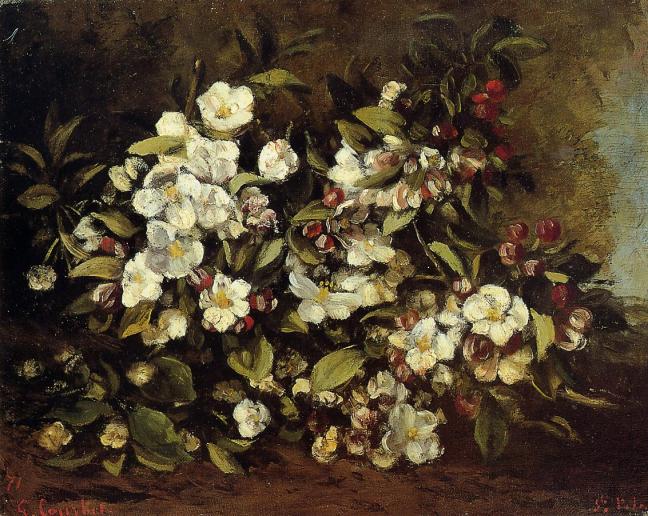
‘Branch of apple blossoms’ – Gustave Courbet, 1871 – WikiArt

.

God is love, and he who dwells in love
dwells in God and God in him.”
~ The Bible (1 John, 4:16)

.

I have been reading Meister Eckhart’s sermon n°5 lately, in the translation by Clare de B. Evans, from an old publication named simply ‘Meister Eckhart’. It’s a sermon dedicated to love and its many aspects. At the very beginning, Meister Eckhart sums up the nature of love in four magistral sentences that had a deep effect on me. So I decided to write down some of my take and understanding on each of these quotes by the Meister and present them to you. I hope they will be of interest…

.

‘God is love’. That is so, inasmuch as all that can love,
all that does love, he compels by his love to love him.”
~ Meister Eckhart

It is greatly convincing to think that we can love someone or something. That there is something inside us, a quality or emotion, that can spring out of our mind and body and direct itself towards an object, a someone loved, a something loved, and that this love is a personal affair. Well now the question arises: What is it in us that can love, and what is this other that is loved? Notice first that there is nothing in you that can love but love itself. Our mind is in no capacity to love. Rather love happens, shows up naturally, when our mind is set aside for a while — for our thoughts, most of our thoughts, have the power to defeat love, to render it unfelt, dormant, as if inexistent. So if you love anything, anyone, it is not because of him, or her, or it. It is because you have been freed from yourself as a private, separate self or mind, and that in this freedom, love can arise, unfettered, can stretch its dormant limbs, and shine in all directions. After all, have you ever been in love with someone without at the same time loving everyone, everything, around that one? Love is an awakening, an opening. And in that opening, in that crack, reality shows its profound nature. Love is the profound, intimate nature of everything. So when you love someone, there is nothing there, and nobody, no other, that can be loved, except the essence that this one is. Therefore you can only ever love the essence. And you could not love the essence of anything if you were not yourself the essence of everything. That’s how you are compelled, when you love anything, to love god first, which is the essence of both the lover and the loved.

[…]

More reflections on some Meister Eckhart’s statements about love… (READ MORE…)

.

Know Thyself

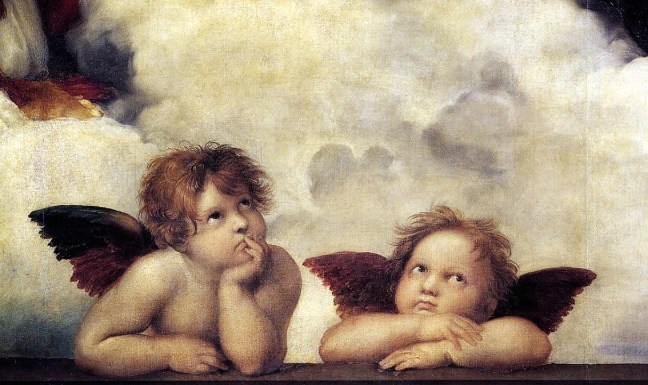
‘Putti, detail from The Sistine Madonna’ – Raphael, 1513 – WikiArt

.

γνῶθι σεαυτόν

.

Know thyself. Know who you are. That’s how simple it is. You may start from the far end, from a belief, a philosophy, an exotic term. You may call it religion, or spirituality, or non-duality — whichever name you want. You may go through the rugged path of belief, faith, practice, meditation, prayer, philosophy — all the names and concepts, the endless thinking about it, and the seeking that seems to never end. But now, when you stop and consider it all at last, you will come to the realisation that, deep down, it all comes down to that simple sentence. ‘Know thyself’. Not the knowing of your thoughts, ideas, opinions, feelings. Not your idiosyncrasies, or character, or outer shape, or preferences. None of that. To know oneself points directly to the knowing of your essence, of your innermost being, what you are made of at the core, when every other thing that can be pointed to has been discarded as superfluous. This is who you truly are. This maxim was once carved in golden letters on the front of the Temple of Apollo in Ancient Greece. That’s what this wisest of civilisations gave to the world as its supreme and most fundamental advice. ‘Know Thyself’.

So self-knowledge is the key. Of course, you may analyse it, take it apart, trace the endless chain of philosophers that gave their stand on this famous maxim, but I would not encourage you to do so. Sometimes, what’s really of crucial, definite importance resides at the simplest, closest address. The one you never truly considered for fault of being almost as nothing, a child’s play unworthy of your attention. Could it be that simple? That the meaning of the whole of life, the solution to our happiness, and the key to the whole riddle of existence could be found there, in the simple knowing of ourself? Let’s assume that it can and consider it seriously. Let’s embark on this shortest of journeys, the one going within, in the direction of our own self, where no distance is needed, no time necessary, and no special expertise required. This simple journey is the one of which the Ancient Greek poet and philosopher Ion of Chios wrote in the 5th century AD: “This ‘know yourself’ is a saying not so big, but such a task Zeus alone of the gods understands.”

[…]

A reverie that explores the path towards the knowing of our self… (READ MORE…)

.

Fear and Trembling

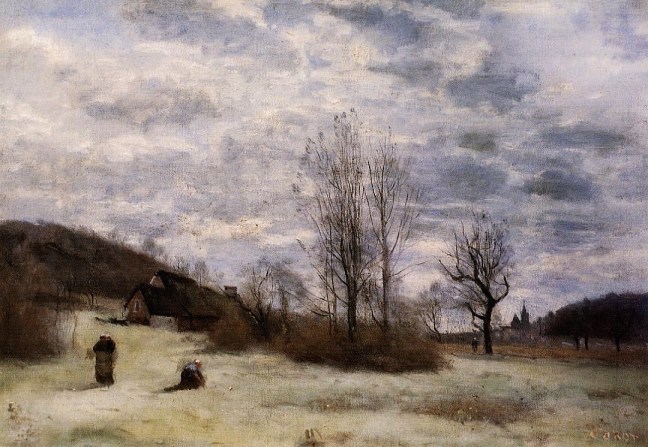
‘Plains near Beauvais’ – Camille Corot, 1860-70 – WikiArt

.

The fear of the Lord is a fountain of life,
to depart from the snares of death.”
~ Proverbs, 14:27

.

There is an expression that we may find puzzling, maybe slightly paternalist, condescending and outdated, but is well worth looking at. We find this expression mostly in Christianity and Islam, where the mentions ‘fear of God’, ‘fear of the Lord’, or the injunction ‘fear God’ are found far more than a hundred times in the Bible, or in the Quran. This fear is said to be one of the seven gifts of the Holy Spirit, along with wisdom, understanding, guidance, mightiness, knowledge, and devoutness. But why would we be afraid of what we longed for the most in our lives? We should be embracing it with ardour and ease. So what is this “fear of the Lord” that, in Proverbs 9:10, is said to be “the beginning of wisdom”? Why is it given such primary importance?

Maybe we fear god for the same reason that we fear death. We think that we are something, someone, a self that we appreciate and have a fondness for, that we love and want to cling to as something precious. We want it to continue. So we have elaborated strategies to keep our self padded with multiple pleasurable sensations through our various habits as thoughts, daydreams, pleasure oriented activities, routines, manipulations, avoidances, all these addictions that have come to form the main part of what we call our self. But these are vain distractions, for awareness as god seems to have in itself a momentum, a power to draw every thing and being to itself. So this pull can be felt as a threatening force from the limited point of view of a self that feels vulnerable, and finds temporary security in being something, even if this something is in final analysis the cause of its suffering. In Hebrews 10:31, it is said: “It is a fearful thing to fall into the hands of the living God.”

[…]

An essay that inquires into the notion of the fear of god… (READ MORE…)

.

Cleansing the Temple

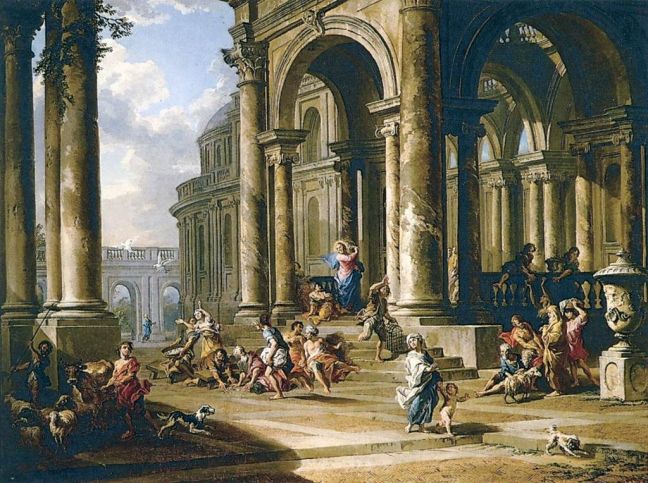
‘Expulsion of the Moneychangers from the Temple’ – Giovanni Paolo Pannini, 1724 – Wikimedia

Maybe this is where peace in fact resides. In the fact that peace or happiness can never be found, never be reached. It will be nowhere where you expect it, not in any objective appearance or event, not in any wish granted, not in any kind of alignment between what you want and what you have. You will never obtain what you want. Truth is not there, in what you wish. It doesn’t care for your egoistic projections, for your own private self-interest. Truth is not a mere good to be bargained for, or hoped for, or waited for, which, if not granted will disappoint you, and make you like a rejected lover, or a bruised self. Truth is not any kind of crude object. Remember Jesus who cast out the merchants in the temple. Were you really thinking that there was a physical Jesus actually chasing the merchants from the temple, on the ground of some kind of moral rule?

The merchants in the temple, it is you. It is all of us when we have decided to argue with reality, to buy our happiness with some kind of object obtained, to bargain or negotiate with some invented superior entity the responsibility of what is happening to us, to come to god with pockets full of expectations and desires, making peace a simple object to be bought in the market place of our likes and dislikes. “Wouldst thou be free from any taint of trade?” did Meister Eckhart ask. Imagine the relief that it is: to know or realise that you will not have what you want, that ‘what is’ is all there is, all that you will ever have. What a relief! What a load finally put down, and got rid of! All that you want, desire, expect, all that, will never ever be granted to you. You can forget it all. ‘What is’ is the deal. The grandiose enlightenment you were waiting for lies there, in what simply is! It will never get better than that! You have it all here, in front of you. That is the gift that was specially designed for you. Happiness resides in what you have, in what you are, here and now. This is the secret that Krishnamurti meant when he said: “I don’t mind what happens.”

[…]

On how truth is not an object to be bought in the marketplace… (READ MORE…)

.

The Mystic Heart of Sport

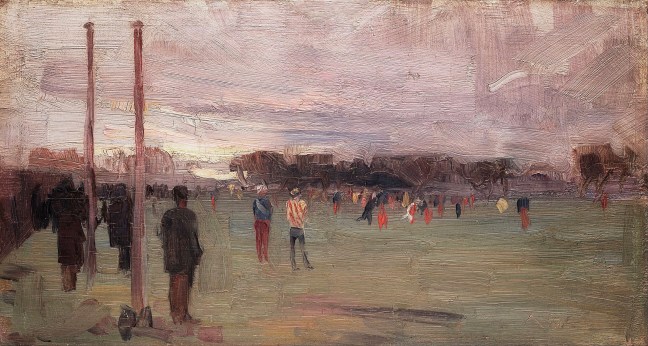
‘The national game’ – Arthur Streeton, 1889 (Art Gallery of New South Wales) – Wikimedia

.
Brendan McNamee
is my newly invited guest on ‘The Dawn Within’. Brendan is an independent scholar and lecturer with a PhD at the University of Ulster in Ireland. He is the author of numerous books and essays on a wide range of writers, including John Banville, Michel Houellebecq, Gerald Murnane, Elizabeth Bowen, Sean O’Casey, Flannery O’Connor, W B Yeats and others. I’d like to present here one of his essays called ‘The Mystic Heart of Sport’. My attention was one day drawn to this eloquent title, while browsing through the platform ‘Academia’.

The text speaks about sport in general, using here the example of football, and mingling its wonderful argument with quotes by William Blake, Meister Eckhart, or W. B. Yeats. Brendan McNamee shows that “the conflict” on the football pitch is “between gods and mortals”, between “time and eternity”, both “inextricably entwined”. At its best, a game of football can give birth to “moments that justify sport at its best being called ‘poetry in motion’. Moments of sheer grace” when “skill and spontaneity join hands and, momentarily, dancer and dance are one.” I hope you will enjoy Brendan’s skilful writing and exposition as much as I have…

.

Eternity is in love with the productions of time.”
~ William Blake

.
~~~

The Mystic Heart of Sport

.
In The Hitchhiker’s Guide to the Galaxy Arthur Dent makes the startling discovery that white mice, rather than being the objects of experiments carried out by humans, were in fact carrying out experiments on humans. I wonder if a similar principle might be applied to sport. Take any high-stakes football match. Passions run high. The passion, on the parts of both players and spectators, is primarily for victory. The players receive a huge ego (and cash) boost, and from the fans’ point of view, a win for their team is, by some mysterious process of osmosis, a win for themselves. This lust for victory is so intense that the other source of sporting joy, the quality of the game itself, is often relegated to a secondary position, rendered lip service, of course, but seen really as essentially a means to an end. This, I would contend, is topsy-turvy. I want to argue here that it is the lust for victory that should serve the game, not the other way around, and that this order of things reflects a wider truth about life itself.

[…]

Discover Brendan McNamee’s skilful essay on the mystic of sport… (READ MORE…)

.