The Treasure Within

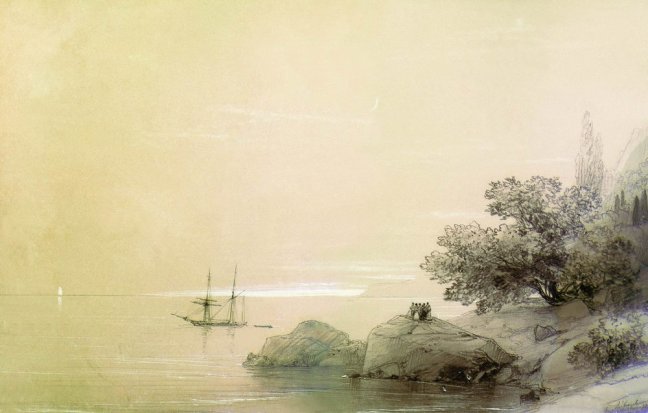
‘Morning mist in the mountains’ – Caspar David Friedrich, 1808 – WikiArt

There is something in us, a presence, a feeling of being, that can say I Am. Nothing else can. No body can. For how could a body say I Am, which is but a bundle of tissues, a physical structure that can only be seen as an object, at a distance. That which is at a distance cannot say I Am. I Am is for the innermost of your being, for what is here beyond a shadow of doubt, in you, as you, indissociable of yourself. Feel that I Am is for that which never moves, is never tired or sick, is never concerned by age, or beliefs, or any passing content of the mind. Go for what in yourself is indestructible, constant, that could never be hurt, and notice that that is the thing which is necessary, responsible for your being able to say I Am. I Am is your anchor, the lighthouse you must never depart from. If you do, you will be plagued with suffering and grab the first thing you could identify with, amongst others your body, and your mind content. Thought is a good client for providing you with a fake identity. It mimics a self to perfection where there is none, where there is only here a presence infinite, borderless, shared by all. Without that, no I Am would be possible. No I Am would be there, and no humans either, no beings, nothing at all, just a black, empty void.

I Am is the light that makes life possible, that renders it palpable, sensible, experienced. You could say that for an object to find its isness, its existence, there would have to be an I Am first, there would have to be an essence, a ground that gives all things and all beings their shape, length, width, and existence. This essence is that without which there’d be no you, no possibility to say I Am. That without which there’d be no support for your thoughts. That without which your body could not in a zillion aeons find its ground, its birth, its death, and its life and beating heart. Thought has nothing to do with your asserting I Am. It is in no way involved in it. It will try to convince you, that thought is behind it all, is the voice of your being, the one that can say I Am. The body has convincing arguments too. They two form a good pair. But don’t be deceived. These are not where you draw your sense I Am from. I Am is deeper. I Am is fundamental, not a passing thought or feeling, bound to an object, to a body. I Am embraces all things and all beings. Even the world could not be thriving and bubbling without having its grounding essence. It needs, for its rising and falling, for its being seen, heard, felt, a something that holds it and creates it, like the content of a dream needs the mind of a dreamer. The world would be at a loss without I Am.

And in fact it is: at a loss. For why do you think the world is plagued with suffering and conflict? If you ever find yourself suffering or in conflict, it is that you have lost your I Am. You have given it, bargained it to a body, or a story, or some mere random thoughts. You have exchanged it for an ambition, an eagerness to be something, somebody, and to feel the reward of it. I Am is without a reward, without a body, faultless, pristine. It doesn’t know the meaning of suffering, or conflict, or confusion. So keep it always close to you, don’t lose its splendid gaze. For your body, mind, and random thoughts are all craving to take on the role of a self and blind you, conceal in the process your gorgeous, inborn, god given identity. They’ll happily send I Am to the wrong place, to keep it unnoticed, forgotten. But I Am is always here, like a patient presence, holding even your ignorance in its benevolent hands. It will wait for your looking, your noticing, the better days of your realising who you are, that is found here nestled within I Am. You owe I Am everything, right to your feeling of being, behind the mere words.

For there is a Word behind the words, which I Am is the pointer to. A living, pulsating reality. Call it being, call it god, call it Word. We have made I Am into a mere body, a limited self, and have therefore compelled ourself to look outside for our peace and completeness. The seeking for our lost completeness is what is called suffering. But the way to overcome suffering and conflict in our lives lies within, in our very being, in what is hidden in plain sight every time we say I Am. A human being can never have its private sense of I Am, for being is shared in equal measure by all beings and things. It is boundless and has within it the peace and completeness that you had been looking for without, as a result of your misplacing I Am. I Am owns its peace and completeness through its being alone, whole, One, and therefore unable to be parted, or lost, or forgotten. So have a good look every time you say simply I Am, and recognise it for what it is, and not what you believe it is. Don’t limit I Am to a projected, illusory, made up entity. I Am is the gorgeously carved door to your being happy and whole, and to have the world reflecting that wholeness and happiness. It is your treasure within, that you have ignored, or misused. So repair the sense I Am in yourself, and give it back to its original, initial, pristine glory and undefeatable reality.

.

~~~

Text by Alain Joly

Painting by Caspar David Friedrich (1774-1840)

~~~

.

Website:
Caspar David Friedrich (Wikipedia)

Suggestion:
– Other ‘Reveries’ from the blog…

.
Intimacy

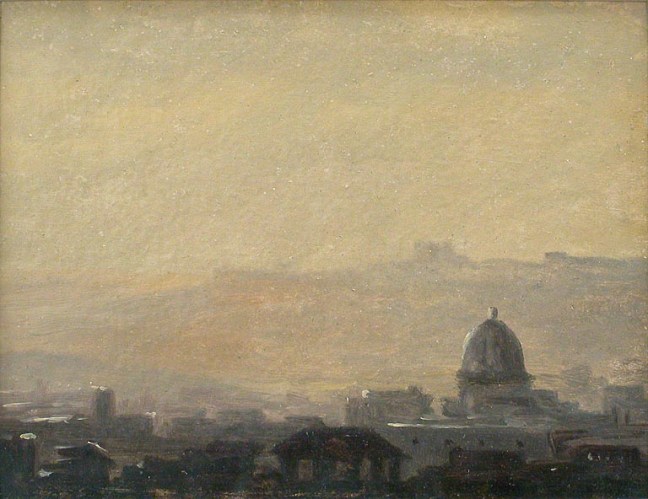
‘Untitled’ – Charles-Francois Daubigny – WikiArt

Spirituality is about intimacy. Nothing else. That is all you will feel, when you go to the right place, when your most tender being comes towering in your life: intimacy. Intimacy with everyone and everything. When you are not content about being a person, about only living the life of body and senses, about all things objective that can be seen, heard, felt, then is left something that you could never comprehend. Then comes that innermost part of yourself which is now found to impress and impregnate both you and your experience. Then comes something measureless. This was already your most familiar experience, although you have made it a stranger in your life, for engaging only with the shallow, with the surface, the easy, the habitual, the measurable. These will never take you to intimacy but to separation, remoteness, distance, and finally discord. So go to what is not only passing, but to what is inmost, intrinsic, that cannot be discarded and dispensed with. Your world will open to something precious beyond understanding, which is the intimacy contained in experience as a whole, when it is not dampened by your insistence in being something separate from experience.

Intimacy feels like being with a close friend, when nothing needs to be said other than simply to live, enjoy, and taste presence. Intimacy is to make yourself and experience as precious as a lover. In that process, it melts you down, so that you are nowhere to be found. This absence of yourself is love, which is your freedom, and the thriving of this presence which you are and have always been without your noticing. It will bring everybody and everything — the whole world — close to your self. So close that you won’t see a difference between your experience and your own self. You will be revealed as one boundless presence — the undefeatable essence of your being, before the thousands things of experience come to soil it, dampen it. You will be in love, inside love, for intimacy is just another word for it. Intimacy is about shared being. It may seem personal, but it is not. What makes it seem personal is that we involve the body-mind, that we think binds it. In fact, intimacy has nothing to do with the body and the mind. It is a warmth without limit or end.

In its purest form, being sends us in a place of immediate intimacy with everyone and everything, a sense of togetherness, of belonging that cannot be helped. Intimacy is a gathering in and as being, whether we are two people, or ten, or a hundred. We feel an absence of plurality, or otherness. It can be informed in a split of a second, deploying itself from a place unknown and unknowable. Its appearance is free, unconditioned by time. Its disappearance is impossible, only apparent or believed. It comes from a place which has neither a beginning nor an end, and is not bound to the limitations of space. It reveals itself as something fundamental to our living this life, but which we have failed to notice was here. It is the highest degree of your essence. Being intimate is the last place in yourself you will ever visit. There is no beyond it. It will come as your last day, your final breath, for there is no living as a separate entity, as a private being, once you have drunken at its source, and suffered its irrevocable implications. To be intimate is to die to yourself, and disappear in the radiance of only and simply being.

.

~~~

Text by Alain Joly

Painting by Charles-François Daubigny (1817-1878)

~~~

.

Website:
Charles-François Daubigny (Wikipedia)

Suggestion:
– Other ‘Reveries’ from the blog…

.
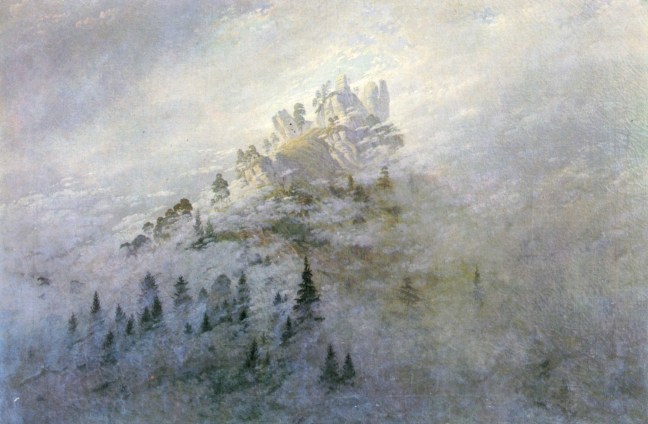
The Dream of a World

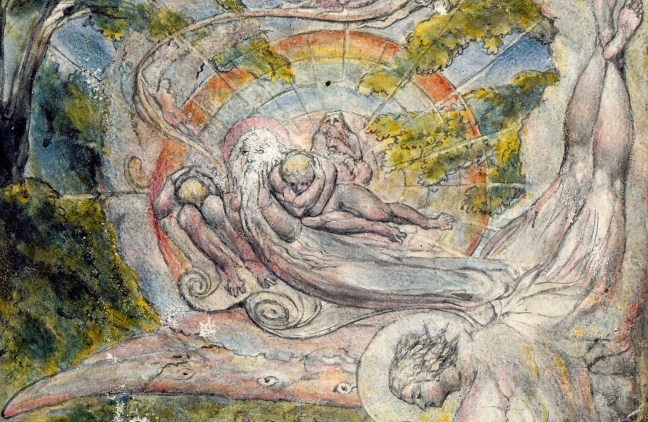
‘Milton`s Mysterious Dream’ (part) – William Blake, 1816-20 – WikiArt

There is a fraud in our life. An illusion that makes us feel that life is going to get better. That time or circumstance will bring us to a place of understanding, where our troubles will come to an end, where there will be betterment, improvement, change. To believe this will make us miss that we are already here and now in a place of no change, of no betterment, where nothing can improve or get better. This place is our very self, our sense of being that we have never been able to affect or modify, no matter how relentless our life has been, no matter our despair, our sorrow, our losses. Nothing we have gone through has touched it in any way. All our stories and sufferings have taken the shape of our thoughts and beliefs about them. But while we are desperately trying to give a form to our life, a solidity to our body, a reality to our problems, and a truth to our beliefs, right here and now, right where it all is seemingly taking place, hidden within experience, enveloping it all, is already a presence, a vastness, a reality that is embracing everything, and that is our only reality, our only place, our only possible self in this living experience.

For there is not a world there where we could be in. That would be a lovely idea, but the fact is: there is no possibility to prove the existence of such a world. We can only assert it, marvel at it through our senses, study it, analyse it, but of a solid proof there is none. The existence of a world is dependent on our perceiving it, and perceptions are contained in our knowing them. Without the knowing faculty, there cannot be a world. The whole glory and misery of the world, of the whole universe, is all gathered in that fathomless fraction of knowing, or awareness. Without that simple, ungraspable, dimensionless, ethereal element of knowing, no world could ever come into existence. So in fact, knowing is all there is, consciousness is the essence of every single appearance that comes to be seen, heard, touched, or experienced. The world is shaped, or its appearance created, through our being aware of it. So the whole of our living experience is but a dream in consciousness, a game that can be played and enjoyed at the level of our body-mind, but whose reality is only the awareness of it.

Now, where are we if we are not in a world? Where are we if the world is not even there? What is this something that we feel we are in, and exists, and is undoubtedly? What is a world, an experience, when we have passed through all illusions, all beliefs, all shaky appearances? What is left here that holds our experience, that is indomitable, indestructible, present without a shadow of doubt? This place is our self, what we are, our very essence, the reason behind our saying ‘I’. So we live in our self, not in a world. We see our limited existence pass and consume itself within that which is creating it, which is our own aware being, the knowing that we are and could never not be. And there, in ourself, in being, where the world takes its apparent form, is found what we have been looking for in every direction, in a non-existing world, in experience: a sense of relief, peace, beauty, love, and the understanding of our essence, the explanation of it all. An explanation that is not conceptual, but a living one, a subjective one, something made plain by being it. We and life then become self-explanatory. The fraud has been diluted. All imagination has died down. Now our living experience has acquired the rawness of truth. Something that is, unlike the world or our experience, beyond doubt and absolute.

.

~~~

Text by Alain Joly

Painting by William Blake (1757-1827)

~~~

.

Website:
William Blake (Wikipedia)

Suggestion:
– Other ‘Reveries’ from the blog…

.
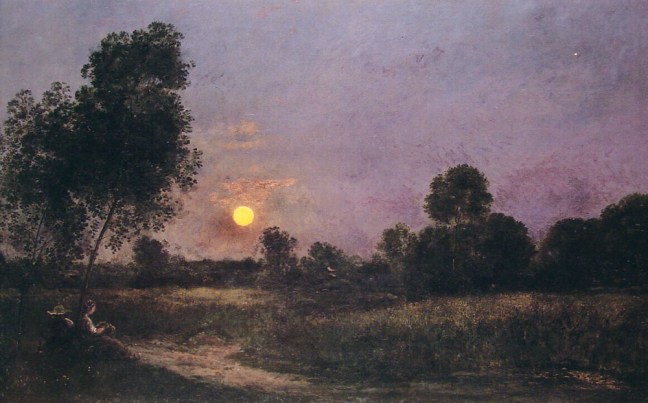
Overflowing Questions

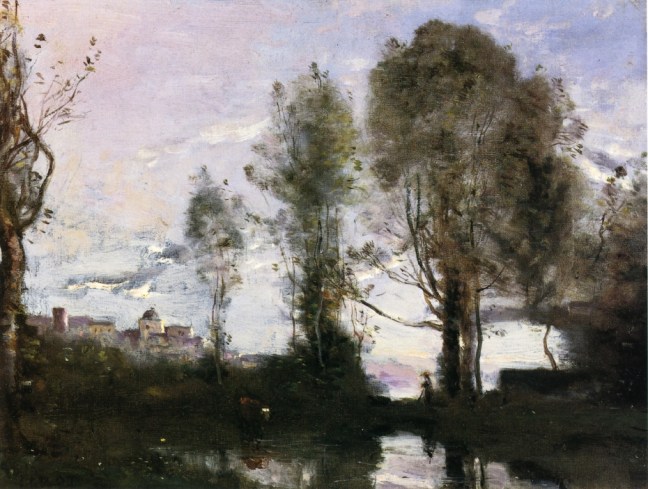
‘Edge of a Lake (Souvenir of Italy)’ – Camille Corot, c.1855-60 – WikiArt

Wouldn’t you like to have a knowledge which cannot be surpassed, which amounts to everything? That has in its core the truth of living, the philosopher’s stone from which everything springs, and to which all appearances owe their existence to? Actually, don’t you already long for it, and have done so for as long as you can remember? Is it not what you secretly hope for in your life? To have this knowledge, this direct access to the peace of your being? To have it here at hand, like a secret bond which you can find under and within every difficult situation, every outrage, every burst of suffering? And wouldn’t you love to harvest what this intimate knowledge contains? Its most reliable sense of joy, of contentment, and see yourself plentiful, complete, enough, in an absence of need? Wouldn’t that be great? To uncover it, and let it find its natural place in you, and as you, easily, without your doing very much about it? Wouldn’t that be great? Would anything be more valuable to you? Would that not be worth a life? Any life?

And what if you were told that you are not this bunch of objects which you have believed yourself to be — these endless qualifications, and the myriad of thoughts and feelings to which you have tied yourself with? Wouldn’t that give you freedom, a sense of release? To be unattached, not bound to your body-mind, at least not in a fundamental way? Wouldn’t that be healing, to be not the body but what holds it in its embrace? Wouldn’t that be soothing, to be not the mind but that which lends it the space to wander about? What is to you more elating and convincing than finding yourself naturally, effortlessly, in a place of health and vigour? The body’s ailments? The mind’s silly wanderings? Well, what if they were not really yours? Wouldn’t you like to find out, what would be their fate when left alone? What could be their trajectory when you rest peaceful in your own healthy, infinite body of awareness? Wouldn’t that be great to make this discovery? To have the final answer behind all that has been troubling you for so long?

And what if you were to uncover some even bigger findings? That behind your long, busy, eventful, suffering life, there has been a stillness, a silence which couldn’t be stirred or broken? And that nothing truly ever happened in your life? That it has been just a passing dream? What would be the implications of that ? And what if you were to find out that the world is just only clothed by the awareness of it? That it is not there in the way you had imagined so far? And that behind it all was also dawning the certainty, the knowing of your immortal, undefeatable nature? Wouldn’t that be wonderful? To see, feel, touch the truth of it with your hands, that death is a myth? That it is not there? Not in the least? Wouldn’t that be extraordinary? That things do die but not you? That body does become ashes but not you — not that which you truly are? That mind withers away but not you — not your primal being which you have to concede is eternal, is infinite? Wouldn’t that take your breath away? Wouldn’t that blow your mind?

.

~~~

Text by Alain Joly

Painting by Camille Corot (1796-1875)

~~~

.

Website:
Jean-Baptiste-Camille Corot (Wikipedia)

Suggestion:
– Other ‘Reveries’ from the blog…

.
A Safe Harbour

‘Sea against a rocky shore’ – Ivan Aivazovsky, 1851 – WikiArt

In our relative existence, we are always only a simple human being, a disciple of truth. We are seeking to merge the relative with the absolute, and to raise the finite where the infinite compels it to be. There is no being a super human, with a perfected soul. There is no being a specialist in the field of spirituality. The knower is a so shy and humble presence that it won’t show up when you are there. You will hide it with the boastful assertion of your own self. So if you want to espouse your true nature, you will have to feel yourself as almost nothing. You will have to stop reifying yourself, and make your person a servant of truth. There is a soothing freedom from pride and arrogance to be experienced in our human life.

The feeling of separation is what makes you assert yourself. To only and simply be is felt to be insufficient. You need to be or have something that makes you whole and happy, which you then seek through objects, qualities, qualifications, events, circumstances. To be somebody, to be important is the privilege of incompleteness. Being has no privilege, is not a superior position. it won’t make you anything. It won’t give you an advantage. You’d have to be miserable for that. You’d have to be limited. Your nature as peace doesn’t belong to you the person. When you have realised yourself as the one being that you truly are, then it won’t make you anything, it won’t give you a pedestal. Your knowing is in not knowing. In simply being.

There is a special, humble glory that lies in not being a self that feels separate. Peace is the perfume of your divine nature, that stands unaffected before the person that you happen to be. It is the nature that lends itself to the making of the world and to the selfing of its myriad of apparent entities. It is the secret power behind all appearances. Your nakedness is the key for its being seen and felt in your existence. You will then live from the stand of that knowing presence. Your self will cease feeling separate and superior. Your person will be depersonalised, will have infinity as its ‘I’ identity, and love as its guiding principle. But you won’t get any pride out of it, for your person is now devoid of its own, personal substance.

It is no accident that the life of many truth seekers is expressed through poverty and nakedness. In not possessing, in being undefended, as is the case for nuns, monks, hermits, anchorites. There is joy in not owning your own self, and your own identity. There is release in being at the service of the loving, silent being which you have discovered yourself to be. You have lost the prestige and identity contained in being a seeker. For there is no seeking in being. Being contains the gist of that which you want to obtain or achieve through your constant seeking — the juice of it. Being is the heart of life, and its reward. The Eden which you have placed far and away, as a cherished belief or possibility, is now found here, in the simple knowing of your being.

So there are no Shris, Maharshis, Bhagavans, Rinpoches, Maharaj-s, or Your Holiness, at the level of the person. There are even no sages. All these titles are only for ‘being’, for the reverence of truth, for the One. There is always only one Bhagavan. One Rimpoche. One sage. The peace contained in simply being is not another quality that is added to you as a person. A person, a body-mind, doesn’t have peace. Peace or understanding doesn’t belong to you. It is not for the person. It is all contained in that which lends you consciousness. It is in the presence that makes you, out of which you draw your personhood, and which allows you to love, live, and share. You are not an autonomous, self-contained person. You are infinity lending itself to a portion of finitude. How would an appearance be conscious, if it wasn’t for the presence which contains and creates this appearance? This peaceful, infinite presence is all there truly is. The One you have to bow to. Your teacher and your beloved. Your safe harbour in the storm of appearances.

.

~~~

Text by Alain Joly

Painting by Ivan Aivazovsky (1817-1900)

~~~

.

Website:
Ivan Aivazovsky (Wikipedia)

Suggestion:
– Other ‘Reveries’ from the blog…

.
The Birth of Personhood

‘Flower of Blood’ – Odilon Redon, 1895 – WikiArt

It is consciousness — not body, not thoughts — that gives us the impression that we are a person with a continuity. There is absolutely no chance that a bundle of thoughts, feelings, and bodily sensations, could give us that impression. We borrow our personhood to consciousness, to the fact of being aware — to this light that creates us in the darkness that are otherwise thoughts, feelings, body. Our sense of continuity belongs to consciousness, to presence — that portion of ourself that is empty, unchanging, not objective, but full to the brim with itself. Our thoughts are but isolated events that are changing over the course of time, and so are our feelings and bodily sensations. The content of our mind is like a passing, unpredictable weather. So continuity in that area is absurd. Our essential self is to be found in and as being. What makes us is in that which is unmade. That impersonal part of ourself is what paradoxically gives us the chance of being a person. We are therefore nothing but empty, undivided being playing ‘being a person seemingly characterised by body and thoughts’. We have got it all upside down: Our person is not prior to consciousness. Consciousness is prior to our person, and the sine qua non of our existence or appearance.

Our thoughts are far away from each other, inconsistent, contradictory, confused, hesitant. They are not the voice of our self, are incapable of forming an identity of any kind. Our identity is to be found somewhere else, in something that we cannot get hold of, or limit, or name. The only thing that could link the different events of thoughts, feelings, sufferings, bodily sensations, and perceptions — all that for us constitute our self, a person with a name and form — is the presence of consciousness. We owe the impression that we are something solid, a real person, to emptiness, silence, stillness. So our person is actually non-existent, or rather has its existence in that which stands unseen between the happenings or events that we think make us. So our story, our thoughts, our body, become evanescent, losing their reality, disappearing within the experience of our massive sense of being — its coming to our attention. Being is seen to be the nature of ourself, which we had imagined in passing, isolated, impermanent, objective events and qualities. And believe me, that makes for a beautiful, gorgeous person — the one we have always wanted to be! A person is infinity being born.

The fact that there is a certain coherence in being a body-mind, and that we are able to live a life, is nothing but the expression of a play, a ‘lila’ as the Hindus are saying. We are nothing but a character in the hands of an actor. A body-mind is the little necessary to carry our wider identity to its term. In fact, all that we seemingly are — a person with an apparent life — is just the vehicle for a bigger quest. We are pretending a body-mind, so that we can realise our divine being. We are carrying infinity on our back, on the back of the finite, giving it the seeming, temporary life of an entity progressing in time and space. But this story, this appearance of a life, is but an excuse, something marginal that serves a wider purpose. We are meant to carry God on our shoulders for a while. At first unknowingly. Until we know God knowingly. Until God has acquired enough substance, and has sufficiently widened Its being in our life. Until God can in return carry us on Its own shoulders. And move us. And swallow us. Then, we find the security and courage to surrender ourself in God’s solid being and be like God Itself. We transfer our being in and as God’s being. And die there.

.

~~~

Text by Alain Joly

Painting by Odilon Redon (1840-1916)

~~~

.

Website:
Odilon Redon (Wikipedia)

Suggestion:
Other ‘Ways of Being’ from the blog…

.

Vedantic Logic

Hampi Vijayanagara, Karnataka – India

We are always too late with our identity. We come after. We experience something within, a sensation, an unease, a thought, and then say: I am that. We start from what happens, from experience, out of which we draw some identity. We are lazy. We identify with what comes. We experience our body, and draw the conclusion that this body is what we are at the deepest level. And then we live from there, from this conclusion, from this belief, this concept of ‘me-my-body’ — which we refer to as ‘I’. Our chance has passed. We have drawn comfort in that conclusion, but have invited its many companions of voyage too, which are suffering, fear, lack, and the likes. We have given ourself to the wind of arbitrary experiences. We depend on everything that passes uninvited. No wonder we suffer, finding there no stability, and no peace. We are at the mercy of what comes. So we are desperately trying to shape what comes, in order to shape our identity, and derive from it some elements of happiness. Hence our constant striving, seeking, debating with life, struggling with what we are, and with what the world brings.

We think that all the responsibility falls on us, that we are the designers of our identity. We are little ghosts exhorting themselves to happiness. And every time we fail and fall from this imaginary pedestal, we head for another direction, another hope, another expectation, and so goes our life — dependent and miserable. Until we finally listen. Until we see that there is an identity before any experience of body and mind. It isn’t that difficult to see and understand. This is only logic. This is, as Swami Dayananda Saraswati used to say, Vedantic logic: “Vedantic logic and worldly logic are diagonally opposite. Worldly logic is: ‘I experience sorrow; therefore I’m sorrowful’. Whereas vedantic logic is: ‘I experience sorrow; therefore I’m not sorrowful’.” So we have to go further back, and it takes some courage. For we are so gullible. We don’t have any true, reasonable stand. Yet, the way we speak betrays our intuition that we are not fully identified with our body and mind. After all, we constantly comment on them. We are not fully implicated. We put ourself at a distance from our own identities, but don’t go far enough. We stay somewhere along the way, as a self separate from it all. We don’t finish the journey. We don’t look well enough. We presuppose we are something, a somebody, a person, and leave ourself there, close, so very close from a higher, nobler truth.

Cannot there be an experience where ‘I’ is really, truly ‘I’? Where ‘I’ cannot be projected or conceptualised? Where it is not belittled, depreciated? Where it cannot be coloured, biased, conditioned? Where it is here in ourself, as ourself, like a pure, unalloyed, super subjective identity which is like a tower in our life, knowing everything that comes without having to be anything, without drawing an identity from it? And experiencing every single object of body-mind-world while staying itself unaffected, unaltered, and whole? After all, when we say ’I am depressed’, what we really say is that ’I’ is ‘depressed’. ‘Depressed’ has become my new identity. So ‘I’ is being repressed, suppressed for a while, replaced by ‘depressed’. But the good news is that if there is an ‘I’ that can be depressed, this same ‘I’ is here standing before the state of being depressed. There is a being before being depressed. We have let ourself being coloured, forgetting that we are in fact that which is here to be coloured. We have lent ourself to the first coming visitor. But the Vedantic logic is here to remind us that when depression is on us, or affects us, it only hides our true identity for a while. It conceals us but doesn’t change us. We stay what we are — a being untouched — depression being only what clouds us for a time. There is something here under cover, a reality, a presence, an aware being that is only being itself. This being can never be touched by depression or sorrow. What is touched by sorrow is a belief, an idea, a projection of ourself as an entity that can be affected by the passing weathers of life. Meanwhile, this pure, innocent being that we are, and that is our one only identity, stays on, living its life of being only being, while a non-existing self is playing depressed and being melodramatic.

.

~~~

Text and photo by Alain Joly

Quote by Swami Dayananda Saraswati (1930-2015)

~~~

.

Website:
Dayananda Saraswati (Wikipedia)

Suggestion:
– Other ‘Reveries’ from the blog…

.