The Treasure Within

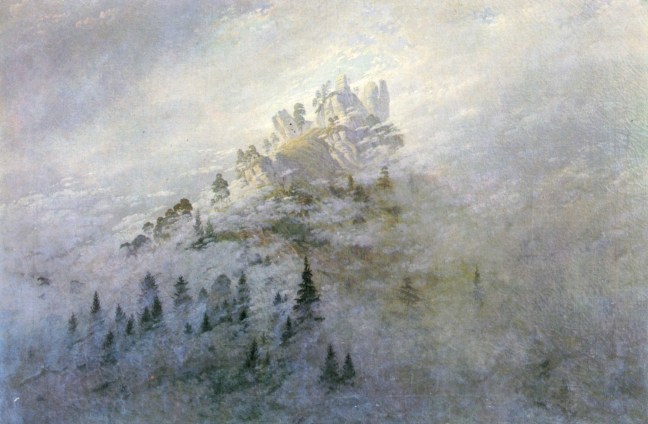
‘Morning mist in the mountains’ – Caspar David Friedrich, 1808 – WikiArt

There is something in us, a presence, a feeling of being, that can say I Am. Nothing else can. No body can. For how could a body say I Am, which is but a bundle of tissues, a physical structure that can only be seen as an object, at a distance. That which is at a distance cannot say I Am. I Am is for the innermost of your being, for what is here beyond a shadow of doubt, in you, as you, indissociable of yourself. Feel that I Am is for that which never moves, is never tired or sick, is never concerned by age, or beliefs, or any passing content of the mind. Go for what in yourself is indestructible, constant, that could never be hurt, and notice that that is the thing which is necessary, responsible for your being able to say I Am. I Am is your anchor, the lighthouse you must never depart from. If you do, you will be plagued with suffering and grab the first thing you could identify with, amongst others your body, and your mind content. Thought is a good client for providing you with a fake identity. It mimics a self to perfection where there is none, where there is only here a presence infinite, borderless, shared by all. Without that, no I Am would be possible. No I Am would be there, and no humans either, no beings, nothing at all, just a black, empty void.

I Am is the light that makes life possible, that renders it palpable, sensible, experienced. You could say that for an object to find its isness, its existence, there would have to be an I Am first, there would have to be an essence, a ground that gives all things and all beings their shape, length, width, and existence. This essence is that without which there’d be no you, no possibility to say I Am. That without which there’d be no support for your thoughts. That without which your body could not in a zillion aeons find its ground, its birth, its death, and its life and beating heart. Thought has nothing to do with your asserting I Am. It is in no way involved in it. It will try to convince you, that thought is behind it all, is the voice of your being, the one that can say I Am. The body has convincing arguments too. They two form a good pair. But don’t be deceived. These are not where you draw your sense I Am from. I Am is deeper. I Am is fundamental, not a passing thought or feeling, bound to an object, to a body. I Am embraces all things and all beings. Even the world could not be thriving and bubbling without having its grounding essence. It needs, for its rising and falling, for its being seen, heard, felt, a something that holds it and creates it, like the content of a dream needs the mind of a dreamer. The world would be at a loss without I Am.

And in fact it is: at a loss. For why do you think the world is plagued with suffering and conflict? If you ever find yourself suffering or in conflict, it is that you have lost your I Am. You have given it, bargained it to a body, or a story, or some mere random thoughts. You have exchanged it for an ambition, an eagerness to be something, somebody, and to feel the reward of it. I Am is without a reward, without a body, faultless, pristine. It doesn’t know the meaning of suffering, or conflict, or confusion. So keep it always close to you, don’t lose its splendid gaze. For your body, mind, and random thoughts are all craving to take on the role of a self and blind you, conceal in the process your gorgeous, inborn, god given identity. They’ll happily send I Am to the wrong place, to keep it unnoticed, forgotten. But I Am is always here, like a patient presence, holding even your ignorance in its benevolent hands. It will wait for your looking, your noticing, the better days of your realising who you are, that is found here nestled within I Am. You owe I Am everything, right to your feeling of being, behind the mere words.

For there is a Word behind the words, which I Am is the pointer to. A living, pulsating reality. Call it being, call it god, call it Word. We have made I Am into a mere body, a limited self, and have therefore compelled ourself to look outside for our peace and completeness. The seeking for our lost completeness is what is called suffering. But the way to overcome suffering and conflict in our lives lies within, in our very being, in what is hidden in plain sight every time we say I Am. A human being can never have its private sense of I Am, for being is shared in equal measure by all beings and things. It is boundless and has within it the peace and completeness that you had been looking for without, as a result of your misplacing I Am. I Am owns its peace and completeness through its being alone, whole, One, and therefore unable to be parted, or lost, or forgotten. So have a good look every time you say simply I Am, and recognise it for what it is, and not what you believe it is. Don’t limit I Am to a projected, illusory, made up entity. I Am is the gorgeously carved door to your being happy and whole, and to have the world reflecting that wholeness and happiness. It is your treasure within, that you have ignored, or misused. So repair the sense I Am in yourself, and give it back to its original, initial, pristine glory and undefeatable reality.

.

~~~

Text by Alain Joly

Painting by Caspar David Friedrich (1774-1840)

~~~

.

Website:
Caspar David Friedrich (Wikipedia)

Suggestion:
– Other ‘Reveries’ from the blog…

.
On Courage

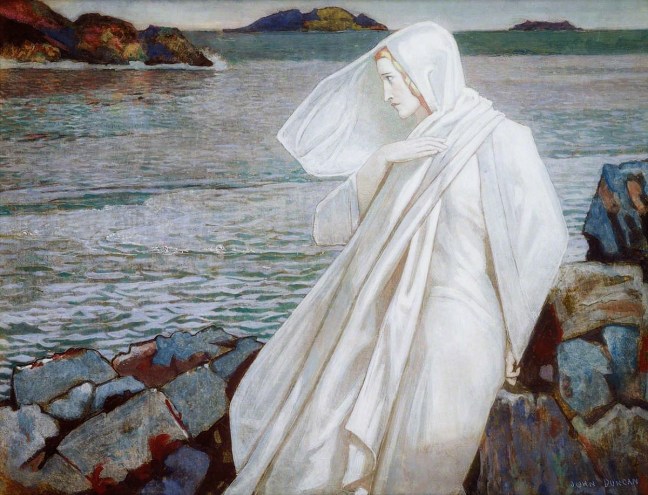
‘The Turn of the Tide’ – John Duncan – WikiArt

Not to suffer is not as desirable as we like to proclaim. We have mixed feelings towards our agonies and traumas. In fact, we have come to like the beastly thing. Suffering has given us many of the things we cherish in our life. Suffering has given us the hopes that we love to entertain, the pleasures we have developed as a routine of escape, and all the little addictions we enjoy in secret. It has shaped our drives and the nature of our beloved possessions. And our best friendships may have developed as a result of this beating pang in our heart. So this is not easy to let suffering go. A lot will go with it that is like the backbone of our beloved self. Being at peace and happy comes with a price.

There is some identity in our suffering, where is hidden a private treasure that we’d rather keep and nurture. If we are honest, we have to confess that our wounds have made us what we are, have formed the self that we believe we are, the personality that we have come to befriend. We haven’t fought our suffering with constancy, and have come to collude with it, socialise, associate, fraternise. We have indulged in every bit of it. We have surprised ourself having feelings for our pain, entertaining a secret love affair with everything that bites us. So to end suffering requires clarity and courage. For we won’t abandon a dream so easily, or put an end to a pleasure without balking. We need to be convinced. Our road to true happiness is paved with reluctance. We have a natural and well-rehearsed resistance to bliss.

[…]

Reflecting on how courage is found at the heart of ourself… (READ MORE…)

.

Twisted Rainbow

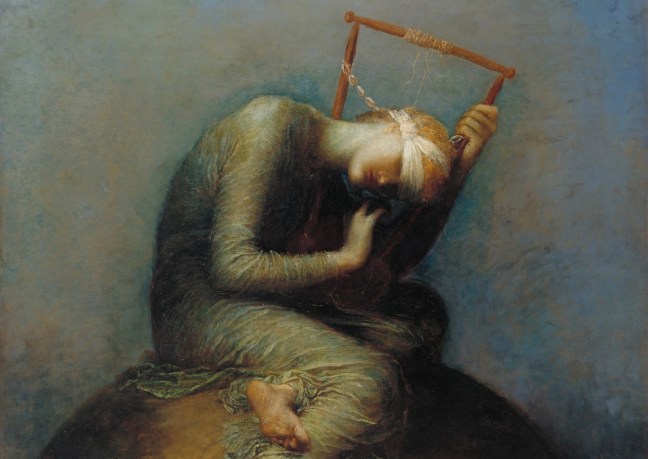
‘Hope’ (detail) – George Frederick Watts, 1886 – WikiArt

Unhappiness is a strange thing, for against all appearances, and under serious investigation, it is not really found. We are making it up as we go along. In fact, there is no such thing as an absence of happiness. Yet we are nurturing this absence with great consistency, designing our so called unhappiness with care, through our thoughts, our memory, our attachments, our stubborn persistence. But only try to experience its effects outside your thoughts and feelings, in the absence of your mind, and you’d have to confess that you can’t find here anything like a misery. The reason is: unhappiness is not a thing in itself. It is veiled happiness. It is the covering up of your innate peace. It is past residues and future expectations tossing the tranquillity of the now. But all such disturbances, discomforts, or distresses, are always only temporary events, passing weathers distracting us from what is always here, always faithful, always to be trusted: the peace contained in simply being. This peace is in fact the very making and backbone of our lives, its solid background. It could never leave you no matter how hard you may try. Its not being felt is a form of snobbery. You have missed your innate joy in reason of your not looking in the right place. You have neglected your true, natural being for wanting to be somebody. You have been scorning yourself out of vainglory. In fact, unhappiness is but the simple mourning of a loved one who is missed: our true self. It is but a distraction from the boredom of our ignorance. Or a warning for a wrong turn taken.

Unhappiness is not found in physical pain, or in the natural grief following a loss. These are all compatible with happiness, as is a shared, compassionate sorrow. These are wise and healthy responses to life situations and challenges. Unhappiness is of a different nature. It is more like a habit or an indulgence. Often, we would rather be unhappy than shatter a well-rehearsed idea of ourself, in which we have invested our most cherished identity. Unhappiness is also the result of a fallacy, and a form of delusion. It is a shadow which we nourish through our belief in being a person caught between seeking and resisting, and the reward of fulfilment. Unhappiness is only as real as our limited self is. One will follow the other both in death and in birth. So really, unhappiness is a self-inflicted pain. In a way, we could say that it is a sin. It is ourself being driven away from our happy, forgotten nature, and bound to the suffering self which we have identified ourself with. It is our twisted rainbow in the sky of ignorance, that appears naturally without being truly there. It is created by the rain of all our renouncements, of our constant search for security and approval, through accumulation and avoidance. So next time you meet some measure of unhappiness in your life, don’t believe it. Don’t be caught up and allured by its convincing appearance. See through it until you find its referent. See that unhappiness is not real as affliction or suffering. It only exists as the sum of all that hinders the happiness which is the nature of your self as being. Your misery may in fact only be a passing, unassuming thought, maybe an innocent, unchallenged belief, or just a feeling hovering about, which you are taking too seriously. Not very much really. Hardly enough to send you far and away from the delight of simply being.

.

~~~

Text by Alain Joly

Painting by George Frederic Watts (1817-1904)

~~~

.

Websites:
George Frederic Watts ( Wikipedia)
Hope (Watts) (Wikipedia)

Suggestion:
– Other ‘Reveries’ from the blog…

.
The Adventure of Thought

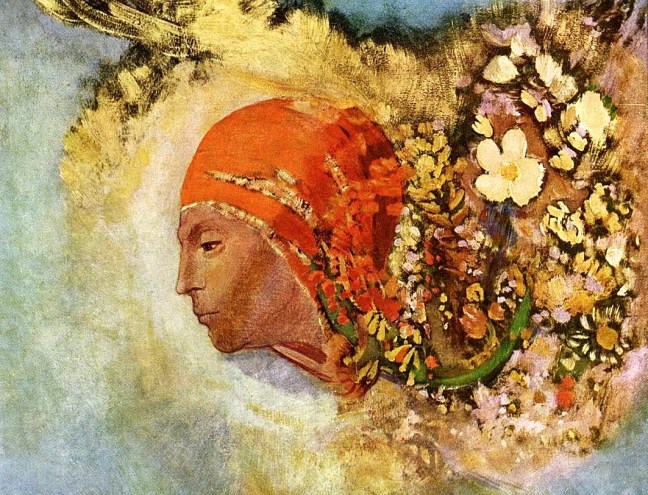
‘Head with Flowers’ (part) – Odilon Redon, 1907 – WikiArt

Thoughts are a strange thing. For they seem to be both indelibly ours and strangers passing in our sky. We have an ambivalent relationship to them. Sometimes they are part of us like a lover can be, so intricately woven to our being that they seem to have been sculpted out of our very essence. On other occasions, we see them from afar, unwanted, a despicable thing that we judge unworthy — thieves that have come to set us on a wrong course, rendering us unrecognisable to ourself. We have a love-hate relationship to our thoughts. We love the ones we judge to be good and worship them, befriend them, glorify them, and hate the ones that come to upset us, the bad ones that we refuse to endorse, or have a responsibility for. The ones that we leave scared and alone, ready to multiply and threaten our very being. They are like the obeying soldiers of our wounded self, the dark agents of our fears and of our rancour.

Thoughts end up being prey to our likes and dislikes, treated like objects are, judged as being often disloyal, incompetent, insufficient. We seem to be separated from them, to have little to do with them. But thoughts have been supremely important to us. In a way, they have created us, through our identifying with them. They have formed the limits of our self as a separate entity. In fact, thoughts are thinking us. We are the prey to their conditioned making, and are at the mercy of their limited expression. So we are most of the time reduced to being ourself a thought, a thought thinking itself out, and believing that it is representing nothing less but what we are at the core. Yet we are truly far from the mark. Thoughts have deluded us, have drifted from their being a simple tool to stealing our very identity by faking the appearance of a self separated from its thoughts, when that self is in fact just a magnified, engrossed, elaborated thought that bears no resemblance to what we truly are. Thoughts thrive on confusion, they flourish and fatten on the prosperous soil of ignorance.

But try to go beyond thoughts, to pass them by, to ignore them as being unimportant and move on, deeper, towards the very centre of your self. Notice the sense of being that is here before them, and that hosts them in last analysis. Touch the silence behind thought. Embrace who you are before you associate with things. Go to the place where no identification is possible, where you are free from conceptualisation, where thoughts have become unrelated to yourself, lost entities that have no relationship whatsoever to your truest being. You will begin to disconnect thoughts from yourself, to render them innocuous, and stop looking to them for your security or identity. You will discover a way of living where thoughts are scarce and rarify. You will have no room for thoughts. You will have disencumbered yourself, and will stop being blind to what is. For you will notice that your being extends to all possible things, and all times and places. It is a presence so unified that thoughts are being gradually expelled from your deepest being by losing their unifying justification. They become redundant to your self. They become what they should never have ceased being: a wonderful tool at the service of unity, a practical thing that is but the expression of the one. You will have stripped them of their being an impostor. That’s how you stop being a thought. Because you don’t need one to be yourself.

.

~~~

Text by Alain Joly

Painting by Odilon Redon (1840-1916)

~~~

.

Website:
Odilon Redon (Wikipedia)

Suggestion:
– Other ‘Reveries’ from the blog…

.
The Heart Sutra

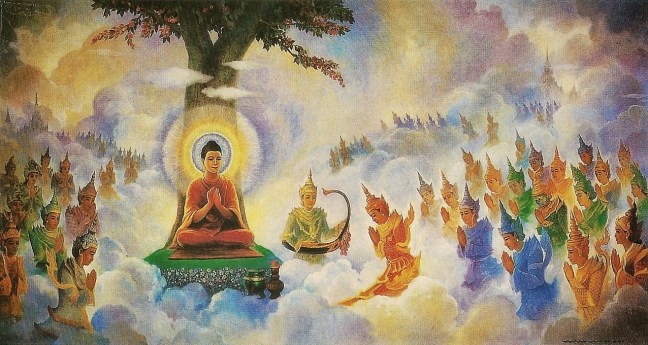
‘Buddha preaching Abhidhamma in Tavatimsa’ – Wikimedia Commons

.

प्रज्ञापारमिताहृदय

心經

བཅོམ་ལྡན་འདས་མ་ཤེས་རབ་ཀྱི་ཕ་རོལ་ཏུ་ཕྱིན་པའི་སྙིང་པོ

.

There is a text that came from the dawn of ages, whose author is unknown, but which has been widely accepted, practised, and chanted in Mahāyāna Buddhism as a condensed exposé of the teaching of Buddha. Although known and praised as the ‘Heart Sutra’, its original Sanskrit name translates as ‘The Heart of the Perfection of Wisdom’. If the Sutra’s main teaching asserts that all phenomena is ‘Śūnyatā’, a term widely translated as emptiness, its wide implications extend to many other aspects in the understanding of our true nature. Originally translated in Chinese by a 9th century Buddhist monk called Prajñā, the text exists in a shorter and longer version. I am sharing here the standard long version that provides an elegant and story-like context to the main teaching. I have also chosen to give to the many Sanskrit terms their original meaning or context. Following the Sutra is a short text that I wrote, some words that the text has evoked in me. I hope that this presentation will give justice to the profundity of this text, and that you will enjoy the reading.

~

Form is emptiness, emptiness is form.”
~ The Heart Sutra

[…]

Discover this milestone of Buddhist literature: the ‘Heart Sutra’… (READ MORE…)

.

The Riddle of Ignorance

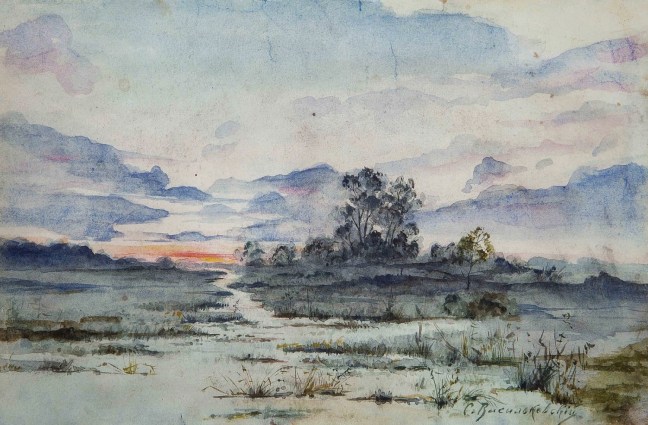
‘Landscape’ – Sergey Vasilkovsky – WikiArt

.
There is a truer, hidden reality lying just under the veneer of life. Don’t think that what you have is the real thing. It is not. This hidden reality is being covered by the thick blanket of our deceptive representation of reality, made of a whole array of thoughts, feelings, memories, worries, beliefs, conditionings, that have numbed our aliveness, blunted our sensitivity, and rendered our god-given natural endowment as if inexistant. This is why, in some religious traditions, man has been proclaimed ’ignorant’. This is a word that indicates that simple fact — the plain and unfortunate forgetting of a nature in us that has been temporarily hidden, and that craves in the background for our recognition, our remembering. This is why all men and women on this earth are seeking peace and happiness in one form or another.

This particular reality is the subject of countless religious books and spiritual traditions in the world. This was never about having many different beliefs like we sometimes think it is. It was about revealing this truer reality of ours. In the process of doing so, approaches may vary depending on the times and cultures where they arose, and misunderstandings have sprung proportionally, but the fact of our ignorance is the same for all, at all times, in all places. And the reality discovered behind its dispelling is not only the same for all, but is one whole and single reality present here and now as the rock-like experience of being in all beings — be they human or not. This is not a small affair to be pushed around and despised as being mere ‘beliefs’, but is the very core, substance, and meaning of our lives. So why is such an obvious reality being missed by so many of us? What has made it so commonly invisible, and inaccessible?

[…]

Some reflections about how reality is being ignored by man… (READ MORE…)

.