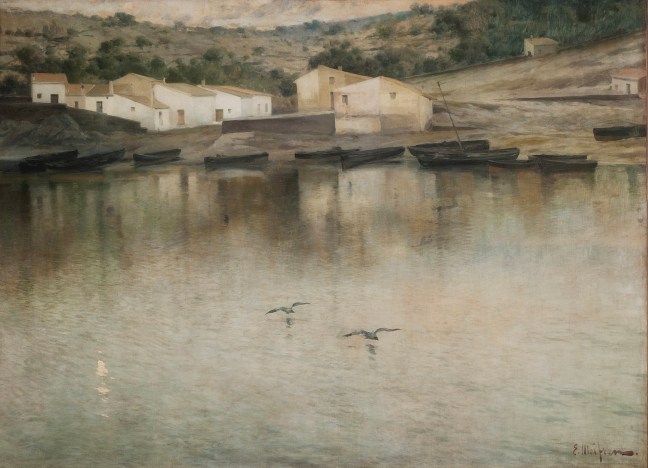
The Silent Heart

‘Silencio’ – Eliseu Meifrèn p, 1900 – Wikimedia

Silence in the spiritual endeavour is taken to be much more than the absence of noise. It is in fact stillness. Silence is the absence of movement. It is the quiet reality that lies at the very heart of our being. By silencing the mind, we get to our silent heart — the silent heart of being that lies deep down within ourself. In fact, not so deep down. This is one of these illusions, to think that our heart, our silent being lies deep down, hidden, buried. In fact, our silent heart is showering our existence. It is our natural state, teeming, unmissable, that we have made seemingly absent, that we have silenced with the deafening noise of our mind, of our endless chattering, and of this belief a million times rehearsed that we are something, a thinking entity divided from every other thing or entity, and a private, personal self that we believe is attached to the body.

In fact, our mind is made of that silence. Only, we have added so much to it that our silent, unsubstantial heart has been overwhelmed by our many thoughts, feelings, sensations, perceptions that got all our attention. We have crowded our mind and have stripped it of its natural identity, which is simply being. We have silenced silence. We have mixed it with everything objective, noisy, agitated. So it has seemingly disappeared, although still overwhelmingly present. It is not that it is hidden, but we have transferred our natural, silent identity as being, to a fake identity as body, thoughts, senses. We have exchanged being for existence. We have downgraded ourself from simply being to being something. From pure, unalloyed awareness to that which this awareness is aware of. From silence to the crowding of that silence. We are crowded beings, living at the surface of things, dancing and struggling with everything superficial. We have broken the pact that tied us to the infinite, which is our true home and identity.

It results that we have become a person, when we are truly this silent, depersonalised, but utterly intimate heart of being which is the birthplace of all things and all beings. We are that which is before everything that appears and is the prey to our senses. We are this non-substantial substance that allows everything to find an existence. But we are not ourself a thing existing, a person. We are the still and silent being that is the heart of ourself and of all possible existence. Being something is to transfer our identity to that which we are aware of. But this identity has no reality other than in our thoughts and imagination. It is a belief. In plainly and only being, devoid of the imagination of mind, of its restless and ephemeral content, there is an aware silence. A silent heart. Still beating as our eternal, undefeatable identity. We have to live there, for this is the life we are meant to live. Anything else is a corrupted, even poisoned position. The state of the world is here to prove it, to attest that we have displaced our gorgeous identity away from the silent ground of being, to live in and as an appearance, and to believe in what is only a passing dream.

.

~~~

Text by Alain Joly

Painting by Eliseu Meifrèn (1857-1940)

~~~

.

Website:
Eliseu Meifrèn (Wikipedia)

Suggestion:
Other ‘Ways of Being’ from the blog…

.

On God’s Existence

‘Calm on the Mediterranean Sea’ – Ivan Aivazovsky, 1892 – WikiArt

There is no god. God is an invention that we have placed far away, out there, as an object for our prayers and hopes. As an entity to whom we can address our suffering. God was given that role so that we are not alone. We have divided ourself up into a self here and another greater self there, between which reside our secret longings and our beliefs. We have made god into a handy projection, for our convenience. A soothing presence who will be there for us after death, whom we can trust and rely on, whom we can give ourself to, and find protection in. We feel good in that undoubted certainty of a god.

But there is no god outside of ourself, no distant god, either in place or time. Of this we can be sure. Because wherever we may travel, however far we may go, we find only ourself. We are bound to our own being which we feel in a ‘here’, and in a ‘now’. So we fail in going somewhere that is outside ourself. It’s an impossible task. We cannot go there. Not in a million years. So god cannot be found outside of ourself. Nothing can. Everywhere is here. And every time is now. The only place for god to be is in our own being. There is no other place to be — even for god. There is no way around it. But we have first to understand our own being, our own nature. There, in ourself, is the resolution of the conundrum of god.

So what is this place of ourself, to which we are bound? What is it made of? If we leave our body aside, and our many thoughts and sensations, if we leave the world out of the picture, what is left of ourself that we can say is here, is now? What is this consciousness that we have lived with for as long as we can remember, and for which we seem to have but little interest ? This thing which has held our peace, our happiness, our perceived sense of beauty, even if only experienced rarely or fleetingly? This consciousness that is holding us, that is giving us our very existence, holding our suffering and our conflicts? Should we not feel grateful to have been held with such consistency? To have been held with our feelings, whether happy or sorrowful? To have been lent a body, whether healthy or sick, and a mind, though both may be just a passing dream?

This thing which is here undoubtedly, showing that peace is possible, that beauty is real, that happiness is within reach, is this not our most profound self? Is it not our very being? What we are here? What we are now? And this god which cannot be anywhere outside of ourself, could this god not be this, this very presence of ourself? Our very being? Our very consciousness? Which we are by nature every day of our life? That which can be felt in every bit of our heart and soul? That can give an explanation for ‘there is no god’? That can give a reality to ‘there is god’? That can show that, in fact, not only there is god, but there is only god? That everything, all that we are and experience, is god? That the god which we had thought at a distance, is nothing but the loving presence and reality of ourself and of everything? That life is nothing but the living, pulsating being of god, which we are only and wholly? And which we share with every other apparent being, and every possible appearance? And that this, is the one thing that ever was, and will ever be? And that this, is not inside ourself, for of ourself it is seen that there is not? And that this, is not outside either, for there is no being outside something inexistant? And that now, at the end of our journey, and all things considered, is realised that god is not even god? Because for a god to be, there would have to be separate things and selves to give it a form, and to call it god. There would still have to be a trace of suffering. There would still have to be separation. So there’s got to be no god. God is only for the poor fellows. But for who we are, there is no god. Only being being, at the most. Beyond that, nothing much can be said, lest we should invent some other god.

.

~~~

Text by Alain Joly

Painting by Ivan Aivazovsky (1817-1900)

~~~

.

Website:
Ivan Aivazovsky (Wikipedia)

Suggestion:
– Other ‘Reveries’ from the blog…

.

On Courage

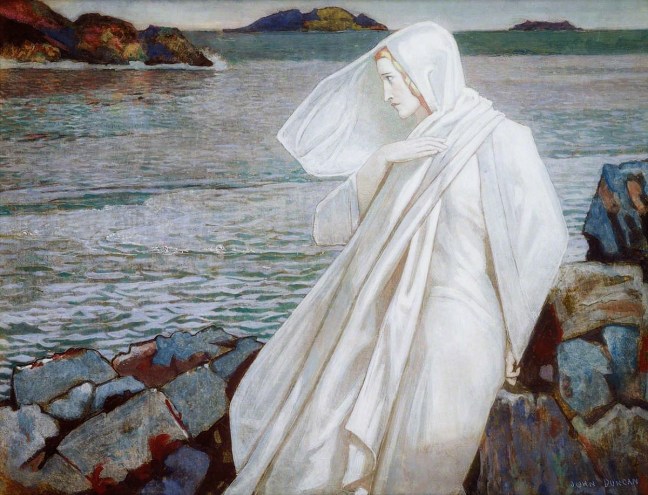
‘The Turn of the Tide’ – John Duncan – WikiArt

Not to suffer is not as desirable as we like to proclaim. We have mixed feelings towards our agonies and traumas. In fact, we have come to like the beastly thing. Suffering has given us many of the things we cherish in our life. Suffering has given us the hopes that we love to entertain, the pleasures we have developed as a routine of escape, and all the little addictions we enjoy in secret. It has shaped our drives and the nature of our beloved possessions. And our best friendships may have developed as a result of this beating pang in our heart. So this is not easy to let suffering go. A lot will go with it that is like the backbone of our beloved self. Being at peace and happy comes with a price.

There is some identity in our suffering, where is hidden a private treasure that we’d rather keep and nurture. If we are honest, we have to confess that our wounds have made us what we are, have formed the self that we believe we are, the personality that we have come to befriend. We haven’t fought our suffering with constancy, and have come to collude with it, socialise, associate, fraternise. We have indulged in every bit of it. We have surprised ourself having feelings for our pain, entertaining a secret love affair with everything that bites us. So to end suffering requires clarity and courage. For we won’t abandon a dream so easily, or put an end to a pleasure without balking. We need to be convinced. Our road to true happiness is paved with reluctance. We have a natural and well-rehearsed resistance to bliss.

[…]

Reflecting on how courage is found at the heart of ourself… (READ MORE…)

.

The Coveted Jewel

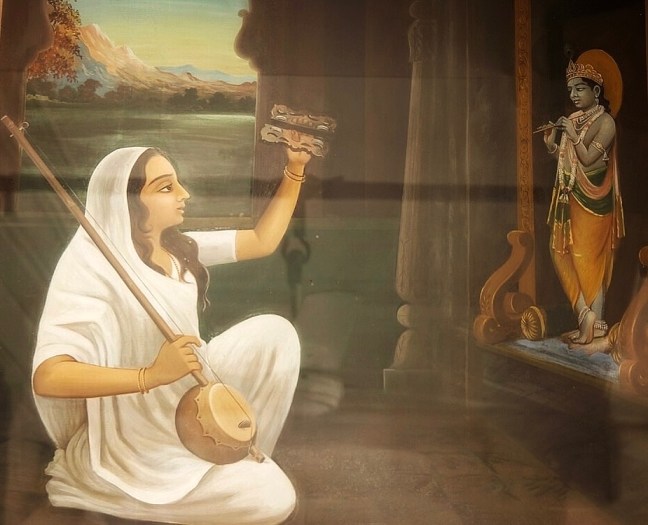
‘Meera and Krishna’ – City Palace Museum, Udaipur – Wikimedia

With god, or with our utmost being, one shouldn’t be too clinical. Presence is better seen, better felt, as our beloved. That’s how you have truth nearer, when you’re in love with it, and want to bring it close, so very close to you. Because its most intimate essence is not at a distance from you, but has merged in you, and as you, from the eternal now, so that you could remember him on all occasions, and feel her, feel him, as the very core of your eternal being. So your beloved is already hugging you, forever holding you in its infinite, most loving embrace. That’s where you draw your unabated search from, for who wouldn’t do anything, anything at all, to seek to reunite with the love of his life. And how could you not cross the most ruthless torrent to marry the intimate essence of her wondrous being. So go through love. Seek her in your tender heart, where she has been aching for your presence. Look for him in your innermost bosom, where only he longs to surrender. And feel the pang of separation, for it is itself the pathway to your beloved.

And there is more to it: love is uncompromising. So you won’t fancy being separated, won’t like finding yourself away from the warmth of your beloved. So your gaze will never wander far and away from your lover’s tender eyes. And you won’t find difficult to spot her even in the wildest display of experiences and activities, where objects come to assail you. You won’t be easily seduced by another than your beloved, for who would want to leave the bliss of a shared love for the chill contained in seeking an outside pleasure, far so far away from your lover’s beating heart. But be careful now, for this love for the beloved is a unique love. Beware! You can never love your loved one as an other. Love is indivisible. The love you feel is always only the expression of your own silent being. So you will have to let your lover go, not because you separate from her, but rather because you merge your being with his being, and in so doing become one being. This one beingness of the lover and the beloved is the truth of eternal love. Love cannot be split in two, and the love you feel for the beloved — for any beloved — doesn’t belong to you. Love is a burning flame that consumes itself into itself. For there is always ever one mind, one love, one being, regardless of the number of apparent lovers. This is what makes love the most coveted jewel of our lives. Because you disappear, and in that disappearing, you find your gorgeous, luminous, infinite self.

.

~~~

Text by Alain Joly

~~~

.

Suggestion:
Other ‘Ways of Being’ from the blog…

.
The Glorious Reality

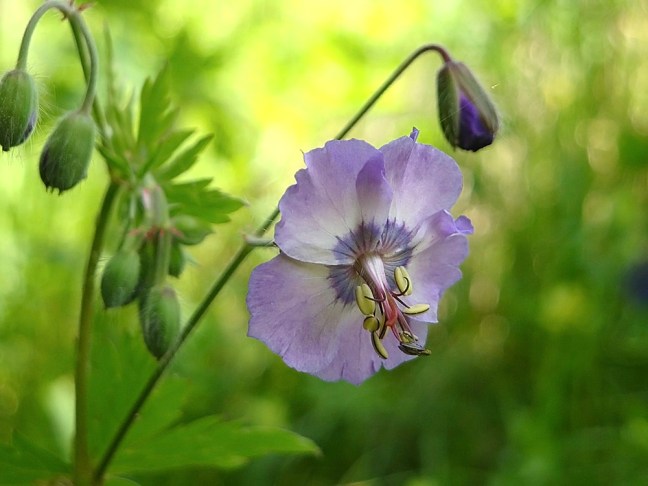
Do nothing that may be unworthy of the
glorious reality within your heart and you
shall be happy and remain happy.”

~ Nisargadatta Maharaj

.

~

Quote by Nisargadatta Maharaj (1897-1981)

Photo by Alain Joly

~

.

Bibliography:
– ‘I Am That’ – by Sri Nisargadatta Maharaj – (Chetana Pvt.Ltd)

Website:
Nisargadatta Maharaj (Wikipedia)

Suggestions:
Beauty in Essence (other pointers from the blog)
Khetwadi Lane (Homage to Nisargadatta Maharaj)

.

The Beatitudes

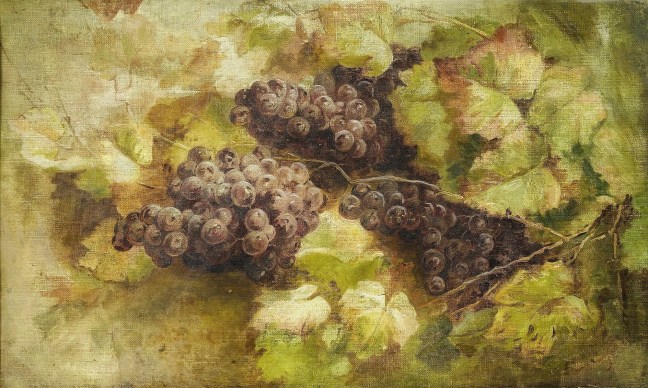
‘Still Life with grapes’ – Giovanni Segantini, 1899 – Wikimedia

.

The Beatitudes is the name given to eight blessings that Jesus pronounced at the beginning of his ‘Sermon to the Mount’ in the Gospel of Matthew (5:3-10). Each of these blessings begins with the Latin word ‘beātī’ (from ‘beātus’ meaning ‘happy’, ‘wealthy’), translated here as ‘blessed’. They are short and bold little sayings that I have come across lately, eight ways to be blessed, eight blessings on the path to our true being, each the recipient of some profound meaning which I have endeavoured to develop here. I hope you enjoy the reading…

Seeing the multitudes, he went up onto the mountain. When he had sat down, his disciples came to him. He opened his mouth and taught them, saying,
~ Matthew, 5:1-2 (World English Bible)

.

Blessed are the poor in spirit,
for theirs is the kingdom of heaven
.”
~ Matthew, 5:3

You’ve got to be empty. Not to indulge in your thoughts, feelings, and experiences, making them the owners of your kingdom. You’ve got to be empty. To not be seduced by every passing colours. To stop being a possessor, forever looking for what could enrich you. You’ve got to be empty. To not be involved, endlessly busying yourself with everything you have gathered to exist, looking in them for an identity. You’ve got to be empty, to stay away, to keep alone. To be the one disinterested, self-sufficient, which means finding peace in the essential of what you are. That essential is ‘being’. Simply being, devoid of anything that this being could be, or have, or think, or feel. Then this being will enrich you in its austerity, it will clothe you in nakedness, it will fill you in emptiness. Being is all you will ever own, for the simple reason that it is all you are. Nothing else is but being. This is the only asceticism worth living. Be blessed with that inner poverty.

[…]

My reading on Jesus’ eight blessings from the Beatitudes… (READ MORE…)

.

The Sober Life

.
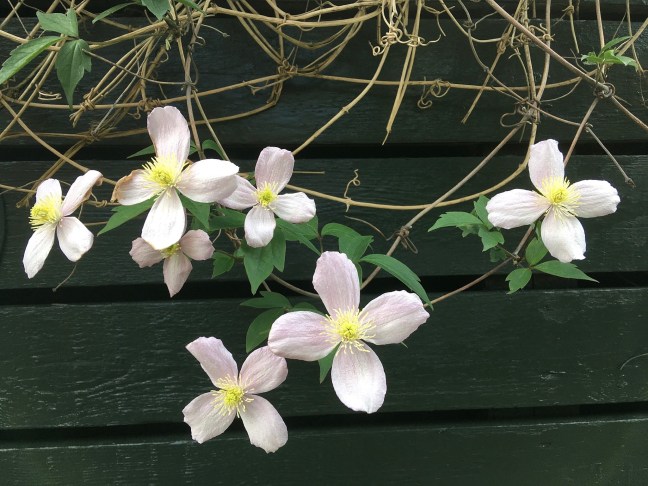
To be sober means not to let the heart cling to anything except God.
Cleaving to other things makes the soul drunk,
and it begins to do quite unaccountable things
.”
.
~ Theophan the Recluse

.

~~~

Quote by Theophan the Recluse (1815-1894)

Photo by Alain Joly

~~~

.

Bibliography:
– ‘The Art of Prayer: an orthodox anthology’ – Compiled by Igumen Chariton of Valamo (Trans. by E. Kadloubovsky and E. M. Palmer) – (Faber & Faber)

Website:
– Theophan the Recluse (Wikipedia)

Suggestions:
Beauty in Essence (other pointers from the blog)

.