The Impossible Deed

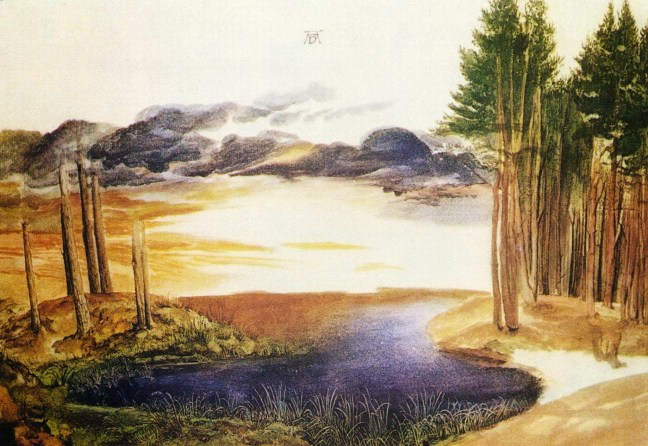
‘Pond in the wood’ – Albrecht Durer, 1496 – WikiArt


We are used to knowing
. We have been trained in it, brainwashed with it, and drained by it. Knowing has been privileged at the expense of being. So we have become expert knowers, professional doers, but at being, we are infants, clumsy, penniless. We are without a self worth the name. We are homeless without knowing it. We are without a solid ground — a trembling, uncertain little thing living in the wilderness of objects, battling in the haziness of beliefs, having no place to truly be, to truly rest. We are a wanderer of ignorance, a nescient soul lacking the elementary knowledge of its own being.

But OK, I will give us that. I understand this urge to know. Knowing gives us a bright, shiny sense of self. A fantastic ego. It is rewarding. Being gives nothing, is completely unproductive. At least, so we think. But this knowing of our being is not any kind of knowledge. The will to know the ‘I’ is a sacred will, a holy endeavour. If we want to know ourself, we will come to know it. This is a desire that cannot be left unfulfilled. This knowledge cannot resist any serious enquiry. It will give in sooner than we think. But it is a hard one to desire. The difficulty resides in wanting to know. We shy away from that desire. There is something there we’d rather stay away from. We would rather know beforehand what we have to know, and remain on shallow land. We don’t want to rock the boat of our being. After all, this is where we stand. We don’t want to be swept away from our cherished ideas and beliefs, and be deprived of the security we have so dearly earned. We would rather stay a seeker of the known.

But try it now — to know yourself. And do it with your mind, with your usual knowing faculty. Go there, at the heart of your self. Decide it. Make it your goal: to know who or what you are. It doesn’t matter where you begin. But go not to the periphery, to that which you can know as an object. Go to the heart of your self, to that thing which you have called ‘I’ all your life. What is this ‘I’ that you are being all the time? This ‘I’ is never visited. But now is the day. Go there. Find out what it is. See that you will meet there like an impassable, impenetrable wall. You will find closed doors. All your knowing, your ego, your accumulations: this has made a blocking stone. This has barred the entry, has prevented all true seeing, all knowing worthy of the name. Feel that you cannot go there with your mind. But this impossibility is gold. So keep at it. Keep pushing. Don’t be shy. Use both shoulders if needed. Give it all the strength you have. It will recede. I promise you. Everything can be known. This is no exception.

Notice that what you come against is yourself. This impossibility of knowing the ‘I’ lies in your belief in being an entity. The knower is the obstacle, the impassable wall that bars the way. To know yourself is an impossible deed. You can never know who you are, because who you are is only contained in ‘you are’ — in the feeling of ‘I am’, of being. We are so unaware of our being. Being has been forgotten, relegated in the background, replaced by a knower, a doer, a busy self that insists on knowing who he or she is. But to know ourself, the knower has to first realise itself as being. To know is to be, and to be knowingly. This knowledge dips its reality in being. There is no knowing ourself without being first. Knowing here is only achieved through being, which is the knowing of ‘I’ without a knower. The will to know dissolves into being, which is the only knower there is and will ever be.

This knowledge is found in and as the being of the one who wants to know. You can only know who you are by being it, or rather by simply and only being. In that field of self-knowledge, being is knowing. Being is the knowing done without a knower, and therefore without an object known. It is a pure, unalloyed knowing. Everything you ever wanted to know, to be, attain, achieve, all the content of every sacred book, all happiness, all longings, is found in being, in that which you already are. Your amness is the gate code cracked. You will find who you are on the other side of knowing, which is being. And it is delivered with peace, which is the nature of being. This knowledge is the only knowledge that doesn’t take place in duality. It is achieved in the oneness implied in plainly being. So this impossible deed has now been transformed as the infinite being that we were all along, but had veiled through our insistence in being a knower of the known. We don’t know who we are with our knowing faculty. Ourself is the only thing we cannot know as an object. We know our identity through the fact of simply being. There is no other knowing than being. Being is what we are, without a single ripple of a knower knowing. Know that and you will be reborn as the unborn.

.

~~~

Text by Alain Joly

Painting by Albrecht Dürer (1471-1528)

~~~

.

Website:
Albrecht Dürer (Wikipedia)

Suggestion:
– Other ‘Reveries’ from the blog…

.
The Birth of Personhood

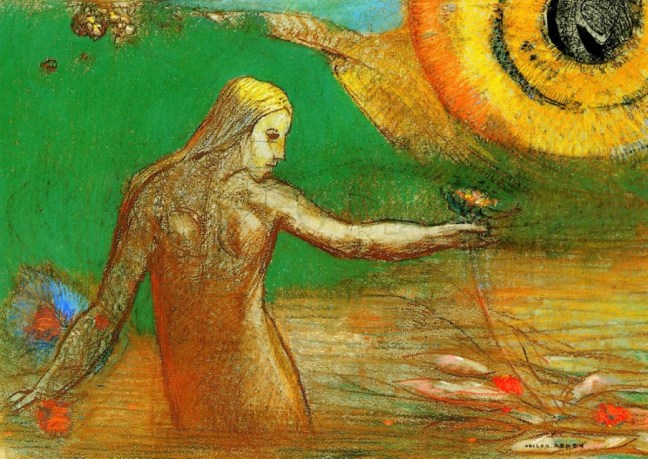
‘Flower of Blood’ – Odilon Redon, 1895 – WikiArt

It is consciousness — not body, not thoughts — that gives us the impression that we are a person with a continuity. There is absolutely no chance that a bundle of thoughts, feelings, and bodily sensations, could give us that impression. We borrow our personhood to consciousness, to the fact of being aware — to this light that creates us in the darkness that are otherwise thoughts, feelings, body. Our sense of continuity belongs to consciousness, to presence — that portion of ourself that is empty, unchanging, not objective, but full to the brim with itself. Our thoughts are but isolated events that are changing over the course of time, and so are our feelings and bodily sensations. The content of our mind is like a passing, unpredictable weather. So continuity in that area is absurd. Our essential self is to be found in and as being. What makes us is in that which is unmade. That impersonal part of ourself is what paradoxically gives us the chance of being a person. We are therefore nothing but empty, undivided being playing ‘being a person seemingly characterised by body and thoughts’. We have got it all upside down: Our person is not prior to consciousness. Consciousness is prior to our person, and the sine qua non of our existence or appearance.

Our thoughts are far away from each other, inconsistent, contradictory, confused, hesitant. They are not the voice of our self, are incapable of forming an identity of any kind. Our identity is to be found somewhere else, in something that we cannot get hold of, or limit, or name. The only thing that could link the different events of thoughts, feelings, sufferings, bodily sensations, and perceptions — all that for us constitute our self, a person with a name and form — is the presence of consciousness. We owe the impression that we are something solid, a real person, to emptiness, silence, stillness. So our person is actually non-existent, or rather has its existence in that which stands unseen between the happenings or events that we think make us. So our story, our thoughts, our body, become evanescent, losing their reality, disappearing within the experience of our massive sense of being — its coming to our attention. Being is seen to be the nature of ourself, which we had imagined in passing, isolated, impermanent, objective events and qualities. And believe me, that makes for a beautiful, gorgeous person — the one we have always wanted to be! A person is infinity being born.

The fact that there is a certain coherence in being a body-mind, and that we are able to live a life, is nothing but the expression of a play, a ‘lila’ as the Hindus are saying. We are nothing but a character in the hands of an actor. A body-mind is the little necessary to carry our wider identity to its term. In fact, all that we seemingly are — a person with an apparent life — is just the vehicle for a bigger quest. We are pretending a body-mind, so that we can realise our divine being. We are carrying infinity on our back, on the back of the finite, giving it the seeming, temporary life of an entity progressing in time and space. But this story, this appearance of a life, is but an excuse, something marginal that serves a wider purpose. We are meant to carry God on our shoulders for a while. At first unknowingly. Until we know God knowingly. Until God has acquired enough substance, and has sufficiently widened Its being in our life. Until God can in return carry us on Its own shoulders. And move us. And swallow us. Then, we find the security and courage to surrender ourself in God’s solid being and be like God Itself. We transfer our being in and as God’s being. And die there.

.

~~~

Text by Alain Joly

Painting by Odilon Redon (1840-1916)

~~~

.

Website:
Odilon Redon (Wikipedia)

Suggestion:
Other ‘Ways of Being’ from the blog…

.

Meditation in a Nutshell

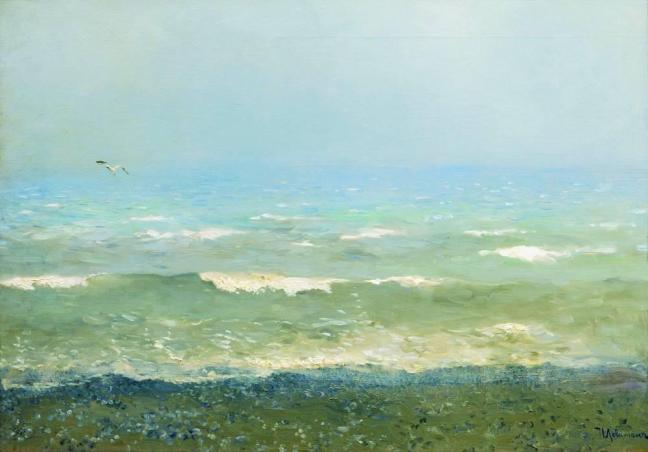
‘Mediterranean Seacost’ – Isaac Levitan, 1890 – WikiArt

When you have an hour in front of you given to meditation or contemplation, don’t ever think that you are engaging in something that is happening in time and place. It is not an hour that you have, that you occupy with an activity. Nothing is taking place, and nothing is lasting in time. Forget these well-rehearsed notions. Your meditation is a presence in which time and place cease to appear as a frame in which you live. They die out in yourself, are melted in your essence, to never reappear quite in the same way. They are washed by your living presence. You are cleansed of their conceptual limitations. Meditation is like a good bath, and you are the water. Nobody is having a bath. Presence is not what you are in. Presence is what you are, and you are nowhere to be found.

There is only a sinking, a deepening of presence. Borders are discovered to be not there. Walls falling all around. Divisions re-assembled. Your being ceases to be mistaken for a limited entity, but is solely the wild, unlimited, unlocated, dimensionless expanse of the nature of everything and everyone. You are in a place that doesn’t have any location, and where time cannot enter. Presence is the only thing in presence. Your life ceases to take place in time, which appears to be just a tool that finds its expression through your thinking process. And space is the illusion that perceptions are creating for you to have a location. Presence provides you with all the necessary appearances to create a body-mind-world. Meanwhile, you as pure being remain untouched, changeless, massive, solid, teeming. Meditation as an activity has ended. Who could possibly meditate in the absence of a meditator?

You have now landed in a spot where you have no need to be a separate entity, and no advantage for it. You have ceased being a person with a story and a destiny. Your body doesn’t qualify you anymore, and is not the recipient of your self. You have become independent, free, non-aligned. You acquire the proportions of a whole world, which has now become your most intimate body. You have lost all qualifications, all identities, and have surrendered to the one all encompassing, all pervading being. Nothing could describe you now. What you are has been relieved of every objective substance. You couldn’t worry the least for your self, which you discover to be devoid of even the possibility of being harmed, diminished, or impaired. Suffering appears to you like the most exotic thing there is. Hope is not even on the list, and all impulse of seeking is gone and forgotten. Wholeness fills you all, and makes you the thing you had previously sought, hoped and suffered for, in every possible direction except in the direction of your own present, inescapable being.

What you have longed for is what you are, which is being alone. When you have been stripped of all the attributes that pertain to time and place, to qualities, conditionings, situations, objects, including the body-mind-world you apparently live in, then you may come upon what you truly are. A being alone, unattached, empty of place, devoid of time, fierce and fearless like a peaceful, unmovable, gargantuan warrior. Why a warrior? Because you as being have subdued all forms, and have been made the vanquisher and pacifier of every division, limitation, separation, and defect. You have consented to your formless nature. This verily, is meditation in a nutshell.

.

~~~

Text by Alain Joly

Painting by Isaac Levitan (1860-1900)

~~~

.

Website:
Isaac Levitan (Wikipedia)

Suggestion:
– Other ‘Reveries’ from the blog…

Vedantic Logic

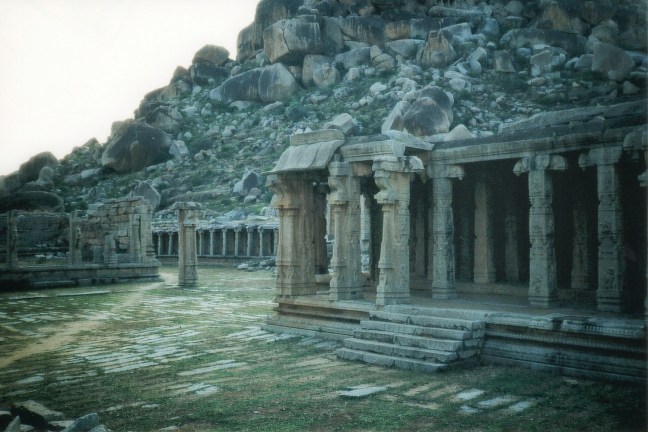
Hampi Vijayanagara, Karnataka – India

We are always too late with our identity. We come after. We experience something within, a sensation, an unease, a thought, and then say: I am that. We start from what happens, from experience, out of which we draw some identity. We are lazy. We identify with what comes. We experience our body, and draw the conclusion that this body is what we are at the deepest level. And then we live from there, from this conclusion, from this belief, this concept of ‘me-my-body’ — which we refer to as ‘I’. Our chance has passed. We have drawn comfort in that conclusion, but have invited its many companions of voyage too, which are suffering, fear, lack, and the likes. We have given ourself to the wind of arbitrary experiences. We depend on everything that passes uninvited. No wonder we suffer, finding there no stability, and no peace. We are at the mercy of what comes. So we are desperately trying to shape what comes, in order to shape our identity, and derive from it some elements of happiness. Hence our constant striving, seeking, debating with life, struggling with what we are, and with what the world brings.

We think that all the responsibility falls on us, that we are the designers of our identity. We are little ghosts exhorting themselves to happiness. And every time we fail and fall from this imaginary pedestal, we head for another direction, another hope, another expectation, and so goes our life — dependent and miserable. Until we finally listen. Until we see that there is an identity before any experience of body and mind. It isn’t that difficult to see and understand. This is only logic. This is, as Swami Dayananda Saraswati used to say, Vedantic logic: “Vedantic logic and worldly logic are diagonally opposite. Worldly logic is: ‘I experience sorrow; therefore I’m sorrowful’. Whereas vedantic logic is: ‘I experience sorrow; therefore I’m not sorrowful’.” So we have to go further back, and it takes some courage. For we are so gullible. We don’t have any true, reasonable stand. Yet, the way we speak betrays our intuition that we are not fully identified with our body and mind. After all, we constantly comment on them. We are not fully implicated. We put ourself at a distance from our own identities, but don’t go far enough. We stay somewhere along the way, as a self separate from it all. We don’t finish the journey. We don’t look well enough. We presuppose we are something, a somebody, a person, and leave ourself there, close, so very close from a higher, nobler truth.

Cannot there be an experience where ‘I’ is really, truly ‘I’? Where ‘I’ cannot be projected or conceptualised? Where it is not belittled, depreciated? Where it cannot be coloured, biased, conditioned? Where it is here in ourself, as ourself, like a pure, unalloyed, super subjective identity which is like a tower in our life, knowing everything that comes without having to be anything, without drawing an identity from it? And experiencing every single object of body-mind-world while staying itself unaffected, unaltered, and whole? After all, when we say ’I am depressed’, what we really say is that ’I’ is ‘depressed’. ‘Depressed’ has become my new identity. So ‘I’ is being repressed, suppressed for a while, replaced by ‘depressed’. But the good news is that if there is an ‘I’ that can be depressed, this same ‘I’ is here standing before the state of being depressed. There is a being before being depressed. We have let ourself being coloured, forgetting that we are in fact that which is here to be coloured. We have lent ourself to the first coming visitor. But the Vedantic logic is here to remind us that when depression is on us, or affects us, it only hides our true identity for a while. It conceals us but doesn’t change us. We stay what we are — a being untouched — depression being only what clouds us for a time. There is something here under cover, a reality, a presence, an aware being that is only being itself. This being can never be touched by depression or sorrow. What is touched by sorrow is a belief, an idea, a projection of ourself as an entity that can be affected by the passing weathers of life. Meanwhile, this pure, innocent being that we are, and that is our one only identity, stays on, living its life of being only being, while a non-existing self is playing depressed and being melodramatic.

.

~~~

Text and photo by Alain Joly

Quote by Swami Dayananda Saraswati (1930-2015)

~~~

.

Website:
Dayananda Saraswati (Wikipedia)

Suggestion:
– Other ‘Reveries’ from the blog…

.
The Householder Sage

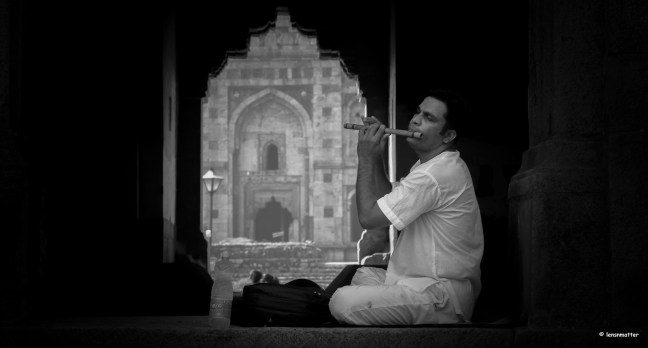
Photo by lensnmatter on Foter.com / CC BY-NC-SA

.

Objectivity, in any form, is the only obstacle to Truth.”
~ Atmananda Krishna Menon

.

It really is a remarkable thing that some of the clearest expressions of modern day non-duality have come from simple Indian men who lived simple lives in society. Atmananda Krishna Menon, married and a father of three children, a police inspector, was one such man. He became, along with Ramana Maharshi and Nisargadatta Maharaj, an essential pillar of the non-dual understanding in India, giving voice to a new approach called the Direct Path, and becoming a guiding light for many seekers of truth in the West. 

Krishna Menon was born in 1883 in Kerala. He grew up in a well educated Brahmin family — some of his relatives were poets or scholars — and had a happy childhood. He was endowed with a good and curious mind, that allowed him to find pathways towards understanding that are clear, simple and effective. Krishna Menon had the highest respect for the function of a true guru. His encounter with his teacher was simple and eloquent. Walking by the roadside, he met in 1919 a swami and sannyasin from Calcutta named Yogananda. It was a short, transforming and unforgettable meeting that lasted only one night but touched him to his very soul. “This paralyzed my ego.” did he say. He realised his true self in just a few years and began teaching. His impeccable logic and clarity drew many a student around him. 

The Truth goes into you undressed,
not through language at all
.”
~ Atmananda Krishna Menon

[…]

Discover the life and teaching of Atmananda Krishna Menon… (READ MORE…)

.

Shankara the Great

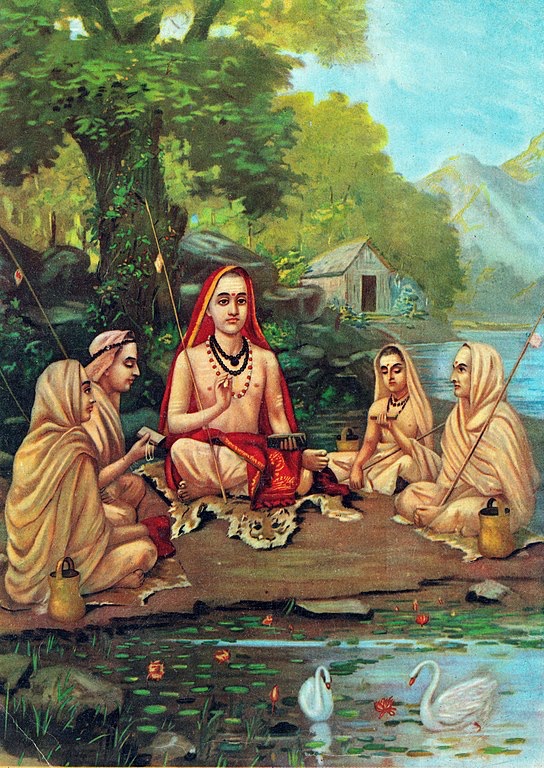
‘Adi Shankara and his disciples’ – by Raja Ravi Varma, 1904 – Wikimedia

.

अहं निर्विकल्पो निराकार रूपो, 
विभुत्वाच सर्वत्र सर्वेन्द्रियाणाम् । 
न चासङ्गतं नैव मुक्तिर्न मेयः, 
चिदानन्दरूपः शिवोऽहम् शिवोऽहम् ।

ahaṃ nirvikalpo nirākāra rūpo
vibhutvā ca sarvatra sarvendriyāṇaṃ |
na cāsaṅgataṃ naiva muktir na meyaḥ
cidānandarūpaḥ śivo’ham śivo’ham |

.

The early spiritual works produced in India were anonymous, probably stated by some ancient sages whose identities got lost. There is one name though that rose and was brought to fame and excellence, a teacher whose life has been narrated in many hagiographies and legends. His name: Adi Shankara, or Shankaracharya. His work as a philosopher and religious reformer is considered prominent in the unfolding of Hinduism. He is also known for having formulated and codified the ancient spiritual current of Non-duality, called in India Advaita Vedanta.

India’s most celebrated teacher was born in Kerala, in a village called Kaladi, in the accepted year of 788. Everything is uncertain about Shankara, since his numerous biographies were written centuries after his death and were designed to build a legend around his life. The name ‘Shankaracharya’ means the teacher ‘acharya’ of the way to bring about happiness (‘sham’ means ‘auspicious’ and ‘kara’ ‘maker’). He died at the early age of 32. A short life that nevertheless allowed him to travel widely all over India, initiating debates, founding monasteries ‘Matha’, and writing numerous pieces of work among which commentaries of ancient texts like the Brahma Sutras, the Bhagavad Gita, or the Principal Upanishads. 

Amongst the many works authentically attributed to him is the Atmashatkam, also known as Nirvanashatkam. The legend says that Shankara, aged only eight at the time, wrote this devotional poem of six slokas as an answer to his newly found guru Govindapada who asked him the simple question “Who are you?”. This is a very striking and moving exposition of everything that we are not, everything that has been wrongly attributed as being our identity. Through experientially discarding every such thing, one comes to dawn on the simple realisation of our true nature, namely the Self or, as it is named in this translation, ‘the auspicious, love and pure consciousness’. This was concluding each stanza in the original Sanskrit as ‘I am Shiva! I am Shiva!’ (Shivoham)…

I am not mind, nor intellect, nor ego, 
nor the reflections of inner self. 
I am not the five senses. I am beyond that. 
I am not the seven elements or the five sheaths. 
I am indeed, That eternal knowing and bliss, 
the auspicious, love and pure consciousness.

[…]

A discovery of the ancient teachings of Adi Shankara… (READ MORE…)

.

In the Morning I Remember

Here is a beautiful prayer composed by Adi Shankara around the 8th century. These three verses, meant to be recited in the early morning, are a beautiful and touching summary of the heart of Advaita. I have chosen here a simple version, devoid of the Sanskrit terms…

~

प्रातः स्मरामि हृदि संस्फुरदात्मतत्त्वं
सच्चित्सुखं परमहंसगतिं तुरीयम् ।
यत्स्वप्नजागरसुषुप्तिमवैति नित्यं
तद्ब्रह्म निष्कलमहं न च भूतसङ्घः ॥१॥

prātaḥ smarāmi hṛdi saṃsphuradātmatattvaṃ
saccitsukhaṃ paramahaṃsagatiṃ turīyam |
yatsvapnajāgarasuṣuptimavaiti nityaṃ
tadbrahma niṣkalamahaṃ na ca bhūtasaṅghaḥ ||1||

~

At dawn, I meditate in my heart on the truth of the radiant inner Self.
This true Self is Pure Being, Awareness, and Joy, the transcendent goal of the great sages.
The eternal witness of the waking, dream and deep sleep states.
I am more than my body, mind and emotions, I am that undivided Spirit.

At dawn, I worship the true Self that is beyond the reach of mind and speech,
By whose grace, speech is even made possible,
This Self is described in the scriptures as “Not this, Not this”.
It is called the God of the Gods, It is unborn, undying, one with the All.

At dawn, I salute the true Self that is beyond all darkness, brilliant as the sun,
The infinite, eternal reality, the highest.
On whom this whole universe of infinite forms is superimposed.
It is like a snake on a rope. The snake seems so real, but when you pick it up, it’s just a rope.
This world is ever-changing, fleeting, but this eternal Light is real and everlasting.

Who recites in the early morning these three sacred Slokas,
which are the ornaments of the three worlds,
obtains the Supreme Abode.

~ Adi Shankara (8th century)


C727EDAF-5B36-4020-8A69-4AA950D7689C


  • Vimala Thakar wrote a beautiful translation and commentary on these lines, starting eloquently: 

In the morning as I meet the dawn, I remember that my heart contains the God, the Beloved, who has not yet been defined and described. I remember that it is He who vibrates within my heart, enables me to breathe, to talk, to listen, to move.”

  • Sanskrit language has infinite subtleties that don’t always appear, even in the best translations. Here, Vimala gives the beautiful analogy of the swan present in the original language:

I arrive at a state of being that has been called by the ancient wise Indians “Paramahansa”, a swan that swims through the waters of duality.”

  • Further down, she exposes the impossibility for the mind to attain the reality of Presence by these beautiful lines:

On the frontiers of the mind I give the mind a job to explore that which lies beyond its own frontiers, that which is not accessible to the word, to the speech, as well as to the mind.

I ask the mind to travel back, through the word, to the source of the word, the sound, and find out how the sound is born.”

“The source can only be experienced, the source can only be perceived and understood, but never defined and described. That is how the mind becomes silent.”

  • She then exemplifies the famous vedantic analogy of the serpent and the rope, and ends up with a perfect conclusion:

I had mistaken the rope of duality for the snake and cobra of misery and sorrow. But the light dispels the darkness and I see that the duality is only a rope that cannot bind me in any way unless I bind myself with it.”

The perfect eternity. The God divine. That is really my nature. I had mistaken the tensions of duality to be me, but then the light dispels all the darkness, and I get rooted back into the ‘ajam’, the ‘aychuta’ – that which can never be swept off its feet. Ajam – that which was never born, and can never die. I am that.”


~~~

Prayer by Adi Shankara (8th century)

Translation & Commentary by Vimala Thakar
(Hunger Mountain, MA – October, 1972)

~~~


– The prayer by Adi Shankara comes from Aghori.it

– Here is the full commentary from Vimala Thakar.

– Photo by Alain Joly

Bibliography:
– ‘The Crest-Jewel of Wisdom’ – by Shankaracharya / Translated by Charles Johnston – (The Freedom Religion Press)
– ‘Blossoms of Friendship’ – by Vimala Thakar – (Rodmell Press)

Website:
Adi Shankara (Wikipedia)
Vimala Thakar (Wikipedia)


Suggestion:
Other articles from the same category ‘Shreds of Infinity