The End of Self-Improvement

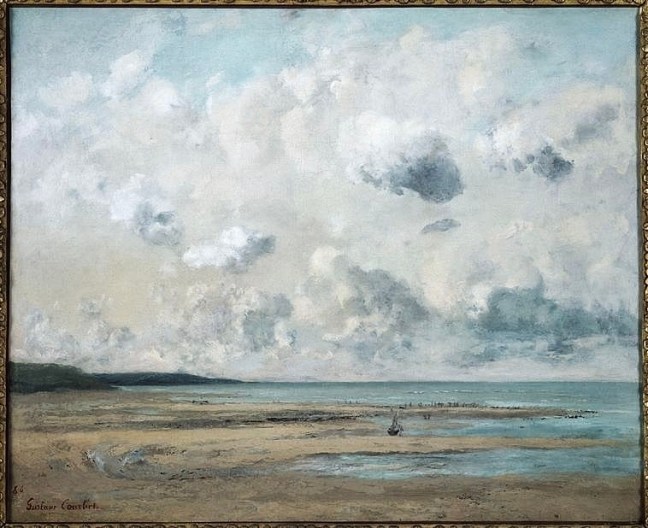
‘Shores of Normandy’ – Gustave Courbet, 1866 – WikiArt

.

To know that your Self has not changed,
this illustration itself is enough.”
~ Ramana Maharshi

.

There is no ameliorating emptiness, developing the unborn, aggrandising what is, and expecting the timeless to be anything more or different than what it is. Being leaves no room for improvement because it is not a thing, it is not a result, a something that has a cause. How do you improve the non-objective? How does the infinite progress? How do you make better a self that is absent as self — as something different or separate from experience? So self-improvement is a misunderstanding and a form of violence. It is an imposition, a belief that we squeeze to fit our idea of reality, an objection to the innate perfection of what is. It is mind-made, a product, a progeny of conditioning. It is designed for the continuation of our belief in being a self or entity that can be objectively defined. And remember this: every object, every ‘thing presented to the mind’ — as Latin word ‘objectum’ stands for — is in fact nothing but something thrown in the way of your knowing who you are. This is the meaning of Latin ‘obicere’ — ‘ob-‘: ‘in the way of’ and ‘jacere’: ‘to throw’. The self that you believe yourself to be, and that you strive to improve, is your hindrance. It is what makes you blind to your true nature.

To improve on a self is to make it continue, it is to give it credit, to give it the existence it never had. After all, we all want to feel real, to see that we can act, and have a power on our self. So we have the desire to consolidate and sculpt our being through rendering it an object that we can manipulate. We want to make a profit of our self, and see a return on our investment. In fact, to improve myself is nothing but a form of merchandising. It is a trade and a transaction. It is retail management, the ‘cutting off’ of our self with the aim of maximising profits. But don’t ever forget that if you are able to improve yourself, you can therefore also make it deteriorate, worsen, decline, decay. So what then?… is self-improvement decay, error, illusion? Is it ourself going astray, being mislaid? Are we really so sure that our being could ever decay? That awareness is a so fragile thing?

[…]

On how there is no improving our self and being… (READ MORE…)

.

The Distant Country

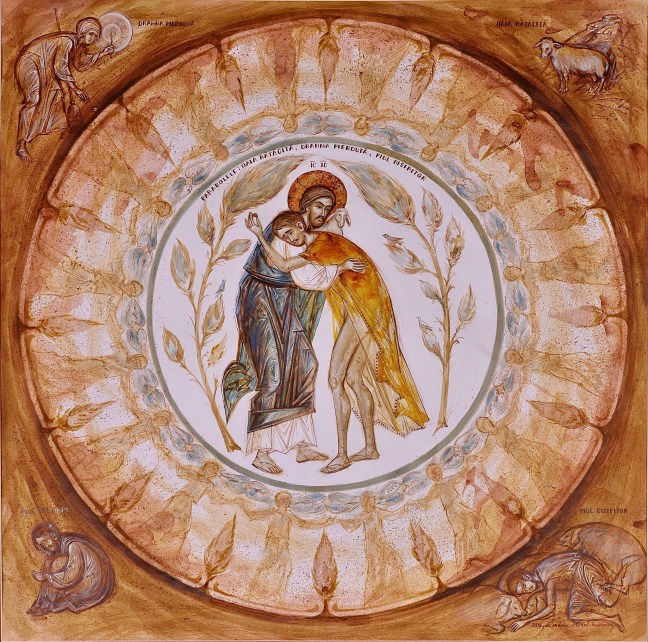
‘The return of the prodigal son’ – by Elena Murariu, 2018 – Wikimedia

How ironic this life is, isn’t it? How incongruous to have imagined that this is the real deal: being a person locked in and bound to the limits of a body. How astonishing to have this certainty to be a self that feels separate and needs to be fulfilled. To think we have to fight our way through the world, and suffer with such consistency. To have been persuaded that seeking is our way of life, without which we are doomed to poverty and stagnation. Yet the illusion of our being in a world is so convincing that we had to buy its many effects and constraints, and be subjected to its perils. So we have gone far away, thinking that we could live remote from our true home and identity, that we could roam the world on our own, and snob our essence. So we have landed into what we are not. We have lived the adventures of a person, gone through challenges and despair, carried ourself through time and space, and lived attached to worries and hopes, to the aches of regrets and loneliness, and the brief consolation contained in the occasional relief from our wrestling with the physicality of the world. So we have paid the price of such a lonesome, faraway trip. As Augustine of Hippo once said: “Distant country signifies forgetfulness of God“. We have left our father behind, despised his presence, judged his love as unworthy. Unhappiness is intrinsic in having mistaken an illusion for the reality, just as it is natural to be in the shadow when we hide from the sun. But maybe there is a return from our erroneous view. Maybe the time has come to stop being tied to a false idea, and to return from our adventures into deceitfulness.

Now see that this faraway trip is but the following of a belief. It is our being led into an illusion, a fantasy — shared by all — that the life in and as this body-mind is all the reality there is, and that the way we live and believe is our truthful condition, to which we have to submit ourself. We have swallowed that suffering is the condition of life, and the way to alleviate it resides in either circumstances, good luck, or smart choices. But in fact, suffering is but the consequence of our departure from our true, forgotten nature. It is the natural outcome of our prodigality, of our obsessive desire to possess and be more than what we already are, of our seeking happiness inside the development of our adventures into ego-land. But as far as we may have erred into agony and chance, there is chiselled in our very nature, a return into the open arms of our simple, inescapable being. This quiet resting as our innermost being is the home from which we should never depart, no matter how enticing is the call for an adventure in the distant land of separation. There is a father or mother here, a being eternal, always waiting for the return of their prodigal son or daughter. And it is in the nature of this return to be a welcoming one, for the simple reason that you are yourself the embrace contained in being only being. So your return to the father was never a return from any kind of reality, but the noticing that we had in fact never left its loving embrace, and that all that was needed is our letting go, our bowing to the grace contained in simply being.

.

~~~

Text by Alain Joly

Painting by Elena Murariu (born 1963)

~~~

.

Website:
Elena Murariu (Your Portal to the Art of Icon)

Suggestion:
– Other ‘Reveries’ from the blog…

.

A Treasure of Understanding

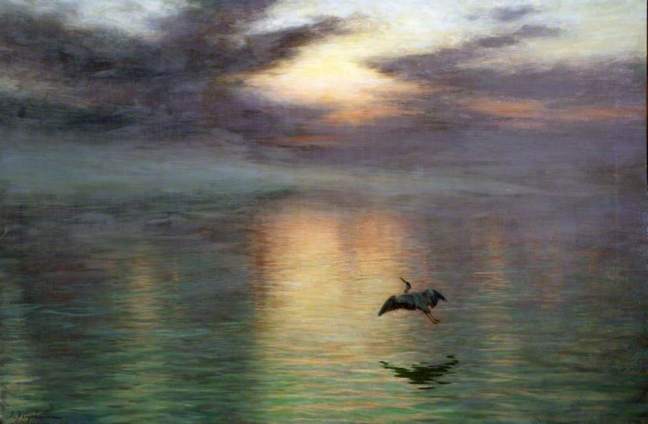
‘Dawn’ – Joseph Farquharson, 1903 – WikiArt

There is no such a thing as conceptual understanding in matters of spirituality. As soon as we form an idea, a concept, an image, a projection about ourself, we are still where we have always been: in our mind, in the known, in grounds we have already trodden a thousand times. These grounds are the grounds of our misunderstanding, where beliefs have already shaped and conditioned the idea we have about ourself. An idea that we rehearse and consolidate with every thought or act springing out of the field of our conceptual world. No understanding can ever come from this barren field. For one good, essential reason, which is that our understanding comes from only being. Being is the field of our understanding. Being is understanding itself. And the mind — with the ego which it gives rise to — is the only thing that is hindering our coming in contact with being in its purest form. That’s why concepts and ideas can never be understanding itself. They hide our clarity. In fact, they trample it.

So, should you ever want to come in contact with the pristine vibe contained in understanding, then a little digging is a necessary prerequisite. Don’t stay in your mind, take a new breath, be an explorer. You may use the tool of mind as you use a spear to dig a treasure. But please don’t take the spear for the treasure. This treasure is the treasure of being that stands unseen below the surface of your wrestling with concepts and ideas. Don’t let being be undermined by the description or explanation of the method. A beautiful image of truth will never be truth itself. It won’t hold the true taste of it. You won’t get its exquisite perfume, unless you see what stands under your mind and your ego. Understand your being by being only being. Throw the spear out. Finish the digging with your bare hands if required. Be yourself your treasure.

You come to an understanding when you stand under everything that is appearing or forming in your experience. Being is what stands under. It is the one thing that doesn’t change, that can never die or dis-appear, and out of which everything objective or knowable come into existence, and is under the scrutiny of your senses. But objective experience can never lead you to any understanding. Not out of its own will. You have to coerce yourself, make your own acquired, conceptual idea of reality recede and reveal its illusory, invented nature. You have to make what was, what will be, what should be, and what seems to be, into what is. That’s where understanding lives, in what is, in the here and now of your essential being. Understanding is implicit to being, and being explicit in understanding. Feel your being in its purest form, and see that you are yourself the understanding that you have craved to achieve through your mind.

So being stands under your apparent self which, in its light, is discovered to be non-existent, or rather only existent as being. That being is your true support, deserving all your praises. Actually, it is the support of everything, the great pervader — that’s why some have called it the creator. Not that it creates while being outside of its creation, but rather it is the substantial essence of everything — what makes a world possible and viable. So to understand yourself is to touch this essence through your being it, and to praise that part of yourself which you can never not be with, and which comes with a special flavour of well-being. That’s how you feel your true nature, through that subtle yet indestructible joy of simply being, which your never satisfied body-mind-self could never give you other than fleetingly. Understanding as being comprehends everything. It holds and embraces all life in the fullness of its presence. So to understand is to rest in your natural being, which requires no commenting or even understanding. You are, and this is that.

.

~~~

Text by Alain Joly

Painting by Joseph Farquharson (1846-1935)

~~~

.

Website:
Joseph Farquharson (Wikipedia)

Suggestion:
– Other ‘Reveries’ from the blog…

.

The Reluctant Messiah

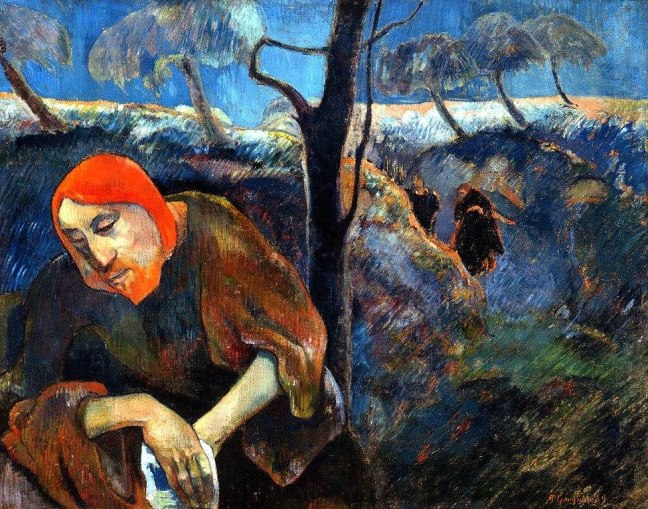
‘Christ on the Mount of Olives’ – Paul Gauguin, 1889 – Wikimedia

.

Father, if thou be willing, remove this cup from me:
nevertheless not my will, but thine, be done.”
~ Luke, 22:42

.

Maybe it is more serious than you think. Maybe the line has been crossed without your noticing. Maybe there is no return to being what you imagined to be: A self, a person, self-contained in a body, armed with all the thoughts needed to represent you. Maybe there is no memory left of this old belief, and that you have to let it all go, all the kaleidoscope of separation, all the daunting suffering, all the interplay and thrill contained in being just one piece in the puzzle of life. Now all pieces have been joined to fade into one single presence with no pieces in it, a presence that you have espoused, that you have recognised to be your home — inherited and inhabited since before the dawn of time. Now you may have to move in with fear and reverence, for living in that new identity has consequences. It might transform you beyond your recognising, and in more drastic ways than you had expected.

It might shatter your dearest hopes and expectations, that were here in your heart, entertained to the point of cultivation. It might give you what you have sought all along, and stop dead every single desire for an ‘other’ to satisfy and fulfil you. It might demolish a dream, and disintegrate the map of yourself, that described who you were in such lively, never-ending details. It might silence you, when you so much enjoyed the delightful babbling of your anxious mind. And I won’t mention all your intimately held treasures of belief, all your ideas and opinions, that have put together that carefully built image of yourself: how they might be dampened, damaged, discarded for being found redundant.

[…]

Read more about how our resistance can be made into surrender… (READ MORE…)

.

God Unveiled

‘Illustrated Depiction of God with Holy Bettmann’ – Tintoretto, 16th AD – WikiArt

.
For many of us, god is nothing more
than the idea or belief we have inherited of such a being, an idea that is conditioned by religion as the lazy representation of an omniscient, omnipotent entity that is both our creator and protector — in the popular Christian imagery an old bearded figure who lives far and away from us, in a lofty, elevated place for a good view on its creation and creatures. The existence of such a god is almost only a matter of belief or faith, and the relationship we have with it one of reward and punishment, devotion, fear, prayer, praise, but rarely of understanding and exactitude. It seems that we better have god in a hazy place, feel more at ease with not knowing too much about the wisdom that may hide behind that term. So our ignorance is a calculated one, a refusal to rock the boat, and a patting of our carefully assembled opinions from which we derive our sacrosanct identity and security. But let’s tackle god here. Let’s undress the myth and have a thorough eye-contact with the divine. Let’s dare some experiential understanding. Let’s have god out of its hiding place.

Maybe god was never defined because it is the one thing in life that is indefinable. Everything objective that we can know, see, hear, touch, smell, taste — qualities and all — can be described with words and given a name. We have our life surrounded by objects. The objective has filled our experience to the brim, and we are being choked in it — with no breathing possible, and no space allotted to the unknown. God is one such unknown. But how could we describe something that we cannot know as an object? So to god we can only give a generic, provisional name. Because god cannot be pointed at and recognised as an object or entity. God is not an easy catch. The divine defies our understanding, and this defiance is at the core of our misinterpretation of god. So if you want to know god, you have to look for it in your life, and turn every stone and pebble that crowd your experience. So start by removing everything in existence that you can know, see, hear, touch, smell, taste — qualities and all — that have an objective quality and can be given a proper name. You know: everything that you can show to another fellow, and that he too can see, hear, know, understand, and comprehend, just like you. Take it all away, and then see what remains behind.

[…]

An explanation of the nature and reality of God’s being… (READ MORE…)

.

The Adventure of Thought

‘Head with Flowers’ (part) – Odilon Redon, 1907 – WikiArt

Thoughts are a strange thing. For they seem to be both indelibly ours and strangers passing in our sky. We have an ambivalent relationship to them. Sometimes they are part of us like a lover can be, so intricately woven to our being that they seem to have been sculpted out of our very essence. On other occasions, we see them from afar, unwanted, a despicable thing that we judge unworthy — thieves that have come to set us on a wrong course, rendering us unrecognisable to ourself. We have a love-hate relationship to our thoughts. We love the ones we judge to be good and worship them, befriend them, glorify them, and hate the ones that come to upset us, the bad ones that we refuse to endorse, or have a responsibility for. The ones that we leave scared and alone, ready to multiply and threaten our very being. They are like the obeying soldiers of our wounded self, the dark agents of our fears and of our rancour.

Thoughts end up being prey to our likes and dislikes, treated like objects are, judged as being often disloyal, incompetent, insufficient. We seem to be separated from them, to have little to do with them. But thoughts have been supremely important to us. In a way, they have created us, through our identifying with them. They have formed the limits of our self as a separate entity. In fact, thoughts are thinking us. We are the prey to their conditioned making, and are at the mercy of their limited expression. So we are most of the time reduced to being ourself a thought, a thought thinking itself out, and believing that it is representing nothing less but what we are at the core. Yet we are truly far from the mark. Thoughts have deluded us, have drifted from their being a simple tool to stealing our very identity by faking the appearance of a self separated from its thoughts, when that self is in fact just a magnified, engrossed, elaborated thought that bears no resemblance to what we truly are. Thoughts thrive on confusion, they flourish and fatten on the prosperous soil of ignorance.

But try to go beyond thoughts, to pass them by, to ignore them as being unimportant and move on, deeper, towards the very centre of your self. Notice the sense of being that is here before them, and that hosts them in last analysis. Touch the silence behind thought. Embrace who you are before you associate with things. Go to the place where no identification is possible, where you are free from conceptualisation, where thoughts have become unrelated to yourself, lost entities that have no relationship whatsoever to your truest being. You will begin to disconnect thoughts from yourself, to render them innocuous, and stop looking to them for your security or identity. You will discover a way of living where thoughts are scarce and rarify. You will have no room for thoughts. You will have disencumbered yourself, and will stop being blind to what is. For you will notice that your being extends to all possible things, and all times and places. It is a presence so unified that thoughts are being gradually expelled from your deepest being by losing their unifying justification. They become redundant to your self. They become what they should never have ceased being: a wonderful tool at the service of unity, a practical thing that is but the expression of the one. You will have stripped them of their being an impostor. That’s how you stop being a thought. Because you don’t need one to be yourself.

.

~~~

Text by Alain Joly

Painting by Odilon Redon (1840-1916)

~~~

.

Website:
Odilon Redon (Wikipedia)

Suggestion:
– Other ‘Reveries’ from the blog…

.

The Greatest Trick

In fact, the understanding of our true nature is the simplest thing on earth. We have to, repeatedly, not be doing anything. The problem is: we cannot help but doing something, hoping something, trying something, anything, to get us where we think we should be. Where we are is never enough; never somewhere we should go to. What we are is not satisfying; we have to attain something that is better, no matter what. Even being, we think that we have to be being it — as if we were not already being. In all analysis, there is in fact such a thing as ‘nothing to do’ in spirituality, but only at the point when we are already not doing anything. If we are doing something, well, then we are doing something. This doing is an expression of our belief in not being ‘there’ yet, in our incompleteness, in our striving to get somewhere, to be someone. Then we have de facto missed all possibility of realisation: for we are already established in doing, in efforting. At this point, it is too late to not be doing anything. We need to revise our judgement.

We have been overtrained in doing. Maybe this doing is in fact what we have become — the essence of our self as a seemingly separate entity. We are born the moment we have the impulse of doing something, of being a doer, a knower. This is our original mistake, what we should never have been doing. We think we have to be somebody; to be nobody is a curse, a shame, an emptiness that we have to fill at all cost, even at the cost of losing ourself. So there is comfort in being a self, a somebody, in achieving something, in doing anything at all. The fact that we should be suffering for it, and be limited by it, well that’s the nature of existence, are we told. We are willing to pay that price for doing something, for being somebody. So let me do. Let me be. That’s how to feel ‘I am’ for now. That’s the story which was handed down to us. That’s how we have been regimented by society. And we have by now rehearsed it long enough, to perfection. We think that we’re not doing it when the doing has already been achieved. We are in fact implementing doing all the time while believing we are not doing it. This is the greatest trick that was ever performed on us.

[…]

A playful reflection into the question of the doer… (READ MORE…)

.