The Fantasy of a Self

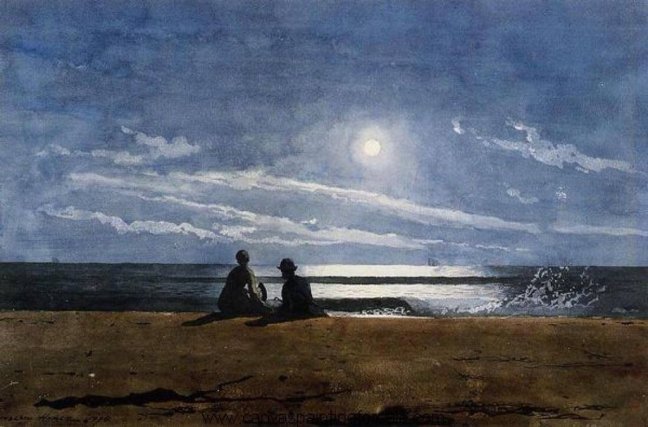
‘Moonlight’ – Winslow Homer, 1874 – WikiArt

We only ever land where we are. There is no escape from where we are. Where we are, is all there is. I mean this deepest place of ourself, from which we have never been separated, is the very thing which we have been looking for in a thousand distant places, in endless situations, in hopes and expectations, in projections, attachments, identifications. Our mind has been thirsting for this place of peace for as long as we can remember, and it has been escaping us with perfect consistency. For there is a rule attached to this place: we can’t find it outside of ourself. And the reason is: there is no place outside of ourself. Ourself — what we are here and now — contains all that we could long for. It is the home which we have left through our contant looking for it in the wrong direction. Our seeking is way too aggressive for its tender being. Our peaceful home lies in the nest that our being is, and this nest of being is where all existence finds its birth and takes its journey.

The problem with accessing our being — our peaceful home — is that we have introduced a self. We have posited a self that is separate from the peace it is looking for. And if peace is situated at a distance from ourself, therefore where we are is the place where peace is not. We have superimposed a self on our peaceful being, and in doing so have invited suffering, which is but the seeking for our lost peace or happiness. It all comes from the connivance of a few thoughts, feelings and sensations, which have set themselves up as a self. It is all part of a scheme on their part, and a gross one if you ask me. For how could something that is coming and going have a self? Something as flittering as a thought, or a sensation, could never produce a self. The self that we think we are, and that we feel is at a distance from experience, is fabricated. It is a product that we have elaborated to feel secure. But we cannot find security in a self. Security is rather the absence of a self, and the merging of ourself with experience, which is felt as oneness.

This self, without our noticing, has created untold damages, it has made life into a havoc. It has invented a within and a without, a here and there, a now and then, when there is in fact only a seamless experience. All these distinctions are of course necessary for our functioning in a world, but they are not the reality. And to ignore their reality is to transform them from a few peaceful, useful devices into brigands that have made experience either something to be feared and avoided, or desired and pursued. In other words, being a self has made experience into a dependence, a battlefield for our own imaginary benefit. But in fact, there is in reality only a now that is ever present and eternal, and a here that has no boundary, no limit, and is infinite. And there is a within that we will cease seing within, for after all thoughts and images are filtering experience to the point of making it their own creation. Thoughts are not just within. They are scattered all over the field of experience, colouring everything we see or hear. And the without will cease being without. For where could without be if not in our intimate experience. So the trees, the houses, and the dog we meet in the street are part of our very own being, for there is only one being out of which they could make an appearance. Where would another being than our being be? To posit another being than our being, or a without without, or a within within, or a there, or a then, is to be absent to our true being or nature, and to live in a world scattered about and fragmented, where reigns every bit of suffering and conflict. But to live as the One renders without within, within without, there here, then now, and our being just only one being. The rest is but a fantasy which we can either buy and suffer from, or borrow and play with.

.

~~~

Text by Alain Joly

Painting by Winslow Homer (1836-1910)

~~~

.

Website:
Winslow Homer (Wikipedia)

Suggestion:
Other ‘Ways of Being’ from the blog…

.
The Intimacy of Experience

‘First Leaves, near Nantes’ – Camille Corot, 1855 – WikiArt

.
I will tell you where to be
. Be where every experience feels an equally good experience. Don’t be attached to judgment and comparison. These are the mind’s favorite tools and activities. The mind tricks you to believe that experience is an uneven ground. That according to the content of your experience, you will be gifted with either happiness or suffering, peace or conflict, harmony or disorder. So the experience you are having becomes extraordinarily important. We become dependent on what happens to us, and come to dread it. So we retire into the secure place of our habitual self, with its cortège of worry, control, expectation, and manipulation.

There is a place in us where you don’t find experience to be such a determining factor. Where you will not let experience determine you, fix you, limit you. You won’t be shaped by its content. You won’t be made into something, someone, with qualities and flaws, to be judged, evaluated, compared with — the likeness of experience — in fact, just another object. The mind is a manufacturer of objects, entities, persons, fixing the insubstantial nature of your being into a self to be moulded and made either happy or miserable. To be made happy by an experience is to be cheated on by it: we are being manipulated, and made to believe an illusion. To let experience make us miserable is sheer deceitfulness, it is us being easily dazzled by the treachery and artifice of objects.

[…]

Continue this exploration of the nature of experience… (READ MORE…)

.

’katholikos’

‘The Life of St. Ignatius Loyola. Plate 4.‘ – Carlos Saenz de Tejada – WikiArt

You’ve got to respect the whole. That’s how you live the good life, in having reverence for the totality of your experience. Not just for the superfluous, all that is being the foam of life, that exists and appears, that you can see, hear, touch. You will never make a totality from the world of objects, from thoughts and perceptions. These are but occasional appearances, superficies. They are above you as it were, dancing upon you, at the periphery of who you are, but are not the reality covering your experience — its most profound constituent. You’ve got to go beyond the mundane and the obvious. For we keep leaving something out of experience. We don’t take the whole thing. We are choosy, only care for objects, don’t integrate our ‘within’ — where the reality of our being is. Notice that there is a world here, that is encompassing our world — a presence pervading our reality, taking everything in.

Actually, this is what the word ‘catholic’ is about. In Greek, ‘katholikos’ means: ‘pertaining to the whole’. We have to pay due respect to the whole, to the totality. We must look back at what we truly are, and find there the expression of the whole. I am not sure that Ignatius of Antioch had this in mind, when he first coined the term ‘catholic’ in the early 2nd century AD. He probably meant that the new belief, the new credence, was to be the universal truth, meant for everyone, adopted by all. But there was no need for adoption — the baby was already in the womb. There were no beliefs to be had, no hopes to project and entertain, no happiness to seek outside of our common day experience as being. He didn’t see that in this very word was the answer to all religions, to every quest for the divine peace; that what we were looking for was already here, close, so close to our very experience; and that there was no need to form a belief about it, or a new credence.

To accord with the whole is to be reconciled with our true nature — the reality of our being. It is to be ‘of one mind’, which is what reconciliation means, and to be brought together under the vault of one reality. This is achieved by turning towards the One, which is our true and only constituent. Universality wasn’t meant to be achieved in multiplicity. Universality is the quality of oneness noticed. The totality is in every place you happen to be. There is no totality of which you wouldn’t be the vessel. For the whole is not a geography, not a place to be in. It is the embrace of being. There is a totality in and as the being which you are now, here. You are not inside a totality. The totality is inside you. But mind you, this most venerated Christian Patriarch Ignatius of Antioch did say something of the highest order, when he brought up the word. He said that “wherever Jesus Christ is, there is the Catholic Church.” Yes. Yes indeed. Wherever we as our deepest being are, whenever we as our most profound nature-consciousness are, there is the expression of the whole, of oneness — the totality which is the very nature of the Lord’s House, and which is our nature and our house too.

.

~~~

Text by Alain Joly

Quote by Ignatius of Antioch (died c. 108/140)

Painting by Carlos Saenz de Tejada (1897-1958)

~~~

.

Websites:
Ignatius of Antioch (Wikipedia)
Carlos Saenz de Tejada (Wikipedia)

Suggestion:
Other ‘Ways of Being’ from the blog…

.

The Impossible Deed

‘Pond in the wood’ – Albrecht Durer, 1496 – WikiArt


We are used to knowing
. We have been trained in it, brainwashed with it, and drained by it. Knowing has been privileged at the expense of being. So we have become expert knowers, professional doers, but at being, we are infants, clumsy, penniless. We are without a self worth the name. We are homeless without knowing it. We are without a solid ground — a trembling, uncertain little thing living in the wilderness of objects, battling in the haziness of beliefs, having no place to truly be, to truly rest. We are a wanderer of ignorance, a nescient soul lacking the elementary knowledge of its own being.

But OK, I will give us that. I understand this urge to know. Knowing gives us a bright, shiny sense of self. A fantastic ego. It is rewarding. Being gives nothing, is completely unproductive. At least, so we think. But this knowing of our being is not any kind of knowledge. The will to know the ‘I’ is a sacred will, a holy endeavour. If we want to know ourself, we will come to know it. This is a desire that cannot be left unfulfilled. This knowledge cannot resist any serious enquiry. It will give in sooner than we think. But it is a hard one to desire. The difficulty resides in wanting to know. We shy away from that desire. There is something there we’d rather stay away from. We would rather know beforehand what we have to know, and remain on shallow land. We don’t want to rock the boat of our being. After all, this is where we stand. We don’t want to be swept away from our cherished ideas and beliefs, and be deprived of the security we have so dearly earned. We would rather stay a seeker of the known.

But try it now — to know yourself. And do it with your mind, with your usual knowing faculty. Go there, at the heart of your self. Decide it. Make it your goal: to know who or what you are. It doesn’t matter where you begin. But go not to the periphery, to that which you can know as an object. Go to the heart of your self, to that thing which you have called ‘I’ all your life. What is this ‘I’ that you are being all the time? This ‘I’ is never visited. But now is the day. Go there. Find out what it is. See that you will meet there like an impassable, impenetrable wall. You will find closed doors. All your knowing, your ego, your accumulations: this has made a blocking stone. This has barred the entry, has prevented all true seeing, all knowing worthy of the name. Feel that you cannot go there with your mind. But this impossibility is gold. So keep at it. Keep pushing. Don’t be shy. Use both shoulders if needed. Give it all the strength you have. It will recede. I promise you. Everything can be known. This is no exception.

Notice that what you come against is yourself. This impossibility of knowing the ‘I’ lies in your belief in being an entity. The knower is the obstacle, the impassable wall that bars the way. To know yourself is an impossible deed. You can never know who you are, because who you are is only contained in ‘you are’ — in the feeling of ‘I am’, of being. We are so unaware of our being. Being has been forgotten, relegated in the background, replaced by a knower, a doer, a busy self that insists on knowing who he or she is. But to know ourself, the knower has to first realise itself as being. To know is to be, and to be knowingly. This knowledge dips its reality in being. There is no knowing ourself without being first. Knowing here is only achieved through being, which is the knowing of ‘I’ without a knower. The will to know dissolves into being, which is the only knower there is and will ever be.

This knowledge is found in and as the being of the one who wants to know. You can only know who you are by being it, or rather by simply and only being. In that field of self-knowledge, being is knowing. Being is the knowing done without a knower, and therefore without an object known. It is a pure, unalloyed knowing. Everything you ever wanted to know, to be, attain, achieve, all the content of every sacred book, all happiness, all longings, is found in being, in that which you already are. Your amness is the gate code cracked. You will find who you are on the other side of knowing, which is being. And it is delivered with peace, which is the nature of being. This knowledge is the only knowledge that doesn’t take place in duality. It is achieved in the oneness implied in plainly being. So this impossible deed has now been transformed as the infinite being that we were all along, but had veiled through our insistence in being a knower of the known. We don’t know who we are with our knowing faculty. Ourself is the only thing we cannot know as an object. We know our identity through the fact of simply being. There is no other knowing than being. Being is what we are, without a single ripple of a knower knowing. Know that and you will be reborn as the unborn.

.

~~~

Text by Alain Joly

Painting by Albrecht Dürer (1471-1528)

~~~

.

Website:
Albrecht Dürer (Wikipedia)

Suggestion:
– Other ‘Reveries’ from the blog…

.

Creep

‘Radiohead @ TD Garden (Boston, MA)’ – by Kenny Sun – Wikimedia

I wonder if you have ever seen the face of love, what loving indifference is? I have some days ago, while watching a concert by Radiohead on the internet. It was during the band’s most celebrated hit, called ‘Creep’. This song is the stage of an unrequited love. But I suggest it goes further than that. It is the story of a rage, of not being enough. We all have lived through expectations that were turned down. We all have made efforts that didn’t pay off. We all want to feel special, to belong, to be at peace. We abhor being behind ourself, faking our contentment and control. So we all have known this feeling of being a ‘creep’, or at least of not being good enough. That’s why we live so hectically, constantly looking for better and more, wanting to feel complete, enough at last. Maybe that’s why the song happened to be such a hit, beyond its obvious musical qualities: it is like an echo of the secret battle we are engaged in, of our quiet desperation, and of our repeated attempt to put an end to our suffering.

I was watching the song being played, the singer yelling its rage amongst the gnashing saturated blasts coming from Jonny Greenwood’s guitar, lights illuminating the stage like a flash of lightning would. Then it surprised me. For just a few seconds, the camera caught in the public a young woman whose attitude was quiet, mildly concerned, but deeply tuned to herself. Everybody around her was involved, shouting, dancing, taking their share, drawing their identity and happiness from the vibes of the music. But she was not. Didn’t need to. Her need was to be quiet. Peace was her home. Beauty was where she was, and where she had landed on. She was tasting her being. She was taking it all in, but with a peaceful, loving indifference. For her, separation had been slain, and she had become a silent watcher, a taster of being, a madonna.

There was no need for her to dance and shout the lyrics of her favourite Radiohead song, for she dwelled in silence. It was all taking place somewhere else, in a placeless place where time was nowhere to been seen or experienced. All our objects of adoration are never the point, are never the goal. They are the means to feel and taste in ourself this most profound sense of peaceful being that is always here, always now with us, and that we miss in reason of our obsessive attachment to objects, with their derived outcomes and rewards. When the love or enthusiasm for an object — a song, a piece of art, a football match — is brought to its paroxysm, we merge with it, and in this merging forget our own person. This forgetting is the stage set for a meeting with ourself, for an encounter with our own silent being. We feel what we could call, a paradoxical serenity. So the pleasure of the senses is never the object of our desire, and never what our seeking is about. We are after something more elusive, the harder catch that is our own being. We long for this profound sense of peace and security that lives there as our identity. This serenity is not dependent on circumstances, but lies naturally in and as our most intimate being. This pure being is our true identity, and is in fact what we are really seeking behind all our pleasure oriented pursuits. Pleasure can never be a match to being. Pleasure is but the child of separation, while being is the realisation of our deepest identity as love, and its expression as oneness.

Love takes over experience. Love dominates experience, it brings it down to its knees, reveals what it is made of. Experience appears to be of secondary importance, not because it is not important, but because its importance lies in the light that shines on it and gives it its reality and meaning. We cease to be personally involved. We are just present, and this presence is our most precious and efficient involvement. We are indifferent not because we do not care, but in reason of the preeminence of love in our heart, with its acute, unfocused awareness. Love responds to the whole. There is no personal self present, that feels separate and insecure, fearing and seeking. That one is absent, leaving all the place to the quality of simply being, with no preferences in it, but with a total, impersonal, peaceful engagement. This peace is the most profound signature or identity contained in every experience that we go through. To recognise the nature of ourself as peaceful being, is to recognise the nature of experience as that one same peaceful being. We will never have to complain: ‘I wish I was special’. Never have to say: ‘I don’t belong here’. In love, there is no being a creep.

.

~~~

Text by Alain Joly

Photo by Kenny Sun (Wikimedia)

~~~

.

Website:
Creep (Radiohead Song) (Wikipedia)

Suggestion:
Other ‘Ways of Being’ from the blog…

.

The Face of the Infinite

For many things in life, we are exigent, demanding. We won’t let things be as they are. We are picky — we want more and better. We expect, hope, resist, desire, and are rarely satisfied. We are seekers of advantageous situations, and have a good idea of what they can be. Yet when it comes to ourself, to knowing who or what we are, we lose all inquisitiveness. We take ourself for granted. We may want to be more loving, less violent, have more of the good qualities, and less of the bad ones, but who is the ‘I’ that desires these things, we don’t want to know. Maybe we have an intuition that there is great danger in uncovering our true identity. After all, it was never talked about, a sort of family secret that society doesn’t want you to interfere with. Even religion is not clear about it, that encourages you to rather follow, pray, and submit yourself to God, but not to know who you are. At least not in a clearly stated way. You may know about anything you want, but please keep yourself out of it. In fact, ‘Know Thyself’ is the least encouraged commandment in this world of ours, and that alone should be enough to fuel our curiosity.

So who am I? What is my identity? What is this last part of my experience that is yet to pioneer and fully settle in? Which has remained untouched, virgin of our constant and fanatic rummaging? Which hasn’t yet been recognised for the simple reason that it is not a place we can know, let alone go to? It is so ourself that it cannot be seen, felt, experienced as something objective, or as an entity. This land of ourself has slipped out of our attention. We are blind to our eternal home. We have left behind us, untackled, unidentified, in the darkness of our wilful mind, the vibrant sky of our being. So what is my true identity? What is this unchanging substance that is the formless form of my being? In other words, what am I identical with, or the same as? ‘Same’, in its most ancient etymology, has the meaning of ‘one’. So we can rule out all the separate, isolated objects that we project ourself to be — that includes our body and our mind, and the many thoughts we’re thinking. Our identity is not in something which we identify with, but in the expression of oneness — the one being that is by definition free from all identification. This identity with the One has been achieved from time immemorial. We don’t need to come back to it, to rehearse it, or affirm it. Our identity has dissolved into the One, which is identified with no other than itself.

Where does unity or oneness live in my experience? In what portion of my conscious being can I feel an absence of otherness? Where do I find in myself no distinction, variation, or divergence, not even a breach that would differentiate me from reality? Where am I wholly and only being? What is it that I truly am, with no intervention of a past or a future? Where is this within that is also without? What is this ‘I’ that I could never ever cease to be? Who am I when all objectivity and multiplicity have died down? Where do I find an absence of ‘me’ in myself? Or rather, where do I find a sense of ‘me’, in me, that is not already the ‘me’ of everything and everyone? Where am I when every remnant of a seeking mind has left? Where do I find an individuality that is not universality? Where could I not find God’s presence in my experience? Where is this ‘where’, where I can never say where, what, when, how, why to what I am? And lastly, where have now all my questions dissolved? Only settle for a living, silent answer. Any other verbal or conceptual answer at this point would ruin it all. It would be like slamming the door in the face of the infinite.

.

~~~

Text and photo by Alain Joly

~~~

.

Suggestion:
– Other ‘Reveries’ from the blog…

.

A False Impression

There is an impression that I am the one who knows, or is aware. But this is a false impression and an unfortunate one. In fact, we as a body-mind don’t know anything, for the good reason that there is no one here that is in charge of the knowing. We don’t have this ability. It is not for us to know anything. Knowing doesn’t belong to an individual, separate self. We owe our knowing to something that knows us first, and lends us that potential. That really gives a totally different perspective to our existence, and grants us a gorgeous humbleness: Knowing is without a knower. The knower is but a set of thoughts that we have superimposed on awareness. It is entirely made up. It is of our invention, to give us a wee importance — after all, we all want a little attention. Knowing is in the nature of being. And being is the nature of everything. Knowing is all there is. It is the light of our world, indissociable from our experience. We as selves are just shadows. Everything is dancing and taking place without our being in any way party to it. At best, we are just a colouring, a point of view, an avatar governed by some divine rules which we have perilously chosen to ignore. This is our feebleness: wanting to own and appropriate, being more than what we already are. But in doing so, we have in fact belittled ourself. We have made ourself separate from the life we live in. We have created a self where there is none. We have awakened the devil of suffering in us.

So leave the knowing in some more skilful hands. It will spare you a lot of trouble and misunderstanding. You won’t have to be a person — all the heaviness contained in it. You won’t have to be a self that knows, but knowing will appear to be your one and only self — the entirety of your being. This pure and sublime knowing will give a measure of beauty and happiness in your life. It will encompass everything. It will widen your perspective and make you profoundly secure. You will know your being with precision and clarity, and live both in remoteness and intimacy — remoteness for a serene view on your experience, and intimacy for the delight contained in oneness. And love will be your everyday companion, the deepest essence of your being. And you will be clothed in understanding, which you believed could be achieved through your being a knower. Not at all. Understanding comes when you cease being a self, a knower, when you let go of all identities and egoistic purposes. Then it comes: the understanding — the knowing that knowing is all there is, and that you don’t need to be any more than that. So learn to keep at bay all private, egoistic desires to be anything other than this impersonal, undivided presence of yourself, that has the capacity of being and knowing. You have no need to be a knower, or a doer of anything in your life. Let the show run by itself. Only give it your golden, loving indifference. That’s the most glorious thing you can do in this life. You will be showered by the benefits of it.

.

~~~

Text and photo by Alain Joly

~~~

.

Read this essay from the blog ‘The Impossibility of Knowing’…

Suggestion:
Other ‘Ways of Being’ from the blog…

.