Arise, O Krishna!

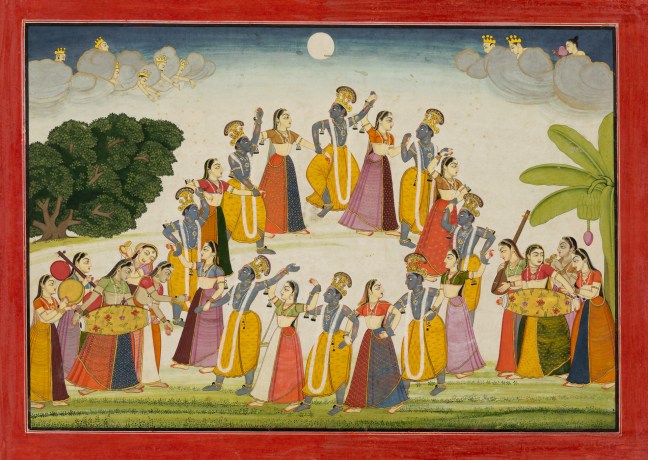
‘The Rasa Mandala Dance of Krishna and the Gopis’ – Anonymous, 1760 – Wikimedia

Arise, O Krishna! This is not a time for discretion. There is enchantment around the lake of experience. Ladies have come with fine clothes and jewellery to be adorned by you. You have to be their cup-bearer, the one presence giving to every forms of experience their gorgeous light. For what is a thought without the cup in which it grows, stands for a second, and disappears? Krishna, you alone are the meaning and beauty attached to every object that inhabit our daily living. So this is not a time to hide, but to reveal, to shed light, to glorify. The Gopis — the milkmaids of the Krishnaite folklore — have come to you in the effervescence of their longing. You are the reason for their looking so beautiful. They come to you to be revealed and embellished by your presence, by the one being that is their most precious jewel. So enter the round, O Krishna, and dance with every one of them.

Give to the thoughts that come and wander for a time in our minds their chamber of peace. Clothe them with clarity and intelligence. Appease the suffering of which they are the vehicle, and offer them the rest they deserve. Don’t let anyone unattended. Not a feeling should be left alone, frightened or sad, without benefiting from your warm embrace. No sensations should come along without your building for them a temple of awareness. Be the one present for all, infallible, unswerving. Should a Gopi be lost in the contemplation of nature, and you are here showering her vision with beauty. You are the noble harmony of every experience, and what confers to the dance of life the sweetest of melodies. And have you noticed, O Krishna, how your absence can throw a shadow of sorrow on every experience that passes unseen by you? And have you witnessed how acute is our longing for you, when you withdraw your loving gaze from the many happenings of our lives?

So now, with flowers in their hair, and boundlessness in their hearts, do the Gopis join in your endless round, O Krishna. You hold everyone, every experience, every object that stands lost and alone, in your loving arms. You create around them an armour of beauty, and clothe them in truth’s brightest apparel. That’s how we find the peace at the heart of experience: by marrying every appearance to the gentle presence that holds them. And that presence is ourself — who we are — now giving shape to every perception, every occurrence, sheltering them in the being that gives them protection and form. That’s how the Gopis are experienced as an emanation of Krishna, and how Krishna is seen to be their primordial cause. So now arise, O Krishna! Truly arise! We have come here in celebration of truth, to contemplate you and be contemplated by you. The set for the dance has been arranged. We have come to you enamoured as humble milkmaids, as the fervent Gopis of your heart.

.

~~~

Text by Alain Joly

Painting by Anonymous (1760-65)

~~~

.

Website:
Raslila (Wikipedia)

Suggestion:
Other ‘Ways of Being’ from the blog…

.
The Straight Story

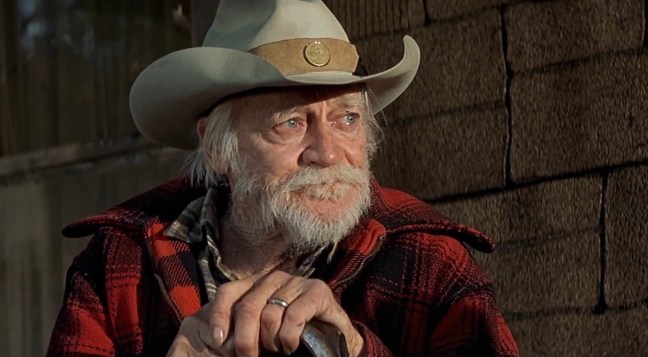
‘The Straight Story’ – by David Lynch (with Richard Farnsworth)

.

When I catch an idea for a film,
I fall in love with the way cinema can express it
.”
~ David Lynch

.

Have you ever seen a film made of love? Well, I have. And no further than this morning. A modest, not very well-known masterpiece by David Lynch, called ‘The Straight Story’. It is based on a true story: In 1994 in the United States, Alvin Straight — an old man — decides to pay a visit to his brother who has just suffered a stroke. They haven’t spoken for ages, out of an old rancour, so he wants to repair and reunite. With a clear mind, he embarks on a 390 kilometres journey from Laurens, Iowa, to Mount Zion in the Wisconsin, but he does it in his own inimitable way. On a riding lawn mower!… With bad hips and two sticks for help, and a refusal of doctors. With a maximum speed of about 8 kms per hour, and a trailer to pull. And with love as a luggage.

As often when it comes to starting a spiritual journey, it all begins with a fall and the subsequent realisation that something needs to be changed. And in order to make our quest a successful one, we have to make the journey just as important as the destination. And this is what Alvin does. His trip becomes an occasion for adventure. Everything he meets, he does with the eyes of wonder, and the now is the only time in which his travel takes place. Everything is important. Everything matters. The journey is not just a means to an end. We don’t reach infinity step by step anymore than we meet eternity in time. Every meeting with truth is made in truth’s home. And every encounter with our true nature is made within, in and as our innermost sense of being. No matter the extent of our understanding, in order to be, we have to be being. And Alvin, clearly, knows it all too well.

[…]

Some reflections on seeing this film by David Lynch… (READ MORE…)

.

Anything at All

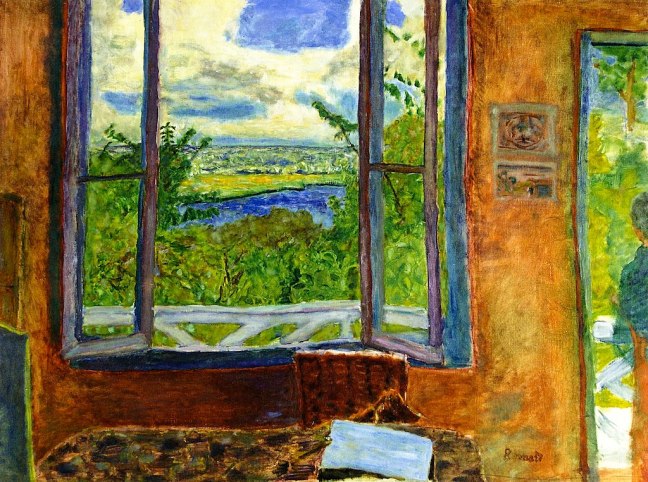
‘Fenêtre ouverte sur la Seine’ – Pierre Bonnard, 1911 – Wikipedia

Isn’t it humbling to realise that whatever experience you or anybody may have, whatever experience there is anywhere, anyhow, from any thing, at any time, in any dimension of life, will come down to being just this, this pure and impersonal sense of being that is the source and essence of all selves and things. You may live a child’s experience deep in the Amazon forest or a tree standing proudly in the Californian air. You may be a woman or a man in Paris, Kathmandu, or a lost, forgotten village in Greenland. You may live rich and imbued with yourself or excruciatingly poor, sleeping on a pavement somewhere, forgotten from all. You may be an ant living the life of an ant, in a scrumptious colony of fellow ants, or a dignified elephant leading the herd, the matriarch in her world. You may be an expression of utmost violence or anger, or lingering in total peace and appreciation of the world. Or an energetic horse running in the morning dew, or a distant owl hooting quietly before falling asleep. Or maybe a wave crashing in the ocean, or a whale flapping the water, or a little anchovy swimming in the big silver mass of its shoal. Or a soaring eagle, or any wild flower of any wild mountain meadow, or that heavy stone there, resting in a river bed. Or the lamp at your bedside. You may be anything that stands, sits, lies, flies, swims, exists, loves, suffers, ages or dies. You may be the majestic suns and planets of the universe dancing around, following their laws and trajectories. You may be god himself, or the goddess herself. The thousands and thousands expressions of devotion towards the divine, any human being lost in prayer. You may be just a thought. One word ushered at a lover’s ear. Or a gentle wind. Or a wonder. Or a tear. Or a sigh. Or nothing at all. A dream. Empty space. Anything. You may be anything at all. — And this is eternity. And the infinite is at your door. Here. Now. Love expressing itself. Being being ignited. Sameness. God’s presence felt.

.

~~~

Text by Alain Joly

Painting by Pierre Bonnard (1867-1947)

~~~

.

Website:
Pierre Bonnard (Wikipedia)

Suggestion:
Other ‘Ways of Being’ from the blog…

.
A Plea Answered

For those of us who complain that god never answers their plea, let me tell you something. God is more subtle than that. He never was an entity, with a voice that could speak. She never even was a kind of object, however subtle, that could soothe at the level you are expecting, through the granting of a favour, the offering of a reward. Neither could god curse you with punishment. He doesn’t take sides. She never takes umbrage. God grants only one thing: Its glorious, infinite, loving presence. The lack of answer, the absence of favour, the withdrawing of reward, the malediction of punishment… it’s all on your side. Because you have blinded yourself to its eternal smile at you. Because you have covered your ears lest you might hear its constant whisper at you. For you were too busy thinking, pleading, complaining, expecting, reaching for an outside object or presence, that could give you, forgive you. For you were too engrossed in overwhelming feelings, worries, disputes, about yourself and others, and had definite certitudes about so many things, and such endlessly running opinions and preferences. In other words, you have isolated yourself, separated yourself, crippled yourself, and as a result made god silent and powerless — an empty void where it isn’t.

But god is never silent, if you turn towards where it lives. Its subtle presence at the core of your being is speaking endlessly, calling you with all the patience required. And that presence is never powerless, for it holds you eternally in its sweet embrace, as you can notice if you look at your own being with the same passion. And please don’t forget that your suffering is god’s answer to you. It is her calling disguised, what you had expected all along, the present that you didn’t bother to wrap with golden ribbons. And god also made you a favour. He came to live right at the heart of your being, so that you could never be at a distance from him; so that you could feel him as your own, ever-present self. And by the way, god wasn’t holding back anything. She is generous, offering you the constant reward of peace and happiness. Only you have to feel it in your heart, and not rush out for an auspicious circumstance or a desired object. And if you have ever felt the pang of a curse, understand that this indeed was of your own making. For you have cut yourself from god’s divine hold, and in doing so have lessened the abundance of its bounties. You have made yourself a lone traveller. You have shut your heart from the fountain of love that is steadily flowing as your own, ever-present, precious being, which is god’s being too. God has no power to curse, but you sure have, until you get the courage to open yourself to the infinite presence that sits in and as your self. That simple feeling of being, that all powerful god eternally crowing your self, will block all possible entry for a curse, and keep you safe.

And now for one last, precious recommendation: To live with the presence of god in your heart not only will protect you from your own talent at cursing yourself, but will open wide the doors of perception for the flooding of beauty. It will make your life a torrent of peace. For god will shower on you gifts after gifts of its benevolent presence. And he will grant you all possible rewards, all answers, all favours, clearing your path towards the blessing of immortal life, of unconditional love and objectless happiness. God was never disingenuous. She never was the void or absence that you took her to be. He/she is a presence so full that you could be his or hers for life eternal. Some have called it the Kingdom of Heaven, some Nirvana. And what blessing and surprise it is to find it right here, right now, as your very own self, veiled only by the plea of not having it, of wanting it, hoping for it, looking for it. Remember: you are not a self in your own right. Your self is nothing but god’s presence espousing you. For you share the same being, as the being of everything and everyone. But I won’t say more. Now you have your answer.

.

~~~

Text and photo by Alain Joly

~~~

.

Other ‘Ways of Being’ from the blog…

.
The Burning Bush

‘The Icon of Theotokos the Unburnt Bush’ (detail) – 19th AD, Museum of Radomysl Castle, Ukraine – Wikimedia

Don’t be shy. Come out of the bush. That bush which is of your own making. The hazy bush of your thoughts, feelings, and the ten thousand things perceived. All that you have invented to keep your self going, to give it a form and a lustrous appearance. This is a bush of endless confusion and deceit. Don’t get entangled in its thorny maze, to be kept here safe but miserable. Don’t be lured into the bush of your apparent self, with its intricate problems, and its endless, unresolvable knots. Don’t make that bush your prison, be it a golden one. Don’t let it dictate your life, to forever seek in the world all that can soothe and heal for a time. And don’t expect that you will find in other similar bushes the remedy to your entanglement. You can gather as many bushes you like, they will never make a marriage worth of the name. Any other thought-induced bush will be revealed as being lost in the same, inherent, desperate obscurity which your self is lost in.

Don’t be deceived once more. Don’t be shy. Come out of the bush. Put it on fire. Burn it to the ground. You’d be surprised of what is left behind. How do you burn a bush? Expose it to the sun of your being. How do you expose the false, but by seeing the truth? How do you fight the fear of death, but by realising your immortality? How do you disengage yourself from your endless suffering, but by recognising your true nature as peace and happiness? You have a sun at hand that is more than happy to help you in that enterprise. Expose the mirror of your separation to that sun and its burning rays will strip this idea naked of any true reality. Show yourself. Come out of the bush. Let that pure being do its job on you. Let it burn that bush of yours down to its roots.

And don’t expect a desolate land after that. There will be no carpet of black, sullen, malodorous ashes. Be audacious, for you will only burn the false that is in you. All that doesn’t truly stand on its own. All that which is not. All that you have made up. These sure will go to never return. These are the unburnt bush of your apparent self. For how do you burn something that isn’t there? How do you extricate something that wasn’t truly entangled in the first place? How do you spot the unseen? How do you kill the invisible? As for the burnt ground, you will only meet what truly is. As for the desolation, you will only be welcomed with opulent love and beauty. As for the loss and suffering, you will only be exposed to the profound peace of your essential being. You will be blessed to notice a self that was here all along but that you had been made blind to. This is where this fire is not a fire of destruction but one of creation. This is where this fire is a never ending fire where no bush, no seeds of folly can ever thrive.

.

~~~

Text by Alain Joly

Painting by Museum of Ukrainian Home Icons

~~~

Websites:
Museum of Ukrainian Home Icons
Radomysl Castle (Wikipedia)

.

Other ‘Ways of Being’ from the blog…

.
The Mystical Doctor

‘View of Toledo’ – El Greco, 1596 (Metropolitan Museum of Art) – Wikimedia

.During the night of 2 December 1577, in the city of Toledo in central Spain, a priest was imprisoned by a group of Carmelites who were refusing Teresa of Ávila’s reformation projects for their Order. He was jailed for 9 months in a monastery under brutal conditions. He was publicly beaten at least weekly, confined in a cell of barely 10 by 6 feet, with only a little light passing through a hole during the day, with bread and scraps of salt fish for a meal, and no change of clothes. But his burning love of god, along with his unfailing devotion and clarity of mind, allowed the 35 years old friar to compose, along with other shorter poems, the greater part of a sumptuous poem — ‘The Spiritual Canticle’ — about a bride’s search for her beloved. The poem, symbolising the soul seeking union with god, and inspired by the ‘Songs of Songs’ of the Bible, starts with these eloquent lines:.

Where have You hidden Yourself,
And abandoned me in my groaning, O my Beloved?
You have fled like the hart,
Having wounded me.
I ran after You, crying; but You were gone
.”
~ ‘The Spiritual Canticle’

The name of this priest and poet was John of the Cross, a Spanish Catholic mystic born in 1542 near Ávila, to whom we owe some of the brightest exposition of truth in the Christian world. Thomas Merton, who held him in very high esteem, presented him as “one of the greatest as well as the safest mystical theologians God has given to His Church.” John of the Cross was born in a poor family of Jewish converts to Catholicism, and received a simple education. He entered the Carmelite Order, made his First Profession when 21, and met Teresa of Ávila a few years later, of whom he remained a faithful associate all his life. Although not a scholar, his studies in theology and philosophy allowed him to quote abundantly from the Bible, and be acquainted with the work of St. Thomas Aquinas.

Although I have chosen to quote here only from the poem ‘The Spiritual Canticle’, John of the Cross is the author of many other poems, among which the renowned ‘The Dark Night’ — better known as ‘The Dark Night of the Soul’ — and ‘The Ascent of Mount Carmel’. His poems have a rich and powerful imagery and are considered to be masterpieces of Spanish poetry. Although they transpire with beauty and meaning, they are not to be readily understood. This is why John of the Cross wrote precise and extensive commentaries on them, some soaring pieces of teaching whose beauty and profundity is sometimes breathtaking. The most exquisite poetry is here going hand in hand with both a great depth of understanding, and the sweetest accents of devotion. The commentaries were written in prose but are here occasionally presented in a free verse form when they lent themselves to it. I am sharing the 1909 translation made by David Lewis, with corrections by Benedict Zimmerman. Listen with what tender accents of poetry and longing the bride is here conversing with her bridegroom, and how a suffering soul who has tasted of the divine is longing for “the secret chamber of God”, which is nothing but the pure consciousness that is hiding in our innermost being:

.
O you soul, then, most beautiful of creatures,
who so long to know the place where your Beloved is,
that you may seek Him, and be united to Him,
you know now that you are yourself
that very tabernacle where He dwells,
the secret chamber of His retreat where He is hidden.
Rejoice, therefore, and exult, because all your good
and all your hope is so near you as to be within you;
or, to speak more accurately, that you can not be without it.”
~ ‘The Spiritual Canticle’, 1.8 (Commentaries)

[…]

Discover the rich poetry and commentaries of John of the Cross… (READ MORE…)

.

A Loss and a Gain

‘The Voyage of Life: Old Age’ – Thomas Cole, 1842 – WikiArt

Well, at some point in our lives, we may start to make a rapid calculation. It may dawn on us that if we had counted on this body and mind to represent us right through the end of life, well… let’s be blunt on this: that’s certainly not our best investment. Old age will make it clear that, after a certain time, if we wait long enough, everything begins to go wrong with our bodies — and so with our minds. We-our body are losing it. New pains arise. Strength diminishes. Memory capacity fades. And disease is lurking. There are threats accumulating, to say the least. We have to come to terms with this plain fact of existence: we will never go back to where we were. We cannot keep holding on to our body, continue having faith in it. This constant hoping for a better body, or a healthier mind, has to end, and this is now. In a way, it really is something to laugh about — a sort of cosmic joke. How could we have been so naïve? This simple and inescapable fact shows — if we needed that kind of confirmation — that this body and mind is not the place for a healthy sense of being. We need to find a way out of this faulty understanding.

We find health in our innermost being. That is the answer. And the body is not this being. It doesn’t represent it. It is not its temple. The body exists but it is not being. Only being has the right and capacity to be. The body is at best a distant vassal. A tool. It is not the home of our being, but rather, it finds its home in being. It rests there. It can borrow its qualities. It can make Being its beloved teacher, if it is wise and humble enough to espouse Being’s extraordinary traits. Then the body and its companion as mind might feel enlarged. They might find their true essence as infinity and eternity. They might acquire a soft and gentle making — less heaviness. And the body-mind will be lit with a strange transparency. It will slowly give up its hard matter-like making in favour of a more airy essence. It might surrender itself slowly while still being alive. Then the natural flaws of its ending will have very little meaning — not something to be afraid of. For its death has already been achieved in love — its true essence. Then its apparent shortcomings and loss will be found to be the supreme gain of life itself. We enter a new kingdom, where death can never be death. It is simply the extinction of everything that wasn’t truly ours in the first place. It is a gentle clarification, and the revelation of our essence. “You may die, my dear body, you may fail and disappear, with your companion-mind, but I will meet you on the burning ground and see you rise again as ‘I’”. This is the meaning of old age and death. This is the gift of our apparent failures. To be raised and revealed as essence. See… we won’t lose it.

.

~~~

Text by Alain Joly

Painting by Thomas Cole (1801-1848)

~~~

.

Website:
Thomas Cole (Wikipedia)

.

Other ‘Ways of Being’ from the blog…

.