The Odyssey

‘Odysseus questions the seer Tiresias’ – Alessandro Allori, 1580 – Wikimedia

No doubt that our life feels like an odyssey. It does for everybody. In the ancient, epic poem of Homer, the Odyssey is a journey home. It is with us too. But the fact that we are on a journey home is not always apparent. At least not to begin with. We’re too busy to see anything. We’re fighting demons. We’re full of desires, many of them, constantly assailing us. We think we’re going somewhere, without seeing very well where that is. We’re wrestling with the gods. We have many ideas, beliefs, hopes, sufferings. We feel we are a person in a world, who needs to reach a happy place that never comes. The reason is: home is within. The happy place is in ourself. It is not out there. It is in the ending of a belief, of a misunderstanding, of a bad judgement as to what we truly are. We are stuck in a place that doesn’t exist. We are stuck in a belief.

It eventually dawns on us that our happy place is where we are finally reunited with our inner peace. That’s the journey home: the journey within. But it takes a long and difficult travel of sufferings and errands to understand that there is no travelling back home outside ourself, in the diversity of the world. Home is within. Once we go within, the journey becomes shorter. The odyssey is in fact only the journey to the journey home. But to go back home implies that we were already there, and have left it at some point. So it appears that our going home, our odyssey, is an illusion of some kind. We are going in search of what we already have. We have gone on a war. For to seek what we already are is always a war. It always brings suffering, lack, and the such. It separates us from home. It multiplies monsters. That’s an easy thing to see. There is no need of a long odyssey.

We have the belief that reality is in appearances and forms, when it is in fact in the formless. We have the belief that our body-mind is our identity, when we are only contained in the infinite awareness of being. We have the belief that we need to adjust to a world that is separate from our own being, when we and the world are one being alone, perfectly adjusted to each other. We indulge in the comfort of our illusory view on existence, when this comfort is only the postponing of our journey home, and the fuelling for our own suffering. ‘There’ is our journey within — to go from an illusion to the reality hidden within the illusion. To go from what we are not to what our nature truly is — which really is only to go from what we are to what we are.

Now, if we’re struggling within, it means we are still without. We still see the within as the without. We still have monsters there, and a difficult trip to be engaged in. We’re still on an odyssey. We’re still intoxicated by the Lotus-eaters, who make us forget about our journey home. We’re still captured by the cyclops Polyphemus. Still fighting some giant cannibals; or wrestling with the goddess Circe, who turns us into what we are not. We’re still resisting the enticing song of the Sirens, who keeps us mortal beings. Still being held captive by the false promise of the nymph Kalypso who, by the way, is literally ‘she who conceals’. We’re not yet in a journey within — not yet in a journey home.

Once we have understood that our home is only within, in and as our innermost being, we must be there as a beggar. We never enter our own being, our happy place, as a king in its kingdom. We have to be a beggar, a nobody. That’s what Odysseus does when he reaches home: he comes as a beggar, unknown to all. That’s the way to be home. We leave being a person of any kind, of any rank. Then, the last fights with our few remaining demons is quickly done — not a big deal. It doesn’t take time or distance. Doesn’t take endless coming and going, reaching and leaving, being on the journey. Home is home. We cannot go where we are. Home is an easy place to be in. That’s where we have seemingly started, and find ourself naturally in.

In our own Odyssey, there is always a twist at the end. In fact, we realise that there was no danger or difficulty, no storms or monsters, no length of time, no far-off countries. We had been on a quiet, mirror-like mountain lake all along — just didn’t notice it. The whole story was invented. Beautiful, exciting, painful, maybe necessary, but invented.

.

~~~

Text by Alain Joly

Painting by Alessandro Allori (1535-1607)

~~~

.

Website:
– Alessandro Allori (Wikipedia)

Suggestion:
– Other ‘Reveries’ from the blog…

The Straight Story

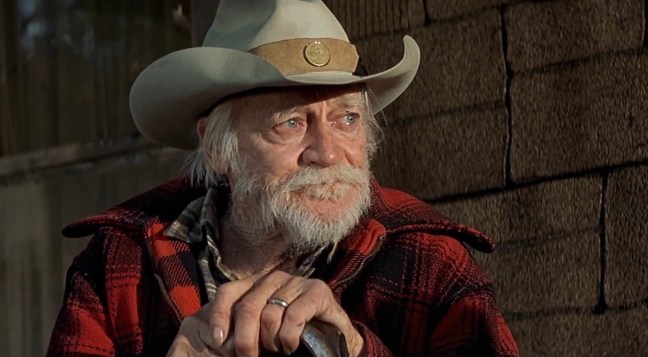
‘The Straight Story’ – by David Lynch (with Richard Farnsworth)

.

When I catch an idea for a film,
I fall in love with the way cinema can express it
.”
~ David Lynch

.

Have you ever seen a film made of love? Well, I have. And no further than this morning. A modest, not very well-known masterpiece by David Lynch, called ‘The Straight Story’. It is based on a true story: In 1994 in the United States, Alvin Straight — an old man — decides to pay a visit to his brother who has just suffered a stroke. They haven’t spoken for ages, out of an old rancour, so he wants to repair and reunite. With a clear mind, he embarks on a 390 kilometres journey from Laurens, Iowa, to Mount Zion in the Wisconsin, but he does it in his own inimitable way. On a riding lawn mower!… With bad hips and two sticks for help, and a refusal of doctors. With a maximum speed of about 8 kms per hour, and a trailer to pull. And with love as a luggage.

As often when it comes to starting a spiritual journey, it all begins with a fall and the subsequent realisation that something needs to be changed. And in order to make our quest a successful one, we have to make the journey just as important as the destination. And this is what Alvin does. His trip becomes an occasion for adventure. Everything he meets, he does with the eyes of wonder, and the now is the only time in which his travel takes place. Everything is important. Everything matters. The journey is not just a means to an end. We don’t reach infinity step by step anymore than we meet eternity in time. Every meeting with truth is made in truth’s home. And every encounter with our true nature is made within, in and as our innermost sense of being. No matter the extent of our understanding, in order to be, we have to be being. And Alvin, clearly, knows it all too well.

[…]

Some reflections on seeing this film by David Lynch… (READ MORE…)

.

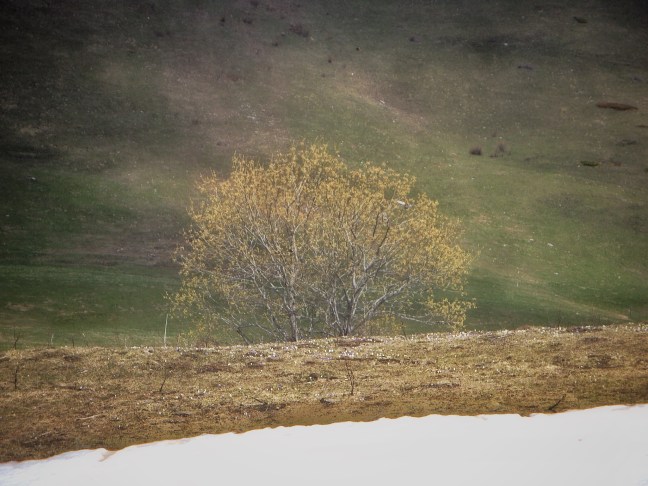
The Cradle

Nothing I’ve come to see brought me as far 
As I had thought it would — what silly thought!
For I’m forever here where I began,
Locked for eternity in this cradle —
That empty space of birth where I belong.

Never could I travel so long or wide,
As to find a new place away from me.
I live and get busy like in a dream,
But home is immobile — a dreamer’s mind
From where it is impossible to leave.

So this is my cherished destination,
To where I time and again longed to be. 
I thought I left a thousand times before
But had been still at home unknowingly,
Had reached my paradise before journey began.

So now I will not part again and roam
Amongst far lands and promises that fail.
I’ll be simply a humble home keeper,
With all my travels and activities
Kept here at bay and safe in that cradle.

And if I may be blessed with some delight,
I will not make it mine — what impudence!
The twitches I may own but not the peace;
For my home is too broad to be enclosed,
Laughter too wild for an identity.

.

~~~

Text and photo by Alain Joly

~~~

.

Suggestion:
Voices from Silence (other poems from the blog)

.

The Pilgrims

9CD0A5BF-E702-498F-A679-2D7294F2D385

“Man is indeed abroad to satisfy needs which are more to him than food and clothing. He is out to find himself. Man’s history is the history of his journey to the unknown in quest of the realisation of his immortal self – his soul. Through the rise and fall of empires; through the building up gigantic piles of wealth and the ruthless scattering of them upon the dust; through the creation of vast bodies of symbols that give shape to his dreams and aspirations, and the casting of them away like the playthings of an outworn infancy; through his forging of magic keys with which to unlock the mysteries of creation, and through his throwing away of this labour of ages to go back to his workshop and work up afresh some new form; yes, through it all man is marching from epoch to epoch towards the fullest realisation of his soul, – the soul which is greater than the things man accumulates, the deeds he accomplishes, the theories he builds; the soul whose onward course is never checked by death or dissolution.

Man’s mistakes and failures have by no means been trifling or small, they have strewn his path with colossal ruins; his sufferings have been immense, like birth-pangs for a giant child; they are the prelude of a fulfilment whose scope is infinite. Man has gone through and is still undergoing martyrdoms in various ways, and his institutions are the altars he has built whereto he brings his daily sacrifices, marvellous in kind and stupendous in quantity. All this would be absolutely unmeaning and unbearable if all along he did not feel that deepest joy of the soul within him, which tries its divine strength by suffering and proves its exhaustless riches by renunciation.

Yes, they are coming, the pilgrims, one and all – coming to their true inheritance of the world; they are ever broadening their consciousness, ever seeking a higher and higher unity, ever approaching nearer to the one central Truth which is all-comprehensive.”

~ Rabindranath Tagore (1861 – 1941)

.

~~~

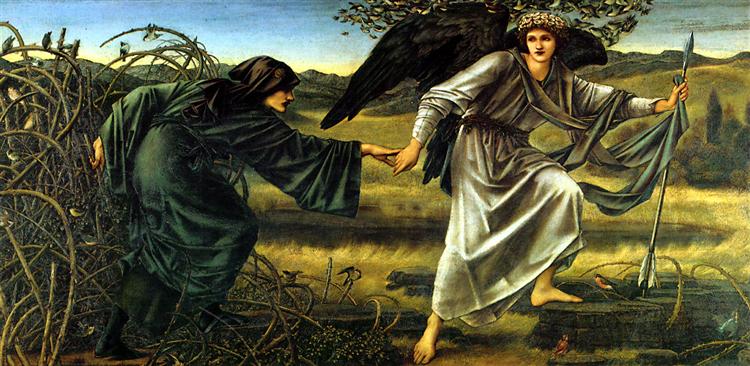
 Painting by Edward Burne-Jones (1833 – 1898)

~~~

.

Bibliography:
– ‘Sadhana’: The Realization of Life – by Rabindranath Tagore – (CreateSpace Independent Publishing Platform)

Website:
Rabindranath Tagore (Wikipedia)

.

Suggestions:
– Other articles from the same category in ‘Shreds of Infinity
The Heart of Tagore (Homage to Rabindranath Tagore)

.

.

On Labyrinths, Grace and the Via Creativa

61B7A971-D8B9-4596-AE8A-304476178763
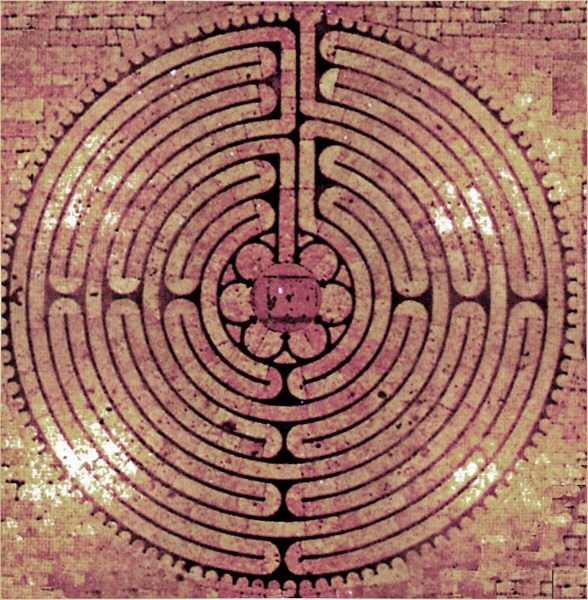
Labyrinth of Chartres Cathedral

Miriam Louisa Simons is a retired artist and educator, and the creator of several excellent blogs on the non-dual journey. I’m happy that she is the first friend invited to contribute here. Out of a lifelong dedication to art and spiritual inquiry, she invites us to delve into the image of the Labyrinth, uncover its connections with our life, with grace, until ‘we arrive naked at the freedom that was always there’…


Do you think I know what I’m doing?
That for one breath or half-breath I belong to myself?
As much as a pen knows what it’s writing,
or the ball can guess where it’s going next.

~ Rumi


The Labyrinth is a familiar symbol. Its enigmatic presence has left footprints that fade back into the beginning of the human story. Its origins and its purpose have been rich fodder for research and speculation.

I don’t pretend to know the truth of its tale, but see the archetypal labyrinth as apt visual shorthand for the map of a life, and that’s how its symbolism is used in this little essay.

The many lanes of the Labyrinth are in fact only one long path that winds and twists and turns back on itself as it explores all the territory of a life before arriving at its Heart.

By ‘Heart’ I mean the natural essence of the ‘walker’ of the Labyrinth – beyond both conception and perception – the unknowable and ineffable awareness we nevertheless recognize as our changeless Being.

An essay from Miriam Louisa Simons (READ MORE…)


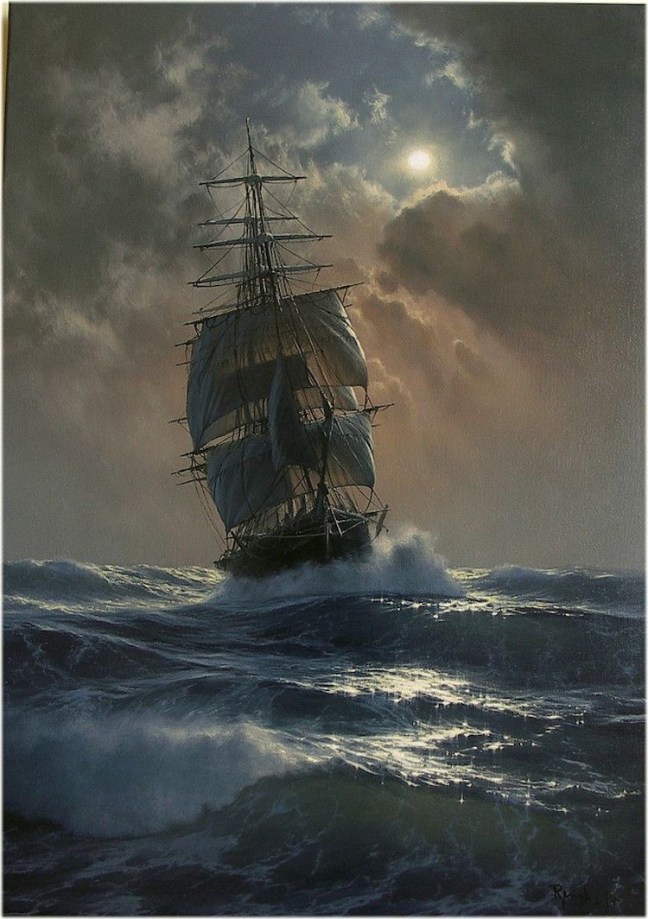
Let us all set out on a long journey

Let us all set out on a long journey
One for which time doesn’t count
For it has to be lived in this very moment
This only is the mark of eternity

It is a never return engagement
For we know not the winds and rains
Neither the heights of the waves
The traps that go with such an endeavour

Sailing is indeed a hard work
For the clouds seemingly beautiful
Attractive in their so pristine shades of white
Could turn suddenly our deadliest enemies

We look so frail in our vessel
So fragile in front of great nature
Not the oceans and skies and clouds
Though grand they are indeed

It is time for keeping up the sails of willingness
Roaming along the raging roads
For now it is our own Nature
That claims to be marvelled at

Looked at with wonder
And curiosity
At last

At last!


~~~

Poem by Alain Joly

Painting by Marek Rużyk

~~~


Suggestion:
Voices from Silence (other poems from the blog)