
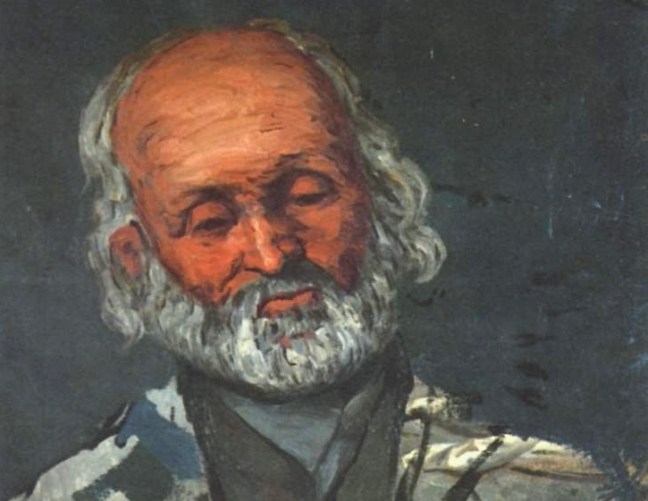
‘Portrait of an old man’ – Paul Cézanne, 1868 – WikiArt
Od age and ailments have an astonishing virtue. They teach us that our body and our mind have a weak reality, that they soften, do not last, crumble. They are like everything else. Their reality is passing, illusory, and ours is not what we have taken it to be. For we notice that as our body weakens, falls apart, we do not with it. We stay as strong as ever. We shine as something else. Not a body. Not a mind. Not an apparent self. But spirit. Our spirit strengthens. Our presence widens — if we care to look at all, to be aware, to not attach ourself to a dying object, to a withering skill. If we stay as our solid being, as that which we haven’t been attentive to so far, for reason of an irrational and obstinate fascination for our body-mind-experience, and our puny self.
So when these, that didn’t have a true reality, go; when these, that didn’t stand the mark of eternity, wither; then our fascination shifts for that which cannot go, wither, or crumble. For what stays massively behind. This reality of ourself hits us in the face — what we are, what we were even when we weren’t looking, weren’t interested, had our life within the limitations of our body-mind. Then it comes soothing us, telling us of our nature, of our grandeur. Then, what falls apart is not just our body or our skills, but also our beliefs about our mistaken reality. Our error as to what our nature is. Now we have a conversation with the infinite, and a rising love affair with the eternal. Now we have a compassion for what we believed ourself to be — body, mind, self, skill, experience — and that now have the humility to show their frail existence. Now we stop minding so much about them, and we find the peace that it is to do so.
So where do we choose to go when we cannot go anywhere, when places become fewer, when time stops being a promise, when circumstances lessen? Where is this place that our body cannot take us to, and that comprehends all that we as a body were chasing relentlessly? What is it that our thoughts cannot give us, and that we now find is here behind and before every thought, every belief, hope, or fantasy? There is a sumptuous gift behind every body or mind that loses grip on the objective world. There is a treasure in the quiet home of our self, when we are asked to stop seeking our happy self in a thousand places, practices, or experiences.
There comes a time when we cannot chase our preferences anymore. When we have to leave behind our dearest experiences. When we have no more time to become, attain, grasp that which we want to grasp, attain, become. But there is offered a time for letting go, for a sweet abandon, for uncovering that which in us can never wither, weaken, age, crumble, suffer any kind of ailment. There is a place which holds the whole world in its loving heart, and this place of love is ourself when we have renounced to find it within time, place, or circumstance. There is a virtue in not expecting from body, mind, world, experience, what they can never give us. There is a virtue in resting where we are, where we swallow body, mind, world in an instant, and are free in spite of circumstances.
.
~~~
Text by Alain Joly
Painting by Paul Cézanne (1839-1906)
~~~
.
Website:
– Paul Cézanne (Wikipedia)
Suggestion:
Other ‘Ways of Being’ from the blog…
.


 The Dawn Within