The Silent Heart

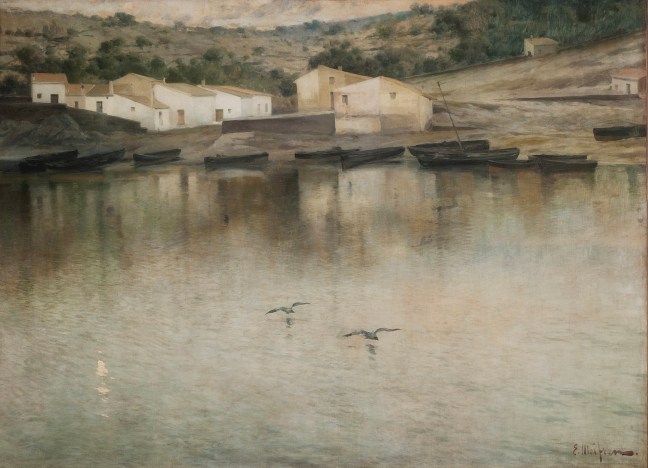
‘Silencio’ – Eliseu Meifrèn p, 1900 – Wikimedia

Silence in the spiritual endeavour is taken to be much more than the absence of noise. It is in fact stillness. Silence is the absence of movement. It is the quiet reality that lies at the very heart of our being. By silencing the mind, we get to our silent heart — the silent heart of being that lies deep down within ourself. In fact, not so deep down. This is one of these illusions, to think that our heart, our silent being lies deep down, hidden, buried. In fact, our silent heart is showering our existence. It is our natural state, teeming, unmissable, that we have made seemingly absent, that we have silenced with the deafening noise of our mind, of our endless chattering, and of this belief a million times rehearsed that we are something, a thinking entity divided from every other thing or entity, and a private, personal self that we believe is attached to the body.

In fact, our mind is made of that silence. Only, we have added so much to it that our silent, unsubstantial heart has been overwhelmed by our many thoughts, feelings, sensations, perceptions that got all our attention. We have crowded our mind and have stripped it of its natural identity, which is simply being. We have silenced silence. We have mixed it with everything objective, noisy, agitated. So it has seemingly disappeared, although still overwhelmingly present. It is not that it is hidden, but we have transferred our natural, silent identity as being, to a fake identity as body, thoughts, senses. We have exchanged being for existence. We have downgraded ourself from simply being to being something. From pure, unalloyed awareness to that which this awareness is aware of. From silence to the crowding of that silence. We are crowded beings, living at the surface of things, dancing and struggling with everything superficial. We have broken the pact that tied us to the infinite, which is our true home and identity.

It results that we have become a person, when we are truly this silent, depersonalised, but utterly intimate heart of being which is the birthplace of all things and all beings. We are that which is before everything that appears and is the prey to our senses. We are this non-substantial substance that allows everything to find an existence. But we are not ourself a thing existing, a person. We are the still and silent being that is the heart of ourself and of all possible existence. Being something is to transfer our identity to that which we are aware of. But this identity has no reality other than in our thoughts and imagination. It is a belief. In plainly and only being, devoid of the imagination of mind, of its restless and ephemeral content, there is an aware silence. A silent heart. Still beating as our eternal, undefeatable identity. We have to live there, for this is the life we are meant to live. Anything else is a corrupted, even poisoned position. The state of the world is here to prove it, to attest that we have displaced our gorgeous identity away from the silent ground of being, to live in and as an appearance, and to believe in what is only a passing dream.

.

~~~

Text by Alain Joly

Painting by Eliseu Meifrèn (1857-1940)

~~~

.

Website:
Eliseu Meifrèn (Wikipedia)

Suggestion:
Other ‘Ways of Being’ from the blog…

.
An Abundance of Spirit

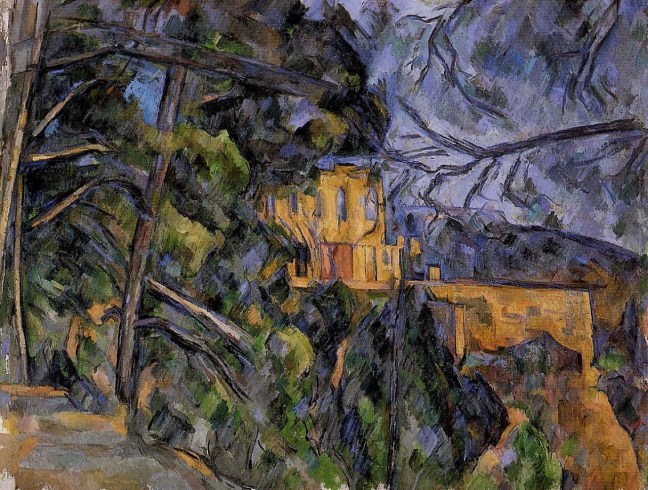
‘Chateau Noir’ – Paul Cezanne, 1904 – WikiArt

We always go too far, too quick. We jump to the objective display of reality, and in doing so leave our reality behind. It is a strange phenomenon, this forgetting, this negligence, this hurry. In fact, we pass ourself by, and rush towards what we think matters the most, what we believe to be real. This is how we have made this life difficult, an impossible thing to comprehend, and a hardship: in this forgetting, in this passing by. Our suffering is the product of a simple, single act of absent-mindedness. We have put ourself into oblivion by having made the facile postulation that reality is in the objective, in what we can see, hear, touch with our senses. And then have clung to it, to the point of losing our mind inside it, and losing ourself with it. What an absurd thing to have done.

We ought to be slow and still, if we are to meet our nature. We need to be attentive, if we are to notice our being. Not the one-pointed kind of attention, that we are already so well-acquainted with, but the sluggish one. The lazy one, that doesn’t want to go out and stumble into the world. That doesn’t feel like wrestling with thoughts. That cannot be bothered with the threat or seduction contained in the last surge of a sensation or a feeling. I can assure you that there is already a lot to see, hear, feel, on our way to the vast, far-ranging world that our senses provide. So let us not have time or space on our schedule. Let us forget the agenda that our person has and wants to fulfil. Let us not form any concept, idea, or projection, and delve into what is here before every appearance.

We may see, in slowing down, that there is here a presence that stands still, transparent, and aware. We may hear the sound of a silence that stays unaffected by the clamour of existence. We may feel the world to be but the thousand colours of our sumptuous being. We may notice the pregnancy of spirit in what is seen, heard, felt, and realise this pregnancy to be our very own nature felt, heard, seen. This abundance of spirit in our life is but the disappearance of the entity that sees, hears, feels the world, and the surging of the One as our own and only reality or world. Then we won’t pass truth by anymore. Our own nature will be unmistakable, unmissable. It will meet us in the face at the first surge of an object seen, heard, felt. We won’t miss it because it is all there is. Because there is here the absence of a self living in separation, and the absence of a world as world. This absence is our presence, our nature, our self, our world, and there ends our suffering.

.

~~~

Text by Alain Joly

Painting by Paul Cézanne (1839-1906)

~~~

.

Website:
Paul Cézanne (Wikipedia)

Suggestion:
Other ‘Ways of Being’ from the blog…

.
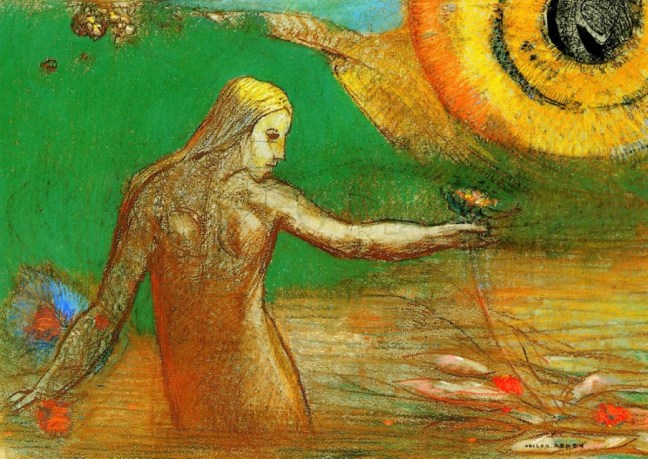
The Birth of Personhood

‘Flower of Blood’ – Odilon Redon, 1895 – WikiArt

It is consciousness — not body, not thoughts — that gives us the impression that we are a person with a continuity. There is absolutely no chance that a bundle of thoughts, feelings, and bodily sensations, could give us that impression. We borrow our personhood to consciousness, to the fact of being aware — to this light that creates us in the darkness that are otherwise thoughts, feelings, body. Our sense of continuity belongs to consciousness, to presence — that portion of ourself that is empty, unchanging, not objective, but full to the brim with itself. Our thoughts are but isolated events that are changing over the course of time, and so are our feelings and bodily sensations. The content of our mind is like a passing, unpredictable weather. So continuity in that area is absurd. Our essential self is to be found in and as being. What makes us is in that which is unmade. That impersonal part of ourself is what paradoxically gives us the chance of being a person. We are therefore nothing but empty, undivided being playing ‘being a person seemingly characterised by body and thoughts’. We have got it all upside down: Our person is not prior to consciousness. Consciousness is prior to our person, and the sine qua non of our existence or appearance.

Our thoughts are far away from each other, inconsistent, contradictory, confused, hesitant. They are not the voice of our self, are incapable of forming an identity of any kind. Our identity is to be found somewhere else, in something that we cannot get hold of, or limit, or name. The only thing that could link the different events of thoughts, feelings, sufferings, bodily sensations, and perceptions — all that for us constitute our self, a person with a name and form — is the presence of consciousness. We owe the impression that we are something solid, a real person, to emptiness, silence, stillness. So our person is actually non-existent, or rather has its existence in that which stands unseen between the happenings or events that we think make us. So our story, our thoughts, our body, become evanescent, losing their reality, disappearing within the experience of our massive sense of being — its coming to our attention. Being is seen to be the nature of ourself, which we had imagined in passing, isolated, impermanent, objective events and qualities. And believe me, that makes for a beautiful, gorgeous person — the one we have always wanted to be! A person is infinity being born.

The fact that there is a certain coherence in being a body-mind, and that we are able to live a life, is nothing but the expression of a play, a ‘lila’ as the Hindus are saying. We are nothing but a character in the hands of an actor. A body-mind is the little necessary to carry our wider identity to its term. In fact, all that we seemingly are — a person with an apparent life — is just the vehicle for a bigger quest. We are pretending a body-mind, so that we can realise our divine being. We are carrying infinity on our back, on the back of the finite, giving it the seeming, temporary life of an entity progressing in time and space. But this story, this appearance of a life, is but an excuse, something marginal that serves a wider purpose. We are meant to carry God on our shoulders for a while. At first unknowingly. Until we know God knowingly. Until God has acquired enough substance, and has sufficiently widened Its being in our life. Until God can in return carry us on Its own shoulders. And move us. And swallow us. Then, we find the security and courage to surrender ourself in God’s solid being and be like God Itself. We transfer our being in and as God’s being. And die there.

.

~~~

Text by Alain Joly

Painting by Odilon Redon (1840-1916)

~~~

.

Website:
Odilon Redon (Wikipedia)

Suggestion:
Other ‘Ways of Being’ from the blog…

.
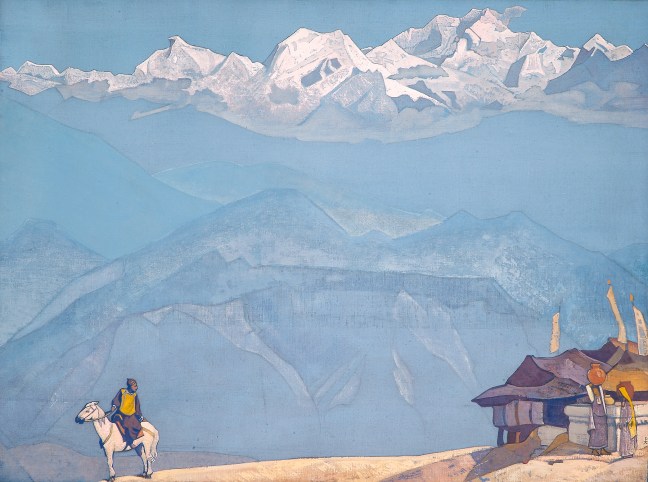
Remembrance

‘Remember’ – Nicholas Roerich, 1924 – WikiArt

All the things that stand out in us, and that we finally believe to be us — our story — are the rugged parts of our existence. They are what we fear or project. What we separate from and refuse to embrace. What we identify with and refuse to let go. What we have used for our identity, to shape our person, and draw some pride and contentment, or some shame and resentment. All the same. We are the children of circumstances and failures, of successes and apparent choices. Of sufferings. So we have shaped ourself with and from what we are not — from what we can remember and hook on. From events and ideas. From what can give us a form and a semblance of reality. But with all these, we are left only with what doesn’t truly satisfy us, doesn’t quench our thirst, doesn’t make us a rock but only a fragile, elusive entity. There is more to us than story and existence. There is what we cannot remember and make a story of. What we cannot fit into the shape of a person. What we have left unnoticed in the interstices of our life.

Why is it, do you think, that we often have difficulty remembering the happiest parts of our lives, which tend to disappear into thin air? Why cannot we seize happiness? Why is it that we seem to disappear in it and with it? That the best part of what we are, is the part less remembered and graspable? We tend to emphasise the foreground, the highlights, what exists, appears, and disappears. We have little consideration for what stands behind, unnoticed — the still, silent, benevolent matrix of it all. The unfathomable that we are, with its indomitable nature. That which lends a ground to all forms and appearances, including time and space. That which is not an object in our experience. Which is not an idea or a representation. Which is alive and can only be felt in and as the depth of our being. Which has the solidity of a rock that can never be moved. Which will never be a person, never have accidents, never be shamed or shaped by circumstances or events. This most profound nature of our being holds for us the peace and happiness which we are seeking in the foreground. We borrow the happiest parts of our existence to our own nature, while thinking it lies in chances and accidents.

If this nature of ourself is not felt, we will live with fear and lack. So this is our worthiest remembrance. This is where we have to be. To live as that field of being is to remember our nature as the rock-like essence of all beings, things and events. Then, this sublime identity that we have found ourself to be will matter more than any life achievement or result. It will be like the air we breathe. It is ourself seen in the conscious light of our being. In this, happiness is prevailing because it is the very colour of being. In fact, happiness is devouring our old self, which is why and how we as a separate entity disappear every time we feel at peace and content. Peace becomes our very identity — the eternal, ever-present nature of our being. Life then puts on the clothes of clarity and well-being, and our self deserts the ruggedness of the eventful life of time and place. What we ‘remember’, according to the etymology, is what we ‘call to mind’. So we ought to be cautious of what we remember or forget. That will condition our being happy or miserable.

.

~~~

Text by Alain Joly

Painting by Nicholas Roerich (1874-1947)

~~~

.

Website:
Nicholas Roerich (Wikipedia)

Suggestion:
Other ‘Ways of Being’ from the blog…

.
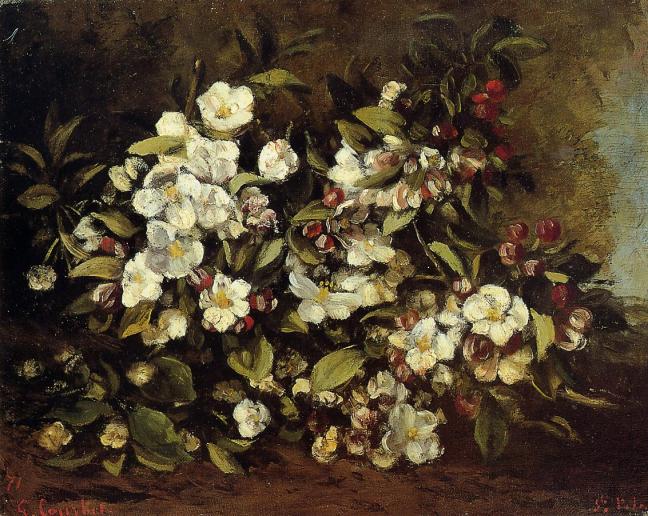
Four Variations on Love

‘Branch of apple blossoms’ – Gustave Courbet, 1871 – WikiArt

.

God is love, and he who dwells in love
dwells in God and God in him.”
~ The Bible (1 John, 4:16)

.

I have been reading Meister Eckhart’s sermon n°5 lately, in the translation by Clare de B. Evans, from an old publication named simply ‘Meister Eckhart’. It’s a sermon dedicated to love and its many aspects. At the very beginning, Meister Eckhart sums up the nature of love in four magistral sentences that had a deep effect on me. So I decided to write down some of my take and understanding on each of these quotes by the Meister and present them to you. I hope they will be of interest…

.

‘God is love’. That is so, inasmuch as all that can love,
all that does love, he compels by his love to love him.”
~ Meister Eckhart

It is greatly convincing to think that we can love someone or something. That there is something inside us, a quality or emotion, that can spring out of our mind and body and direct itself towards an object, a someone loved, a something loved, and that this love is a personal affair. Well now the question arises: What is it in us that can love, and what is this other that is loved? Notice first that there is nothing in you that can love but love itself. Our mind is in no capacity to love. Rather love happens, shows up naturally, when our mind is set aside for a while — for our thoughts, most of our thoughts, have the power to defeat love, to render it unfelt, dormant, as if inexistent. So if you love anything, anyone, it is not because of him, or her, or it. It is because you have been freed from yourself as a private, separate self or mind, and that in this freedom, love can arise, unfettered, can stretch its dormant limbs, and shine in all directions. After all, have you ever been in love with someone without at the same time loving everyone, everything, around that one? Love is an awakening, an opening. And in that opening, in that crack, reality shows its profound nature. Love is the profound, intimate nature of everything. So when you love someone, there is nothing there, and nobody, no other, that can be loved, except the essence that this one is. Therefore you can only ever love the essence. And you could not love the essence of anything if you were not yourself the essence of everything. That’s how you are compelled, when you love anything, to love god first, which is the essence of both the lover and the loved.

[…]

More reflections on some Meister Eckhart’s statements about love… (READ MORE…)

.

A Speck of Light

What you are is nothing ordinary, nowhere near being ordinary. We have gotten used to seeing ourself small, a speck of consciousness in the wider picture of the universe, with its trillions of other specks. We have made consciousness a mere apparatus, something that allows us to apprehend reality. For most of us, reality as the world is the real thing. Consciousness is nothing to speak about or even mention: just a tiny, taken for granted sparkle in the mind. A mere instrument at the service of a limited, separate entity. This instrument is nearly transparent, hardly worth considering, and is often reduced to what is called conscience, which is in fact only mind. But could it be that the most important aspect of our lives resides there, in and as that speck, in and as that sparkle that we have ignored and misunderstood for millennia? We have been exclusively fascinated by the content of our minds, by our bodies, and by this enthralling world, and we have stopped there, leaving the most precious jewel of our lives aside. But this attitude is in fact an elaborate system of avoidance. As Krishnamurti once said: “Your whole concern is with escape.”

We are constantly privileging the content at the expense of the vessel that holds it, and the known at the expense of the unknowable. We want to possess and control, and feel the satisfaction of it. We prefer having experiences to exploring the nature of all experiences. But there is a seed waiting in the tender soil of our mind, that needs our attention and care. It thrives when being observed. It grows under the scrutiny of a loving contemplation. Its infinite proportions are a thing to watch, that can turn your life upside down, and sweep it clean of its erroneous foundations.

[…]

Consciousness: from its being veiled to its being realised… (READ MORE…)

.

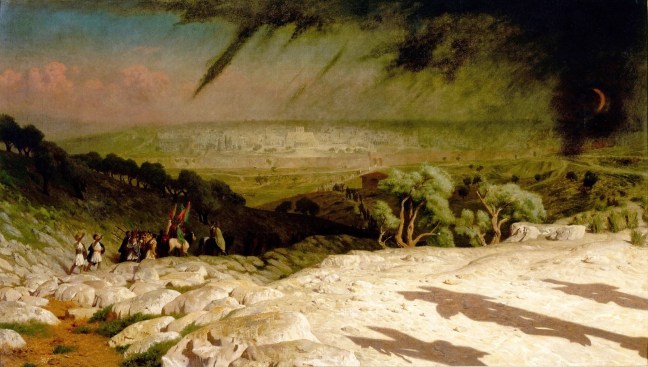
‘Consummatum Est’

‘Consummatum Est’ – Jean-Léon Gérôme, 1867 – Wikimedia

I happened to visit a church recently, and was intrigued by one single sentence placed just under the main crucifix, which read in French as: “Tout est consommé”. I had never heard this particular formulation before. These words appear in the Gospel of John (19:30), and have been translated into “It is finished” in modern English. These are the very last words uttered by Jesus on the cross before he relinquished his bodily existence, and was resurrected as pure being. In Latin, it runs as “Consummatum Est’.

Consummatum Est

All is consummated, which means all is finished, accomplished, brought to completion. It means we are wholly with the ‘highest’, nothing is left that lingers in separation. All that is other than god, other than the very presence or being that we are, has been consummated, put into the fire of consciousness, eaten, devoured, transformed into its very essence. The truth of it has been exposed, and the objects — all that seems to have its proper existence — have been revealed to be of one single essence. The ten thousand things have been digested, transformed into the truth of their being. They have been revealed as the One. The illusion of multiple existence has been seen for what it is: one being giving no room for an other. Anything that stood as separate or ‘other’, has been consummated into the fire of emptiness. Not a barren emptiness, but a living one, a fertile emptiness, teeming with possibilities, with creativity. Everything that was objective has been devoured into supreme subjectivity, which is nothing but the feeling of being, in which all existing things have found their home, have dissolved their separate identities, have bargained their many names for the Nameless. The many have been revealed as being one. Therefore whole, complete, in need of no ‘other’, or ‘better’, or ‘more’. The many shadows of obscurity or illusion have returned into the light of their essential being. They have disappeared, have relinquished their illusory separateness, incompleteness, or ignorance to return into the truth of their ultimate being as oneness, fullness, or understanding. The shadow of existence always shows up as many. But the pure light of being is revealed as one. This is an end, a finish line, because there is no more to be revealed, no more to be added, understood, analysed, enquired. This is a natural completion, a form of creative death, which means the realisation of the very nature of death as the living aliveness of pure being. It is whole, therefore unattached, innocent, incapable of being sullied or diminished, immune to death, and open to the infinite. Finally, you come to the understanding that this consumption is the sublime alchemical process, the transfiguration through which suffering is metamorphosed into peace, separation into oneness, and death into eternal life. This is the realisation, awakening, or resurrection of our true essence that was buried under, or veiled by, our illusory sense of self and the constant toil of life in the forms of suffering and death. In other words, you have been crucified on the altar of ultimate being. ‘Consummatum Est’.

.

~~~

Text by Alain Joly

Painting by Jean-Léon Gérôme (1824-1904)

~~~

.

Websites:
Jean-Léon Gérôme (Wikipedia)
‘Consummatum Est’ – Painting (Wikipedia)

Suggestion:
Other ‘Ways of Being’ from the blog…

.