Holy Ground

We have no being of our own. We have built our existence as a person, as a body, as a bouquet of perceiving faculties, on a ground that is not our ground. We are borrowers, incomplete entities, which is the reason for our restlessness, for our many lacks, and for our sense of insufficiency. Wholeness and plenitude are attributes of the ground or essence. This essence is hidden because we are overlooking it. We, on our choice, have displaced our attention to what we mistakenly take to be ourself: our thoughts, feelings, sensations and perceptions — all that makes a narrative, that gives us an appearance, a consistency, an existence. But one such existence is a fraud. It is not what we essentially are. We have displaced our self, our identity, from the ground to the landscape, from the essence to the superfluous appearances that owe their existence to that universal, infinite being or ground.

But an appearance can never make us. A thought doesn’t make an identity. An idea, an image, a body, are not what we are in essence. But they all have a common ground, hence our confusion in our perceived identity. This common ground is our deepest sense of being, the consciousness that is found at the root of ourself. If only we were aware that what is seeing, thinking, perceiving in us, is actually the ground, not ourself; that what is experiencing, what is aware in our everyday life, is in fact this supreme, infinite ground, then we would acquire a very different idea or perception about ourself, another responsibility, another awe, another reverence for our reality. Our reality would be discovered to be the ground of all beings, called ‘god’ in the spiritual literature. God is not a word for a thing or a person, but for a living experience, a taste, the feeling of being that has its reality here and now. It is not distant, not dependent on a belief. It is a hard reality, accessible in all experience. It is our true nature, what we are, and what we know we are, without a shadow of doubt.

God is not a guess, a maybe, a question. God is a certainty, an evidence, and the answer to our suffering. It is our very conscious sense of being, the very thing which in us makes for the feeling ‘I’, for what I am in truth and in depth. It is our one and only reality. If we do live from that essential ‘I’, then we live from inside the holiest of temples. We cease living and acting from a private, separate sense of an individual self. Behind the veil of our mist, of our everyday fascination for mind, body, appearance, existence, is a presence that is revealed when we let go of ourself. It bears in its DNA the savour of holiness, and of a quiet, unbreakable happiness. Holiness is not an attribute of things, places or people for which we may have reverence. Sacredness doesn’t belong to the landscape, or the object. It is rather the natural expression of our true self, of ‘I’. It is in abiding in our true nature or essence that we feel a deep reverence for everyone and everything. What is sacred is our intimate, infinite being, and this being draws its holiness from its one pristine, untarnished, infinite nature. Wholeness makes for holiness. Holiness belongs to the ground, and the ground has it in its nature to shower benevolence to all hosted appearances. This is how we have, shining in our experience, the qualities of peace, love, beauty. They are all offsprings of the holy ground, which is ourself.

.

~~~

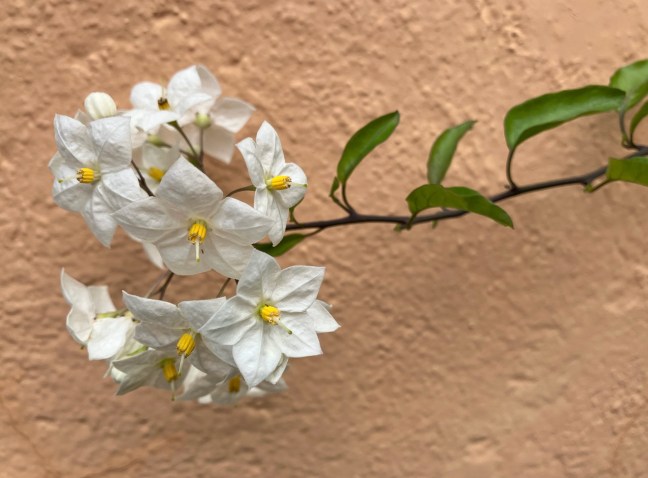
Text and photo by Alain Joly

~~~

.

Suggestion:
Other ‘Ways of Being’ from the blog…

.

The Dream of a World

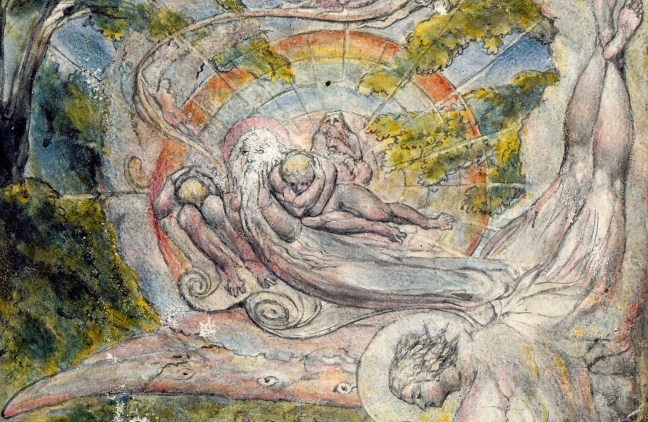
‘Milton`s Mysterious Dream’ (part) – William Blake, 1816-20 – WikiArt

There is a fraud in our life. An illusion that makes us feel that life is going to get better. That time or circumstance will bring us to a place of understanding, where our troubles will come to an end, where there will be betterment, improvement, change. To believe this will make us miss that we are already here and now in a place of no change, of no betterment, where nothing can improve or get better. This place is our very self, our sense of being that we have never been able to affect or modify, no matter how relentless our life has been, no matter our despair, our sorrow, our losses. Nothing we have gone through has touched it in any way. All our stories and sufferings have taken the shape of our thoughts and beliefs about them. But while we are desperately trying to give a form to our life, a solidity to our body, a reality to our problems, and a truth to our beliefs, right here and now, right where it all is seemingly taking place, hidden within experience, enveloping it all, is already a presence, a vastness, a reality that is embracing everything, and that is our only reality, our only place, our only possible self in this living experience.

For there is not a world there where we could be in. That would be a lovely idea, but the fact is: there is no possibility to prove the existence of such a world. We can only assert it, marvel at it through our senses, study it, analyse it, but of a solid proof there is none. The existence of a world is dependent on our perceiving it, and perceptions are contained in our knowing them. Without the knowing faculty, there cannot be a world. The whole glory and misery of the world, of the whole universe, is all gathered in that fathomless fraction of knowing, or awareness. Without that simple, ungraspable, dimensionless, ethereal element of knowing, no world could ever come into existence. So in fact, knowing is all there is, consciousness is the essence of every single appearance that comes to be seen, heard, touched, or experienced. The world is shaped, or its appearance created, through our being aware of it. So the whole of our living experience is but a dream in consciousness, a game that can be played and enjoyed at the level of our body-mind, but whose reality is only the awareness of it.

Now, where are we if we are not in a world? Where are we if the world is not even there? What is this something that we feel we are in, and exists, and is undoubtedly? What is a world, an experience, when we have passed through all illusions, all beliefs, all shaky appearances? What is left here that holds our experience, that is indomitable, indestructible, present without a shadow of doubt? This place is our self, what we are, our very essence, the reason behind our saying ‘I’. So we live in our self, not in a world. We see our limited existence pass and consume itself within that which is creating it, which is our own aware being, the knowing that we are and could never not be. And there, in ourself, in being, where the world takes its apparent form, is found what we have been looking for in every direction, in a non-existing world, in experience: a sense of relief, peace, beauty, love, and the understanding of our essence, the explanation of it all. An explanation that is not conceptual, but a living one, a subjective one, something made plain by being it. We and life then become self-explanatory. The fraud has been diluted. All imagination has died down. Now our living experience has acquired the rawness of truth. Something that is, unlike the world or our experience, beyond doubt and absolute.

.

~~~

Text by Alain Joly

Painting by William Blake (1757-1827)

~~~

.

Website:
William Blake (Wikipedia)

Suggestion:
– Other ‘Reveries’ from the blog…

.
The Ultimate

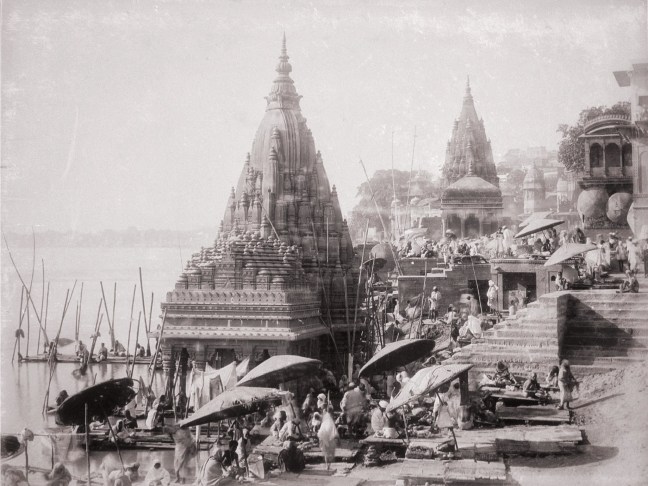
‘Benares, Temple of Tarhishwara or Well of Manikarankia – Samuel Bourne, 1860 – Wikimedia

The thing in ourself that has the capacity to know anything is itself not a thing. We can only exist in relation to things, but only the state of no-thing can we ever truly be. The illusion that we are something separate, a self — whatever we are — is due to the knowing of an object. When no such objective knowing is being activated, then there is no necessity to be anything. There is no purpose in being a self. The being that we appear to be is realised as void. And without a self to know them, things have no support for their reality. Within that perspective, all things dis-appear, are swallowed back into no-thingness, into where they have never ceased to be. This ultimate realisation is in fact not a realisation. It is the ultimate truth contained in simply being, when all duality has been nipped in the bud, unable to show any reality as such, lost in a being so subjective that nothing can be there which could be formed and recognised as ‘other’. This is the end of form. It is the state of no-thing that cannot be spoken of. It can only be approached, envisaged, but never lived as an objective experience, or from the position of an experiencer. It is the timeless, objectless point where the moth dis-appears into the flame of being. Its identity as ‘moth’ has been dis-qualified from itself to never be formed again. Now engulfed into the very no-thing that we are when all objectivity has dis-appeared, we are left with being, our pure essence, where no form could ever be formed. This is in fact, paradoxically, how a world, a thought, anything, can seem to appear — through the intercession of formlessness. This place is where we can never go. This thing is what we can never be. World, thought, self, death, bondage, liberation, are only the gaming of god, or infinite being, with no reality of their own. Only at the point of un-being, of coming to an end, can we ever be true, ultimate being. This is what ‘ultimate’ in fact means: ‘to come to an end’. To cease being anything is the ultimate truth of life. What is left is pure, essential, unqualified, infinite being, where no self or world could ever come to be. This, truly, is the ultimate. That ultimate, because of its purity, can bear in itself the illusion of being coloured or stained; because of its essentiality, can be divided in an endless chain of cause and effect; because of its unqualified nature, can adopt any form or quality; in reason of its unknowability, can be known through a multiplicity of names; and because of its infinite nature, can be seemingly separated as a multitude. And it does this without ever ceasing to be the ultimate. Now, know in all occasions that you are not a suffering self lost in the multitude, with a name, a form, and qualities — an entity living in a world, endlessly caught in multiple, arbitrary causes and effects. Know only being as your ultimate, uncreated self. There only is the abode of peace.

.

~~~

Text by Alain Joly

Photograph by Samuel Bourne (1834-1912)

~~~

.

Website:
Samuel Bourne (Wikipedia)

Suggestion:
Other ‘Ways of Being’ from the blog…

.

A Chronicle of Thought

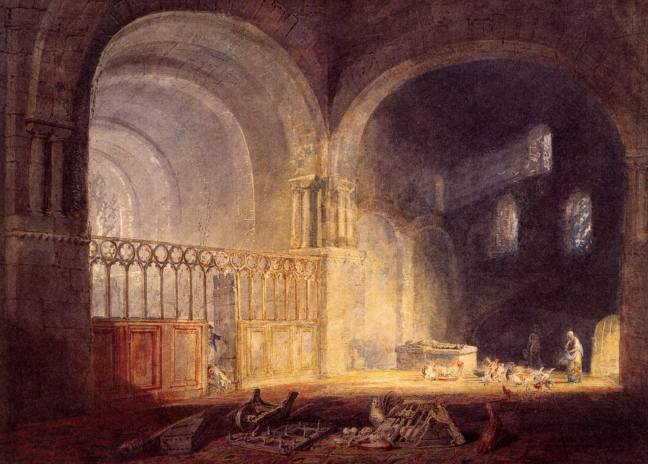
‘Transept of Ewenny Priory, Glamorganshire’ – J.M.W. Turner, 1797 – WikiArt

Most of our thinking is so much unnecessary work. Consider all the worries we had, that have been fuelled by thought, and have now evaporated into thin air. Think of all our expectations and dreams that were never fulfilled, replaced by just being what we are now. There’s been so much energy wasted in these internal fights with reality. So much presence that we have missed or hidden for being tied up with these endless rounds of endless thoughts. Thinking can be a damaging factor in our being aware of our utmost reality. And we most often don’t need to have thoughts to actually be caught in their net. Thoughts are good at delegating. They will sooner than we think be replaced by chronic tensions, nasty feelings, diffuse depression, and the uneasiness of being a self. All the troubles contained in being a person — the endless suffering that goes with it, and the seeking that never seems to stop. In fact, we have been sculpted by our thoughts. We owe thoughts all that we have seemingly become. It really gives me shivers to think about it.

Our thoughts are both the cause and result of the idea of ourself they have imposed on us over time. We have been a follower of thoughts. We have been conditioned by them. They have us in their spell, and we could spend a lifetime without confronting them, without going right to the bottom of their essence. Have you ever met a thought face to face? Do it now. Ask your next unnecessary thought that simple question: ‘Why are you here?’, and see its reaction. See how it will shy away and retreat. Thoughts are not courageous beings. They thrive out of our carelessness. They love our being inattentive. It goes the same way with the self they have made us into. If it is left to act alone, that self will never leave you out of its own will. It will keep hiding your most truthful identity. It will continue feeding you with its thoughtfully rehearsed beliefs and illusions. You will keep being an entity. You won’t see the infinite that your being is made of. Silence and eternity will keep evading you. They too are shy — they don’t like when that boastful self is around.

Thoughts are silent workers, and pernicious ones. We think we have them when they in fact have us. The problem is not so much in their being there, but in what they have left in their trail for us to believe in. That’s why we call them ‘thought’ — a past participle. Thoughts are known when they have already been thought. They are agents from the past, that are here for a mission. They have created an entity that is in turn thinking them with the view of keeping itself strong and alive. So we are caught and doomed, aren’t we? Well… maybe not. Maybe thoughts too have their weaknesses, and I’ll tell you one. Pierce your thoughts through to get to their ground of being. Your freedom from thoughts is in your looking beyond them. And your freedom from being a self is in giving attention to what beholds that self, to what gives it the light necessary for its appearance, and for the knowing of your thoughts. Everything that you can know is lit by a knowing faculty. Be engrossed by that light, be only that one, for there is no thinker behind any of your thoughts, and no knower behind any of your ‘knowns’. Espouse the being in you that is responsible for being aware of everything — thoughts, objects, experiences, the feeling of being a self separate from the world. Just stay present in, as, and to this deepest, most intimate presence — the one which you cannot know, or even be as an object, and which will deliver you from being a self. In that deliverance is contained the severing of all the thoughts that are like the bricks and walls of your illusory self. You will hear the sound of the rubbles crashing at your feet. This sound is the sound that freedom makes. Silence comes afterwards — and this silence is you, who you are before the coming of any thought, truthful or not. But really, nothing is new here — after all, Paul the Apostle said it all long ago in far more succinct terms:

Whenever anyone turns to the Lord, the veil is taken away.
Now the Lord is the Spirit, and where the Spirit of the Lord is, there is freedom.
And we all, who with unveiled faces contemplate the Lord’s glory,
are being transformed into his image with ever-increasing glory.”
~ 2 Corinthians, 3:16-18

.

~~~

Text by Alain Joly

Quote by Paul the Apostle (5-64/65 AD)

Painting by J.M.W. Turner (1775-1851)

~~~

.

Websites:
Paul the Apostle (Wikipedia)
J.M.W. Turner (Wikipedia)

Suggestion:
– Other ‘Reveries’ from the blog…

.
The Story of It All

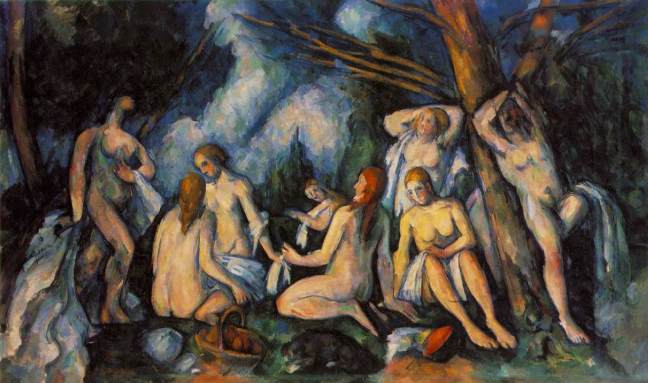
‘Large Bathers’ – Paul Cézanne, 1905 – WikiArt

There is a hidden presence everywhere we go, that hides within our experience. It is concealed within its own shining, and is the reason for our seeing and experiencing anything. It seems to be woven into our very being, to have married its being to our being. Would we want to separate ourself from it, that we wouldn’t know where to go. In fact, there is no way outside ourself. We have it all here as we are. Our life is unfolding within that which is ‘myself’. We are the garden of our self, of all our human endeavour, of our quest and of our finding, of our lack and of our glory. All that we live for, when reduced to its core target, is to be relieved from our chronic sense of not having enough. We feel there is a thing here to be found, without knowing what it is. So we become blind to ourself, and are consequently driven into the world, seeking there in the distance of time or place, what is already here in and as our very self. We are our own hidden remedy, our secret paradise. We have shrouded the infinite within ourself, and are erring within our own misconception.

In fact, we have been misled by our having a body, imagining us inside it rather than it inside us. We have belittled ourself, have lost faith, squeezing ourself into a thought that we have aggrandised to being an entity. We are a trick of the mind — nothing more — and have lived caught within our own creation, struggling inside our own mistake, wrestling with a world that we have stripped of its essence. We have divided our experience into separate objects, and have reduced ourself to being one such object. Now we are striving to unravel our own mistake, to defeat our foolish, unfortunate belief — hence our suffering and our struggling. Our life has been made into a scream for peace and justice, and the silence of simply being has retired within us, into the hiding place where we have pushed it. We have shied away from our truthful nature, and wandered off from simply being naked being. We have clothed our emptiness with the garment of a self delineated by thought and identification. We have limited the infinite to our convenience, and squeezed eternity into the burden of time.

But there is a dawn here just as we are. There is a light ready to overcome our night. For we never got lost far from our home, never took our stand away from our own being. So our journey is always only the shortest step from ourself to ourself. We have to return where we never left. We have to get acquainted with ourself, with who we truly are, and get accustomed to our being — much wider than we ever noticed. We have a sky at our disposal when we have dismissed the thousands fascinations and identifications with everything that is at a distance from ourself, and is the prey to our mind and our senses. There, curled within and prolonged without, treated so far with contempt, is our own indomitable self. There, trampled by a belief about ourself that we have imposed on everything, is a magnificence. There, is the being of our being, what we-the-seeker have sought everywhere except in its own place of living, which is ourself. We have missed it because it was the last thing investigated, the last stone lifted, for being too close and intimate. Who could have thought that the sought was the seeker?

Now we only have to be that ground of being alone, at the exception of all that is moving and changing in it, and that isn’t us, not truly us. We only have to sink beneath the moving sea of our multiple, insatiable experiences, and let ourself reach that part of ourself that cannot be known or possessed, and is yet our undeniable self and identity. Here we discover that our being is the being of everyone and everything, and that we are bound to this totality by love. Here every single thing in our experience is unraveling itself back to its essence, taking its right place within it — and that essence is found to be our essence. And god’s being too finds its right place and meaning in and as ourself — and we too have our place in god. And our so precious peace is now teeming as our own being, and justice is found right under every step we are taking. Now we have silence as our very best companion, and our seeking — which was our suffering — has been buried under it. Now we are right where we were supposed to be when the world became a world, and the son of god became a woman or a man. And now…

Now let me rest and live and walk the world as I am, alone and one, and all in I.


~~~

Text by Alain Joly

Painting by Paul Cezanne (1839-1906)

~~~

.

Website:
Paul Cezanne (Wikipedia)

Suggestion:
– Other ‘Reveries’ from the blog…

.
The Distant Country

‘The return of the prodigal son’ – by Elena Murariu, 2018 – Wikimedia

How ironic this life is, isn’t it? How incongruous to have imagined that this is the real deal: being a person locked in and bound to the limits of a body. How astonishing to have this certainty to be a self that feels separate and needs to be fulfilled. To think we have to fight our way through the world, and suffer with such consistency. To have been persuaded that seeking is our way of life, without which we are doomed to poverty and stagnation. Yet the illusion of our being in a world is so convincing that we had to buy its many effects and constraints, and be subjected to its perils. So we have gone far away, thinking that we could live remote from our true home and identity, that we could roam the world on our own, and snob our essence. So we have landed into what we are not. We have lived the adventures of a person, gone through challenges and despair, carried ourself through time and space, and lived attached to worries and hopes, to the aches of regrets and loneliness, and the brief consolation contained in the occasional relief from our wrestling with the physicality of the world. So we have paid the price of such a lonesome, faraway trip. As Augustine of Hippo once said: “Distant country signifies forgetfulness of God“. We have left our father behind, despised his presence, judged his love as unworthy. Unhappiness is intrinsic in having mistaken an illusion for the reality, just as it is natural to be in the shadow when we hide from the sun. But maybe there is a return from our erroneous view. Maybe the time has come to stop being tied to a false idea, and to return from our adventures into deceitfulness.

Now see that this faraway trip is but the following of a belief. It is our being led into an illusion, a fantasy — shared by all — that the life in and as this body-mind is all the reality there is, and that the way we live and believe is our truthful condition, to which we have to submit ourself. We have swallowed that suffering is the condition of life, and the way to alleviate it resides in either circumstances, good luck, or smart choices. But in fact, suffering is but the consequence of our departure from our true, forgotten nature. It is the natural outcome of our prodigality, of our obsessive desire to possess and be more than what we already are, of our seeking happiness inside the development of our adventures into ego-land. But as far as we may have erred into agony and chance, there is chiselled in our very nature, a return into the open arms of our simple, inescapable being. This quiet resting as our innermost being is the home from which we should never depart, no matter how enticing is the call for an adventure in the distant land of separation. There is a father or mother here, a being eternal, always waiting for the return of their prodigal son or daughter. And it is in the nature of this return to be a welcoming one, for the simple reason that you are yourself the embrace contained in being only being. So your return to the father was never a return from any kind of reality, but the noticing that we had in fact never left its loving embrace, and that all that was needed is our letting go, our bowing to the grace contained in simply being.

.

~~~

Text by Alain Joly

Painting by Elena Murariu (born 1963)

~~~

.

Website:
Elena Murariu (Your Portal to the Art of Icon)

Suggestion:
– Other ‘Reveries’ from the blog…

.
A Treasure of Understanding

‘Dawn’ – Joseph Farquharson, 1903 – WikiArt

There is no such a thing as conceptual understanding in matters of spirituality. As soon as we form an idea, a concept, an image, a projection about ourself, we are still where we have always been: in our mind, in the known, in grounds we have already trodden a thousand times. These grounds are the grounds of our misunderstanding, where beliefs have already shaped and conditioned the idea we have about ourself. An idea that we rehearse and consolidate with every thought or act springing out of the field of our conceptual world. No understanding can ever come from this barren field. For one good, essential reason, which is that our understanding comes from only being. Being is the field of our understanding. Being is understanding itself. And the mind — with the ego which it gives rise to — is the only thing that is hindering our coming in contact with being in its purest form. That’s why concepts and ideas can never be understanding itself. They hide our clarity. In fact, they trample it.

So, should you ever want to come in contact with the pristine vibe contained in understanding, then a little digging is a necessary prerequisite. Don’t stay in your mind, take a new breath, be an explorer. You may use the tool of mind as you use a spear to dig a treasure. But please don’t take the spear for the treasure. This treasure is the treasure of being that stands unseen below the surface of your wrestling with concepts and ideas. Don’t let being be undermined by the description or explanation of the method. A beautiful image of truth will never be truth itself. It won’t hold the true taste of it. You won’t get its exquisite perfume, unless you see what stands under your mind and your ego. Understand your being by being only being. Throw the spear out. Finish the digging with your bare hands if required. Be yourself your treasure.

You come to an understanding when you stand under everything that is appearing or forming in your experience. Being is what stands under. It is the one thing that doesn’t change, that can never die or dis-appear, and out of which everything objective or knowable come into existence, and is under the scrutiny of your senses. But objective experience can never lead you to any understanding. Not out of its own will. You have to coerce yourself, make your own acquired, conceptual idea of reality recede and reveal its illusory, invented nature. You have to make what was, what will be, what should be, and what seems to be, into what is. That’s where understanding lives, in what is, in the here and now of your essential being. Understanding is implicit to being, and being explicit in understanding. Feel your being in its purest form, and see that you are yourself the understanding that you have craved to achieve through your mind.

So being stands under your apparent self which, in its light, is discovered to be non-existent, or rather only existent as being. That being is your true support, deserving all your praises. Actually, it is the support of everything, the great pervader — that’s why some have called it the creator. Not that it creates while being outside of its creation, but rather it is the substantial essence of everything — what makes a world possible and viable. So to understand yourself is to touch this essence through your being it, and to praise that part of yourself which you can never not be with, and which comes with a special flavour of well-being. That’s how you feel your true nature, through that subtle yet indestructible joy of simply being, which your never satisfied body-mind-self could never give you other than fleetingly. Understanding as being comprehends everything. It holds and embraces all life in the fullness of its presence. So to understand is to rest in your natural being, which requires no commenting or even understanding. You are, and this is that.

.

~~~

Text by Alain Joly

Painting by Joseph Farquharson (1846-1935)

~~~

.

Website:
Joseph Farquharson (Wikipedia)

Suggestion:
– Other ‘Reveries’ from the blog…

.