Pathways

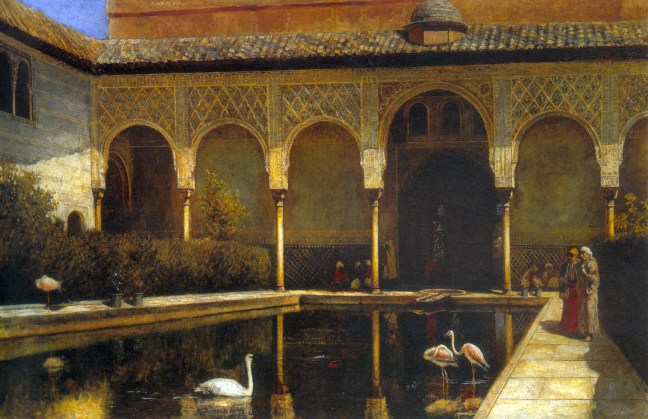
‘Court in the Alhambra’ – Edwin Lord Weeks, 1876 – WikiArt

The spiritual endeavour is really such good fun. You may happen to experience some suffering in your life and feel entangled — with thoughts rushing into your mind and problems seizing the entirety of yourself. The web of experience is overwhelming you and you can find no space to breathe within. You may then have to have a little conversation with yourself. You may have to disentangle yourself from your stubborn identification with thoughts and with the overcrowding objects born of the senses. That’s when you may present yourself with a simple question like: “What is this part in myself that is aware of my experience?” And so are you now taken amongst the scents of 8th century India, treading its immemorial dust with Shankara, debating with the great Vedantic master. He will show you how to move inwards right at the core of that aware presence in yourself. You will be taken with him to the core of this investigation, which is but the separation of the multiple objects of experience from the one aware, pervading presence of consciousness that is your true identity. That’s when Shankara leaves you with this one infaillible recipe:

.
I bow down to that all-knowing One
which is pure Consciousness, all-pervading, all,
residing in the hearts of all beings
and beyond all objects of knowledge.”
~ Shankara (Upadesasahasri, 1:1)

.
You may then find yourself sitting in your kitchen, cutting vegetables, with your thoughts suddenly wandering in the 17th century Paris, surrounded by the walls of a Carmelite monastery’s kitchen, chatting along with Brother Lawrence. He might tell you with his big generous smile: you know brother, “nothing is easier than to repeat often in the day these little internal adorations.” That’s when you understand that this investigation can be made into a joyful, often repeated practice, where you go and meet yourself within, have a little chat with this hidden presence, spontaneously, as you gaze into the eyes of a friend. Amongst the frantic sound of knives hitting the wooden board and the fumes of the next meal simmering on the stove, you meet Brother Lawrence’s glance offering you this last precious advice:

.
I renounced, for the love of Him,
everything that was not He;
and I began to live as if there was none
but He and I in the world.”
~ Brother Lawrence

[…]

Continue this journey into the investigation of your true nature… (READ MORE…)

.

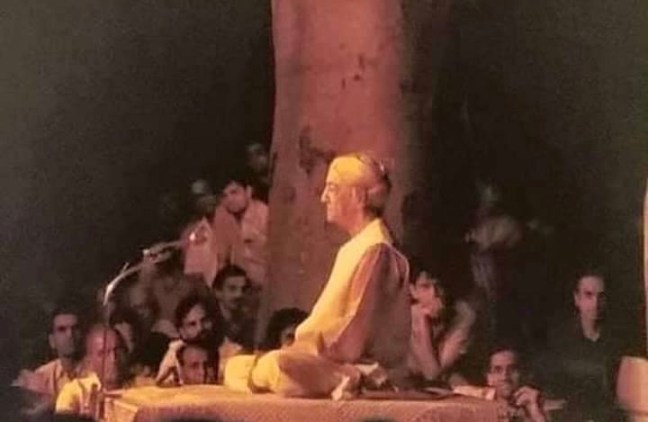
The Flame without Smoke

©️ Krishnamurti Foundation India

.

Love is the only flame without smoke.”
~ J. Krishnamurti

.

The flame and the smoke is an analogy Krishnamurti referred to sometimes. For him, the flame is this burning centre of being that “can never be expressed with words”, that “is beyond the clutches of time”, and that is often expressed as love. The smoke is of the mind. It is “the smoke of envy, of holding, of missing, of recalling the past, of longing for tomorrow, of sorrow and worry; and this effectively smothers the flame.” The smoke is often what we take to be the flame but is not. It is all that is passing, all the thoughts, feelings, perceptions — the smoke that we have gathered to form experience, and that we take to be ourself, our centre of being. This wilful, separate, time bound, suffering self has appropriated the feeling of being when it is in fact the very smoke that is veiling our true nature. Being only is that flame without smoke. It is our true identity and “the source of all happiness”.

I have gathered, over the years, on social medias, many of the most striking quotes by Krishnamurti, that popped up on my screen. These, I found, acted on me like little koans, that had the power to pierce the smoke of the mind, and reveal the subtlest truths. They are like candies which, when chewed upon carefully, reveal the flame of what we truly are. They are short and easy, but need to be taken seriously. They can crack open our resistance, and show us that flame without smoke. I share them here with you…

~~~

Do not pursue what should be,
but understand what is.”
~ J. Krishnamurti

~

Love is not at the end of time.
It is now, or it isn’t.
And hell is when it is not
…”
~ J. Krishnamurti

~

Thought is never free because it is based on knowledge,
and knowledge is always limited.”
~ J. Krishnamurti

~

It is essential to understand the seeker,
before you try to find out what it is he is seeking
.”
~ J. Krishnamurti

~

The ego is a ring of defence around nothing.”
~ J. Krishnamurti

[…]

Discover more of this selection of quotes by Jiddu Krishnamurti… (READ MORE…)

.

The Highest Language

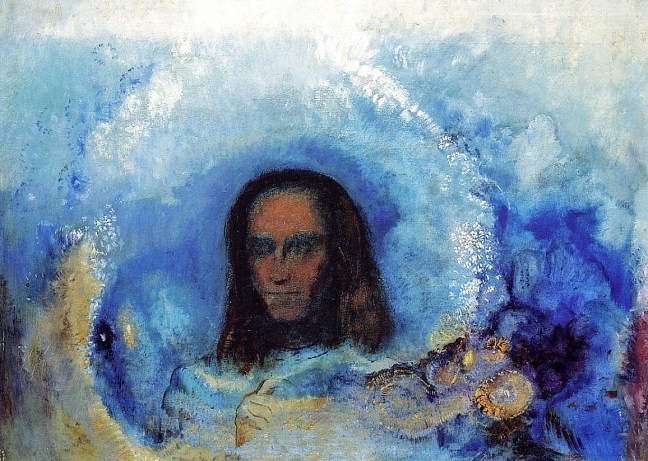
‘Silence’ – Odilon Redon, 1911 – WikiArt

In our language, the word ‘silence’ is defined as the complete absence of sound, or the abstinence of speech. Yet silence has fascinated us beyond these elementary descriptions to evoke the unknown and the mysterious. Something in silence speaks to us, and is a presence beyond its apparent nature as absence. Spiritual teachers from all traditions have abundantly used the word for its richness of meaning and its powerful evocative dimension. So pregnant and profound is this experience of silence that the word has often been likened to awareness or the nature of god’s silent being. Among others, Ramana Maharshi has often pointed silence as being the ultimate teacher in these matters, and Krishnamurti has described it in supremely effective and graceful words just below. This page is dedicated to their many expressions of silence:

~~~

The experience of silence alone is the real and perfect knowledge.”
~ Ramana Maharshi (‘Be as You Are’)

~

Keep silence, that you may hear Him speaking
Words unutterable by tongue in speech
Keep silence, that you may hear from that Sun
Things inexpressible in books and discourses.
Keep silence, that the Spirit may speak to you
.”
~ Rumi (‘Masnavi i Ma’navi’)

~

Accept what comes from silence.
Make the best you can of it.
Of the little words that come
out of the silence, like prayers
prayed back to the one who prays,
make a poem that does not disturb
the silence from which it came
.”
~ Wendell Berry

[…]

Read these many quotes on silence by various teachers… (READ MORE…)

.

The Wisdom of Humility

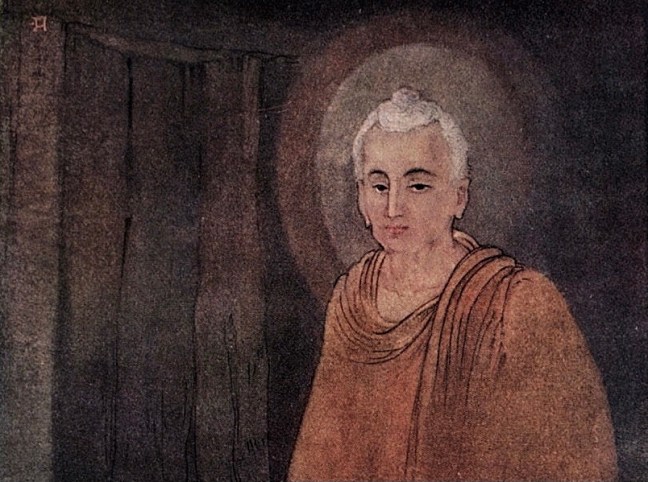
‘Buddha as mendicant’ (Part) – Abanindranath Tagore, 1914 – Wikimedia

.

To look into and understand the meaning and implications of being truly humble, of that state of humility which we often hear about — but rarely fully understand — is a precious thing. The word ‘humble’ finds its roots in the Latin ‘humilis’ which means ‘lowly’, literally ‘on the ground’ (from ‘humus’ meaning ‘earth’). Its etymology covers both the more active aspect contained in being ‘humiliated’, or being ‘humbled’, and the one that refers to the state, or quality, of being ‘selfless’. The first one gives the primary importance to the self that we are, to this separate entity that we believe to be, and which needs to be rendered humbler, smaller, lower. But why would we want to do that? Why, if it wasn’t for our deep intuition that this self is illusory, false, and is ultimately preventing our true identity of peace and happiness to be recognised and realised? 

This inherent peace contained in just ‘being’ refers to the second aspect of the word. Being humble is being without self, without the belief of being separate from objective experience. We are not this restless entity that wants to achieve, to aggrandise itself, and needs to be rendered low. We are rather this pure being whose very nature is complete, and already, unconditionally humble. Otherwise, why would Shiva or Buddha be portrayed as a mendicant? Therefore, the solution to our chronic state of suffering and conflict does not lie in having more, or less, or better ‘self’, but in realising, and living from, this deep and already achieved peace that we are. This realisation, and the action that is born of it, is what true humility is about. This simple phrase from the Bible made it crystal clear long ago: “When pride comes, then comes disgrace, but with humility comes wisdom.” (Proverbs 11:2)

I am sharing here a few quotes that will further explore this deep and essential question:

~~~

In a space of humility,
no conflict is possible
.”
~ Éric Baret (‘Let the Moon be Free’)

~

Humility contains in itself the answer to all the great problems of the life of the soul. It is the only key to faith with which the spiritual life begins: for faith and humility are inseparable. […] If we were incapable of humility we would be incapable of joy, because humility alone can destroy the self-centeredness that makes joy impossible.”
~ Thomas Merton (‘Seeds of Contemplation’)

[…]

Discover many more quotes on this question of humility… (READ MORE…)

.

Taking the Bow

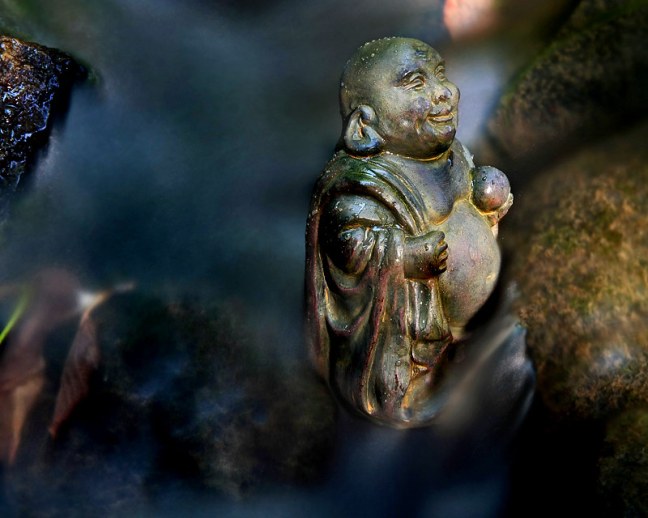
‘Bathing Buddha’ – Photo by ViaMoi on Foter.com

Here is a reminder inspired from the words of Rupert Spira. It is necessary and terribly efficient to look into these matters for ourselves. This is why I like to share here the parts of a spiritual teaching that sounds like ‘something to do’, something to experiment and verify for ourselves:

See that your experience is made of thoughts, feelings, sensations, and perceptions. Where is the ‘I’ that is orchestrating all of those? Where is this ‘I’ in the system? Take any thought that appears in you. Did you choose that thought? See if there was any entity, a chooser that decided to have that particular thought. Go slowly and observe carefully. See that there is no chooser in between each thought. The notion of a chooser is simply itself a thought appearing along many other thoughts. It’s only a thought that says ‘I was there in between each thought choosing it’. It’s the clown that wasn’t actually present but claims responsibility afterwards, and takes the bow. There is a choosing thought, but there is no chooser…’

~~~

Further exploring on the subject:

There is no entity present who could either have or not have free will. Experience is too intimate and immediate to admit of one who may stand back and orchestrate it like a conductor, willing, choosing, deciding, and so on. There is no time present for such a one to exist in. The idea of free will is an inevitable side effect of the belief in a separate entity. If we believe there is a separate entity, we will by definition, whether we know it or not, believe there is free will. If, as this apparent entity, we then believe there is no free will, then that is simply a belief that we superimpose onto our much deeper conviction that we are a separate doer, chooser, decider, and so on. Once the separate entity is seen clearly to be non-existent, the idea of free will dissolves. All that is left is the freedom of consciousness.”
~ Rupert Spira (’Interview with Paula Marvelly: Contemplating the Nature of Experience’)

~

Who is the entity that exercises will to do this or that? Please follow this carefully. If the observer is the observed what need is there for decision at all? … When there is any form of decision, depending on choice, it indicates a mind that is confused. A mind that sees very clearly has no choice, there is only action. And this lack of clarity comes into being when there is this division between the observer and the observed.”
~ J. Krishnamurti (‘Beyond Violence’ – Part IV, Chapter 1 – Brockwood Park, 3rd Public Talk)

~

When the mind returns to the heart, when the separate self is divested of its separateness and stands revealed as the only self of pure awareness, then it becomes clear that there was never a separate self to begin with. And therefore the question as to whether that separate self has choice or not is mute.” 
~ Rupert Spira

~

Freedom, I say, does not mean getting to do whatever one wishes. Nor does freedom have anything to do with so-called ‘free will’, which is a fantasy. Freedom arises with the understanding that in each moment what is, is, and cannot be different, including whatever ’myself’ sees, feels, thinks, or does. In the light of that understanding, while acceding outwardly to social conventions which require playing the role of chooser and decider, inwardly — within one’s private understanding — one may come clean and admit that the ‘myself’ who chooses is a fiction, a story I have learned to tell myself. In that admission one may find freedom — not the freedom to ‘choose’, but the freedom to be.”
~ Robert Saltzman (‘The Ten Thousand Things’)

~

In Hinduism the very idea of free will is non-existent, so there is no word for it. Will is commitment, fixation, bondage. … You must be free first. To be free in the world you must be free of the world. Otherwise your past decides for you and your future. Between what had happened and what must happen you are caught. Call it destiny or karma, but never — freedom. First return to your true being and then act from the heart of love.” 
~ Nisargadatta Maharaj (‘I Am That’)

~

Doing happens, and then you appropriate the doer-ship, but there is no doer-ship. Things happen. When you breathe, you don’t need to think that you’re a breather. When your heart beats, you don’t need to think that you’re a beater. When you’re digesting, you don’t need to think that you’re a digester. These things happen by themselves. The same way, thinking happens by itself; there is no thinker, there is only thinking. The thinker is a thought of other thoughts. So, there’s nothing to do actually means that there is no appropriation in life. Thus, you must give yourself to the fact that life is happening through you, but there is no need to pretend to be the doer. It’s not that there is nothing to do, it’s just that things happen by themselves.”
~ Eric Baret (‘There is No Doer’ in Science & Nonduality)

.

B4B1EF62-8C55-4D3A-A93C-CEF684A607CC

.

Bibliography:
– ‘Being Aware of Being Aware’, – by Rupert Spira – (Sahaja Publications)
– ‘I Am That‘ – by Sri Nisargadatta Maharaj – (Non-Duality Press)
– ‘The Ten Thousand Things’ – by Robert Saltzman – (Non-Duality Press)
– ‘Krishnamurti’s Notebook’ – by J. Krishnamurti – (Krishnamurti Publications of America, US)
– ‘Let the Moon Be Free: Conversations on Kashmiri Tantra’ – by Eric Baret (translation by Jeanric Meller) – (CreateSpace Independent Publishing Platform)

Websites:
Rupert Spira
J. Krishnamurti
Robert Saltzman
Nisargadatta Maharaj (Wikipedia)

Suggestions:
Fleeing to God (other pointers from the blog)
A Day at Brockwood Park (Homage to J. Krishnamurti)
Khetwadi Lane (Homage to Nisargadatta Maharaj)

.

Reality is a Verb

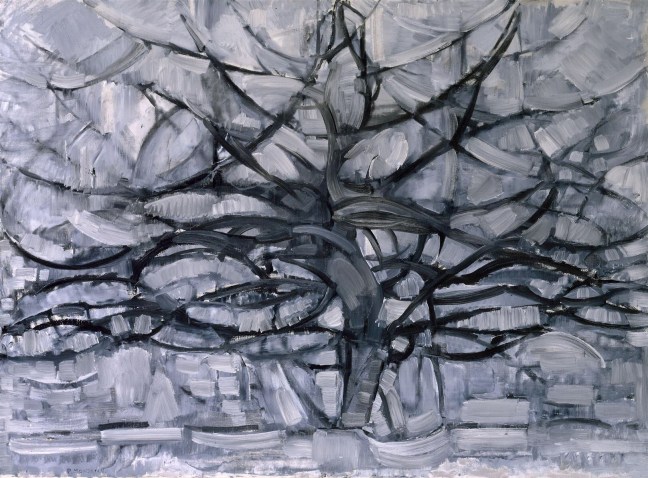
‘The Gray Tree’ – Piet Mondrian, 1911 – WikiArt

Here is a reminder inspired from the words of Rupert Spira. It is necessary and terribly efficient to look into these matters for ourselves. This is why I like to share here the parts of a spiritual teaching that sounds like ‘something to do’, something to experiment and verify for ourselves:

Instead of giving attention to the known object — thoughts, feelings, sensations and perceptions, give your attention to the knowing of your experience. Neither the knower, nor the known — just the knowing of your experience. Feel only in terms of verbs. Instead of thinking ‘I know such and such’, feel ‘There is only knowing and I am that’. Instead of thinking ‘I love you’, feel ‘There is only loving and I am that’. Instead of thinking ‘I see the tree’, feel ‘There is only seeing and I am that’…’

~~~

Further exploring on the subject:

When there is the awareness of the tree there is no evaluation. But when there is a response to the tree, when the tree is judged with like and dislike, then a division takes place in this awareness as the “me” and the “non-me”, the “me” who is different from the thing observed. This “me” is the response, in relationship, of past memory, past experiences. Now can there be an awareness, an observation of the tree, without any judgement, and can there be an observation of the response, the reactions, without any judgement? In this way we eradicate the principle of division, the principle of “me” and “non-me”, both in looking at the tree and in looking at ourselves.” 
– J. Krishnamurti (‘Awareness’ – ‘The Urgency of Change’)

~

We don’t really know or come in contact with an object, called a mind, a body, or a world. All we know is the knowing of our experience. And this knowing is not known by a separate object – the knower — this knowing knows itself. […] In the seeing of a tree for instance, there is no seer and there is no seen. There is no inside ‘I’ that sees and there is no outside ‘tree’ that is seen. The ‘I’ and the ‘tree’ are concepts superimposed by thinking onto the reality of the experience, which in this case could simply be called ‘seeing’.”
~ Rupert Spira (Presence, Vol.2)

~

The natural effortlessness of knowing, and the fact that it is always present, clearly prove it to be really the nature of the self; because this knowingness does not come and go like the other functions and does not part with the ‘I’-principle, even for a moment. […] A function should necessarily have a beginning and an end. Knowledge has neither of these, and so it cannot be a function. It serves as the background of all functions, lighting and co-ordinating all of them and their experiences.”
~ Atmananda Krishna Menon (‘Notes on Spiritual Discourses’ – 82 & 175)

~

Knowing Self,
mind empty and at peace,
the sage lives happily,
seeing, hearing, touching, smelling, eating
.”
– Ashtavakra Gita (Bart Marshall – 17.8)

~

Do not see God as having ever created anything but rather as being in every moment a different configuration that sometimes seems to reveal Him and sometimes seems to conceal Him, without any conditions, because He is the first and the last, the apparent and the hidden and He IS knowledge of everything.”
– Balyani (‘Know Yourself’)

~

In True Meditation all objects (thoughts, feelings, emotions, memories, etc.) are left to their natural functioning. This means that no effort should be made to focus on, manipulate, control, or suppress any object of awareness. In True Meditation the emphasis is on being awareness—not on being aware of objects, but on resting as conscious being itself. In meditation you are not trying to change your experience; you are changing your relationship to your experience.”
– Adyashanti (The Way of Liberation)

~

Only if your knowledge of your own Self is correct, can you hope to know anything else correctly. It is our experience that our physical activities do not stand in the way of our thoughts and feelings. Similarly, it is possible for me as witness to be always knowing – even when the body, senses and mind are functioning. Merely note this fact and become deeply convinced of it. Don’t attempt to objectify the witness by thought.”
~ Atmananda Krishna Menon (’Notes on Spiritual Discourses’ – 288)

~

In the beginning, 
The very first thing, 
The primary experience, 
Is pure knowing being. 
And that becomes 
— Or rather seems to become
Flesh.
This knowing takes the form 
Of seeing,
And seems to become 
The seen world, 
The object, 
The known.
In fact it never actually 
Becomes flesh. 
It always remains 
Pure knowing being
.”
– Rupert Spira (‘The Language of Non-Duality is only Verbs’)

.

B4B1EF62-8C55-4D3A-A93C-CEF684A607CC

.

Bibliography:
– ‘Presence’, Vol. I & II – by Rupert Spira – (Non-Duality Press)
– ‘The First and Last Freedom’ – by J. krishnamurti – (Rider Book)
– ‘Notes on Spiritual Discourses of Shri Atmananda: Volumes 1-2-3’ – Shri Atmananda (Krishna Menon) (Taken by Nitya Tripta) – (Non-duality Press)
– ‘Know Yourself: An explanation of the oneness of being’ – by Balyani – (Beshara Publications) 

Websites:
Rupert Spira
J. Krishnamurti
Adyashanti (Wikipedia)
Atmananda Krishna Menon (Wikipedia)
Ashtavakra Gita (Wikipedia)
Piet Mondrian (Wikipedia)

Suggestions:
Fleeing to God (other pointers from the blog…)

A Day at Brockwood Park (Homage to J. Krishnamurti)
The Householder Sage (Homage to Atmananda Krishna Menon)
The Song of Ashtavakra (Homage to the Ashtavakra Gita)

.

The Little Monsters

Here is a reminder inspired from the words of Rupert Spira. It is necessary and terribly efficient to look into these matters for ourselves. This is why I like to share here the parts of a spiritual teaching that sounds like ‘something to do’, something to experiment and verify for ourselves:

Just experience the raw sensation, for example of fear, without thought, without the labelling. Instead of covering it up, turn around and face it. Let the feeling come totally to you. Face it, keep living with it, keep opening yourself to it so fully, until there is not the slightest resistance to it. Ask yourself: Can I live with this feeling for ever? You have to be able to answer ‘yes’ to that question. Then see what remains of it. Be very careful not to turn this into a practice that you undertake in order to get rid of unpleasant feelings. Make it just a loving contemplation to discover the truth of your being, the dissolution of this feeling being a side-effect, a by-product…’

~~~

Further exploring on the subject:

Observation is like a flame which is attention, 
and with that capacity of observation, 
the wound, the feeling of hurt, the hate, 
all that, is burnt away, gone
.”
~ J. Krishnamurti 

~

Fall in love with this secret humanity. Know that darkness is NOT darkness, only scared fragments longing to come into the light, beings who want love, and attention, and breath, and inclusion in the larger picture of Self. […] Illuminate. Radiate. Make it safe for the little monsters to come out of hiding. Let them know they are beautiful. And worthy. And not monsters at all.”
~ Jeff Foster

~

In simple openness which is welcoming you will come to accept and get to know your negative feelings, desires and fears. Once welcomed in non-directed attention these feelings will burn themselves up, leaving only silence.”
~ Jean Klein (‘I Am’)

~

You never remain with any feeling, pure and simple, but always surround it with the paraphernalia of words. The word distorts it; thought, whirling round it, throws it into shadow, overpower it with mountainous fears and longings. You never remain with a feeling, and with nothing else: with hate, or with that strange feeling of beauty.” […] Try to remain with a feeling, and see what happens. You will find it amazingly difficult. Your mind will not leave the feeling alone; it comes rushing in with its remembrances, its associations, its do’s and don’ts, its everlasting chatter. […] Can you look without the movement of the mind? Can you live with the feeling behind the word, without the feeling that the word builds up? If you can, then you will discover an extraordinary thing, a movement beyond the measure of time, a spring that knows no summer.” 
~ J. Krishnamurti (Commentaries on Living, Series III – Chapter 37 – ‘Aloneness Beyond Loneliness’)

~

The dark thought, the shame, the malice,
meet them at the door laughing, and invite them in.
Be grateful for whoever comes, because each 
has been sent as a guide from the beyond
.”
~ Rumi

.

B4B1EF62-8C55-4D3A-A93C-CEF684A607CC

.

The photo is by Alain Joly

Bibliography:
– ‘Presence’, Vol. I & II – by Rupert Spira (Non-Duality Press)
– ‘Commentaries on Living, I, II & III’ – by J. Krishnamurti – (Quest Books,U.S.)
– ‘The Way of Rest: Finding the Courage to Hold Everything in Love’ – by Jeff Foster – (Sounds True)
– ‘I Am’ – by Jean Klein – (Non-Duality Press)
– ‘The Essential Rumi’ – Translated by Coleman Barks – (HarperOne)

Websites:
Rupert Spira
J. Krishnamurti
Jean Klein (Wikipedia)
Jeff Foster
Rumi (Wikipedia)

Suggestions:
Fleeing to God (other pointers from the blog)
A Day at Brockwood Park (Homage to J. Krishnamurti)
Rumi (Homage to Rumi)
A Secret Love Affair with Life (text by Jeff Foster)

.