A Universal Cure

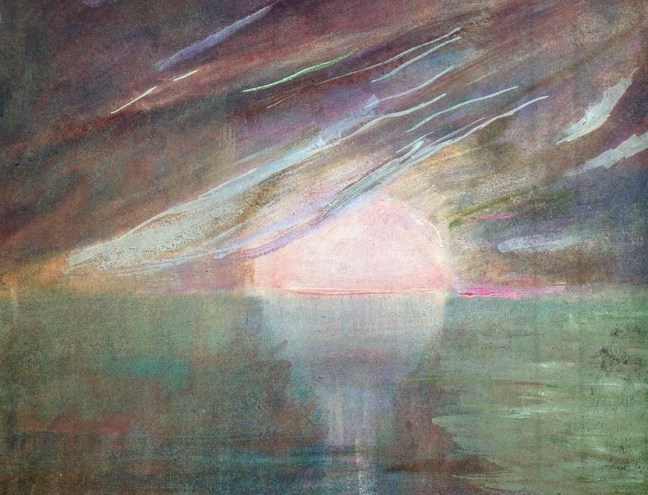
‘Creation of the World XIII’ (part) – Mikalojus Konstantinas Ciurlionis, 1906 – WikiArt

The part that we’re playing is not small. We are not living in a corner, limited by the skin of our bodies, and the world is not limited to the time and space in which it seems to unfold and have its conflicts and sufferings. The world has a foot in the infinite. In fact not just a foot, it is bathed in infinity, in eternity, and so are we, we who have been made small and suffering entities by our limiting beliefs and prejudices. We are ruling the world with our thoughts and then blame ourself for it. For the results are of course as limited as our thoughts can be. We have made the world the hostage of our limitations, and its hostility is in fact our own, that we have projected unto it. We believe and think we can only play small and limited, but in fact, we haven’t quite seen ourself as we are, and from this blindness comes the entirety of the world’s agony, and ours too.

Fortunately, ours and the world’s true essence comes spilling over in every possible way through the manifestation of beauty, and through the many expressions of love or peace. That’s what makes it so attractive in spite of all, and that’s where we should be way more curious than we are. Beauty, love, intelligence, peace, are not created by the random structure of a body and the passing thoughts in our mind. This is not where they are manufactured. They are born of infinity and wholeness. They are the expressions of the One, which we can never own. We are in fact rather owned by them, embraced by the infinity that is their reality. We must surrender to this god given identity. We don’t have to play small. Would we think of god playing small? So why would we of ourself, who are like the arm and willpower of God in God’s dream? So we don’t have to play small in this world. We ought to play our given, sacred part. We ought to be what we are and recognise ourself and the world as a whole, indivisible being. A being that is nothing but our own, that is experienced here and now every time we say ‘I Am’, and that we are fortunate enough to share in.

Act on the world from within. Mould it from there, from the source of yourself and of the world, from the ground of being that you feel as your own being, and that is the common ground of all beings and all things. This ground has the best ability. Religions haven’t called it Paradise or Eden for nothing. There is always a truth behind every misunderstood word. This ground of being is where you can play big, from within, from the interior of everything and everyone. You don’t have to create a new reality. It’s already there within and without, for the taking and for the looking. This reality is already here, already yours. There is love and harmony woven in the fabric of life, just here and now in and as our given experience. Our efforts to heal ourself and the world are veiling this reality, and so are our limited thoughts, which carry the false reality of there being persons and separation instead of the reality of one being and the peace contained in the infinite. Our own unlimited being is the ground where we can play big, for it is as large as God’s being if we are willing to notice its real, undefeatable nature. In fact, being is a universal cure, and it’s always at hand.

.

~~~

Text by Alain Joly

Painting by Mikalojus Konstantinas Ciurlionis (1875-1911)

~~~

.

Website:
Mikalojus Konstantinas Ciurlionis (Wikipedia)

Suggestion:
Other ‘Ways of Being’ from the blog…

.
Daily Calling

It is easy to look, easier than we think. Yes we have seen temples and churches by the thousands, endless acts of devotions, and pilgrims whose faith seems indestructible. Yes we have marvelled at yogis whose ability and constancy is a subject of awe, at monks whose dedication and celibacy seem unattainable. It may have dawned on us that this path is too rigorous, that spirituality in only for the chosen few, for the dedicated ones, whose lives are set on a perfect course for it. So we have renounced to go there, finding excuses — that we don’t have what it takes, that God has for us no calling, that I wouldn’t have half of the rigour that a serious spiritual path requires. So we have stayed where we are, repairing here and there a few cumbersome habits, loving our loved ones, sharing our usual skills with the world, battling with our thoughts, dealing with our sorrows. We didn’t dare, didn’t quite believe that the spiritual endeavour was our path, or the path of the majority of us. We stayed put. We gave up without even the beginning of an understanding.

But spirituality is not what we think. It is not a path of renunciation or remoteness. It is not about belief, opinion, or even conviction. It is about reality. It is about looking what there truly is, here and now. What our experience is made of. What there is behind the gloss of experience. That’s how we are spiritual, by looking for that part of ourself that is not a thought, not a sensation or a feeling, not the body that we have come to be identified with. That’s how we are religious, by finding this deeper identity of ourself that is wholly and naturally related to others and to everything. By recognising that ungraspable, unfathomable, deeper being that is our eternal home, which we have lost sight of in the tempestuous world of our many experiences, a world that has so far attracted the totality of our attention without our objecting. We have simply missed, maybe indulgently, that spirituality is about knowing who we are, no more than that. Spirituality is not about practice or achievement, for its only aim lies in recognising what is eternally here as the very fabric of our self. It is not about age, for age will never affect what we are in the depth of our being. It is not about health, for there is a place in ourself that is forever stamped with wholeness, which is another name for perfect health.

So we don’t need to go to churches or temples, for where we are is our church if we know how to make it so, and inhabit it, not with our worries and projections, but with who we are as our deepest being. And remember that the world makes for a marvellous temple, when we connect to it with our deeper self, and bathe it with the peace of our own being. We will be in touch with our spiritual being every time we experience love in our life. That’s why people have pets, so that they can stay in touch with their heart. That’s why we so dearly seek the intimacy of relationship in our life, so we can lose the distance that our minds have imposed on us. That’s why we love fulfilling our desires, for we know that we find there, in this fulfilling, a taste of our own loving, untouched, unconditioned being.

So there is a mass or a puja going on in every corner of every experience that we may have. There are hallelujahs that can rise any time, anywhere, anyhow, if we are willing to pause and look at what our present experience is made of. And know that we will never be asked to believe, or corrupt any part of our gorgeous being, for we have a duty to be faithful to our self as it is. The only practice or prayer we will ever have to perform is to recognise and be aware of the nature of our being. This true and only identity or nature is lying just behind every temporary appearances and objects that can be formed, named, and pointed to in experience. Know that the formless is our most intimate companion, for it doesn’t live in time or place or objects, but in and as the very ground that is our one and only identity and being. This connection to that deepest, most intimate being in our everyday life, is in itself the most religious endeavour there is, where spirit is discovered to be the only thing in presence, and the home where we find our joy, and our undefeatable reality.

.

~~~

Text and photo by Alain Joly

~~~

.

Suggestion:
– Other ‘Reveries’ from the blog…

.

Holy Ground

We have no being of our own. We have built our existence as a person, as a body, as a bouquet of perceiving faculties, on a ground that is not our ground. We are borrowers, incomplete entities, which is the reason for our restlessness, for our many lacks, and for our sense of insufficiency. Wholeness and plenitude are attributes of the ground or essence. This essence is hidden because we are overlooking it. We, on our choice, have displaced our attention to what we mistakenly take to be ourself: our thoughts, feelings, sensations and perceptions — all that makes a narrative, that gives us an appearance, a consistency, an existence. But one such existence is a fraud. It is not what we essentially are. We have displaced our self, our identity, from the ground to the landscape, from the essence to the superfluous appearances that owe their existence to that universal, infinite being or ground.

But an appearance can never make us. A thought doesn’t make an identity. An idea, an image, a body, are not what we are in essence. But they all have a common ground, hence our confusion in our perceived identity. This common ground is our deepest sense of being, the consciousness that is found at the root of ourself. If only we were aware that what is seeing, thinking, perceiving in us, is actually the ground, not ourself; that what is experiencing, what is aware in our everyday life, is in fact this supreme, infinite ground, then we would acquire a very different idea or perception about ourself, another responsibility, another awe, another reverence for our reality. Our reality would be discovered to be the ground of all beings, called ‘god’ in the spiritual literature. God is not a word for a thing or a person, but for a living experience, a taste, the feeling of being that has its reality here and now. It is not distant, not dependent on a belief. It is a hard reality, accessible in all experience. It is our true nature, what we are, and what we know we are, without a shadow of doubt.

God is not a guess, a maybe, a question. God is a certainty, an evidence, and the answer to our suffering. It is our very conscious sense of being, the very thing which in us makes for the feeling ‘I’, for what I am in truth and in depth. It is our one and only reality. If we do live from that essential ‘I’, then we live from inside the holiest of temples. We cease living and acting from a private, separate sense of an individual self. Behind the veil of our mist, of our everyday fascination for mind, body, appearance, existence, is a presence that is revealed when we let go of ourself. It bears in its DNA the savour of holiness, and of a quiet, unbreakable happiness. Holiness is not an attribute of things, places or people for which we may have reverence. Sacredness doesn’t belong to the landscape, or the object. It is rather the natural expression of our true self, of ‘I’. It is in abiding in our true nature or essence that we feel a deep reverence for everyone and everything. What is sacred is our intimate, infinite being, and this being draws its holiness from its one pristine, untarnished, infinite nature. Wholeness makes for holiness. Holiness belongs to the ground, and the ground has it in its nature to shower benevolence to all hosted appearances. This is how we have, shining in our experience, the qualities of peace, love, beauty. They are all offsprings of the holy ground, which is ourself.

.

~~~

Text and photo by Alain Joly

~~~

.

Suggestion:
Other ‘Ways of Being’ from the blog…

.
’katholikos’

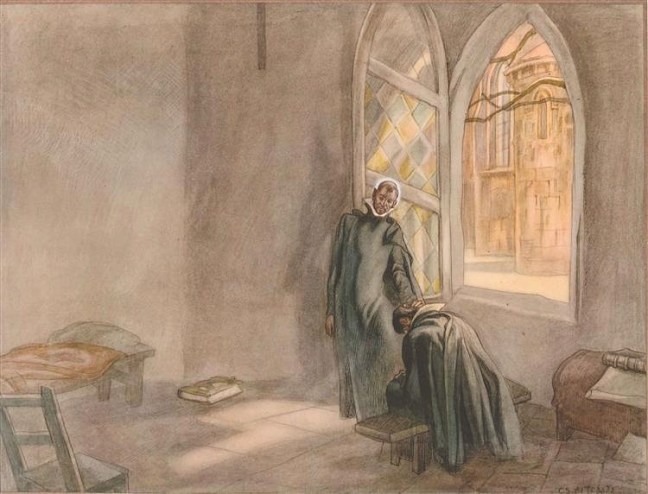
‘The Life of St. Ignatius Loyola. Plate 4.‘ – Carlos Saenz de Tejada – WikiArt

You’ve got to respect the whole. That’s how you live the good life, in having reverence for the totality of your experience. Not just for the superfluous, all that is being the foam of life, that exists and appears, that you can see, hear, touch. You will never make a totality from the world of objects, from thoughts and perceptions. These are but occasional appearances, superficies. They are above you as it were, dancing upon you, at the periphery of who you are, but are not the reality covering your experience — its most profound constituent. You’ve got to go beyond the mundane and the obvious. For we keep leaving something out of experience. We don’t take the whole thing. We are choosy, only care for objects, don’t integrate our ‘within’ — where the reality of our being is. Notice that there is a world here, that is encompassing our world — a presence pervading our reality, taking everything in.

Actually, this is what the word ‘catholic’ is about. In Greek, ‘katholikos’ means: ‘pertaining to the whole’. We have to pay due respect to the whole, to the totality. We must look back at what we truly are, and find there the expression of the whole. I am not sure that Ignatius of Antioch had this in mind, when he first coined the term ‘catholic’ in the early 2nd century AD. He probably meant that the new belief, the new credence, was to be the universal truth, meant for everyone, adopted by all. But there was no need for adoption — the baby was already in the womb. There were no beliefs to be had, no hopes to project and entertain, no happiness to seek outside of our common day experience as being. He didn’t see that in this very word was the answer to all religions, to every quest for the divine peace; that what we were looking for was already here, close, so close to our very experience; and that there was no need to form a belief about it, or a new credence.

To accord with the whole is to be reconciled with our true nature — the reality of our being. It is to be ‘of one mind’, which is what reconciliation means, and to be brought together under the vault of one reality. This is achieved by turning towards the One, which is our true and only constituent. Universality wasn’t meant to be achieved in multiplicity. Universality is the quality of oneness noticed. The totality is in every place you happen to be. There is no totality of which you wouldn’t be the vessel. For the whole is not a geography, not a place to be in. It is the embrace of being. There is a totality in and as the being which you are now, here. You are not inside a totality. The totality is inside you. But mind you, this most venerated Christian Patriarch Ignatius of Antioch did say something of the highest order, when he brought up the word. He said that “wherever Jesus Christ is, there is the Catholic Church.” Yes. Yes indeed. Wherever we as our deepest being are, whenever we as our most profound nature-consciousness are, there is the expression of the whole, of oneness — the totality which is the very nature of the Lord’s House, and which is our nature and our house too.

.

~~~

Text by Alain Joly

Quote by Ignatius of Antioch (died c. 108/140)

Painting by Carlos Saenz de Tejada (1897-1958)

~~~

.

Websites:
Ignatius of Antioch (Wikipedia)
Carlos Saenz de Tejada (Wikipedia)

Suggestion:
Other ‘Ways of Being’ from the blog…

.
Undivided Being

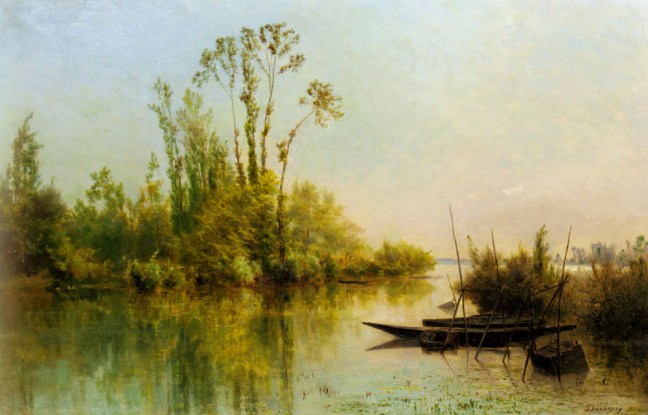
‘The Virgin Islands In Bezons’ – Charles-Francois Daubigny, 1855 – WikiArt

We all want to be happy. That’s our most profound desire. Everything we do is only expressing that longing. We want to be whole, free from contradiction and suffering. That’s the quiet or not so quiet battle that our life is, whether we acknowledge it or not. That’s being human in a nutshell. Really, humanhood is a quest. As an individual, that’s all we are seeking. But are we really an individual? Are we really a particle amongst the space of humanity? Are we truly a self contained in a body, an ‘indivisible entity’ as the word ‘individual’ has sought to make us believe? In Latin, ‘individuum’ stands for ‘atom’. But in fact, we feel that we are not yet an individual — we are divided, torn apart, haven’t quite found the person that we have the urge to be. Our limits are blurry. Our qualities are evasive. Our purpose is hazy. We often don’t find ourself in ourself. There is a blank there if we look carefully. So what is truly existing in us? What is here that is worth being called myself, or ‘I’? What is being an individual?

Now, most people don’t like being told. Our being is a much too serious affair to be delegated to another. We want to feel for ourself. We want to feel both what we are, and that we are. That’s why we keep looking, seeking, failing, finding, falling, doubting. We keep dancing the life we are in, by all means. We are seeking ourself in all that comes. In fact, just being an individual doesn’t seem to make it. We feel there is more to us than being a separate entity, delineated by the limits of our body and mind. It doesn’t fit — doesn’t quite match our intuition. It doesn’t feel that we are that limited. It doesn’t feel that we truly know what we are. Maybe it never was about our bodies. Maybe our individuality takes its source in infinity. This is what we were meant to be. This is what an individual is, undivided, not distinguished from everything, devoted to the quality of being that encompasses the universe and beyond. We were never a thing, a particle. Only, it seems that we have squeezed our indivisibility into a body to fit the general consensus.

Paradoxically, it is not in our differences that we find our individuality, but in the sameness of being. Our differences are simply the residues, the negligible expressions of a conditioning at the level of the body-mind. They are not an expression of our individuality. They do not represent us. We are not to be defined by the small, but by the expanded field of our awareness, the immensity of being. In a strange way, this identity-less identity is making us the very person or individual that we have always wanted to be. Do you want to be the best version of yourself? So be. Just be. Be that formless, identity-less being that you are and have missed for wanting to be only qualities or talents. Qualities and talents need our being first for their field of expression. We are their container. Without this silent presence of being that we are, they remain simple goods that we use to buy a semblance of composure, with its flickering moments of satisfaction and pride. Our being identified with them is the cause of your suffering. But there will come a time when being will be seen as the only mark or evidence of our individuality. Being is what our individuality is made of. It is our true body. Idiosyncrasies and differences are but the crumbs left at the table of experience.

In fact, being is what being an individual is. Our individuality is found in the shining of being. Not in the shining of our conditioning and idiosyncrasies. We will learn to see our so-called qualities behind us, almost non-existent, choked by the brightness of being. Bodies are only points of view. And minds are the tools for the government of our body. Our self is not there, not located. It is an expansion. Being an individual is being whole, undivided. It is to find our completeness in and through the world. It is to see and feel that the totality of experience is made of being, and that being is the essence of our individuality. Being an individual means that we are not a divided, broken up, an assembly of body, thoughts, feelings, experiences that makes for a person. How could we be an individual when we draw our identity from scattered objects that tear us apart and leave us confused — unanchored to our deepest self? We own our freedom to the recognition of our individuality, which consists of undivided being. The word speaks for itself. An individual is an undivided being. It is not found in our qualities and idiosyncrasies, not in our body and mind. We draw our individuality from simply being.

.

~~~

Text by Alain Joly

Painting by Charles-Francois Daubigny (1817-1878)

~~~

.

Website:
Charles-Francois Daubigny (Wikipedia)

Suggestion:
– Other ‘Reveries’ from the blog…

.

The Formula of Life

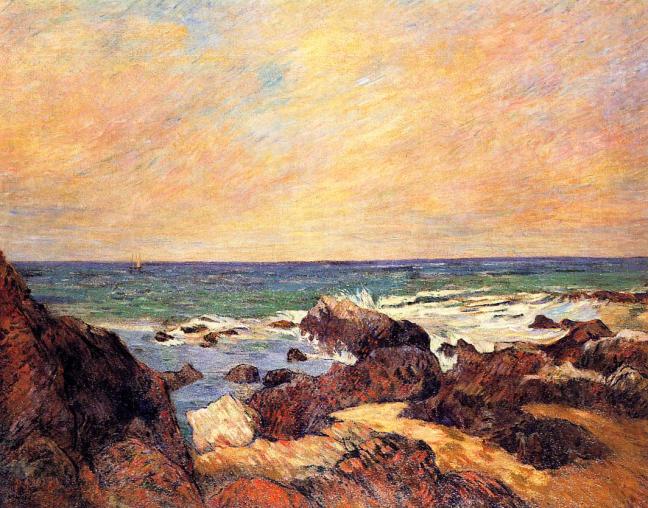
‘Rocks and sea’ – Paul Gauguin, 1886 – WikiArt

There is something mathematical about the spiritual life. You need to get the formula right, which is simply to recognise being as your one only identity. Simply being, with no addition to it. Concentrated being. If you cannot recognise yourself as that, then life will bounce back at you in endless, nasty, different ways. You will be made into somebody frail, vulnerable, suffering. Out of your failure at being who you truly are, you will draw an idea of who you are, a belief in being a separate entity, identifying yourself with your body-mind. This invented self is a diminution of your real identity. It has, inscribed in its very making, an imbalance, a lack. You will feel small, incomplete, at the mercy of beliefs and images, assailed by objects. You will be made uncertain, needy, a seeker of your lost identity. So you will then receive many of your experiences as a threat, as something that can hurt you, diminish you. That’s how fear arises, out of incompleteness, when there is a flaw in the equation of being. You are as to say behind yourself, mistaken. You have failed at just being, and are now being this and that. You have lost your anchor for a trip into objectivity. You have exchanged wholeness for separation.

Now you look everywhere frantically for something to complete you, and you find it a hundred times, in a passing object, in a success, an achievement, a bout of luck, a relationship. But these are fake friends that will fail you. For there is nothing here in the objective world that can match being. Dissatisfaction will hover over you again and again, no matter how many objective goals you may set your heart on, and attain. You will never resolve that equation. A flaw will remain, and your life formula will be left empty of meaning, unable to find its resolution. These objects that were your hope for fulfilment will finally come biting at you, for they are but the tricks that you have used as an escape from yourself. They are your being that you have let down, and split apart. They are your means to mend and repair yourself. But to project yourself in objects is to hope, expect, envy, and open the door to endless suffering. This wound is the sign of your incompleteness, the symptom of your failure at recognising your true identity. Every neglect or rejection of your true nature creates openings where experience will come and stand in front of you as something to be afraid of, or to desire. So you are never safe, never alone. It all comes back to you as a mirror of your own insufficiency.

Remember that you will attract to yourself everything that you cannot hold as your own, and understand. To be at peace in this life is a very simple matter. It lies in only one experience, which is the experience of being. Being is your universal health insurance. Being is your completeness, and therefore your well-being. If you don’t own in and as yourself your well-being, if you fail to occupy the totality of your experience — finding safety there — then you will be assailed by life. Experience will send its soldiers at you, which are but all that you cannot hold or recognise as being your own being. Hurt, confusion, fear, misunderstanding will become your usual, well-rehearsed environment, that you will accept as normal. They will become the weapons that turn against you every time you don’t fully integrate experience as the very blood and bones of infinite being. So don’t let experiences down, to live on their own, lost, clothed in separation and enmity. The enmity of experience is of your own making. You are responsible for what hits you or heals you. And you have in yourself, as yourself, the remedy for every hurt or suffering that overcome you. You have in and as your own being the ability to feel whole, complete, self-satisfied. There lies your natural competence at living. This is how you have experience always on your side, like a friend that you never fail to embrace. This is how you complete the formula of life — through clarity and brightness of being.

.

~~~

Text by Alain Joly

Painting by Paul Gauguin (1848-1903)

~~~

.

Website:
Paul Gauguin (Wikipedia)

Suggestion:
Other ‘Ways of Being’ from the blog…

.
A Holy Formula

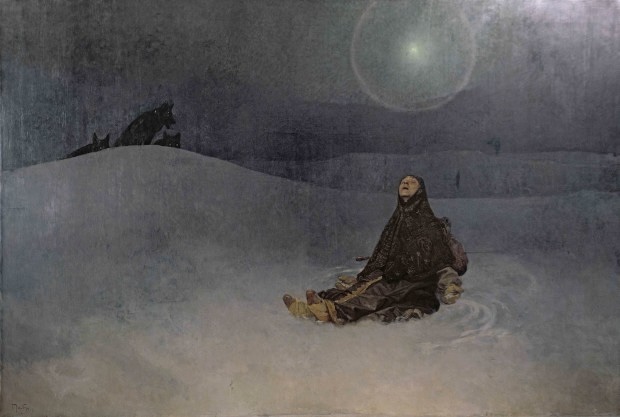
‘Woman in the Wilderness’ – Alphonse Mucha, 1923 – Wikimedia

.

Consciousness is an internal relationship to the whole.”
~ David Bohm

.

You cannot suffer when the world in which you live is discovered to be you. That’s mathematical. A formula that will work magic in your life. For you don’t live separated from everything else. You are not limited to your body, and the world is not something that is distinct from you, at a distance from you. You discover that the jump was made long ago, that you have been the totality already from the beginning of ages, eternally one with it, and that there never was an inch that separated you from the world you live in. That’s how you are complete, by knowing no separation, by entertaining no difference, and therefore having no preference. So you cannot be lacking anything, and suffering is always only the lacking of something, which is born of separation. So stay there, in your inseparable essence, in your world of completeness. Notice that this is what you are, or rather what there is, when you stop fantasising yourself being somebody. You never had an existence of your own. You are the flowering of something deeper. If you ignore or overlook this simple truth, well… then the trouble begins, all the travail of life, and the never ending seeking for fulfilment. This never was about you. Life is bigger, wider than that, and you are here only to honour that and to live by its gorgeous rules.

Then you enter into sacredness. You leave the limitations of being somebody — a projection, an idea that thought has sculpted over time — for a merging with infinity, with who you truly are. This is what sacredness is: an entering into your true self. A visiting of the truth of your being. The anointing of your self with its reality. This entering is a sanction from truth. It is the death of an old idea which you have entertained, for a ride into unknowing. It is a ceremony in which you are being elevated to a reality that you have been blind to. You are being sanctified, or made true. You were already that, already living as that reality, already tasting of that firmament, but were distracted. You were drawn to be something, insisted in being exclusively yourself, by yourself, so you have ignored it. You missed the chance to know yourself truly. You worked too hard to be what you are not. You lacked passivity. Not that you don’t have to do anything to come to this understanding. But rather, this understanding is nothing you do. It is here in you, as you, without your doing anything about it. It doesn’t need your participation, or rather it needs your non-participation, your staying away, your keeping quiet. Your abandonment. The hardest thing of all.

Then you enter into holiness. You taste of your true home, which happens to be the home of god. You are made holy, which means whole, uninjured, healthy. You realise where you are, what you are, the stone you are made of. You notice your true body — the consciousness of everything. You connect with a reality that could never be transgressed or violated. A reality which you could only fall in love with, for it is your beloved self, which you have lost sight of, and are now reunited with, consecrated in, and which you would never want to leave, or not live by. You are made of the same golden dust that the stars are made of. I don’t mean just your body, but what you are at the core, the essence of your self, what you happen to be when you say simply ’I am’. You are made into “an internal relationship to the whole”, as David Bohm expressed so beautifully. And you will struggle to see the world as a collection of different parts, or to see yourself as one such part amongst many others. The One will come to be your only experience. But you will be defeated again and again. You will come to feel a part again. You will be seduced to be somebody time and again. You will want to feel separated again, to win another last adventure or advantage for yourself. You know: your little devil wanting to be the likes of god. But keep going. Keep going. Until one day, it may dawn on you: you are no more.

.

~~~

Text by Alain Joly

Quote by David Bohm (1917-1992)

Painting by Alphonse Mucha (1860-1939)

~~~

.

Websites:
David Bohm (Wikipedia)
Alphonse Mucha (Wikipedia)

Suggestions:
– Other ‘Reveries’ from the blog…
– A page from the blog dedicated to David Bohm: ‘Insights into Wholeness’…

.