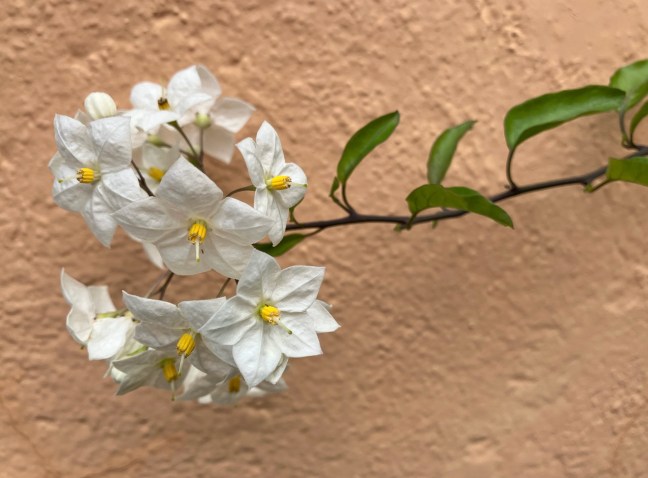
Humanness

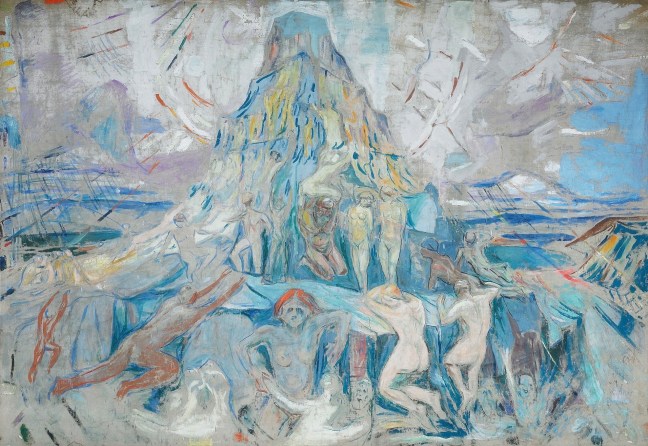
‘The Human Mountain: Towards the Light’ – Edvard Munch, 1927-29 – Wikimedia

There is no human being. This is quite extraordinary to think of it, and even positively mind-blowing. But turn it around as much as you may, the true self of man is not where a body is. It doesn’t take shelter there. A body, or even a mind for that matter, is way too small and inappropriate to house your beautiful being. There is no room there. For how could the infinite enter something that is finite, limited, prone to decay and death? How could something that knows no beginning and no end, be contained in a passing thought, in a mind which is changing, developing, forgetting, believing, cheating and being cheated? In being, you won’t find the beginning of a change, won’t find even the possibility of death. In being, there is no forgetting who you are. Only a mind can forget its own nature, not because there is something there that can forget, but because thoughts, feelings, perceptions, when they are believed to be yourself, are hindering your true nature, rendering it as if absent. What is left is only a cheating thought that believes itself to be real as self, when it is not.

There is nothing depressing in not being a human being, and nothing demeaning. Being is such a malleable thing that we still retain the illusion of being a human being, a person, as we do now, but with the difference that this illusion won’t hide the reality that is behind it, and that is our true identity. Losing our identity as a person doesn’t mean that we won’t feel compassion for another, or love for our beloved, for love is not contained in being a self separate from an other. Love doesn’t need to be directed. We are not doing love, let alone giving it. Love is the expression or signature contained in our simply being. It is the feeling of being that irradiates in every directions, and that is shared as that which we are here and now. And don’t think either that you will lose your ambition, but it will be reoriented to be not your ambition, but the very contagion of being in every aspect of your life and world. And don’t think that you will miss out on happiness, for happiness was never yours, never your expression, never contained in achieving or obtaining a thing that thought has said you desire. Happiness is the very feeling of being, that we cannot contain or limit, but which splashes over to colour life with a golden hue of oneness.

So there is only being taking momentarily the clothes of a human being. But being itself has no qualifications, no colours which would render it a definable entity. The colours and the qualifications are not pertaining to being. They are the property of everything that appears in being, but is not being. They are in body, thoughts, sensations, perceptions, in all the existing things that come and go, dancing to make the form of a world, of what we call a human, a dog, a mountain, or the parking lot in which we park our car. To be being won’t diminish our feeling of being a person. It will enrich it, for being is the essence of a person. Being is the essential of our experience as a human being, only we don’t see that, don’t know that. Our focusing on the belief to be an objective entity that thinks, feels, and perceives has made us blind to our reality. So let’s remind ourself that there are no limited human beings, but only one unlimited being. This knowing and feeling of being only one unlimited being is a source of constant awe in life. And this vision is what gives its true colour and reality to our imaginary humanness.

.

~~~

Text by Alain Joly

Painting by Edvard Munch (1863-1944)

~~~

.

Website:
Edvard Munch (Wikipedia)

Suggestion:
Other ‘Ways of Being’ from the blog…

,

Demons and Angels

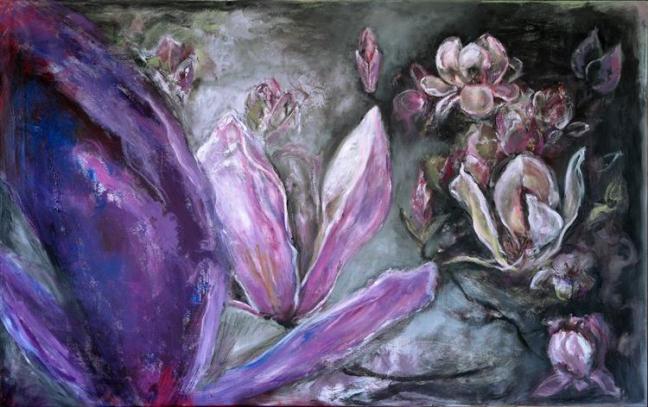
‘Magnolias’ – Carmen Delaco, 2022 – WikiArt

We are only ever made of thoughts. Sometime, thoughts come elaborate, with clearly defined words, perfect punctuation, following their due purpose. And sometime not. Sometime, they come as lightnings, striking us with a belief, an old stale repetitive assumption. Sometime, they linger unsaid, not pronounced, sneaking in but making untold damages. Sometime they don’t even need to be expressed. They have taken us over, have made a puppet of our life, tearing it apart in every mindless direction. All these thoughts are like little devils, unseen demons, unnoticed burglars stealing our identity. We have been brought to our knees, at the mercy of every one of their injunctions. We have been made just a collection of them, and nothing but an assumption. An idea of ourself. A self literally made up by the constant assault of thoughts, and by our believing them — belief being yet another thought.

Look in every direction you may. Notice here the coming of a hope, of a longing that takes form, but is yet just a thought. And when a worry comes, that this longing may never be fulfilled, it is just another thought that comes dancing with it. Attend to your expectations, to how you now imagine a future event. See how this evocation of the future comes as just another thought in your mind, for there is only ever thinking about the future. The future doesn’t exist, is always only imagined by a random thought. A regret, a desire, a fear, any bout of suffering or satisfaction, any feeling, comes wrapped in and as a thought. Thoughts are everywhere in our world. Even our body, our action, our world, are coloured and shaped by a thought or an image that condition their being perceived. A habit is a thought that took root and grew confident, unchecked, and many of our conditionings were once thoughts that have formed to become the established norm. As long as there is a thought somewhere in the system, that comes to define us, to give us a stand, an identity, that identifies with the body, that separates from the world, that gives a fleeting joy, or a tenacious pain, then we are not alone. We are not independent. We are not being our own identity. We have given it all up to thoughts, and have lost our being in them.

So go behind it all. Go before everything that appears for a while and recedes. Go before every worry, every hope, every mindless desire, behind every dull satisfaction that lingers lazily, every fear that strikes and leaves its trail inside you. Go to the place in you before every thought. Visit that portion of yourself where thoughts are of no consequence, where they are made trivial, ridiculous in their powerlessness. Go where distance is not, for thought as time has created the gap between yourself and your true nature, a gap where hides every shades of conflict and suffering in yourself — which are again thoughts. And go where you discover yourself to be unbreakable, unsoilable, eternal, for death too is another of your endless thoughts, maybe the most perverse one, but one that doesn’t stand being seriously investigated. Notice that thought is always some kind of thing, and that there is one place in yourself that a thing, that a thought, will never touch, or affect, or change: it is that portion of emptiness in yourself, which is only full of itself, and is therefore inaccessible to a thought — any thought. That placeless place is your peaceful being, your identity, who you truly are. To stand as that will freeze dead all the many thoughts whose only function was to give you support or approval, identity or escape, or contentment. These are burglar- or demon-thoughts, that come to lie to you, and try to impose their views on everything and on yourself. But a thought that is starting its journey from that virgin place of being is but a devotee and an angel, respecting your true identity and carrying in its wings the offering of your being, which is love. It is but a servant of the higher intelligence of truth. In general, demons are many, and angels are but a few.

.

~~~

Text by Alain Joly

Painting by Carmen Delaco (born 1976)

~~~

.

Website:
Carmen Delaco (WikiArt)

Suggestion:
– Other ‘Reveries’ from the blog…

.

Apocalypse

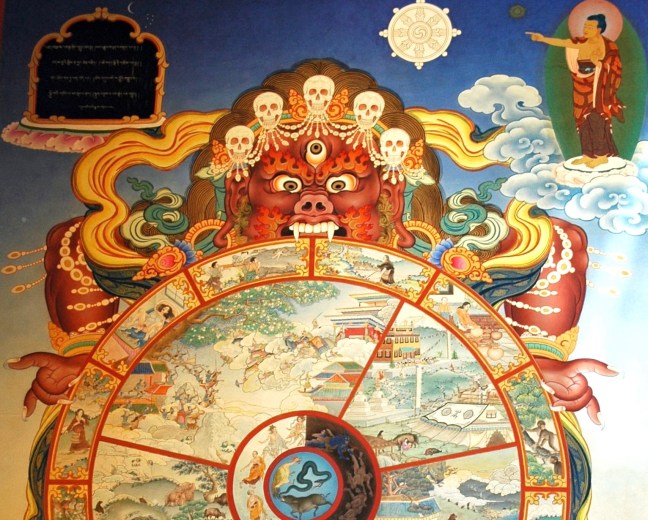
‘Traditional bhavachakra wall mural’ – By Wonderlane (Sakya Monastery of Seattle) – Wikimedia

There is a beautiful and meaningful contrast in Buddhism. It is to be found in the approach to impermanence (‘anicca’), which can be a very effective pathway to our true nature. It says: everything that passes away is not it, is not you. Notice everything in and around you, and see that it won’t be always here. The house where you live will be destroyed, and no objects you possess will stay forever, including your body, and the billions of other bodies, including the trees, the seas, the mountains, the air you breathe. Eventually, they will all go. Your thoughts, emotions, qualities, character, mind, that you think characterise you, well… The planets will wither too, the suns will die down, and space even may one day be swallowed back where it once was seemingly born.

Scan your experience and try to find something that doesn’t pass away. But go far enough. For then will come, like a new dawn, the revelation that there is something here that never passes away. There is a permanence, a nature, that is your very being, which will never not be, and which swallows in its own profound nature all things discovered to be devoid of their own independent natures. So in the end, nothing really passes away, for all the separate objects of your experience do not possess their own individual, separate nature, which could be considered impermanent. Impermanence is when you think you are a body. But in fact, permanence is all there is, and it is lived and seen as the one being that we truly are.

With this understanding, you will come to realise that your suffering also cannot stand the revelation of your completeness. What you called ‘suffering’ can only exist in the belief that all objects have their own separate existence. Believing yourself to be one such separate object, you find yourself to be incomplete, not enough, therefore seeking in objects your happiness or completeness, which you could of course never find. You started with a wrong view in mind, which made everything down the line unsatisfactory, and biased. That’s why the Buddhist term for suffering ´dukkha’ has the meaning of an ‘unstable stand’, or more poetically, the ‘badly fitting axle-hole of a cart or chariot’ giving ‘a very bumpy ride’. So what then? Suffering never actually existed? Was it all in our mind? Created by a simple belief, an ill-fitting understanding, a shaky representation, that rendered our world unstable, untrue?

In Buddhism, the positive is never named. What is is never mentioned. That’s why it is said that our existence bears the three qualities of ‘impermanence’, ‘suffering’, and ‘no-self’. You will never find a self in something that it always in movement, always changing. No self in things, no self in a thought, no self in a body, no self in you — this is how far it goes. There is no self inside your body-mind. There cannot be. This is logic. No phenomenon could ever hosts a self. There is ‘no self-existent essence’, as suggests the Buddhist term ‘anattā’. Essence cannot just exist. It would make it appear or disappear. The essence of all things, including your own self, is infinite, not limited, not bound to any phenomenon. So ‘no-self’ in Buddhism is only a strategy for you to realise that the only self in presence is the nature or being of all things and selves, which we are, but cannot comprehend or even name. This is what the wisdom of Buddhism has put in practice in such an eloquent and radical way. Not even a name are you given for your own being. The nameless, you can only be.

So the ‘three marks of existence’ of Buddhism are nothing but the story of an apocalypse. ‘Impermanence’, ‘suffering’, and ‘no-self’, may give you a rather apocalyptic vision of your existence. But this is only if you have forgotten that the word ‘apocalypse’ means in fact ‘revelation’. The apocalyptic picture of our existence in this world is used as a wake-up call to push us into the revelation of our true nature as being. It is all about strategy. Do not take religious teachings to be the real thing. They are but teachings that point to a deeper, unnameable truth — the turning around of an apocalypse into the revelation of our true being.

.

~~~

Text by Alain Joly

Photo of ‘bhavachakra’ mural by Wonderlane

~~~

.

Website:
Three Marks of Existence (Wikipedia)

Suggestion:
– Other ‘Reveries’ from the blog…

.

Anatomy of a Desire

You must not desire the truth. You must let the truth desire you. For truth has the greatest desire, the most efficient one, to which yours is but a pale copy. It is the desire to be itself alone, unaccompanied, unsoiled. In the fulfilment of that desire, truth will swallow you, will undress you and render you transparent, nonexistent, naked. You’d be inspired to let go, to give in, to trust that desire which is so greater than yours. For your desires are small, inadequate, vile, selfish. They won’t get you where you truly want to be. They will miss the mark. Every time.

So don’t desire truth. Don’t make it like something you can possess. Truth is in fact already possessing you, the only one in command. So undress your being of the superfluous. The superfluous is all the beliefs attached to yourself, that makes you a self that feels separate, an entity in a body, delineated by its thoughts and feelings, that looks up to experience, and betrays its profound suffering through its constant desire for fulfilment.

Notice that your desire has no true owner. The one that desires is not really there. It is but an idea, a desperate attempt to feel that you are complete. But you won’t feel complete by means of desiring, for desire is already the sign of your incompleteness. The problem with being a desirer is that it places you ahead of your natural identity as being. It is a position of ignorance with a plan and a hope. The desirer is a made-up entity whose unacknowledged goal is to consolidate itself. So don’t make truth like a projected goal to be achieved. The desired object of enlightenment, or realisation, was never intended. It was in fact all for the desirer, to strengthen your false identity as a self, to adorn the temple of separation, to attach yourself to another idea. Liberation is not in desiring to be liberated.

[…]

Continue this exploration of desire in matters of truth… (READ MORE…)

.

An Abundance of Spirit

‘Chateau Noir’ – Paul Cezanne, 1904 – WikiArt

We always go too far, too quick. We jump to the objective display of reality, and in doing so leave our reality behind. It is a strange phenomenon, this forgetting, this negligence, this hurry. In fact, we pass ourself by, and rush towards what we think matters the most, what we believe to be real. This is how we have made this life difficult, an impossible thing to comprehend, and a hardship: in this forgetting, in this passing by. Our suffering is the product of a simple, single act of absent-mindedness. We have put ourself into oblivion by having made the facile postulation that reality is in the objective, in what we can see, hear, touch with our senses. And then have clung to it, to the point of losing our mind inside it, and losing ourself with it. What an absurd thing to have done.

We ought to be slow and still, if we are to meet our nature. We need to be attentive, if we are to notice our being. Not the one-pointed kind of attention, that we are already so well-acquainted with, but the sluggish one. The lazy one, that doesn’t want to go out and stumble into the world. That doesn’t feel like wrestling with thoughts. That cannot be bothered with the threat or seduction contained in the last surge of a sensation or a feeling. I can assure you that there is already a lot to see, hear, feel, on our way to the vast, far-ranging world that our senses provide. So let us not have time or space on our schedule. Let us forget the agenda that our person has and wants to fulfil. Let us not form any concept, idea, or projection, and delve into what is here before every appearance.

We may see, in slowing down, that there is here a presence that stands still, transparent, and aware. We may hear the sound of a silence that stays unaffected by the clamour of existence. We may feel the world to be but the thousand colours of our sumptuous being. We may notice the pregnancy of spirit in what is seen, heard, felt, and realise this pregnancy to be our very own nature felt, heard, seen. This abundance of spirit in our life is but the disappearance of the entity that sees, hears, feels the world, and the surging of the One as our own and only reality or world. Then we won’t pass truth by anymore. Our own nature will be unmistakable, unmissable. It will meet us in the face at the first surge of an object seen, heard, felt. We won’t miss it because it is all there is. Because there is here the absence of a self living in separation, and the absence of a world as world. This absence is our presence, our nature, our self, our world, and there ends our suffering.

.

~~~

Text by Alain Joly

Painting by Paul Cézanne (1839-1906)

~~~

.

Website:
Paul Cézanne (Wikipedia)

Suggestion:
Other ‘Ways of Being’ from the blog…

.
Remembrance

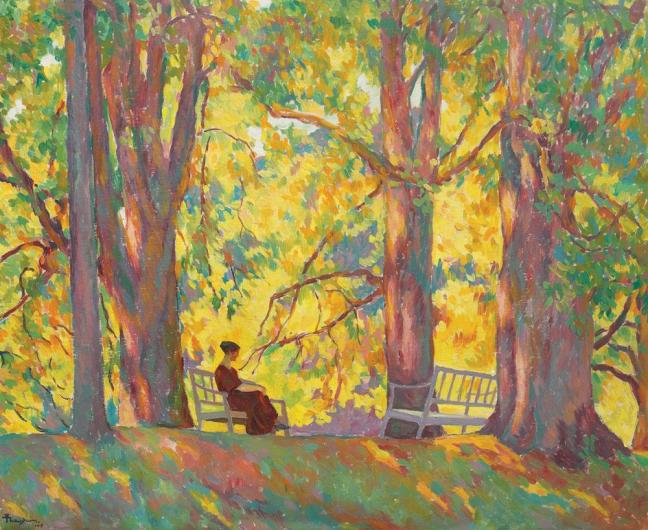
‘Remember’ – Nicholas Roerich, 1924 – WikiArt

All the things that stand out in us, and that we finally believe to be us — our story — are the rugged parts of our existence. They are what we fear or project. What we separate from and refuse to embrace. What we identify with and refuse to let go. What we have used for our identity, to shape our person, and draw some pride and contentment, or some shame and resentment. All the same. We are the children of circumstances and failures, of successes and apparent choices. Of sufferings. So we have shaped ourself with and from what we are not — from what we can remember and hook on. From events and ideas. From what can give us a form and a semblance of reality. But with all these, we are left only with what doesn’t truly satisfy us, doesn’t quench our thirst, doesn’t make us a rock but only a fragile, elusive entity. There is more to us than story and existence. There is what we cannot remember and make a story of. What we cannot fit into the shape of a person. What we have left unnoticed in the interstices of our life.

Why is it, do you think, that we often have difficulty remembering the happiest parts of our lives, which tend to disappear into thin air? Why cannot we seize happiness? Why is it that we seem to disappear in it and with it? That the best part of what we are, is the part less remembered and graspable? We tend to emphasise the foreground, the highlights, what exists, appears, and disappears. We have little consideration for what stands behind, unnoticed — the still, silent, benevolent matrix of it all. The unfathomable that we are, with its indomitable nature. That which lends a ground to all forms and appearances, including time and space. That which is not an object in our experience. Which is not an idea or a representation. Which is alive and can only be felt in and as the depth of our being. Which has the solidity of a rock that can never be moved. Which will never be a person, never have accidents, never be shamed or shaped by circumstances or events. This most profound nature of our being holds for us the peace and happiness which we are seeking in the foreground. We borrow the happiest parts of our existence to our own nature, while thinking it lies in chances and accidents.

If this nature of ourself is not felt, we will live with fear and lack. So this is our worthiest remembrance. This is where we have to be. To live as that field of being is to remember our nature as the rock-like essence of all beings, things and events. Then, this sublime identity that we have found ourself to be will matter more than any life achievement or result. It will be like the air we breathe. It is ourself seen in the conscious light of our being. In this, happiness is prevailing because it is the very colour of being. In fact, happiness is devouring our old self, which is why and how we as a separate entity disappear every time we feel at peace and content. Peace becomes our very identity — the eternal, ever-present nature of our being. Life then puts on the clothes of clarity and well-being, and our self deserts the ruggedness of the eventful life of time and place. What we ‘remember’, according to the etymology, is what we ‘call to mind’. So we ought to be cautious of what we remember or forget. That will condition our being happy or miserable.

.

~~~

Text by Alain Joly

Painting by Nicholas Roerich (1874-1947)

~~~

.

Website:
Nicholas Roerich (Wikipedia)

Suggestion:
Other ‘Ways of Being’ from the blog…

.

The Religious Life

Two monks’ – Carl Bloch, 1861 – WikiArt

Spirituality is an exaggeration. We need to exaggerate our commitment to truth, and be ‘spiritual’ for a time. We need to take on this role. Being is to be favoured at the expense of experience. This is the way to re-establish a lost truth, to re-assert what we truly are against what we have conditioned ourself to be, by force of habit. It takes a lot to fight an addiction, to forget a well-rehearsed habit, to extricate ourself from our deeply imbedded identifications with our body and mind. What’s running in our head has a persuasive power, and perceptions have a way to project everything perceived as being out there, into what we commonly conceptualise as a world separate from ourself. So spirituality is a sort of rehab. We go to the church or the temple only because of our failure in making a cathedral of our experience. We attend the mass in reason of our not being grateful for the given bread of our life. And we meditate for lack of noticing that the meditator is a superimposition on our simple experience of being. We’re overdoing it, but it’s for the good cause. We need a magnifying glass to notice what is hidden in the cacophony of experience.

But spirituality is not a way of life. it is a temporary overemphasis, a dramatisation. We were never meant to be spiritual, or a believer in a religion. Religion is a teaching, a suggestion to realign ourself with truth rather than with an acquired belief. It is the temporary treatment for our suffering. It is the gentle scolding of a parent when we have made a mistake. It is benevolence — an encouragement towards a happier living. It is a bond and a reverence towards the simple reality of our being. So spirituality is an effort towards effortlessness. It is an attempt to recognise the given in ourself, amongst all the things that we have acquired and wrongly identified with. We have to dig out our true nature as pure, undivided, peaceful being, and have to be for a while a zealot for this, an ultra, a devotee of being, and to leave experience alone, to restrict our commitment with the world of things. It is a descent into spirit, before spirit pervades the totality of experience.

So all the paraphernalia of religion, all the words and practices of spirituality, and the endless commenting on the commenting, are only a means to acquire what we already have and already are, although unknowingly. Practice is to just be, and be happy. Prayer is to live a life that has meaning and clarity. Meditation is to have a vision of what we are, and with that vision, to love and share our deepest nature with others and with the world. It is to restore reality, in order to give ourself back to it. Because we cannot understand, feel, love, and just be, we have elaborated rituals, prayers, teachings. Spirituality is not the truth, only the means to access it, as devotion to a deity is but the path towards true, unconditional love. So we might want to push our practice. We might have to snob experience for a while, to leave it in the marge, in order to concentrate on our being only being. And we might want to stay there, in being — a yogi of presence. We don’t want to be an occasional visitor. We long to be a resident, to have being as our eternal companion. To feel that we are that naturally, and effortlessly. We want to drop all affectation. Effort is only a temporary device, to defeat a bias acquired over life times, and instilled by a whole society. We want to be free of ourself, and to quit being a believer, or a practitioner.

Then life becomes a temple, whether we are in the busy heart of a city, or in a monastery, whether we live the active life of a working hero, or the silent one of a dedicated monk. There will be a day when our life will take place in the clarity of being. When our daily activities will receive the flow of a constant radiance of meaning and beauty. When love will be the very canvas of all our relationships. When our duties and chores will be clothed with a flavour of sacredness. On that day, this tragic and magnificent exaggeration that spirituality is, will be replaced by a life that is discovered to be unaffected, spontaneous, uninhibited, relaxed, and genuine. Maybe this truly is the religious life.

.

~~~

Text by Alain Joly

Painting by Carl Bloch (1834-1890)

~~~

.

Website:
Carl Bloch (Wikipedia)

Suggestion:
– Other ‘Reveries’ from the blog…

.