The Heart Sutra

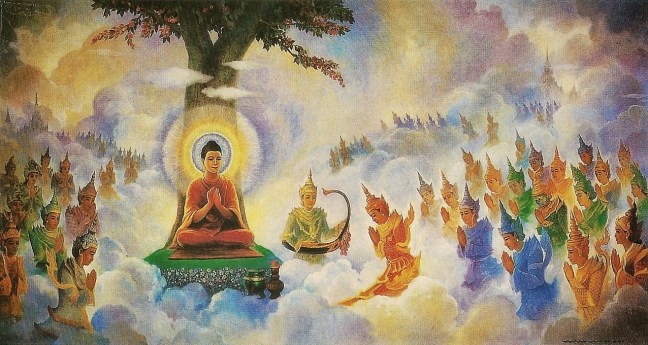
‘Buddha preaching Abhidhamma in Tavatimsa’ – Wikimedia Commons

.

प्रज्ञापारमिताहृदय

心經

བཅོམ་ལྡན་འདས་མ་ཤེས་རབ་ཀྱི་ཕ་རོལ་ཏུ་ཕྱིན་པའི་སྙིང་པོ

.

There is a text that came from the dawn of ages, whose author is unknown, but which has been widely accepted, practised, and chanted in Mahāyāna Buddhism as a condensed exposé of the teaching of Buddha. Although known and praised as the ‘Heart Sutra’, its original Sanskrit name translates as ‘The Heart of the Perfection of Wisdom’. If the Sutra’s main teaching asserts that all phenomena is ‘Śūnyatā’, a term widely translated as emptiness, its wide implications extend to many other aspects in the understanding of our true nature. Originally translated in Chinese by a 9th century Buddhist monk called Prajñā, the text exists in a shorter and longer version. I am sharing here the standard long version that provides an elegant and story-like context to the main teaching. I have also chosen to give to the many Sanskrit terms their original meaning or context. Following the Sutra is a short text that I wrote, some words that the text has evoked in me. I hope that this presentation will give justice to the profundity of this text, and that you will enjoy the reading.

~

Form is emptiness, emptiness is form.”
~ The Heart Sutra

[…]

Discover this milestone of Buddhist literature: the ‘Heart Sutra’… (READ MORE…)

.

The Gospel According to St. Matthew

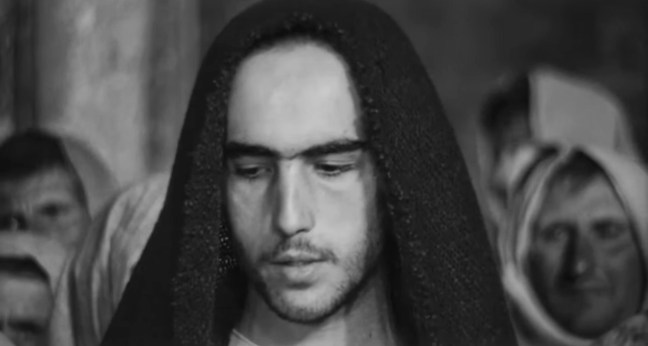
‘The Gospel According to St. Matthew’ – by Pier Paolo Pasolini – (With Enrique Irazoqui)

.

The motivation that unites all of my films
is to give back to reality
its original sacred significance
.”
~ Pier Paolo Pasolini

.

The famous Italian film director Pier Paolo Pasolini made this beautiful statement about his art: “When I make a film, I shift into a state of fascination with an object, a thing, a fact, a look, a landscape, as though it were an engine where the holy is about to explode.” This can be immediately felt as we stroll amongst the first scenes of his 1964 movie ‘The Gospel According to St. Matthew’. We are met with an angelic Mary looking at a bewildered Joseph leaving home after the discovery of her pregnancy. Silence prevails and only a concert of bird’s songs can be heard. Joseph wanders in solitude in a landscape that is desolate yet teeming with presence and energy. He comes to the edge of a town and kneels against a nearby stretch of land where a bunch of children are playing, giving like a lullaby of innocence to Joseph who closes his eyes and abandons himself to the moment. This is the chosen time when an androgynous angel appears and gives him the revelation of the divine nature of Mary’s pregnancy.

[…]

Discover the magnificent film by Pasolini on the Gospel of Matthew… (READ MORE…)

.

The Burning Bush

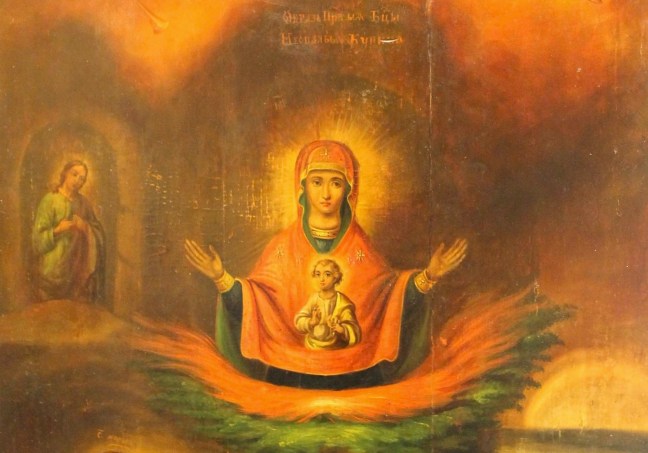
‘The Icon of Theotokos the Unburnt Bush’ (detail) – 19th AD, Museum of Radomysl Castle, Ukraine – Wikimedia

Don’t be shy. Come out of the bush. That bush which is of your own making. The hazy bush of your thoughts, feelings, and the ten thousand things perceived. All that you have invented to keep your self going, to give it a form and a lustrous appearance. This is a bush of endless confusion and deceit. Don’t get entangled in its thorny maze, to be kept here safe but miserable. Don’t be lured into the bush of your apparent self, with its intricate problems, and its endless, unresolvable knots. Don’t make that bush your prison, be it a golden one. Don’t let it dictate your life, to forever seek in the world all that can soothe and heal for a time. And don’t expect that you will find in other similar bushes the remedy to your entanglement. You can gather as many bushes you like, they will never make a marriage worth of the name. Any other thought-induced bush will be revealed as being lost in the same, inherent, desperate obscurity which your self is lost in.

Don’t be deceived once more. Don’t be shy. Come out of the bush. Put it on fire. Burn it to the ground. You’d be surprised of what is left behind. How do you burn a bush? Expose it to the sun of your being. How do you expose the false, but by seeing the truth? How do you fight the fear of death, but by realising your immortality? How do you disengage yourself from your endless suffering, but by recognising your true nature as peace and happiness? You have a sun at hand that is more than happy to help you in that enterprise. Expose the mirror of your separation to that sun and its burning rays will strip this idea naked of any true reality. Show yourself. Come out of the bush. Let that pure being do its job on you. Let it burn that bush of yours down to its roots.

And don’t expect a desolate land after that. There will be no carpet of black, sullen, malodorous ashes. Be audacious, for you will only burn the false that is in you. All that doesn’t truly stand on its own. All that which is not. All that you have made up. These sure will go to never return. These are the unburnt bush of your apparent self. For how do you burn something that isn’t there? How do you extricate something that wasn’t truly entangled in the first place? How do you spot the unseen? How do you kill the invisible? As for the burnt ground, you will only meet what truly is. As for the desolation, you will only be welcomed with opulent love and beauty. As for the loss and suffering, you will only be exposed to the profound peace of your essential being. You will be blessed to notice a self that was here all along but that you had been made blind to. This is where this fire is not a fire of destruction but one of creation. This is where this fire is a never ending fire where no bush, no seeds of folly can ever thrive.

.

~~~

Text by Alain Joly

Painting by Museum of Ukrainian Home Icons

~~~

Websites:
Museum of Ukrainian Home Icons
Radomysl Castle (Wikipedia)

.

Other ‘Ways of Being’ from the blog…

.

The Incidental Life

I would like to live the incidental life. Not the one that is a toil. Not the one that finds its significance in happenings and accidents, in various changes or transformations, in happy or sad expressions. I don’t want to be dependent on the forms of life for my happiness. I don’t want to be bound to its many injunctions, be they ones that are imposed or desired. For this is how life acquires its tragic quality. This is how life becomes something that we have to endure or bear with. Something that we have to go through with clenched teeth — which is with hope and belief. Something that we can be happy with, or grateful for, only if we take the right decisions, make the right efforts, and have some good luck too. I don’t want my life to be so brittle and uncertain. To be so imprisoned in endless causes and conditionings. And to have fear as its background music. No. I don’t want to be so grandiose. I want the incidental life.

To have an incidental life is to forever place our gaze on the horizon of being. This gaze implies surrendering to what is, or not minding what happens, as Krishnamurti once affirmed. This gaze will make you see life as being drenched in beauty and love. And this gaze will render you to your eternal, inborn, given nature of peace, happiness, and freedom. This is when experience clothes itself in a sumptuous dress of truth or understanding. One that will allow you, in familiar terms, to leave your life alone. For it can verily and simply take care of itself. Life doesn’t need your painstaking involvement. It doesn’t fancy your pity or concern or greed. Doesn’t want to be taken advantage of. Let your life be in its right place, which is the place of humility. This is where it will find its true colours and expressions. This is when it will rid itself of all the suffering that encumbered it. This is how it will find its own sacred purpose. Don’t give your life an undue position. Don’t take what is secondary to be foremost. And what is foremost to be secondary. See only being as foremost. This is the sun of life: this being. Its essence and direction. The rest? Well, let it be incidental.

.

~~~

Text and photo by Alain Joly

~~~

.

Other ‘Ways of Being’ from the blog…

.
The Angel of Death

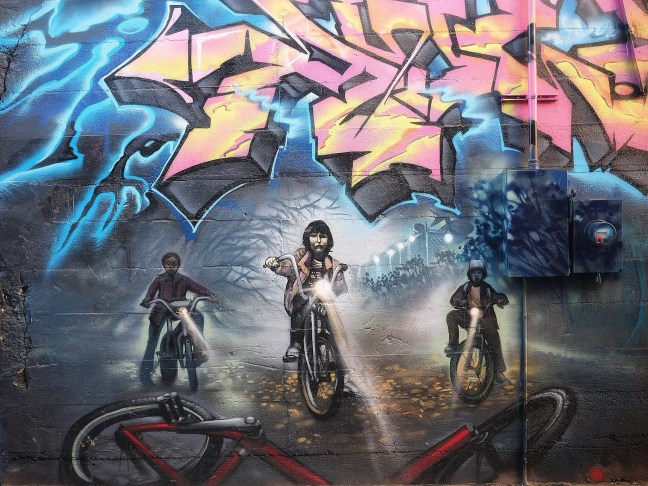
‘Stranger Things Graffiti’ – Paul Sableman (Jher Seno & the Arty Deeds) – Wikimedia

.

A myth is a mask of God, a metaphor
for what lies behind the visible world.”
~ Joseph Campbell (‘The Power of Myth’)

.

There is an astounding profundity in popular culture. It is just for us to see when it pops up, when it arises above the sea of confusion that our life is for the most part. What is designed to be just light entertainment, what appears to have no depth or consistence other than being an easy escape out of ourself, can hide the brightest of gems if we can elevate ourself to its hidden meaning. I stumbled across one such meaningful gem recently.

Running Up That Hill’ is a song created by pop singer Kate Bush in the eighties. It recently got a second life and triumph by appearing in one scene of the famous sci-fi thriller series ‘Stranger Things’. In this particular show, there is a hideous monster that roams in an imaginary city, and feeds on the minds of teens deeply affected and traumatised by their past, luring them into its parallel and ultimately illusory reality. In that particular scene, the girl is trapped in some dark chamber of her mind. The ugly beast keeps her prisoner there — a cave like place where she is about to be engulfed in the monster’s hideous mind. She manages to escape the grip and run towards an opening in the distance where is her true self and salvation. Pieces of rocks are falling all around her to stop her course, but she keeps running one-pointedly ahead while hearing Kate Bush’s song ‘Running Up That Hill’. The reason for her escape is to be found with her friends playing this song she deeply loves, and creating in her that powerful call and incentive.

Why does a particular blend of a scene and a song suddenly hit a target, move people beyond what could be possibly expected? Just one glance in the comments of that particular scene on YouTube makes it clear: “Best scene of the series”, “This scene made me want to live”, “Cathartic”, “A metaphor for what’s battling your mind”. Why does anything hit us and move us to feel in ourself a feeling of being alive? Tears may come, a feeling of thankfulness, maybe even some sense of profound happiness. What is tilting in our minds in these ineffable moments is the recalling of our life’s most essential meaning and purpose, and the remembering of a place in ourself that we have neglected. This place is the forgotten but obvious target for all our thirsty mind-arrows. It is the open space of our deepest being that we keep missing at every moment of our lives, precisely because of its total intimacy and openness. How do we manage to miss it? Because we focus on the periphery of objective experience. We are enclosed in a dark chamber of our own making that lures us into itself, and makes us fragile, hopeful dreamers with fearful minds, forever caught in the prospect of impending death.

[…]

See how popular culture is infused with non-dual reminiscences… (READ MORE…)

.

The Most Important Thing

That might be the most important thing of all. Not the meditations that leave you in a state of gratitude and wonder. Not the repeated understandings, no matter how deep and essential they are. Not the feelings of awe in front of that experience of oneness — the disappearance of yourself, and the appearance of your true, revealed, precious self. “I got it at last” were you thinking… But no. That would have been a bit too easy. None of these might do it in the final end. For these extraordinary revelations will eventually have to die down. For these experiences will have to end of their natural end. For these lack the last little remaining kick. There always seems to be another last ‘top of the mountain’. Another frontier. Another clarification. Another hope. Another deception. Another naïve expectation. And another waving hand and unwanted reminder from your sense of being a separate entity. “Hey, I’m still alive!” And back are you on your meditation cushion for another sprout of failing expectation.

That might be the most important thing of all. Not to leave a way out for yourself to escape and hide in a little corner. To grab yet another last little pleasure. To keep yet another wee sense of pride. To have yet a negligible remaining sense of being ‘me’ and enjoy the show from a distance. For these little remaining indulgences, no matter how small and inconsequential they may appear to be, will give rise once again to a fully grown sense of being a person. And this ‘person’ still has on a leash the dark beast of suffering that seems to come back with ever more strength and power. We might finally be eaten by it and be left here, a panting failure. We might never make it… The beast is barking now. Growling in the background. Waking itself up. Hungering for more and better with sharp scintillating teeth.

That might be the most important thing of all. Simply to give yourself up to just being. To not think you’re going to participate to your own banquet. You cannot be a guest of honour when you are yourself the one to be devoured. You just have to give it all up. Every thing of you. Every remaining bits or crumbs on the table of your apparent self. And it will have to be a pleasant offering. For it will never be forced on you. You are invited to die willingly. Or more precisely, to die understandably. To let go of that pestering little thought of yourself. That old haunting belief. That erroneous identity. Knowing that it’s your only chance. The last little thing left to do. That last remaining kick. The most important thing of all. So do it… That’s how you have a really joyful banquet.

.

You can’t both drink the cup
of the Lord and the cup of demons.
You can’t both partake of the table
of the Lord and of the table of demons
.”
~ 1 Corinthians 10:21 (The Bible)

.

~~~

Text and photo by Alain Joly

~~~

.

Website:
BibleGateway

.
Other ‘Ways of Being’ from the blog…

.
The Dark Night

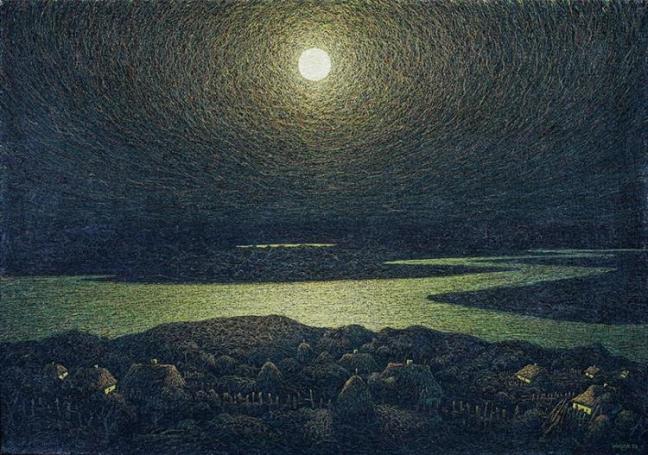
‘Night’ – Ivan Marchuk, 1981 – WikiArt

.

Being human is a complicated gig.
So give that ol’ dark night of the soul a hug.
Howl the eternal yes!

~ Friedrich Nietzsche

.

There is a poem that fed the imagination of many prestigious writers and philosophers like T. S. Eliot, Simone Weil, or Thomas Merton. Many a spiritual seeker has found in it a guiding lamp for the harsh ascent towards divine union. Its name: the ‘Dark Night of the Soul’, a short poem written by the 16th-century Spanish mystic and poet John of the Cross. It refers to the unknowable nature of both the goal and the path, and how such darkness would allow us to merge with the presence of god in ourself. As John of the Cross wrote: “In the dark night of the soul, bright flows the river of God.” I am presenting here the translation by Edgar Allison Peers. Following the poem is a short text that I wrote, words that the poem has evoked in me, the inspiration that it invoked…

.

On a dark night,
Kindled in love with yearnings — oh, happy chance! —
I went forth without being observed,
My house being now at rest.

[…]

.

Read this famous poem by John of the Cross and a few more words… (READ MORE…)

.