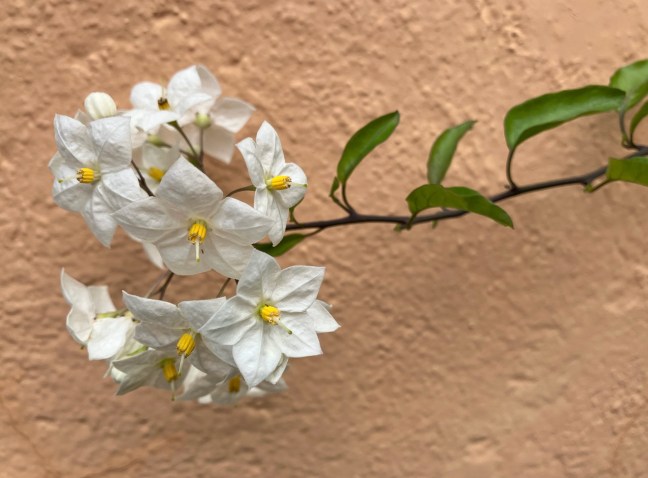
On God’s Existence

‘Calm on the Mediterranean Sea’ – Ivan Aivazovsky, 1892 – WikiArt

There is no god. God is an invention that we have placed far away, out there, as an object for our prayers and hopes. As an entity to whom we can address our suffering. God was given that role so that we are not alone. We have divided ourself up into a self here and another greater self there, between which reside our secret longings and our beliefs. We have made god into a handy projection, for our convenience. A soothing presence who will be there for us after death, whom we can trust and rely on, whom we can give ourself to, and find protection in. We feel good in that undoubted certainty of a god.

But there is no god outside of ourself, no distant god, either in place or time. Of this we can be sure. Because wherever we may travel, however far we may go, we find only ourself. We are bound to our own being which we feel in a ‘here’, and in a ‘now’. So we fail in going somewhere that is outside ourself. It’s an impossible task. We cannot go there. Not in a million years. So god cannot be found outside of ourself. Nothing can. Everywhere is here. And every time is now. The only place for god to be is in our own being. There is no other place to be — even for god. There is no way around it. But we have first to understand our own being, our own nature. There, in ourself, is the resolution of the conundrum of god.

So what is this place of ourself, to which we are bound? What is it made of? If we leave our body aside, and our many thoughts and sensations, if we leave the world out of the picture, what is left of ourself that we can say is here, is now? What is this consciousness that we have lived with for as long as we can remember, and for which we seem to have but little interest ? This thing which has held our peace, our happiness, our perceived sense of beauty, even if only experienced rarely or fleetingly? This consciousness that is holding us, that is giving us our very existence, holding our suffering and our conflicts? Should we not feel grateful to have been held with such consistency? To have been held with our feelings, whether happy or sorrowful? To have been lent a body, whether healthy or sick, and a mind, though both may be just a passing dream?

This thing which is here undoubtedly, showing that peace is possible, that beauty is real, that happiness is within reach, is this not our most profound self? Is it not our very being? What we are here? What we are now? And this god which cannot be anywhere outside of ourself, could this god not be this, this very presence of ourself? Our very being? Our very consciousness? Which we are by nature every day of our life? That which can be felt in every bit of our heart and soul? That can give an explanation for ‘there is no god’? That can give a reality to ‘there is god’? That can show that, in fact, not only there is god, but there is only god? That everything, all that we are and experience, is god? That the god which we had thought at a distance, is nothing but the loving presence and reality of ourself and of everything? That life is nothing but the living, pulsating being of god, which we are only and wholly? And which we share with every other apparent being, and every possible appearance? And that this, is the one thing that ever was, and will ever be? And that this, is not inside ourself, for of ourself it is seen that there is not? And that this, is not outside either, for there is no being outside something inexistant? And that now, at the end of our journey, and all things considered, is realised that god is not even god? Because for a god to be, there would have to be separate things and selves to give it a form, and to call it god. There would still have to be a trace of suffering. There would still have to be separation. So there’s got to be no god. God is only for the poor fellows. But for who we are, there is no god. Only being being, at the most. Beyond that, nothing much can be said, lest we should invent some other god.

.

~~~

Text by Alain Joly

Painting by Ivan Aivazovsky (1817-1900)

~~~

.

Website:
Ivan Aivazovsky (Wikipedia)

Suggestion:
– Other ‘Reveries’ from the blog…

.

Apocalypse

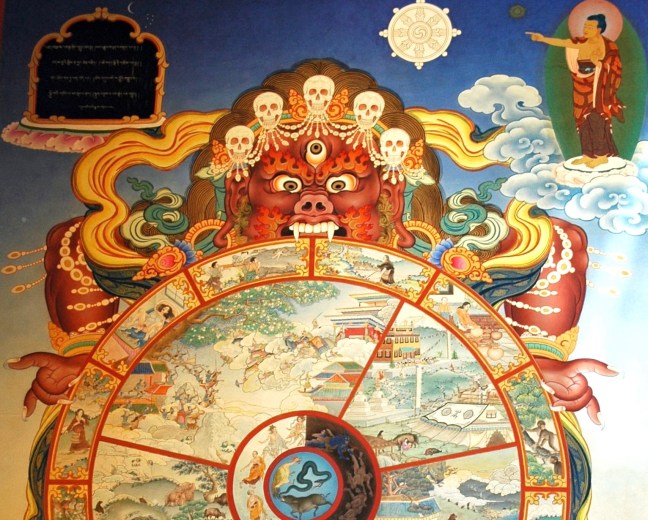
‘Traditional bhavachakra wall mural’ – By Wonderlane (Sakya Monastery of Seattle) – Wikimedia

There is a beautiful and meaningful contrast in Buddhism. It is to be found in the approach to impermanence (‘anicca’), which can be a very effective pathway to our true nature. It says: everything that passes away is not it, is not you. Notice everything in and around you, and see that it won’t be always here. The house where you live will be destroyed, and no objects you possess will stay forever, including your body, and the billions of other bodies, including the trees, the seas, the mountains, the air you breathe. Eventually, they will all go. Your thoughts, emotions, qualities, character, mind, that you think characterise you, well… The planets will wither too, the suns will die down, and space even may one day be swallowed back where it once was seemingly born.

Scan your experience and try to find something that doesn’t pass away. But go far enough. For then will come, like a new dawn, the revelation that there is something here that never passes away. There is a permanence, a nature, that is your very being, which will never not be, and which swallows in its own profound nature all things discovered to be devoid of their own independent natures. So in the end, nothing really passes away, for all the separate objects of your experience do not possess their own individual, separate nature, which could be considered impermanent. Impermanence is when you think you are a body. But in fact, permanence is all there is, and it is lived and seen as the one being that we truly are.

With this understanding, you will come to realise that your suffering also cannot stand the revelation of your completeness. What you called ‘suffering’ can only exist in the belief that all objects have their own separate existence. Believing yourself to be one such separate object, you find yourself to be incomplete, not enough, therefore seeking in objects your happiness or completeness, which you could of course never find. You started with a wrong view in mind, which made everything down the line unsatisfactory, and biased. That’s why the Buddhist term for suffering ´dukkha’ has the meaning of an ‘unstable stand’, or more poetically, the ‘badly fitting axle-hole of a cart or chariot’ giving ‘a very bumpy ride’. So what then? Suffering never actually existed? Was it all in our mind? Created by a simple belief, an ill-fitting understanding, a shaky representation, that rendered our world unstable, untrue?

In Buddhism, the positive is never named. What is is never mentioned. That’s why it is said that our existence bears the three qualities of ‘impermanence’, ‘suffering’, and ‘no-self’. You will never find a self in something that it always in movement, always changing. No self in things, no self in a thought, no self in a body, no self in you — this is how far it goes. There is no self inside your body-mind. There cannot be. This is logic. No phenomenon could ever hosts a self. There is ‘no self-existent essence’, as suggests the Buddhist term ‘anattā’. Essence cannot just exist. It would make it appear or disappear. The essence of all things, including your own self, is infinite, not limited, not bound to any phenomenon. So ‘no-self’ in Buddhism is only a strategy for you to realise that the only self in presence is the nature or being of all things and selves, which we are, but cannot comprehend or even name. This is what the wisdom of Buddhism has put in practice in such an eloquent and radical way. Not even a name are you given for your own being. The nameless, you can only be.

So the ‘three marks of existence’ of Buddhism are nothing but the story of an apocalypse. ‘Impermanence’, ‘suffering’, and ‘no-self’, may give you a rather apocalyptic vision of your existence. But this is only if you have forgotten that the word ‘apocalypse’ means in fact ‘revelation’. The apocalyptic picture of our existence in this world is used as a wake-up call to push us into the revelation of our true nature as being. It is all about strategy. Do not take religious teachings to be the real thing. They are but teachings that point to a deeper, unnameable truth — the turning around of an apocalypse into the revelation of our true being.

.

~~~

Text by Alain Joly

Photo of ‘bhavachakra’ mural by Wonderlane

~~~

.

Website:
Three Marks of Existence (Wikipedia)

Suggestion:
– Other ‘Reveries’ from the blog…

.

A Safe Harbour

‘Sea against a rocky shore’ – Ivan Aivazovsky, 1851 – WikiArt

In our relative existence, we are always only a simple human being, a disciple of truth. We are seeking to merge the relative with the absolute, and to raise the finite where the infinite compels it to be. There is no being a super human, with a perfected soul. There is no being a specialist in the field of spirituality. The knower is a so shy and humble presence that it won’t show up when you are there. You will hide it with the boastful assertion of your own self. So if you want to espouse your true nature, you will have to feel yourself as almost nothing. You will have to stop reifying yourself, and make your person a servant of truth. There is a soothing freedom from pride and arrogance to be experienced in our human life.

The feeling of separation is what makes you assert yourself. To only and simply be is felt to be insufficient. You need to be or have something that makes you whole and happy, which you then seek through objects, qualities, qualifications, events, circumstances. To be somebody, to be important is the privilege of incompleteness. Being has no privilege, is not a superior position. it won’t make you anything. It won’t give you an advantage. You’d have to be miserable for that. You’d have to be limited. Your nature as peace doesn’t belong to you the person. When you have realised yourself as the one being that you truly are, then it won’t make you anything, it won’t give you a pedestal. Your knowing is in not knowing. In simply being.

There is a special, humble glory that lies in not being a self that feels separate. Peace is the perfume of your divine nature, that stands unaffected before the person that you happen to be. It is the nature that lends itself to the making of the world and to the selfing of its myriad of apparent entities. It is the secret power behind all appearances. Your nakedness is the key for its being seen and felt in your existence. You will then live from the stand of that knowing presence. Your self will cease feeling separate and superior. Your person will be depersonalised, will have infinity as its ‘I’ identity, and love as its guiding principle. But you won’t get any pride out of it, for your person is now devoid of its own, personal substance.

It is no accident that the life of many truth seekers is expressed through poverty and nakedness. In not possessing, in being undefended, as is the case for nuns, monks, hermits, anchorites. There is joy in not owning your own self, and your own identity. There is release in being at the service of the loving, silent being which you have discovered yourself to be. You have lost the prestige and identity contained in being a seeker. For there is no seeking in being. Being contains the gist of that which you want to obtain or achieve through your constant seeking — the juice of it. Being is the heart of life, and its reward. The Eden which you have placed far and away, as a cherished belief or possibility, is now found here, in the simple knowing of your being.

So there are no Shris, Maharshis, Bhagavans, Rinpoches, Maharaj-s, or Your Holiness, at the level of the person. There are even no sages. All these titles are only for ‘being’, for the reverence of truth, for the One. There is always only one Bhagavan. One Rimpoche. One sage. The peace contained in simply being is not another quality that is added to you as a person. A person, a body-mind, doesn’t have peace. Peace or understanding doesn’t belong to you. It is not for the person. It is all contained in that which lends you consciousness. It is in the presence that makes you, out of which you draw your personhood, and which allows you to love, live, and share. You are not an autonomous, self-contained person. You are infinity lending itself to a portion of finitude. How would an appearance be conscious, if it wasn’t for the presence which contains and creates this appearance? This peaceful, infinite presence is all there truly is. The One you have to bow to. Your teacher and your beloved. Your safe harbour in the storm of appearances.

.

~~~

Text by Alain Joly

Painting by Ivan Aivazovsky (1817-1900)

~~~

.

Website:
Ivan Aivazovsky (Wikipedia)

Suggestion:
– Other ‘Reveries’ from the blog…

.

The Intimacy of Experience

‘First Leaves, near Nantes’ – Camille Corot, 1855 – WikiArt

.
I will tell you where to be
. Be where every experience feels an equally good experience. Don’t be attached to judgment and comparison. These are the mind’s favorite tools and activities. The mind tricks you to believe that experience is an uneven ground. That according to the content of your experience, you will be gifted with either happiness or suffering, peace or conflict, harmony or disorder. So the experience you are having becomes extraordinarily important. We become dependent on what happens to us, and come to dread it. So we retire into the secure place of our habitual self, with its cortège of worry, control, expectation, and manipulation.

There is a place in us where you don’t find experience to be such a determining factor. Where you will not let experience determine you, fix you, limit you. You won’t be shaped by its content. You won’t be made into something, someone, with qualities and flaws, to be judged, evaluated, compared with — the likeness of experience — in fact, just another object. The mind is a manufacturer of objects, entities, persons, fixing the insubstantial nature of your being into a self to be moulded and made either happy or miserable. To be made happy by an experience is to be cheated on by it: we are being manipulated, and made to believe an illusion. To let experience make us miserable is sheer deceitfulness, it is us being easily dazzled by the treachery and artifice of objects.

[…]

Continue this exploration of the nature of experience… (READ MORE…)

.

An Abundance of Spirit

‘Chateau Noir’ – Paul Cezanne, 1904 – WikiArt

We always go too far, too quick. We jump to the objective display of reality, and in doing so leave our reality behind. It is a strange phenomenon, this forgetting, this negligence, this hurry. In fact, we pass ourself by, and rush towards what we think matters the most, what we believe to be real. This is how we have made this life difficult, an impossible thing to comprehend, and a hardship: in this forgetting, in this passing by. Our suffering is the product of a simple, single act of absent-mindedness. We have put ourself into oblivion by having made the facile postulation that reality is in the objective, in what we can see, hear, touch with our senses. And then have clung to it, to the point of losing our mind inside it, and losing ourself with it. What an absurd thing to have done.

We ought to be slow and still, if we are to meet our nature. We need to be attentive, if we are to notice our being. Not the one-pointed kind of attention, that we are already so well-acquainted with, but the sluggish one. The lazy one, that doesn’t want to go out and stumble into the world. That doesn’t feel like wrestling with thoughts. That cannot be bothered with the threat or seduction contained in the last surge of a sensation or a feeling. I can assure you that there is already a lot to see, hear, feel, on our way to the vast, far-ranging world that our senses provide. So let us not have time or space on our schedule. Let us forget the agenda that our person has and wants to fulfil. Let us not form any concept, idea, or projection, and delve into what is here before every appearance.

We may see, in slowing down, that there is here a presence that stands still, transparent, and aware. We may hear the sound of a silence that stays unaffected by the clamour of existence. We may feel the world to be but the thousand colours of our sumptuous being. We may notice the pregnancy of spirit in what is seen, heard, felt, and realise this pregnancy to be our very own nature felt, heard, seen. This abundance of spirit in our life is but the disappearance of the entity that sees, hears, feels the world, and the surging of the One as our own and only reality or world. Then we won’t pass truth by anymore. Our own nature will be unmistakable, unmissable. It will meet us in the face at the first surge of an object seen, heard, felt. We won’t miss it because it is all there is. Because there is here the absence of a self living in separation, and the absence of a world as world. This absence is our presence, our nature, our self, our world, and there ends our suffering.

.

~~~

Text by Alain Joly

Painting by Paul Cézanne (1839-1906)

~~~

.

Website:
Paul Cézanne (Wikipedia)

Suggestion:
Other ‘Ways of Being’ from the blog…

.
Spiritual Wine

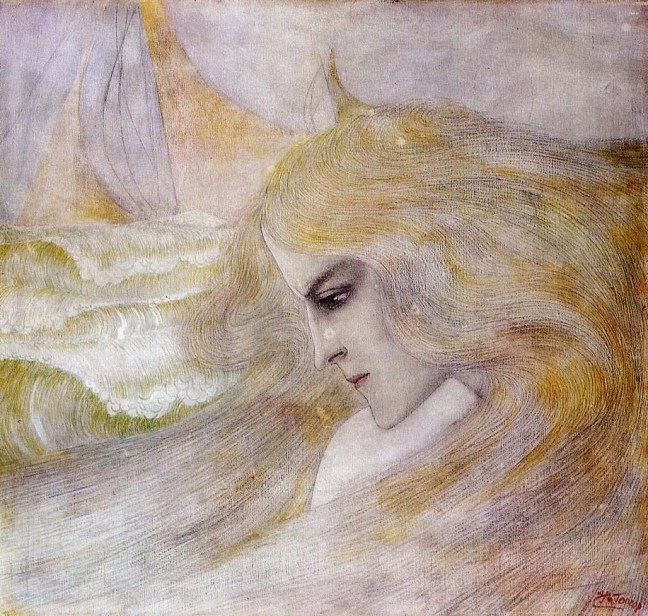
‘Lovers under the moon’ – Serge Sudeikin, 1910 – WikiArt

The word ‘spiritual’ is quite a nebulous one. It is used indiscriminately, carelessly, for a bewildering array of wildly different practices or beliefs. Krishnamurti didn’t like the word, which he found ‘ugly’, ‘romantic’, ‘unpleasant’, and used it cautiously. So maybe the time has come to clean the word, to give it some of its forgotten brilliance, and dig out its original meaning and raison d’être. I would start with the suggestion that the word ‘spiritual’ simply wants to point something at us: that the world, the whole of it, our experience, everything, is in fact made of ‘spirit’. Spirit is all there is, the only thing in presence. And believe me, this is a timely pointer, for most of us believe the world to be a hard reality, made of something solid, composed of a variety of different objects — our body-mind being considered one such object. So the word has the virtue of reminding us of our true nature, of the nature of everything as spirit, or consciousness.

But it is only a provisional word, one for our time of misunderstanding. There will come a time when the suggestion that experience is made of spirit will be a matter of fact, something integrated, not to be thought about anymore. The word will then become redundant, to be replaced by another word of a higher intensity and meaning. Or maybe there won’t be any need for a word to describe reality. Reality will have been understood, digested, lived as the fact of simply being. Spirituality will have become useless. There will be no need of spirituality, no need even of the word ‘happiness’, or ‘peace’. Once you are wholly, and only spirit, which is peace, which is happiness, what need is there to mention it? There will be no seeking either. After all, what you are, you are. Identity will have been achieved. No suffering around. Seeking obsolete. Out of date. To be disposed of. What will remain is a splendour, indescribable, filling the world of experience to the brim with its essence.

Also, spirit means ‘breath’. It is the breath of life, a thing invisible, transparent, quietly sitting in the background, and yet essential and life-giving. It is what is playing us, giving us an identity and a sweetness of living. For spirit is like the air we breathe. It is still, silent, empty, yet a breath that can blow our mind and make us like an inextinguishable fire. It is the breath of god that we have left unnoticed time after time, but whose presence is holding us in its firm embrace. It is a breath of devastating effects, laying us waste, destroying all traces of suffering and separation, blowing our self away, not by slaying it but by showing this self to be just the air within the divine breath of god. You had thought yourself a hard, solid, but fragile entity, and are now shown to be empty yet as indestructible as is a fire in the wind. That’s what being spiritual, or spirit-like, truly means.

Spirit also means character, and courage. It doesn’t pretend, and rejects a lukewarm understanding. It is uncompromising and free. It is not afraid, not conditioned by the hazards of life. It stays firm, alone, whole, undisturbed. Spirit is eternally high, but mingles with the lowly too, for it is humble by nature. And it has clarity as its best asset, for it is blessed with the purity contained in knowing without being itself a knower. This knowing is undivided, self-contained, total, applying to all and everything. This is what makes it holy, a spirit which cannot be taken apart, and which contains universes beyond universes. It has a religious quality, a sanctity that is beyond what humans have called sacred. The wholeness of spirit cannot be broken, dampened, violated, injured, or even changed. Its holiness lies in the fact that it is one without any division or addition.

And spirit is music too. It has a sound to it, and it is our duty to play it, or rather being played by it — the musician being god, or spirit itself. Our being is found to be the breath of god, the movement of consciousness singing our life on the reed of our apparent self. As that, we may become the vessel of a life whose notes have risen above the ten thousand things of existence, to be taken by various harmonies of silence, peace, love — all carried by a quiet but devastating breeze of inner joy, like a hum. We are like God’s music, and our experience is bathing inside it, and being made melody. This is what spirituality is, and what a life lived in and as spirit sounds like.

‘Tis the fire of Love that is in the reed, ‘tis the fervour of Love that is in the wine”, Rumi once wrote in the Masnavi. So spirit is a delightful beverage too. It is what gives us this gentle drunkenness which is the state of our self when it recognises itself to be but God’s being. In Spirit, we are intoxicated by the ‘Love that is in the wine’. For this nectar, we are willing to pay the price of surrender at the tavern.

.

~~~

Text by Alain Joly

Painting by Serge Sudeikin (1882-1946)

~~~

.

Website:
Serge Sudeikin (Wikipedia)

Suggestion:
– Other ‘Reveries’ from the blog…

.

The Possibility We Are In

‘Old Sarum’ – John Constable, 1834 – WikiArt

Whatever there is is God’s presence felt. And whatever we may feel of God’s presence, is what there is here and now, including what exists and appears. It is all here for our recollecting, all here that we can be and be god like. Every experience that we may have, every sorrow and every joy, every fear or trust, every ugly or beautiful appearance, is felt and seen because of our being first. To watch anything is to be watched in return by a presence watching. We can make ourself disappear in it, and be without a self, without the self we have always known and colluded with. And we can share of that impersonal, infinite being that is not ours, but that we can be and embrace as our own. So ‘I am’ is the secret door opener within us, that will give us the world we are in. We will have an aggrandised property, or a world made of the very size of ourself, infinite, manageable, and towards which our being may shine a benevolent beam of light and peace. That I feel is a possibility.

The world will have its secret identity disclosed to us. And we too will have our secret identity revealed. Both being made one, and ourself being of it. Others will cease being others. They will join us as that shared one being. There won’t be any jealousy or comparison, but a rejoicing in and as that oneness felt. Our fate and destiny will be contained inside us, within our own being. There won’t be a time to hope for, or a place to fail in, or a self to mess up. There won’t be a fear of tomorrow, or a regret of yesterday, for both will have merged in and as the being that we are. Time and place will have come to be only convenience. And our very being will have come to be the time and place we are in. That too is a possibility.

The knowing of our own being will have come to be our only experience. The many will have shrunk into the one, and the infinite will have subdued our senses, and made itself seen, heard, touched, and contained within our experience. Happiness will cease being a temporary achievement, and will become the flavour of our shared being with people and things. We will have joy woven into every single corner of our life. That’s the possibility we have at hand.

Movement will be seen as the manifold expression of stillness, and silence recognised as the only component of our living symphony. Turmoil will be felt as this last bit of ourself that we have yet to embrace — not something to be afraid of, but an opportunity that we welcome. We have to see this as a possibility.

So this life is the garden of Eden we once extricated ourself from, but have in fact never left otherwise than in our imagination. And love is not an occasional encounter, but the very air we take our breath from. I’m just throwing the possibility in the air.

Now we recognise after all, that the being of God is what we are — the possibility we are in, without there being a God or a ‘we’.

.

~~~

Text by Alain Joly

Painting by John Constable (1776-1837)

~~~

.

Website:
John Constable (Wikipedia)

Suggestion:
Other ‘Ways of Being’ from the blog…

.