Perfect Days

’Perfect Days’ – by Wim Wenders (with Koji Yakusho)

.

All my films deal with how to live.”
~ Wim Wenders

.

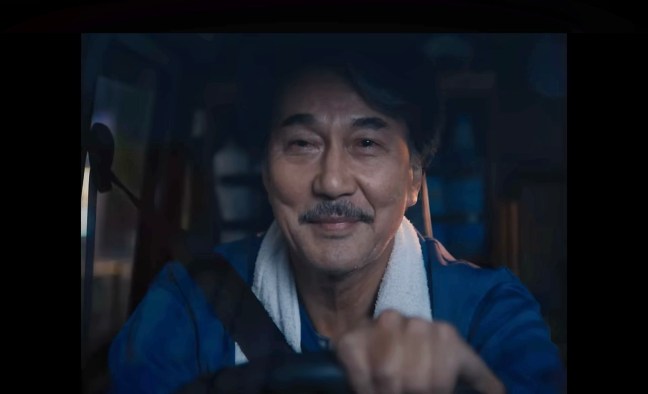
Why do we watch a movie or enjoy any piece of art but for the joy, happiness, or relief we derive from such activity? Well, sometimes we use a movie not so much to feel, but rather to stop feeling. We want to be alleviated from our sense of boredom, or be distracted from our constant worry, or have the lowest ambition to be rewarded with pleasure, plain simple pleasure which, if not delivered, will make us move on to something else. Film as an art form is ambiguous, for it has in itself an entertaining power which makes it the prey to our most suspect desires. Well, Wim Wenders, in this movie, wasn’t going to give way to that ubiquitous trap and fall. With ‘Perfect Days’, he made a movie in which there is no desire to be had, which offers no suspense, no excitement, no resolution of any kind, but from which you would never want to move away. A movie that describes the quiet, plain, orderly living of a man whose job is to clean public toilets in Tokyo.

Hirayama lives each and everyday as if it was a perfect day. For him, there is no possibility of failure in life. And he makes sure that boredom is an impossibility. So he cares. Hirayama cares about everything he does, and seems to be profoundly related to his modest home, to his morning toilet, and to the watering of his plants. He does what he has to do, with no judgment or resistance. He doesn’t mind. He feels his inner freedom. He has everything he needs, so he smiles at life and life smiles back at him. He breathes when he steps outside and looks at the sky as for the first time, the wonder of it all. Then he buys himself a can of coffee from a local vending machine, opens his van, sits, drinks a sip, chooses a song from a bunch of cassette tapes, lights the engine, drives, and listens to ‘The House of the Rising Sun’ by The Animals. For that’s where he is now, in the house of the rising sun, going to his work through the sprawling suburbs of Tokyo’s morning, undisturbed, confident, present.

[…]

A reflection on the film ‘Perfect Days’ by Wim Wenders… (READ MORE…)

.

Finding Relationship

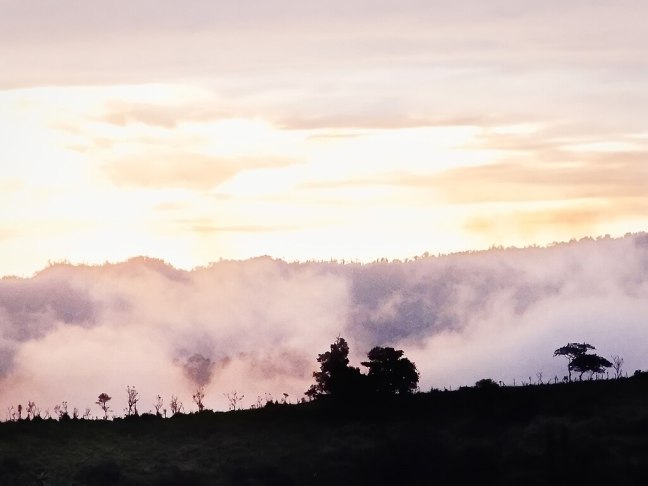
‘Hazy Relationship’ – Rinaldo Wurglitsch – Wikimedia

If you think you are having a relationship with another, you’re telling yourself a story. Literally. For this is what ‘relationship’ truly means: ‘to recount’, ’to relate’, ‘to refer’. More precisely, it means that something has been ‘brought back’, or ‘carried back’. So relationship is not an innocuous word. It expresses something fundamental, that for our relationships to be, we have to conjure up the past, or some kind of knowledge. We have to refer to something, to bring back some old memories, some kind of object or image. We have to bring the past into the now. And this is what we have done so far, to attach our relationships to some kind of reference to the past. We have learnt that we cannot be related to another outside the field of memory or images, without making concepts, without burying our relationships into the impasse of storytelling. But in fact, real relationship only takes place when we stop relating anything to another person or object. It is the moment when you are emptying yourself and the apparent other from the past or the future, which is from knowledge.

Relationship as we know it is a process that involves separation. It is an interplay between two entities that have been brought about, fabricated, their reality made into selves out of fear, habit, convenience, or ignorance. These objective, illusory selves are so brittle that they are incapable of making true connection. They are like empty shells with no real substance. The only possible connection between human beings is love. Just think about it for a moment. Why do we hug anybody? Is it because we acknowledge the powerlessness of words and rather mimic our deep connection through the use of body language and silence? How do you convey what cannot be conveyed? What can you do when words come short, other than fall into silence and cancel the space or division between you and another? This annihilation is the act of love itself. It is the acknowledgement of being or ‘isness’ as the only possible connection. It is the truth of ‘what is’ when all conceptualisation has come to an end, when memory has been brought to its knees.

True relationship is the flowering of consciousness. It is the coming to the foreground of the reality that stands behind all apparently existing things. It is the noticing of the reality that is here amongst beings and things — the ciment behind it all, the nature of everything, the deepest connection there is, before which all other connections pale into insignificance. The irony is that you can only have true relationship with another when you don’t make up a relationship, when you don’t bring in any idea or judgement, when you don’t invite fear or former hurts, or condescendence, or even respect for that matter. You must stay silent, empty of qualifications. You have to be who you truly are, to let the natural relationship of love come to the foreground and act itself out through you, and in spite of you. Let it carry you where you are, at the right place of your pure, innocent self where relationship is not anything you do but what you are as being. It is ‘what is there no matter what between beings’ — be they human or otherwise.

So be watchful of what you bring. For the qualities of the world will depend on the quality of your relationships. That’s how a world is being experienced — through relationships. So don’t start with yourself, with a self, any self, and relate from there, from this position of untruthfulness, of deceitfulness. You’d make an insane world. A world where we use, impose, abuse, misuse, mistreat. That’s how wars are launched, through biased relationships and crooked selves. See how fundamental relationship is, how it can make the world a place where hurt, anger, ignorance are being acted out. Or how it can make the world a place of peace, harmony and love.

.

~~~

Text by Alain Joly

Photo by Rinaldo Wurglitsch

~~~

.

Suggestion:
– Other ‘Reveries’ from the blog…

.
The River of Peace

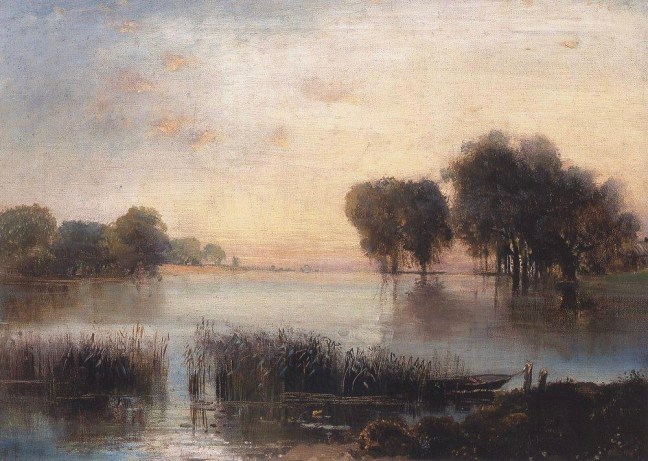
‘Landscape with a River’ – Aleksey Savrasov – WikiArt

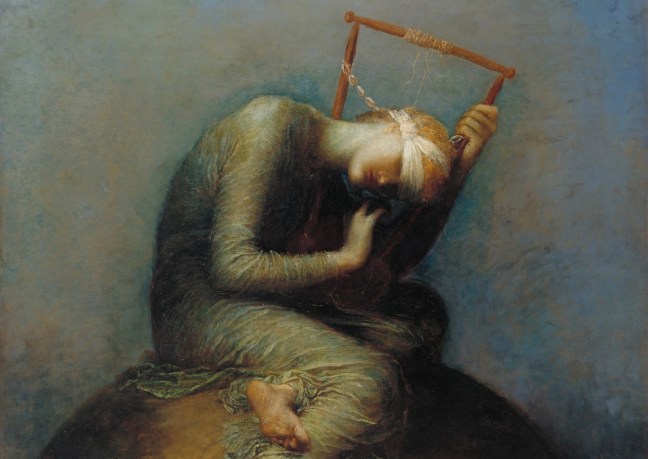
I think it is important to rest in the peace of our being. To gain that position and stay there, rejoice in it, find one’s home in it. To have peace as our perennial identity. To live in its aura. Then we might hang one thing on the door of our sweet cabinet of peace, a notice with these simple words written on it: ‘Do not disturb’. Why should I be disturbed? Should a thought come, out of habit, and visit me, claiming to break my peace for an adventure out of myself, in search of a moment of excitement, a share of happiness, or an elusive instant of peace, then I might gently tell her to stay away. Why should I break my peace for an activity whose only purpose is to find the peace that I already am? Peace then becomes my best manual to navigate through the many demands of life. It will ease my many battles with choice. It will bring my thousand little craving digressions down to a few necessary ones, that will serve me with something that I don’t already have. It will simplify my quest. I won’t have to be so dispersed, grabbing every opportunity to gain a shadow of peace when peace shines for me like a thousand suns. Peace is like a wide, silent, powerful river that follows one destination only: itself. It won’t deviate from its course. It is already made of the many rivulets that come unable to really feed it, of the thousands raindrops that fall and won’t trouble it, of the ocean that it never in a thousand years needs to expect. As for the storms, they only become an opportunity for the river of peace to flood every single thing found on the shore of experience, drowning them in its everlasting course and presence. What would a storm of peace be? What could it be but the sweetest of contamination, where every possible experience is discovered to be peace itself being stirred out of itself, and landing back within itself. This is when you might change the notice on your cabinet’s door and write simply: ‘Come in for peace.’

.

~~~

Text by Alain Joly

Painting by Alexei Savrasov (1830-1897)

~~~

.

Website:
Alexei Savrasov (Wikipedia)

Suggestion:
Other ‘Ways of Being’ from the blog…

.

The Impeded Buddhas

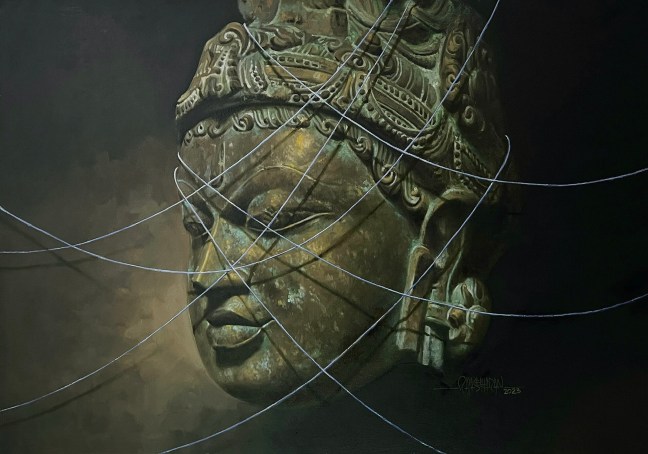
Holy Thread’ – by Rajasekharan Parameswaran – Wikimedia

This is what we want against all odds. No matter what. All of us. We want that love, that piece of eternity, although we may not voice it that way. Yet everything tells us that we will never get it. We can’t have it. It is not something to be had, and we know it. We have experienced its elusiveness a thousand times. But that knowledge doesn’t appease our seeking. This indefatigable quest is ingrained in our system. Something deep inside us is missing, is not quite completed. There is an insufficiency, a suffering that sets us on this path of longing. And this seeking has become such an intimate part of our lives, and has taken so many banal, inconspicuous forms, that it is not often noticed or recognised as such. But the fact is: all that we are truly looking for in our life is this deep, abiding peace, which ultimately comes from love. This is our path. Our journey. To get to that point where we don’t have to suffer and strive.

The problem comes with defining our search precisely. We are being too vague about it. Most of the time, it is not taken seriously. So we stroll about, taking divergent, contradictory roads. We are only interested in bits and pieces. A little happiness here and there will do. Our quest remains a fearful one, and mostly consists in avoiding difficulties, in being attached to what we have, and in acquiring little pleasures. But all we do through this, is to battle with happiness. In fact, the whole of our life is made of that, of this frustrated happiness, this thwarted love. Everything we do — including our most unkind, insensitive, foolish, ignorant actions — we do out of our deep, inner desire for happiness. In a way, we are all spiritual seekers. We are all engaged in the same frantic battle to be happy, at peace, rested, unafraid. We are all brothers and sisters in arms. We may do it in the most clumsy, mindless way, and be punished for it. Or we may be gifted with a thirsty, pointed mind, and all the tools necessary to meditate and recognise our true nature. So this seeking is not for a few elected, but extends to humanity’s tireless striving for betterment.

In fact, we are all — without our realising — accomplished Buddhas, beings of light. But we have chosen to identify with our shortcomings, our failures, our reactive patterns, our sorrows, all the inner waste that life produces along the way. Their objective nature makes them easier to associate with. Unfortunately, by doing so, we have troubled our innate clarity, have limited our infinite nature, and have soiled our innocence. We have become ignorant of who we are. We have confused our luminous, peaceful being with a few passing, trifling occurrences. We have all made the same mistake. Our self is the story of a disillusionment, of a shrouded delight to just be. We are all impeded Buddhas. Paradoxically, our nature as peace and happiness, because of its being veiled by our prejudiced sense of self, is the reason for our feeling incomplete, inadequate, and is in consequence the cause of our suffering. So most of our seeking is a direct product of our natural predisposition towards peace and happiness. Our disentangling from this false, unfortunate association may take us on various roads of varying difficulty and intensity. But the truth behind it all is that everyone — everyone — we meet on our journey is our equal partner in this most sacred quest. This recognition would go a long way in establishing some measure of love in our wounded world.

.

~~~

Text by Alain Joly

Painting by Rajasekharan Parameswaran (born 1964)

~~~

.

Website:
Rajasekharan Parameswaran (Wikipedia)

Suggestion:
– Other ‘Reveries’ from the blog…

.
The Flame without Smoke

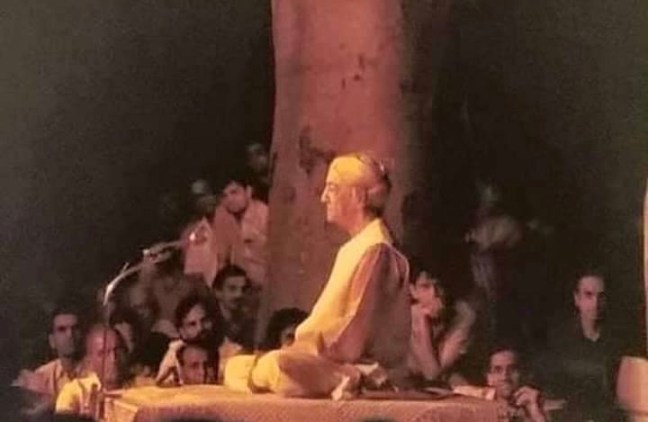
©️ Krishnamurti Foundation India

.

Love is the only flame without smoke.”
~ J. Krishnamurti

.

The flame and the smoke is an analogy Krishnamurti referred to sometimes. For him, the flame is this burning centre of being that “can never be expressed with words”, that “is beyond the clutches of time”, and that is often expressed as love. The smoke is of the mind. It is “the smoke of envy, of holding, of missing, of recalling the past, of longing for tomorrow, of sorrow and worry; and this effectively smothers the flame.” The smoke is often what we take to be the flame but is not. It is all that is passing, all the thoughts, feelings, perceptions — the smoke that we have gathered to form experience, and that we take to be ourself, our centre of being. This wilful, separate, time bound, suffering self has appropriated the feeling of being when it is in fact the very smoke that is veiling our true nature. Being only is that flame without smoke. It is our true identity and “the source of all happiness”.

I have gathered, over the years, on social medias, many of the most striking quotes by Krishnamurti, that popped up on my screen. These, I found, acted on me like little koans, that had the power to pierce the smoke of the mind, and reveal the subtlest truths. They are like candies which, when chewed upon carefully, reveal the flame of what we truly are. They are short and easy, but need to be taken seriously. They can crack open our resistance, and show us that flame without smoke. I share them here with you…

~~~

Do not pursue what should be,
but understand what is.”
~ J. Krishnamurti

~

Love is not at the end of time.
It is now, or it isn’t.
And hell is when it is not
…”
~ J. Krishnamurti

~

Thought is never free because it is based on knowledge,
and knowledge is always limited.”
~ J. Krishnamurti

~

It is essential to understand the seeker,
before you try to find out what it is he is seeking
.”
~ J. Krishnamurti

~

The ego is a ring of defence around nothing.”
~ J. Krishnamurti

[…]

Discover more of this selection of quotes by Jiddu Krishnamurti… (READ MORE…)

.

Unto the Ages of Ages

If people only knew. That they are so close. So close to living with the most profound peace in their heart. So close. So close to having a panoramic understanding of what it is to be who we are. So close to knowing the reason behind the word ‘God’. What it means. What it is, here, now, in this human life. If only they knew. If only we knew. How there is a joy that stands hidden just behind our everyday suffering. A joy, quiet and indestructible, that is present now, at the time of our indomitable sorrow. A joy that permeates our most stubborn feelings of despair. If only they knew. That silence is the very temple of their being, where the most sublime healing can take place. A silence where we can let everything go, to be the pristine self that we have always been. At last. Ah! If only they knew.

If only people knew. That life has an inherent, unnoticed simplicity. That the world that stands in front of them, is not quite the world they had in mind. If only we knew. That we own the beauty we see, we hear. That we hold the world, right here, close, so close to our being. That we were never parted from it. That it is our expression, and that we make it just the way we are. If only we had noticed. That love is not another feeling. Not something we choose to give or to hold back. That there is a love, so wide, so close, so natural. A love we cannot help. A love that is the structure of our self. Its profound nature. Ah! If only they knew. We. Us all. How it could change the dice. How it could make love our shared temple. To live in. Now. Here. If only we knew. How close it stands from us. If only. Ah!

And yet we know. Don’t we? We all know. We know that what we get is not the real deal. That this life is not quite the life we were meant to live. This is why we have hopes, dreams, expectations, projections. This is why we place love, friendship, happiness, beauty at the top of our list. We have that hint, that intuition. We know that the promise is here. That it stands close. So close. Ready to wash our eyes. Ready to speak its word to our ear. A word that we haven’t yet deciphered. Haven’t yet pronounced. That will bridge what we know with what we don’t know yet. And this word is ourself. What we are. A logos in our sky. That needs to be uttered once. Just once. A crossing of our bridge. To finally know what we knew. What we forgot. That which is eternally ours. Unto the ages of ages.

.

~~~

Text and photo by Alain Joly

~~~

.

Suggestion:
– Other ‘Reveries’ from the blog…

.

The Will of God

‘The Wind Blows’ – Hugo Simberg, 1897 – WikiArt

God’s will is what is happening now. Not as a body or an entity, not as a form or any kind of event. The reason is: form has already happened. Every object comes from the past. It has traversed at least a length of time to land in the field of awareness. Like a thought has. A thought is never now. It is the termination of something that took place a moment ago. It is an achieved result. But there is something in our experience that doesn’t come from the past, that hasn’t travelled any distance to be here, and that hasn’t moved through time to be now. So if you want to know what is God’s will, find the only thing in your life that is not a thing, that hasn’t yet taken form, and therefore needs neither space nor time to be. Find that which cannot be found, that which is formless, that which hasn’t travailed. For God’s will doesn’t come second, it cannot be a result, for such a thing would need a cause for itself to be. No. God’s will is first. As a ‘first’, it is in capacity to initiate, to create. But what is created is never itself God’s will, for it is already formed, with a life of its own. It is corruptible as form. So go to the essence, the origin. Find the incorruptible in yourself — that one uncreated thing — and take that only to be the will of God.

So we are in our essence uncreated. This is our identity, to be without form, forever here, forever now, eternally landed, therefore without a will of our own. For what would a separate will be but a thing already formed, an effect with already a cause; and therefore not the causeless, therefore not God’s will. So if we want our life to follow a divine trajectory, we have to give our utmost attention to who we are. That will condition the rest of our existence. That matters the most: that little name we give to ourself, that little identity. Start with the truth of who you are, and be only concerned with the tail of that star. Make yourself bright with it — that’s how to follow God’s will. Be that one that is in no capacity to be a follower. Stand as and for the truth of being and be concerned with nothing else but that. That is the only possible will you can afford. Any other kind of will is not your own, although it may appear to be. So don’t expect to have a will, for a will is but an appearance that has formed in yourself. Go to yourself first. Go for that part of yourself that has no will but God’s will. You will find there a will that encompasses all other wills — for what is a will but the will to be happy, rested, fulfilled? Only at the condition of being without a will of your own can you embrace the one will of your true identity as being. Being is in fact its own will, for it has as its DNA the purpose of all wills, which is the peace of living. From that peace firmly set in your heart, any will is the will of God.

.

~~~

Text by Alain Joly

Painting by Hugo Simberg (1873-1917)

~~~

.

Website:
Hugo Simberg (Wikipedia)

Suggestion:
Other ‘Ways of Being’ from the blog…

.